What if the best orthopedic doctor Kearny NJ patients need isn’t the one who recommends the fastest procedure, but the specialist who first understands what’s causing their pain? When limited mobility starts disrupting work, exercise, or everyday routines, it’s natural to want clear answers and to worry about being pushed toward surgery.
The right fit combines relevant expertise, a careful diagnosis, and a treatment plan shaped around your condition and goals. The Orthopaedic & Sports Medicine Institute, based in Nutley, serves patients from Kearny with care for knee, shoulder, and tendon injuries. Recommendations follow a clinical evaluation, and surgery isn’t automatically the first step.
This guide explains how to match a specialist’s expertise to your injury, what to expect during an orthopedic evaluation, and how treatment may range from non-operative care to minimally invasive procedures. You’ll also learn how to prepare for a consultation and take a clear next step.
Key Takeaways
- The best orthopedic doctor Kearny NJ patients choose should have expertise relevant to their injury and communicate clearly about care options.
- Use a focused selection process: identify your concern, review the specialist’s area of expertise, consider credentials, and discuss treatment choices.
- An orthopedic evaluation connects your medical history and physical examination to a diagnosis. Imaging may be considered when clinically appropriate.
- Treatment recommendations should reflect your individual condition. Surgery isn’t automatically the first step.
- The Orthopaedic & Sports Medicine Institute provides specialized orthopedic care in Nutley for patients from Kearny, including evaluation of knee, shoulder, and tendon injuries.
Finding the Best Orthopedic Doctor Serving Kearny, NJ Starts With Your Needs
Pain, an injury, or limited movement can make choosing care feel like another difficult task. Start by noting which area is affected and how the problem limits daily activities. The best orthopedic doctor Kearny NJ patients can find is not necessarily the most prominent name in a search result. The right fit depends on your condition, the specialist’s relevant expertise, and whether their explanations help you make informed decisions.
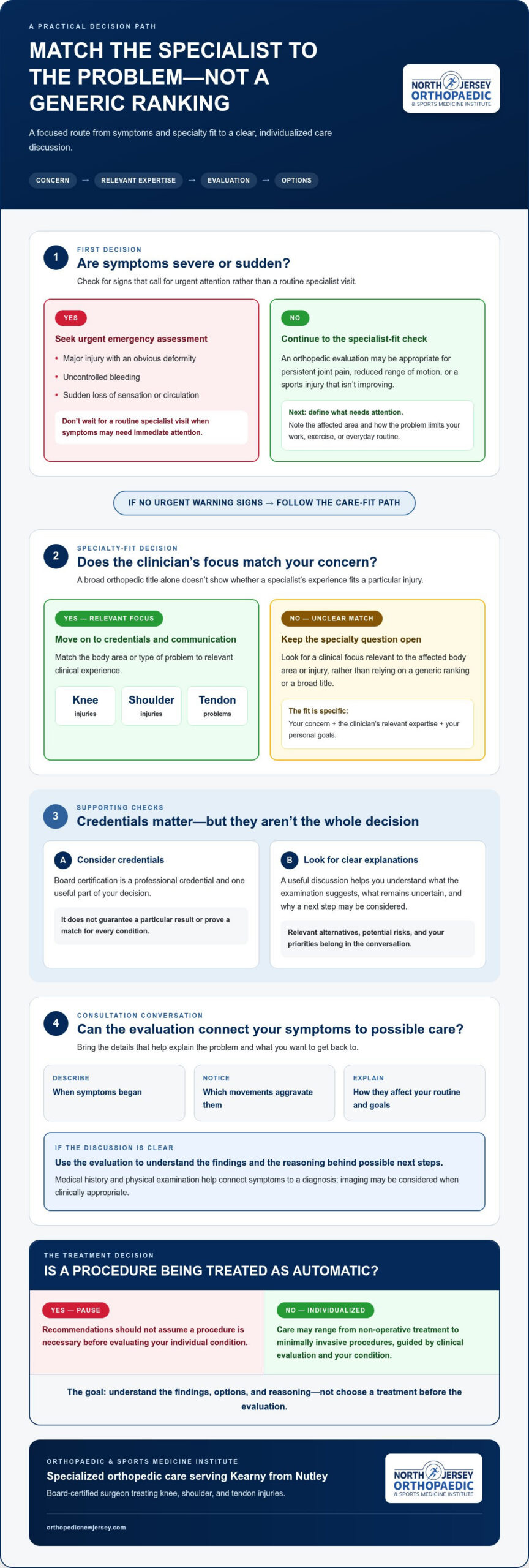
An orthopedic evaluation may be appropriate for persistent joint pain, reduced range of motion, or a sports injury that isn’t improving. Severe or sudden symptoms need a different response. A major injury with an obvious deformity, uncontrolled bleeding, or sudden loss of sensation or circulation warrants urgent emergency assessment. Don’t wait for a routine specialist visit when symptoms may require immediate attention.
Which orthopedic concerns call for a specialist?
An orthopedic specialist evaluates problems involving the musculoskeletal system, including bones, joints, muscles, and tendons. Orthopedic surgery encompasses a broad specialty with different areas of focus, so relevant experience depends on the body part and type of problem. Ongoing knee pain, a shoulder injury, or a suspected tendon problem may call for focused assessment. Symptoms alone can’t establish a diagnosis, and an injury doesn’t automatically mean surgery is needed.
What does “best orthopedic doctor” mean for an individual patient?
Look for a match between your concern and the clinician’s clinical focus rather than relying on a generic ranking. A useful evaluation considers your symptoms and medical history. Clear communication helps you understand what is known, what needs further assessment, and which options may be appropriate. Board certification is one professional credential to consider, not a promise of a particular outcome.
During a consultation, describe when the problem began, which movements aggravate it, and how it affects your routine. The specialist can assess whether the practice’s areas of care align with your concern and explain possible next steps. The Orthopaedic & Sports Medicine Institute is based in Nutley and serves patients from Kearny. Its board-certified surgeon treats knee, shoulder, and tendon injuries. Recommendations are guided by clinical evaluation, not a blanket assumption that a procedure is necessary.
How to Evaluate an Orthopedic Doctor’s Credentials and Specialty Fit
Once you’ve identified your concern, compare specialists by how closely their clinical focus matches it. Then consider credentials and communication. This is more useful than relying on a broad ranking alone. The best orthopedic doctor Kearny NJ patients can choose is one whose expertise, evaluation, and recommendations align with the problem being assessed.
- Identify the concern: Note the affected area, your symptoms, and the activities that have become difficult.
- Review specialty fit: Look for experience relevant to that body area or injury, such as knee, shoulder, or tendon conditions.
- Understand credentials: Consider board certification and other relevant professional qualifications.
- Discuss options: Notice how the clinician explains findings and the reasoning behind possible next steps.
Which credentials and experience should patients understand?
Board certification is a professional credential indicating that a physician has met specialty-specific standards set by a certifying board. It can be one useful part of your decision, but it doesn’t guarantee a particular result or show that a specialist’s experience matches every condition. Consider the body area and injury being evaluated, and look for a relevant clinical focus. The American Academy of Orthopaedic Surgeons offers patient education resources to help you understand orthopedic care and related terminology.
The Orthopaedic & Sports Medicine Institute’s surgeon is board-certified, and the practice provides specialized care for knee, shoulder, and tendon injuries. Consider how that focus relates to the concern you want evaluated. A general orthopedic title alone doesn’t tell you whether a clinician’s expertise matches a particular injury.
How can a patient judge communication and shared decision-making?
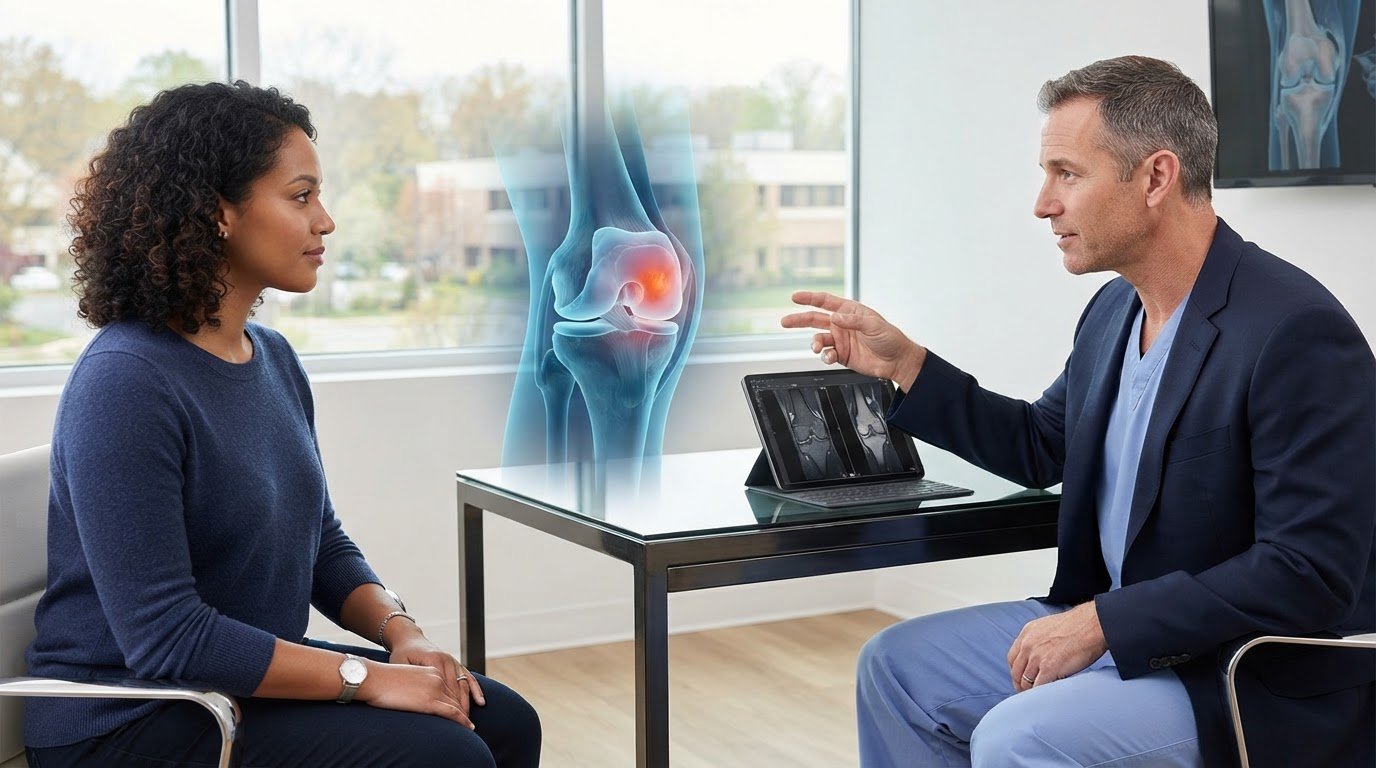
A productive discussion should help you understand what the examination suggests, what remains uncertain, and why a particular next step may be considered. The clinician should explain relevant alternatives and potential risks without treating one option as appropriate before evaluating your individual condition. Clear communication also makes room for your priorities.
Before the visit, note when symptoms began, which movements affect them, and what activities you hope to resume. Share concerns about treatment, including questions about whether a procedure may be necessary. Specialist fit is the alignment between your diagnosis, the clinician’s relevant expertise, and your personal goals. A consultation can help clarify whether that alignment is present and what further evaluation or care may involve.
To learn more about care focused on orthopedic and sports injuries, explore specialized orthopedic care serving Kearny from Nutley.
How an Orthopedic Evaluation Connects Symptoms to Treatment Options
An orthopedic evaluation is a step-by-step process, not a decision about surgery based on one symptom. The clinician gathers your history, examines the affected area, and uses those findings to assess possible causes. The goal is to understand how the problem affects your function and what care may be appropriate for your circumstances.
What happens during a knee, shoulder, or tendon assessment?
Be ready to explain when symptoms began, whether they followed an injury or developed over time, which activities make them worse, and how they limit movement. The clinician may also ask about prior evaluation or treatment. These details help put the examination findings in context.
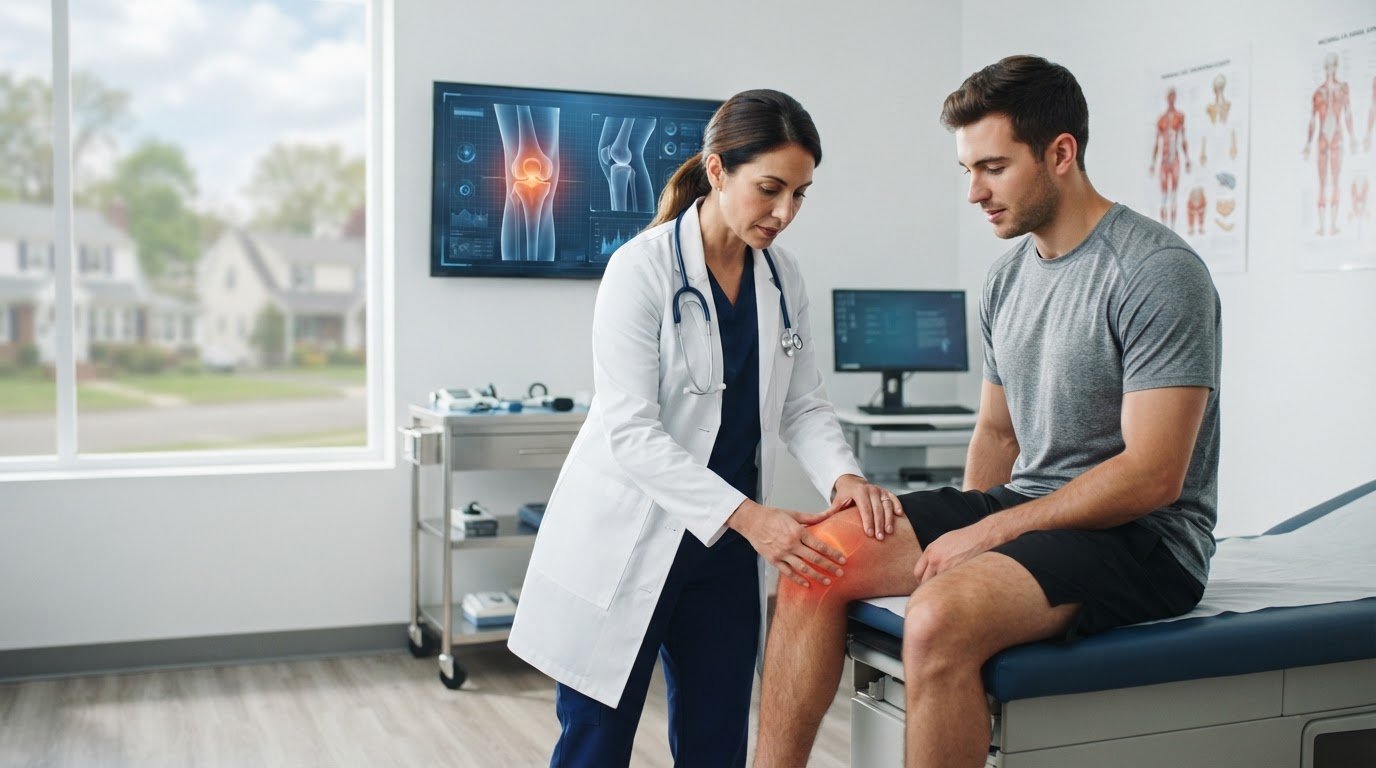
The physical examination is tailored to the affected area and suspected problem. For a knee concern, the clinician may assess movement and stability. For a shoulder complaint, the examination may focus on range of motion and strength. A tendon assessment may include evaluating the area during specific movements. No single symptom or test necessarily establishes a diagnosis on its own.
Imaging, such as an X-ray or MRI, may be considered if your history and examination indicate it could help clarify the diagnosis or guide care. Imaging isn’t automatically required for every orthopedic concern. The clinician can explain what a study may show and how the result could affect the next step.
How are non-surgical and surgical options discussed?
After assessing the findings, the clinician can discuss whether non-operative care, a procedure, or additional evaluation may be appropriate. The recommendation depends on the diagnosis, the severity and impact of the problem, prior care, and your individual needs. A procedure shouldn’t be treated as predetermined before that assessment. Ask what each proposed option is intended to address, what alternatives exist, and what the next step would involve.
Treatment recommendations depend on clinical findings, functional needs, and patient-specific factors. That principle keeps the plan focused on your condition rather than a blanket approach. At The Orthopaedic & Sports Medicine Institute, minimally invasive techniques are used when appropriate to the patient’s evaluated needs.
For more background on one surgical approach, read the guide Minimally Invasive Orthopedic Surgery in NJ. A guide can introduce key concepts, while an individual clinical evaluation determines which options may apply to your diagnosis.
Choosing Orthopedic Care Near Kearny: Location, Preparation, and Access
The Orthopaedic & Sports Medicine Institute provides specialized orthopedic care in Nutley for patients from Kearny and nearby communities, including Bloomfield, Clifton, Belleville, Lyndhurst, North Arlington, and Verona. Knowing where care is based is one part of planning. For a focused consultation, bring a clear account of your symptoms and relevant records so the clinician can understand how the problem affects your daily life and what needs evaluation.
What should Kearny-area patients bring to an orthopedic consultation?
A little preparation can help you use the visit to discuss what matters most. Gather relevant records and make a brief note of the problem’s timeline. If you have prior imaging reports or medical records related to the affected area, bring them when available. An old scan may not answer the current question, so the clinician will consider it alongside your history and examination.
- Symptom timeline: Note when the pain, injury, or movement limitation began and whether it has changed.
- Activity impact: Identify movements or activities that worsen symptoms and describe what has become difficult.
- Prior care: Bring relevant imaging reports or records, if available, and summarize treatments you’ve already tried.
- Medication list: Write down current medications so you can share an accurate list during the visit.
- Questions: Record the concerns you want addressed, including what you hope to understand about diagnosis and care options.
How can patients make the first visit more productive?
Describe your usual activities and the specific tasks you want to manage more comfortably. For one person, that may mean reaching overhead at work. For another, it may be walking, using stairs, or returning to a sport. These details give the clinician context for discussing your functional needs. Be direct about treatment priorities or concerns, too. If you’re worried about whether surgery might be recommended, say so and ask how the evaluation will inform that decision.
Useful questions include: What did the examination suggest? Are there other explanations to consider? Which options may fit the findings, and what would determine the next decision? You don’t need to know the medical terminology in advance. A clear description of your symptoms and goals is a practical starting point.
For additional preparation guidance, review the practice’s consultation information before your visit. Explore orthopedic consultation information for care serving Kearny from Nutley.
Specialized Orthopedic Care Serving Kearny at The Orthopaedic & Sports Medicine Institute
For patients in Kearny seeking focused orthopedic care, The Orthopaedic & Sports Medicine Institute provides specialized orthopedic and sports injury care from its Nutley location. The practice also serves nearby communities, including Bloomfield, Clifton, Belleville, Lyndhurst, North Arlington, and Verona. Its board-certified surgeon treats knee, shoulder, and tendon injuries. Care begins with an individualized evaluation, so recommendations reflect the patient’s condition and clinical findings rather than a predetermined procedure.
Which orthopedic conditions and services are relevant to this practice?
The practice’s focus is relevant for people dealing with knee injuries, shoulder problems, or tendon concerns. Its shoulder care includes rotator cuff repair, labral tear treatment, and shoulder arthritis treatment. It also provides bridge-enhanced ACL repair using the BEAR® Implant. These are specific treatment services, not a promise that a particular option will suit every patient. A clinician’s evaluation helps determine which approaches may be appropriate for an individual diagnosis and circumstances.
For readers exploring ACL care, the practice’s guide, BEAR® Implant ACL Repair in New Jersey, offers additional information about that service. Educational material can help you prepare questions, but it doesn’t replace an assessment of your injury and treatment needs.
What is a practical next step for someone in Kearny?
Review the practice’s orthopedic services and consultation information to understand how its clinical focus relates to your concern. Before an evaluation, write down when symptoms began, which activities are affected, and any treatment questions you want answered. Bring relevant prior records or imaging reports if available. This gives the clinician helpful context for discussing your condition and possible next steps.
If you’re comparing options for the best orthopedic doctor Kearny NJ patients can turn to, focus on the connection between your concern, the specialist’s expertise, and how your treatment options are explained. The Orthopaedic & Sports Medicine Institute offers specialized care in Nutley for patients from Kearny, with recommendations guided by clinical evaluation.
Explore the practice’s care and request an orthopedic consultation to discuss your symptoms and questions with the specialist.
Take the Next Step Toward Orthopedic Care
Choosing the best orthopedic doctor Kearny NJ patients can rely on starts with matching the specialist’s expertise to the condition and understanding how evaluation findings shape the treatment plan. Clear communication matters, too: you should be able to discuss your goals, ask questions, and understand why a care option is being considered.
The Orthopaedic & Sports Medicine Institute provides specialized orthopedic and sports injury care in Nutley for patients from Kearny and nearby communities, including Bloomfield, Clifton, Belleville, Lyndhurst, North Arlington, and Verona. Its board-certified surgeon treats knee, shoulder, and tendon injuries, with minimally invasive techniques used when clinically appropriate. Recommendations are individualized and guided by your clinical evaluation, not a predetermined procedure.
If pain or restricted movement is affecting your routine, preparing a symptom timeline, relevant records, and questions can help make a consultation more focused. Explore orthopedic care and request a consultation to discuss your concerns and possible next steps.
Frequently Asked Questions
How do I choose the best orthopedic doctor in Kearny, NJ?
Choose a specialist whose clinical focus aligns with your injury or symptoms and who explains findings and treatment options clearly. To find the best orthopedic doctor Kearny NJ patients can rely on, consider the affected body area, the clinician’s relevant experience, and whether your questions are addressed. Board certification is one credential to consider, not a guarantee of results. A consultation can clarify whether the specialist’s focus fits your needs.
Can I see an orthopedic specialist in Nutley if I live in Kearny?
Yes. The Orthopaedic & Sports Medicine Institute provides specialized orthopedic and sports injury care in Nutley for patients from Kearny. The practice also serves nearby communities, including Bloomfield, Clifton, Belleville, Lyndhurst, North Arlington, and Verona. Before a visit, prepare a brief symptom history and bring relevant records or imaging reports if available.
What should I look for in an orthopedic surgeon’s credentials?
Look for credentials relevant to orthopedic practice, including board certification, and consider whether the surgeon’s clinical focus matches the body area or injury you need evaluated. Board certification reflects a professional qualification, but it doesn’t guarantee a particular outcome or prove a specialist is the right fit for every condition. Also notice how the surgeon explains examination findings, potential options, and the reasoning behind recommended next steps.
When should I see an orthopedic doctor for knee or shoulder pain?
Consider an orthopedic evaluation if knee or shoulder pain persists, limits movement, interferes with daily activities, or follows a sports injury. A clinician can review your symptoms, examine the affected area, and determine whether further assessment is appropriate. Symptoms alone can’t establish a diagnosis. If an injury is severe or symptoms are sudden and alarming, seek urgent medical assessment rather than waiting for a routine specialist consultation.
Do orthopedic doctors always recommend surgery for sports injuries?
No. Surgery isn’t automatically recommended for every sports injury. The appropriate plan depends on the diagnosis, examination findings, functional impact, prior care, and individual circumstances. Depending on the condition, a specialist may discuss non-operative approaches, a surgical procedure, or further assessment. Ask what each option is intended to address, what alternatives may be considered, and how the clinical findings guide the recommendation.
What happens during an orthopedic consultation?
An orthopedic consultation generally begins with a discussion of your medical history and symptoms, including when they began, which activities affect them, and any care you’ve already received. The clinician then examines the relevant area and discusses the assessment and possible next steps. Imaging may be considered when clinically appropriate, but it isn’t required for every concern. Bring a medication list, relevant records, and questions you want answered.
Does The Orthopaedic & Sports Medicine Institute treat patients from Kearny?
Yes. The Orthopaedic & Sports Medicine Institute is based in Nutley and provides specialized orthopedic and sports injury care for patients from Kearny and nearby communities, including Bloomfield, Clifton, Belleville, Lyndhurst, North Arlington, and Verona. The practice also uses minimally invasive techniques when clinically appropriate. An individualized evaluation connects a patient’s condition and needs with treatment recommendations; no specific procedure or outcome is assumed in advance.