


The smallest incision isn’t automatically the best surgical choice. If you’re researching the benefits of minimally invasive surgery Belleville NJ, you may be hoping for less pain, smaller scars, and a quicker return to daily life. It’s also important to understand whether this approach can address your specific injury.
Minimally invasive orthopedic techniques may limit disruption to surrounding tissue in some procedures, but they don’t eliminate surgical risks or guarantee a faster recovery. Arthroscopy, for example, uses a camera and specialized instruments through small incisions to assess or treat selected joint problems. Not every injury can be treated this way. The right approach depends on your diagnosis, the anatomy involved, the procedure needed, and your overall health.
This guide explains what minimally invasive orthopedic surgery involves, how it may compare with open surgery, and which potential benefits and trade-offs to consider. It also covers practical questions to ask an orthopedic specialist about risks, recovery, and whether a less invasive technique can adequately address your condition.
At the Orthopaedic & Sports Medicine Institute in nearby Nutley, a board-certified surgeon treats knee, shoulder, and tendon injuries with individualized treatment planning. For Belleville patients, understanding the options can help make a conversation about orthopedic care more focused and useful.
Key Takeaways
- The benefits of minimally invasive surgery Belleville NJ patients may experience depend on the procedure, diagnosis, and individual health factors.
- Smaller incisions may reduce disruption to surrounding tissue, but they don’t guarantee less pain, lower risk, or faster recovery.
- Compare minimally invasive and open approaches by how well each can address the specific injury, including its limitations and trade-offs.
- Discuss your treatment goals, potential risks, expected benefits, and rehabilitation needs with your orthopedic specialist.
- The Orthopaedic & Sports Medicine Institute in nearby Nutley provides specialized care for knee, shoulder, and tendon injuries with a board-certified surgeon.
What minimally invasive orthopedic surgery means for Belleville patients
For patients comparing the benefits of minimally invasive surgery Belleville NJ, it helps to know that minimally invasive surgery isn’t one operation. The term describes surgical techniques that may let an orthopedic surgeon reach a joint or injured tissue through smaller incisions, using specialized instruments. The method depends on what needs treatment, not simply on a preference for smaller openings.
In brief: Minimally invasive orthopedic surgery uses smaller incisions and specialized tools to access or treat a musculoskeletal problem. Open surgery typically uses a larger incision to expose the treatment area more directly. Neither description alone determines which approach is best or what recovery will involve.
How orthopedic minimally invasive techniques work
When the anatomy and procedure allow, a surgeon may work through small openings instead of exposing a broader area. In arthroscopy, a narrow camera is inserted through an incision to show the inside of a joint on a screen. The surgeon can use separate small instruments through other openings to examine or treat the problem. This camera-guided approach is used for selected joint procedures, including some shoulder operations.
Arthroscopy is one technique, not a synonym for every minimally invasive procedure. Other approaches vary with the joint, injured tissue, and work required. A general overview of minimally invasive surgery describes the broader range of techniques. An orthopedic treatment plan still needs to fit the particular diagnosis and anatomy.
Robotic surgery is different. “Minimally invasive” describes how the surgeon accesses the treatment area; “robotic-assisted” describes the use of a robotic system during a procedure. The terms aren’t interchangeable, and using one doesn’t automatically mean a procedure is minimally invasive or appropriate for a particular injury.
What the term does not guarantee
A smaller incision doesn’t guarantee less pain, less scarring, lower risk, or a faster return to normal activities. Pain and healing can be influenced by the procedure’s complexity, the tissues involved, a patient’s overall health, and the rehabilitation plan. Even when access is limited, the operation may involve substantial work inside the joint or surrounding structures.
Open surgery remains appropriate when direct access is needed to address an injury safely and effectively. The decision should consider whether a technique can adequately treat the problem, not just whether its incision looks smaller. A less invasive method that can’t fully address the clinical need may not be the better choice.
For Belleville-area patients, the Orthopaedic & Sports Medicine Institute in nearby Nutley provides specialized orthopedic and sports injury care. A board-certified surgeon treats knee, shoulder, and tendon injuries, with minimally invasive techniques considered in light of the diagnosis, anatomy, and treatment goal. The practice serves patients in Belleville and nearby communities, including Bloomfield, Clifton, Lyndhurst, North Arlington, Kearny, and Verona.
Potential benefits of minimally invasive surgery and what they depend on
Smaller incisions can be one advantage of a minimally invasive approach, but they don’t tell the whole story. Depending on the procedure, a limited surgical opening may reduce disruption to nearby soft tissue. Whether that leads to meaningful differences in pain, visible scarring, blood loss, infection risk, or recovery depends on the operation and the evidence for that specific technique.
Benefits vary by procedure, diagnosis, and patient factors, so general claims can’t predict an individual patient’s outcome.
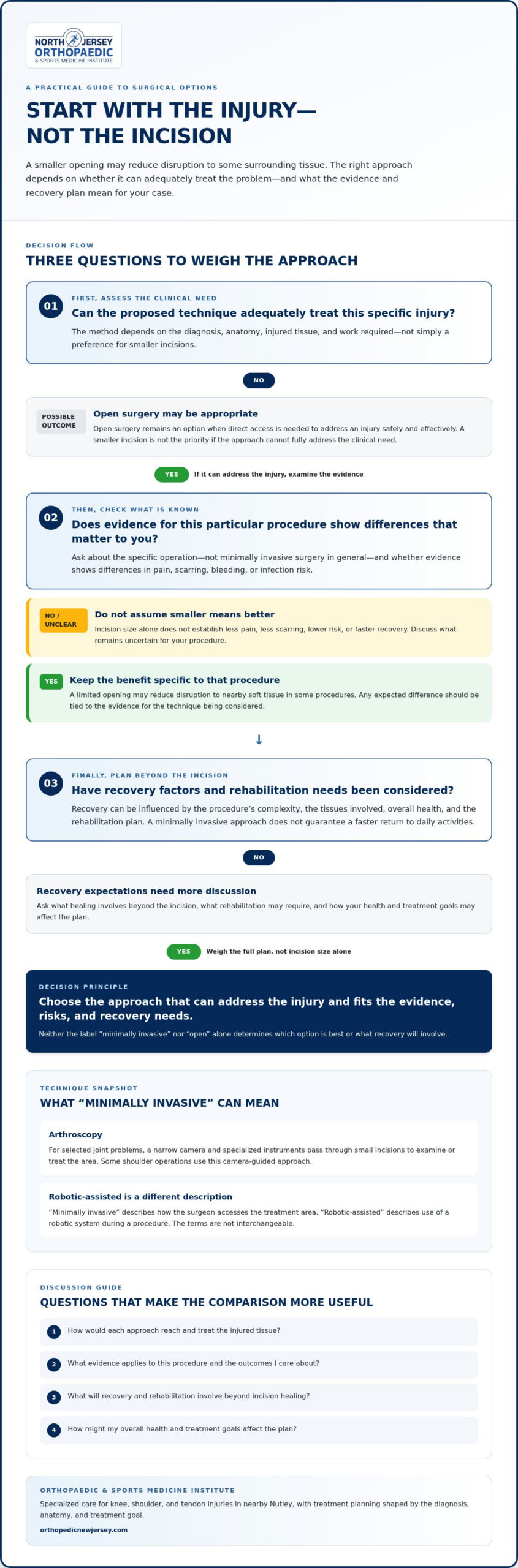
For a useful comparison, focus on the clinical purpose and evidence for the procedure being considered. Ask which potential effects apply to your case, which remain uncertain, and what outcomes are realistic. Discuss:
- How the proposed technique reaches and treats the injured tissue.
- Whether evidence for this specific procedure shows differences in pain, scarring, bleeding, or infection risk.
- What recovery involves beyond the initial healing of an incision.
- How your health and treatment goals may affect the plan.
How incision size may affect the surgical experience
A smaller opening may mean less disturbance to some surrounding tissues, depending on how the procedure is performed. But incision length alone doesn’t determine how much tissue is affected. The work needed inside a joint, the structures being repaired, and the complexity of the injury also matter. Evaluate claims about reduced pain, blood loss, scarring, or infection risk using evidence for the particular operation, rather than assuming those benefits from incision size.
Recovery expectations are individual
Recovery depends on the procedure, the tissue involved, and a patient’s overall health, among other clinical considerations. A minimally invasive approach may offer an advantage during early healing in some cases, but that doesn’t establish when someone can safely return to work, exercise, or sport. Rehabilitation may continue after the incision has healed, especially when treated tissue needs time and guided exercises to regain strength and function.
Ask for a recovery plan that distinguishes early wound care from the longer process of restoring movement and strength. Your surgeon can explain milestones relevant to your procedure, what could slow progress, and which activities may need to be limited during healing. This gives you practical expectations without relying on a generic timeline or a promise that one technique will speed recovery.
For Belleville-area patients considering orthopedic treatment, the Orthopaedic & Sports Medicine Institute in nearby Nutley provides care for knee, shoulder, and tendon injuries, including minimally invasive techniques. A board-certified surgeon can discuss potential benefits and limitations in light of your diagnosis and goals. Learn more about orthopedic care near Belleville and prepare questions for your discussion.
Minimally invasive vs. open orthopedic surgery: weighing benefits and trade-offs
Comparing surgical approaches means looking beyond incision size. The relevant question is which method can address the injury effectively while accounting for the procedure’s evidence, limitations, and risks. For patients exploring the benefits of minimally invasive surgery Belleville NJ, an approach that works well for one joint or injury may not suit another.
| Factor | Minimally invasive approach | Open approach |
|---|---|---|
| Access | May use specialized instruments through smaller openings; some procedures use a camera to view the treatment area. | Uses a larger incision to provide more direct access and visibility. |
| Incision | Often smaller, depending on the procedure and technique. | Typically larger to expose the area being treated. |
| Potential advantages | May limit disruption to some surrounding tissue in selected procedures. | May allow direct access when the injury or repair requires it. |
| Limitations | Restricted access may not suit every injury or treatment goal. | Broader exposure may involve more disruption to surrounding tissue. |
| Suitability | Depends on the diagnosis, anatomy, procedure, and patient factors. | May be appropriate when it best meets the clinical need. |
This comparison describes general differences, not a ranking. Neither approach is automatically safer, faster, or more effective for every orthopedic patient. A smaller incision doesn’t establish that the treatment can adequately address the injury, and an open procedure isn’t inferior simply because it involves wider access. Base the decision on the treatment goal and evidence relevant to the specific procedure.
When a less invasive approach may be considered
A surgeon may consider a less invasive technique when it can appropriately reach and treat the affected structure. Suitability depends on the condition, joint anatomy, and planned repair. Some shoulder or knee problems may be treated with arthroscopic techniques, but that doesn’t mean every injury in those joints has the same options. Diagnosis and procedure-specific assessment guide the choice.
Knee, shoulder, and tendon concerns can involve different tissues and repairs. Imaging and examination help clarify the problem; a specialist then considers whether a minimally invasive approach can meet the treatment goal. The relevant comparison isn’t simply a small versus large incision, but whether each approach can appropriately address the diagnosed injury.
Why open surgery may still be the right option
Open surgery may be selected when the required visibility or access, the complexity of an injury, or the treatment goal calls for it. The least invasive suitable option isn’t necessarily the one with the smallest incision. An approach that limits access but can’t adequately treat the problem may not serve the patient’s needs.
The surgeon weighs possible advantages and limitations against the diagnosis and individual health factors. Discuss what the proposed procedure is intended to accomplish, why its access method fits the injury, and which trade-offs matter for your care. Those details make the comparison clinically meaningful.
Questions Belleville patients can use to assess surgical options
A useful surgical discussion should clarify the diagnosis before comparing techniques. Examination findings and imaging can help identify which structures are affected and how extensive the injury may be. They inform planning, but don’t determine a specific operation on their own. Your symptoms, health, priorities, and treatment goal also matter.
Bring these questions to an orthopedic appointment and take notes on how the answers relate to your case. They can help you assess the proposed approach and the potential benefits of minimally invasive surgery Belleville NJ patients may be considering.
Questions about diagnosis and treatment goals
- What condition is the proposed procedure intended to address? Ask which examination findings or imaging results support the diagnosis, and what the procedure is designed to change.
- Which surgical and nonsurgical options are relevant for me? Ask how the options compare for your particular injury and whether continued nonsurgical care is clinically appropriate.
- How does the recommended approach fit my goals? Explain which daily activities matter to you, such as reaching overhead, walking comfortably, or returning to a particular activity. Ask how the treatment plan accounts for those priorities.
- Why is this approach suited to my anatomy and condition? Invite the surgeon to explain how the procedure would access and treat the affected tissue, and whether another approach could better meet the same goal.
These questions connect test results to a decision. An image may show a structural change, but the treatment recommendation also needs to make sense in light of your symptoms and function.
Questions about benefits, risks, and recovery
- Which benefits are realistic for this procedure and my situation? Ask what the technique may offer and which outcomes can’t be predicted from incision size alone.
- What are the important limitations and possible complications? Ask about risks relevant to the planned procedure and your health, and how the surgeon weighs them against expected benefits.
- What will rehabilitation involve? Discuss whether you’ll need supervised therapy, which activities may be limited, and what factors could change the recovery plan.
- How will progress be assessed? Ask what clinical signs or functional goals will guide follow-up and adjustments to rehabilitation.
For shoulder symptoms, ask how the diagnosis shapes the repair plan and what rehabilitation may involve. A discussion of arthroscopic rotator cuff repair in New Jersey may help you understand the approach in the context of a specific shoulder condition. You can also review the site’s minimally invasive orthopedic surgery guide alongside your specialist’s explanation to prepare for a focused conversation.
The Orthopaedic & Sports Medicine Institute in nearby Nutley provides orthopedic and sports injury care for Belleville-area patients. To discuss knee, shoulder, or tendon concerns and possible treatment approaches, schedule an orthopedic evaluation with the practice.
Explore minimally invasive orthopedic care near Belleville, NJ
Choosing a surgical approach starts with understanding the condition, not selecting a technique by name. The Orthopaedic & Sports Medicine Institute provides specialized orthopedic and sports injury care in Nutley, serving Belleville and nearby communities. A board-certified surgeon treats knee, shoulder, and tendon injuries, using minimally invasive techniques when appropriate to the individual clinical situation.
A consultation connects your diagnosis with a clear treatment goal. If you’re considering the benefits of minimally invasive surgery Belleville NJ, discuss what an approach may offer for your particular injury, its limitations, and how your priorities shape the plan. No technique guarantees a particular outcome, so a thoughtful recommendation weighs potential benefits against risks and the needs of the repair.
What to expect from an orthopedic discussion
Your evaluation may begin with a conversation about your symptoms, when they started, what worsens or eases them, and how they affect daily activities. Relevant medical history also helps inform decisions. The surgeon can consider examination findings alongside available imaging. Together, these details help assess the affected structures and guide planning, but they don’t automatically prescribe one specific operation.
From there, the discussion can focus on the diagnosis, treatment goal, and options that fit the clinical findings. If surgery is being considered, ask how the proposed approach is expected to address the injury, what risks or limitations are relevant, and what rehabilitation may involve. Discuss the activities you hope to resume so the plan reflects your needs, while keeping expectations realistic about recovery and individual variation.
It may help to bring prior imaging reports, a list of current medications, and notes about symptoms or activity limitations. Write down questions in advance, too. A clear conversation can help you understand why an option is recommended and what decisions remain yours to make.
A local next step for Belleville-area patients
The Institute’s Nutley location offers nearby specialized orthopedic and sports medicine care for Belleville-area patients. Its board-certified surgeon evaluates knee, shoulder, and tendon concerns and discusses treatment options in relation to each patient’s diagnosis and goals. If you’re learning about surgical approaches, the New Jersey minimally invasive orthopedic surgery buyer’s guide can also help you prepare questions about technique, risks, and recovery.
Bring your questions and relevant medical information to an orthopedic discussion. The aim is to understand the condition, consider suitable options, and make an informed decision without assuming the smallest incision is always the right answer. To explore care for an orthopedic or sports injury near Belleville, schedule an orthopedic evaluation with the Orthopaedic & Sports Medicine Institute.
Take the next step with a clear treatment goal
Before making a decision, identify what you most want treatment to help you do. That could mean managing pain during everyday movement, improving a specific motion, or returning to an activity that matters to you. Sharing that priority gives your orthopedic discussion a practical focus and connects the proposed treatment with your goals.
If you’re weighing the benefits of minimally invasive surgery Belleville NJ, bring your questions and concerns about recovery to the conversation. A thoughtful decision isn’t about choosing the smallest incision at any cost. It’s about understanding the options for your condition and feeling informed about the recommended approach.
The Orthopaedic & Sports Medicine Institute offers specialized orthopedic care in Nutley, serving Belleville, Bloomfield, Clifton, Lyndhurst, North Arlington, Kearny, and Verona. A board-certified surgeon treats knee, shoulder, and tendon injuries. Explore orthopedic care at the Orthopaedic & Sports Medicine Institute and take an informed step toward discussing your treatment options.
Frequently Asked Questions
Is minimally invasive orthopedic surgery better than open surgery?
No, minimally invasive surgery isn’t better in every case. The suitable approach depends on the injury, joint anatomy, treatment objective, and your overall health. A procedure requiring broad access to repair damaged structures, for example, may be better addressed with open surgery. Ask your surgeon to explain why a recommended method fits your diagnosis, which alternatives are relevant, and how the approaches differ for the specific repair being considered.
Does minimally invasive surgery mean less pain after an orthopedic procedure?
It may mean less disruption to some surrounding tissue, which can contribute to less postoperative discomfort in certain procedures, but that result isn’t assured. For people researching benefits of minimally invasive surgery Belleville NJ, incision size alone can’t predict pain. The operation, treated condition, and individual response all matter. Ask what pain-management plan is appropriate for your procedure and how discomfort may affect sleep, movement, or participation in rehabilitation.
How long does recovery take after minimally invasive orthopedic surgery?
Recovery time varies by procedure, the tissue involved, your health, and the rehabilitation plan. A smaller incision doesn’t establish a return-to-work or return-to-sport date. Ask the surgeon which milestones apply to your procedure, such as when you may begin certain exercises or resume particular activities. Clarify which movements should wait, since progressing before healing and rehabilitation allow can affect the treatment plan.
Can every orthopedic condition be treated with minimally invasive surgery?
No. These techniques are appropriate for some procedures, but not for every injury or patient. A knee problem involving one structure, for instance, may call for a different approach from a complex injury affecting several structures. The surgeon considers the diagnosis, anatomy, injury complexity, and treatment objective. A clinical evaluation helps establish whether minimally invasive surgery, open surgery, or another treatment is suitable for your circumstances.
What are the risks of minimally invasive orthopedic surgery?
Minimally invasive surgery still carries risks, and smaller incisions don’t eliminate the possibility of complications. The risks depend on the operation and individual circumstances, including health factors that may affect surgery or healing. Ask which complications are relevant to your procedure, how they may be managed, and what alternatives exist. Understanding expected benefits alongside limitations and risks can help you make a decision based on your diagnosis rather than a general promise.
Is minimally invasive orthopedic care available near Belleville, NJ?
Yes. The Orthopaedic & Sports Medicine Institute provides specialized orthopedic and sports injury care in Nutley, serving Belleville and nearby communities. A board-certified surgeon treats knee, shoulder, and tendon injuries, including with minimally invasive techniques. The appropriate plan depends on clinical assessment. Discuss your symptoms, examination findings, treatment options, and goals with the practice to understand which approach may fit your individual needs.


