Hidden orthopedic injuries are assessed through a review of symptoms and medical history, a physical examination, and imaging when needed. Diagnosing hidden orthopedic injuries in North Arlington, NJ, can help identify problems affecting the back, hips, knees, feet, or ankles when the source of pain is not immediately clear.
Persistent discomfort, swelling, stiffness, or difficulty with everyday movement can make it hard to tell whether an injury is more than a temporary strain. A focused evaluation relates those symptoms to the structures that may be involved, rather than relying on how the injury feels alone.
This article explains what to expect during an orthopedic assessment, how MRI can reveal soft-tissue and other injuries, and what guides nonsurgical care. You’ll also learn how back, hip, knee, foot, and ankle symptoms are assessed, and when specialized orthopedic care may be the right next step.
Key Takeaways
- Persistent pain, swelling, stiffness, or limited movement can warrant an orthopedic assessment, even when the cause isn’t obvious.
- A focused evaluation combines your medical history and physical examination with relevant tests to guide the next steps in care.
- MRI can help reveal soft-tissue findings that may not be clear from symptoms alone; its results are interpreted alongside the full assessment.
- Notice how symptoms affect movement and function, and learn which patterns may point to a fracture, ligament tear, or other injury.
Back, hip, knee, foot, and ankle conditions
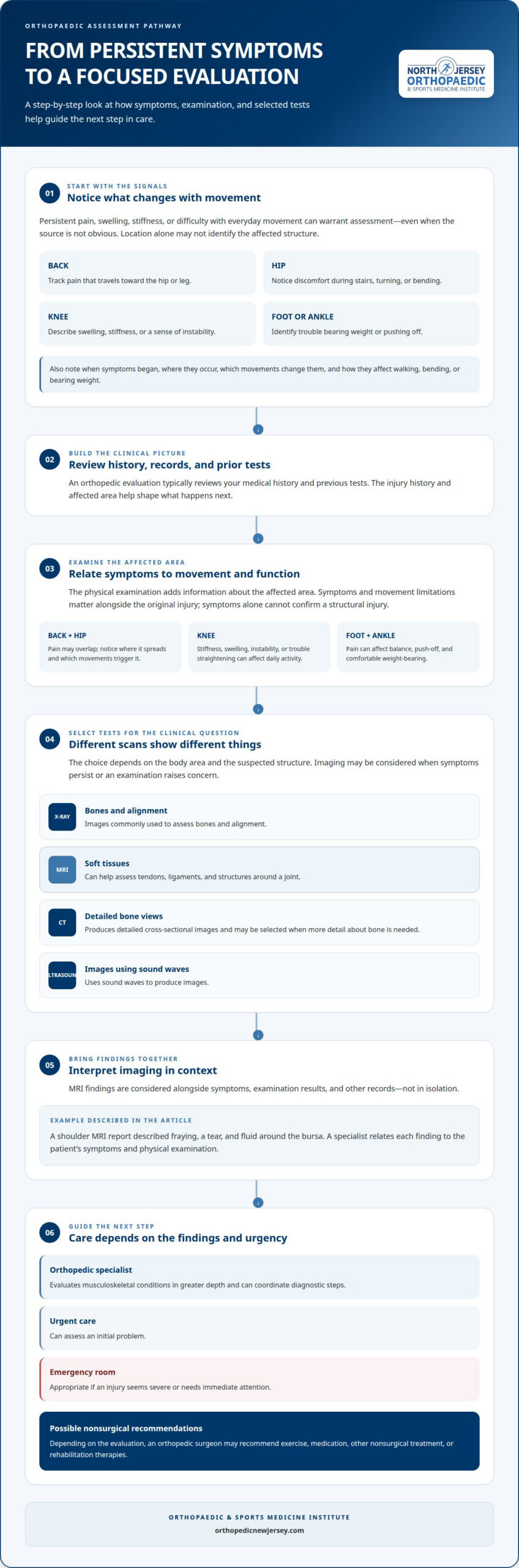
Orthopedic symptoms can arise from bone, cartilage, tendons, ligaments, or muscles. A back injury, for example, may cause pain that travels into the hip or leg. The location of discomfort does not always identify the affected structure. Changes in walking, bending, or bearing weight can provide additional clues.
Back and hip problems can overlap because these areas work together during movement. A back injury may cause pain near the buttock or thigh, while a hip problem can make turning or climbing stairs difficult. Note which movements trigger symptoms and where the discomfort spreads. These details help you describe the problem clearly during an assessment.
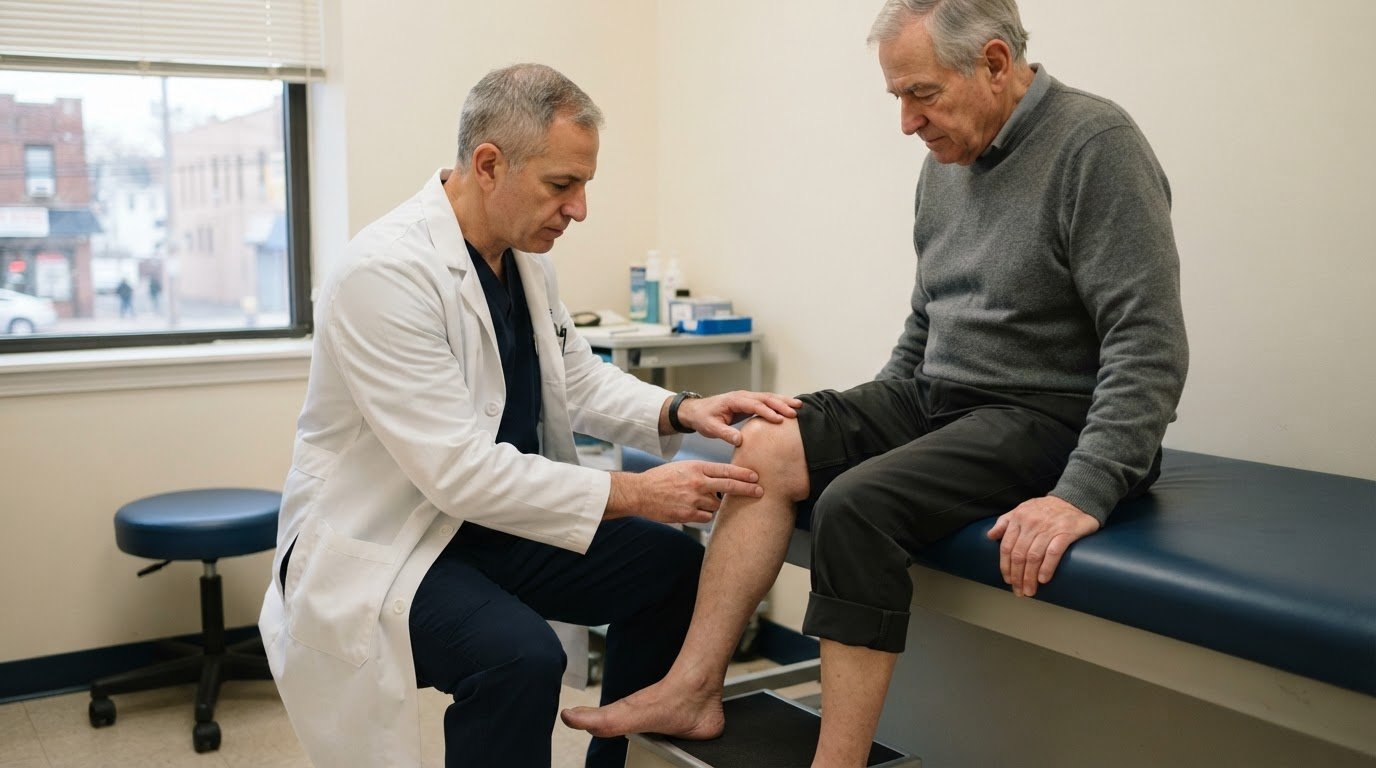
Knee injuries can involve ligaments, cartilage, and tendons. Stiffness, swelling, instability, or difficulty straightening the knee can affect walking and daily activities. For example, a knee that feels unreliable when changing direction may need evaluation, even if pain is not constant. Symptoms and movement limitations matter alongside the original injury.
Foot and ankle injuries can affect balance, push-off, and comfortable weight-bearing. Pain around the heel, arch, or ankle can make standing and walking harder. A twist may affect ligaments, while a direct impact can involve bone or soft tissue. Persistent tenderness or swelling after an injury deserves attention, especially when normal movement remains difficult.
- Back: Track pain that travels toward the hip or leg.
- Hip: Notice discomfort during stairs, turning, or bending.
- Knee: Describe swelling, stiffness, or a sense of instability.
- Foot or ankle: Identify trouble bearing weight or pushing off.
These patterns can guide an evaluation, but symptoms alone cannot confirm an injury. New Jersey’s Direct Access Act allows patients to start physical therapy without first getting a doctor’s prescription. An orthopedic assessment can help clarify whether symptoms point to a structural injury and what care fits the findings. Describe when symptoms began, where they occur, and which movements change them.
Diagnostic and nonsurgical orthopaedic care
Assessment combines your injury history, a physical examination, and relevant records. The next step depends on the affected area and your symptoms.
For a suspected hidden injury, urgent care can assess an initial problem, while an orthopedic specialist evaluates musculoskeletal conditions in greater depth. An emergency room is appropriate if an injury seems severe or needs immediate attention.
An orthopedic evaluation typically reviews your medical history and previous tests, then examines the affected area. The specialist may order or interpret imaging and laboratory tests, prescribe medication, or recommend exercise and rehabilitation therapies.
Exam and imaging costs
There is no single typical total for orthopedic exams and imaging in North Arlington. Costs depend on the examination, body area, imaging method, and insurance or claim arrangements. An MRI and an office evaluation are separate services, so their charges may be handled separately.
For care through this practice, the price depends on the case and is provided after a quote request. Factors include the evaluation and any imaging or treatment involved.
Local orthopedic and imaging providers
North Arlington is near 503 hospitals affiliated with orthopedic surgery specialists. Local care pathways include orthopedic specialists for musculoskeletal assessment, urgent care for an initial evaluation, and imaging facilities for ordered scans.
The appropriate setting depends on the injury and its urgency. An orthopedic specialist can review symptoms and records, then coordinate the diagnostic steps needed. Imaging is selected according to the clinical question, such as assessing a suspected soft-tissue injury.
For an auto accident or workplace injury, tell the office how and where it happened. Auto insurance and workers’ compensation handle bills under claim-specific terms. Ask how diagnostic services are processed under the applicable claim.
Delaying assessment can leave an injury unidentified while pain or movement limitations continue. Ongoing difficulty bearing weight or using an affected joint, for example, can interfere with daily activities. Persistent symptoms warrant evaluation so the examination can guide appropriate next steps.
For a focused assessment of persistent musculoskeletal symptoms, orthopedic evaluation can help clarify which diagnostic steps fit the problem.
An orthopedic surgeon typically performs a physical examination and may recommend exercise, other nonsurgical treatments, or rehabilitation therapies.
MRI scanning
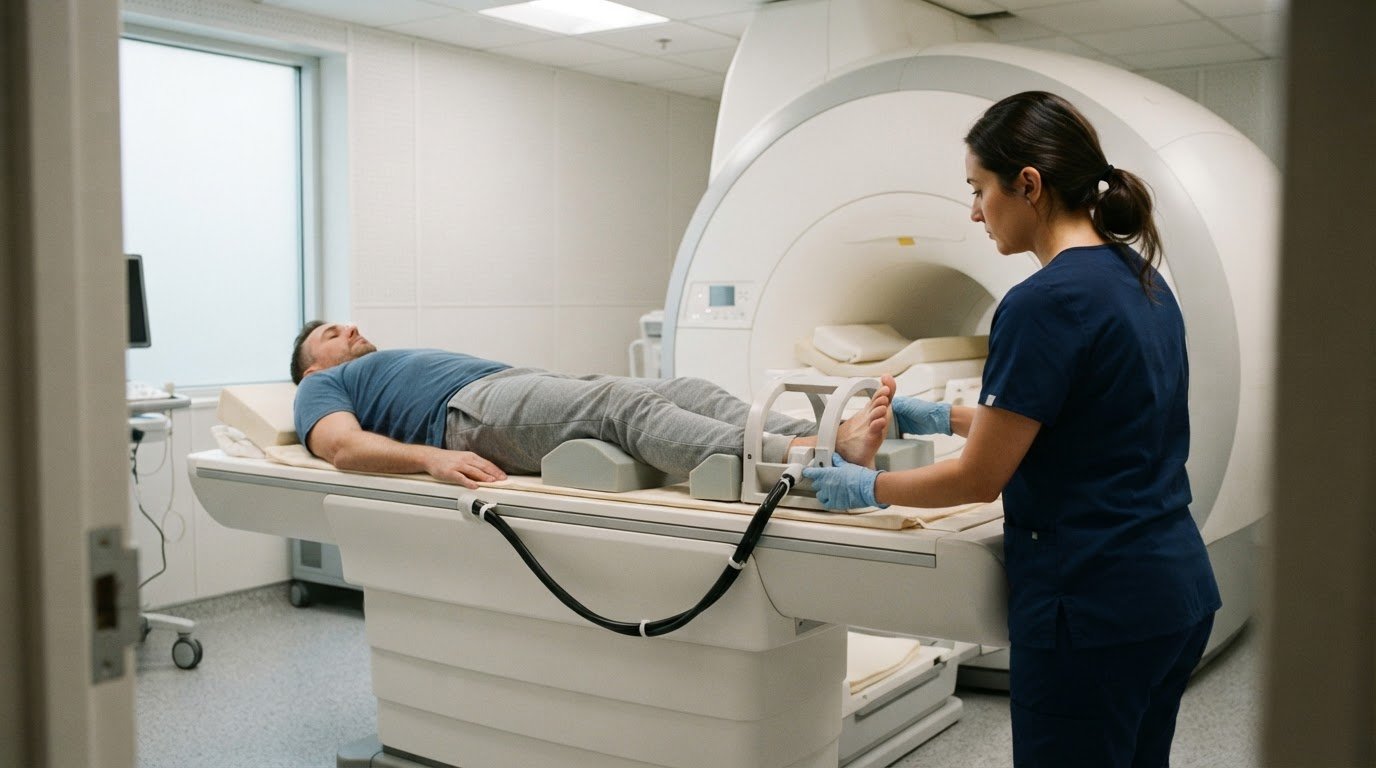
Imaging helps assess a suspected injury by matching the test to the clinical question. X-rays, MRI, CT, and ultrasound provide different views, so the choice depends on the body area and the suspected structure.
MRI’s role in injury diagnosis
MRI can help assess soft tissues, including tendons, ligaments, and structures around a joint. It may be considered when symptoms persist or an examination raises concern about an injury that needs closer assessment. The scan’s findings are interpreted alongside symptoms, examination results, and other records, not in isolation.
In a shoulder-injury case, the U.S. Court of Federal Claims described MRI findings including fraying, a tear, and fluid around the bursa. This example shows how a report can identify multiple findings in one area. A specialist relates each finding to the patient’s symptoms and physical examination.
Comparing imaging methods
X-rays provide images commonly used to assess bones and alignment. MRI offers a different view that can help evaluate soft tissues. CT produces detailed cross-sectional images and may be selected when more detail about bone is needed. Ultrasound uses sound waves to produce images and can assess selected soft tissues.
For example, after a fall, an X-ray may be used to examine a painful bone. If the clinical question involves a tendon or ligament, MRI or ultrasound may be considered. CT can provide another view when bone detail is the focus. The suspected injury and examination guide the choice.
The sequence matters. First, the specialist identifies the injury question from your history and examination. Next, the imaging method is chosen to address that question. Finally, the findings are compared with the location of pain and movement limits. An imaging report alone does not establish which finding explains your symptoms.
For a shoulder concern, a scan may reveal changes near the joint, but their relevance depends on the clinical picture. Shoulder arthritis involves the joint and may require assessment of both symptoms and imaging. A clear explanation of the scan findings can help you understand the diagnosis and discuss appropriate care.
What symptoms suggest a hidden fracture, ligament tear, or soft-tissue injury?
Symptoms can raise concern, but they cannot identify an injury on their own. After a fall, impact, or twist, persistent pain, swelling, tenderness, or difficulty moving the affected area are important details to discuss during an orthopedic assessment. When diagnosing hidden orthopedic injuries in North Arlington, NJ, the clinician considers these symptoms alongside how the injury happened.
A possible fracture may cause localized pain and tenderness, especially after a direct impact. Pain that remains focused over one area of the wrist or ankle, for example, is important context. Difficulty using the limb or bearing weight is another symptom to report, not proof of a fracture. Describe whether pressure or movement changes the discomfort.
Ligament injuries can follow a sudden change in direction or a joint twist. A knee that feels unstable during ordinary walking, or swelling after a twist, may warrant evaluation. Explain when the instability began and which movements make it noticeable. These details help relate the injury mechanism to the examination.
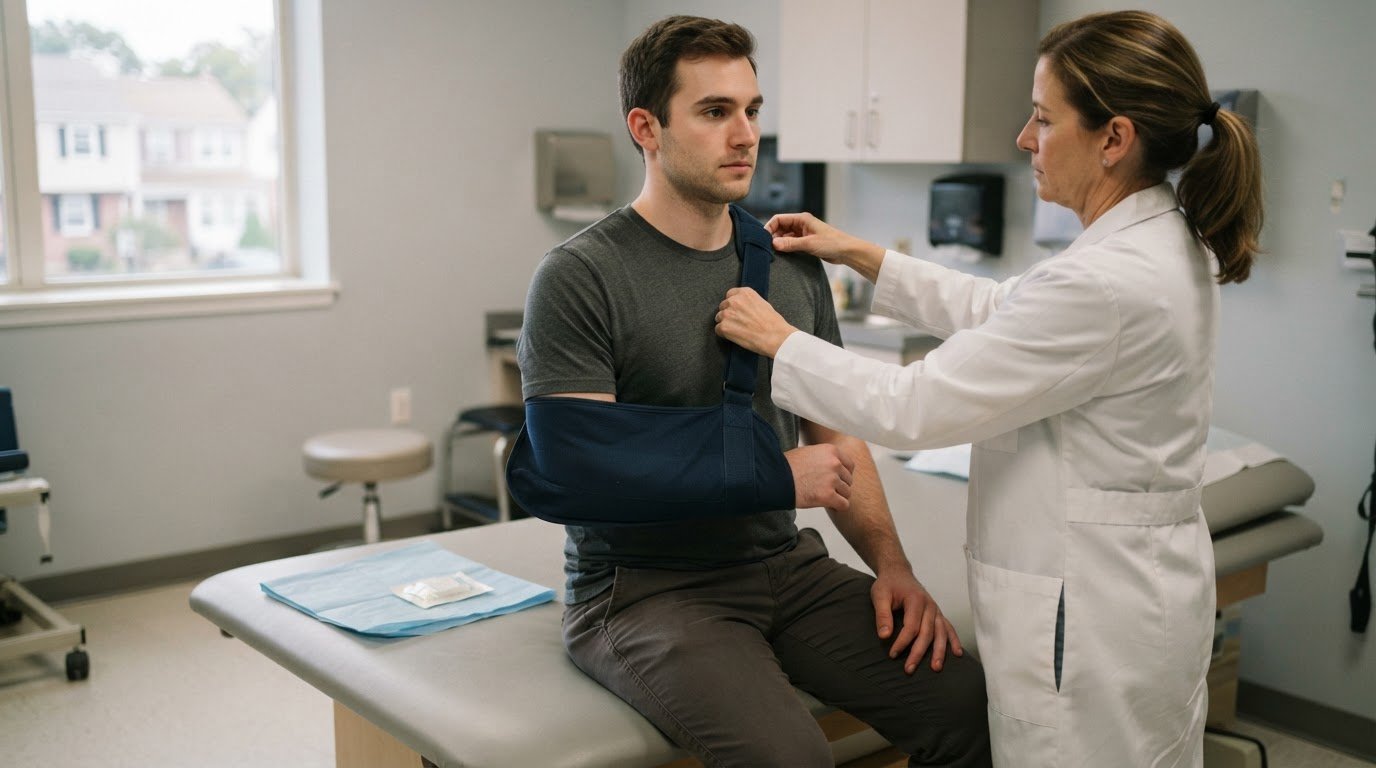
Soft-tissue injuries can involve tendons, muscles, or structures around a joint. A shoulder that hurts when reaching overhead, or an ankle that remains tender after rolling, gives the specialist a specific movement and location to assess. Stiffness, bruising, and reduced range of motion are also useful observations. Note which activities have become difficult.
- Location: Identify the precise area of pain or tenderness.
- Onset: Recall whether symptoms followed a fall, impact, or twist.
- Function: Note changes in walking, lifting, or joint movement.
- Progression: Describe whether pain or swelling is changing.
During an assessment, the specialist considers your reported symptoms and examination findings. Imaging may help answer a specific question about bone or soft tissue. A scan is interpreted in context, since symptoms alone cannot confirm a fracture, ligament tear, or other injury. This stepwise approach supports diagnosing hidden orthopedic injuries in North Arlington, NJ, by relating the suspected injury to clinical findings.
If pain, swelling, or movement difficulty persists after an injury, arrange an orthopedic assessment to discuss appropriate next steps. A focused orthopedic injury evaluation can help assess the problem.
The Orthopaedic & Sports Medicine Institute
The Orthopaedic & Sports Medicine Institute provides specialized orthopedic and sports injury care for people with persistent musculoskeletal symptoms. A board-certified surgeon treats conditions affecting areas such as the knee and shoulder, with care guided by the injury and evaluation findings.
When an assessment identifies a condition requiring specialized treatment, options include minimally invasive orthopaedic surgery, Bridge-Enhanced ACL Repair (BEAR® Implant), rotator cuff repair, and shoulder arthritis treatment. These are condition-specific approaches, not a substitute for emergency care when an injury needs immediate attention.
If ongoing pain, stiffness, or limited movement is affecting your daily activities, contact The Orthopaedic & Sports Medicine Institute to discuss an orthopedic evaluation.
Take the Next Step Toward Clarity
Understanding how symptoms affect daily life can help you prepare for an orthopedic evaluation. If you’re considering diagnosing hidden orthopedic injuries in North Arlington, NJ, note which movements have changed and what activities you hope to resume. These priorities can guide a useful discussion about your concerns and care options.
You do not need to arrive with a diagnosis. A discussion about diagnosing hidden orthopedic injuries in North Arlington, NJ, can begin with the symptoms you have noticed and how they affect your routine. An orthopedic specialist can use that information to discuss whether further evaluation is appropriate.
If you’re ready to discuss persistent orthopedic symptoms, contact The Orthopaedic & Sports Medicine Institute. A clear conversation can help you make informed decisions and take a considered step forward.
Frequently Asked Questions
What hidden orthopedic injuries can be missed after an accident?
Accidents can involve fractures, ligament tears, meniscal injuries, and tendon or cartilage damage. A knee injury, for example, may affect an ACL, MCL, PCL, or meniscus, while a shoulder injury may involve the rotator cuff or labrum. Hip, foot, and ankle fractures are also possible. Pain location and movement limits help guide an assessment, but symptoms alone do not identify the injured structure.