What if the gold standard for ACL recovery wasn’t a replacement, but a restoration of your own native ligament? For athletes and active individuals seeking BEAR implant ACL repair New Jersey, this isn’t just a theoretical possibility; it’s the new clinical reality. You’ve likely been told that a torn ACL cannot heal on its own, leading to the anxiety of choosing between various grafts that often result in permanent donor-site muscle weakness. It’s a difficult trade-off that forces you to sacrifice healthy tissue to stabilize your knee.
You don’t have to accept the “replace rather than repair” narrative anymore. This article explores how the BEAR® Implant acts as a biologic bridge, allowing your body to heal its original ligament without the need for an autograft. We’ll detail the critical 50-day window for candidacy and examine the latest 2026 FDA labeling that highlights a reduced risk of post-traumatic osteoarthritis compared to traditional reconstruction. Discover how this innovative procedure preserves your native anatomy to help you return to peak performance with your full strength and mobility intact.
Key Takeaways
- Understand the paradigm shift from traditional ACL reconstruction to biologic restoration, which allows your body to heal its own native ligament.
- Learn how bridge-enhanced technology uses a collagen sponge and your own blood to stimulate a natural healing response within the knee.
- Discover the benefits of a graft-free procedure that eliminates the need for tissue harvesting and preserves your long-term hamstring and quad strength.
- Identify if you are a candidate for BEAR implant ACL repair New Jersey by understanding the critical 50-day window of opportunity following an injury.
- Explore specialized recovery protocols offered by board-certified experts that help athletes return to peak performance with their original anatomy intact.
What is the BEAR® Implant and How is it Changing ACL Repair in NJ?
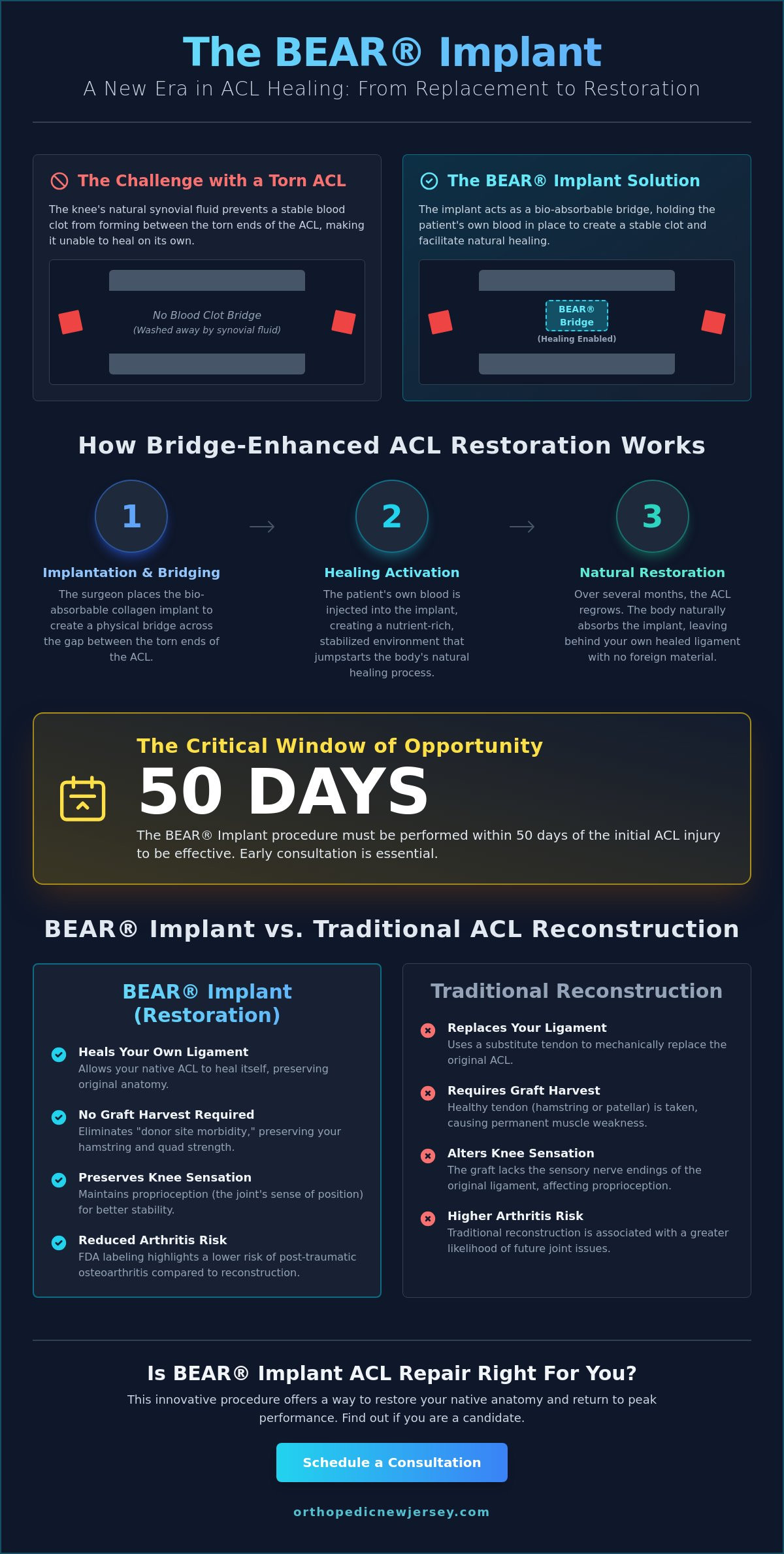
The Bridge-Enhanced ACL Restoration (BEAR®) represents a fundamental shift in orthopaedic science. Historically, a torn anterior cruciate ligament was considered incapable of healing because the fluid inside the knee joint prevents a stable blood clot from forming between the torn ends. The Bridge-Enhanced ACL Restoration (BEAR) is the first FDA-cleared technology that overcomes this biological hurdle. It’s a bio-absorbable implant that acts as a bridge, allowing your own tissue to reconnect and heal. This transition from “reconstruction” to “restoration” is why BEAR implant ACL repair New Jersey has become a sought-after option for athletes in 2026 who want to avoid the long-term deficits of traditional grafts.
North Jersey patients are increasingly choosing this restorative path to avoid the “donor site morbidity” associated with autografts. By 2026, clinical data has reinforced that patients treated with this method show a significantly lower risk of developing post-traumatic osteoarthritis compared to those who undergo hamstring tendon reconstruction. This clinical significance can’t be overstated. It provides a way to maintain the knee’s natural architecture while achieving the stability required for a full return to competitive sports. Patients no longer have to sacrifice a healthy tendon to fix a broken one.
The Technology Behind the Bio-Absorbable Scaffold
The implant is composed of a proprietary, bovine-derived collagen matrix. During the procedure, the surgeon injects a small amount of the patient’s own blood into this sponge-like scaffold. This creates a stabilized, nutrient-rich environment that facilitates healing. This scaffold provides a physical structure for native ACL fibers to migrate across the gap. As the ligament heals and regains its structural integrity, the implant is naturally absorbed by the body. Usually, the scaffold is completely replaced by the patient’s own tissue within several months, leaving no foreign material or permanent hardware behind.
Healing vs. Replacing: A New Medical Philosophy
Choosing to repair rather than replace the ACL offers several anatomical advantages. A traditional reconstruction uses a substitute tissue, such as a piece of your hamstring or patellar tendon. While functional, this substitute doesn’t possess the same sensory nerve endings as your original ligament. Preserving the native tissue maintains your knee’s proprioception, which is the brain’s ability to sense the joint’s position and movement. This is vital for complex athletic maneuvers and long-term joint health. Our minimally invasive surgical approach in Nutley ensures that the surgery is precise, focusing on biological restoration rather than mechanical replacement.
The Science of Bridge-Enhanced ACL Restoration (BEAR)
The biological failure of a standard ACL tear occurs because the knee’s internal environment is hostile to natural healing. Synovial fluid, which lubricates the joint, prevents the formation of a stable blood clot between the torn ligament ends. Without that clot, the body’s natural repair mechanism never starts. The science behind BEAR implant ACL repair New Jersey addresses this specific biological barrier by providing a protected chamber where healing can occur. During the procedure, the surgeon secures the torn ends of the ligament into the collagen sponge, creating a physical bridge that spans the gap of the tear.
This restorative process relies on cellular migration. Once the scaffold is saturated with the patient’s blood, it acts as a trellis for repair. Ligament cells from the torn ends begin to migrate into the sponge, depositing new collagen and slowly rebuilding the ligament’s structural integrity. As highlighted by the Cleveland Clinic on the BEAR Implant, this approach differs fundamentally from reconstruction. In a traditional surgery, a graft acts as a mechanical substitute. With the BEAR procedure, the body is actually regrowing its own tissue. It’s a biological solution to a mechanical problem.
Proprietary Blood-Clot Stabilization
The success of this intervention hinges on the proprietary stabilization of the patient’s blood. The implant acts as a protective housing that prevents the essential blood clot from being washed away by synovial fluid. This stabilization allows the body’s natural wound-healing cascade to proceed undisturbed within the joint. It’s a sophisticated method of mimicking how a cut on your skin heals, but adapted for the complex environment of the human knee. If you’re wondering if this biologic approach is right for your injury, you can consult with a specialist to review your imaging and candidacy.
Preserving the Native Nerve Endings
One of the most profound scientific advantages of this method is the preservation of mechanoreceptors. These are tiny nerve endings within the original ACL that send signals to your brain about the knee’s position and movement. Traditional grafts have a significantly lower nerve density, which often leads to a disconnected feeling in the joint. By keeping the original tissue, the BEAR procedure maintains these vital sensors. This leads to a more natural-feeling knee during recovery, which is a critical factor for athletes who rely on precise spatial awareness during high-impact sports.
BEAR® Implant vs. Traditional ACL Reconstruction
Traditional ACL reconstruction has long been considered the standard of care, yet it involves a biological trade-off. To replace the torn ligament, surgeons must harvest healthy tissue from elsewhere in your body, such as the hamstring, patellar, or quadriceps tendon. This “donor site” often remains a source of chronic weakness or pain long after the knee has stabilized. Choosing BEAR implant ACL repair New Jersey eliminates this compromise entirely. Instead of sacrificing a healthy tendon to act as a substitute, the procedure uses the implant to facilitate the restoration of your original tissue. This fundamental difference affects everything from your initial post-operative pain levels to your athletic performance years down the road.
The primary distinctions between these two approaches are summarized below:
- Tissue Preservation: Traditional methods replace the ligament with a graft; BEAR restores the native ligament.
- Surgical Impact: Reconstruction requires a secondary surgical site to harvest the graft; BEAR is graft-free.
- Long-Term Health: Restoration maintains the original nerve endings and biological mechanics of the knee.
Eliminating Donor Site Morbidity
When a surgeon harvests a piece of your hamstring or quadriceps tendon, that muscle group is permanently altered. Athletes often struggle to regain 100% of their pre-injury strength in the donor limb, which can lead to biomechanical imbalances and secondary injuries. By opting for a graft-free restoration, you bypass these donor site complications. Early-stage physical therapy becomes more focused on knee mobility and quad activation rather than managing pain from a secondary surgical incision. For athletes in North Jersey who play sports requiring explosive pivoting, such as soccer or basketball, maintaining every ounce of natural muscle power is a significant advantage.
Long-Term Knee Health and Stability
The primary concern with any ACL surgery is the long-term health of the joint. Traditional reconstruction is frequently linked to a higher incidence of post-traumatic osteoarthritis. According to six-year data from the BEAR I and II clinical studies, patients who underwent traditional reconstruction had a rate of radiographically confirmed osteoarthritis six times higher than those treated with the BEAR® Implant. This data led to updated FDA labeling in early 2026, which officially recognizes the reduced risk of joint degeneration associated with the implant.
Beyond the physical statistics, there’s a significant psychological advantage to this approach. Patients report higher satisfaction levels at the two-year mark, largely because the knee feels like their “original” anatomy rather than a reconstructed substitute. The absence of chronic kneeling pain, which is common with bone-patellar-bone grafts, allows for a more comfortable return to both daily activities and high-level competition.
Candidacy and the “Window of Opportunity”
While traditional ACL surgery can often be scheduled months or even years after an initial injury, BEAR implant ACL repair New Jersey operates on a much stricter biological timeline. There’s a specific “window of opportunity” that patients must meet to be eligible for this restorative technology. This urgency isn’t a matter of administrative scheduling; it’s a requirement of human biology. The procedure relies on the presence of your original ligament tissue to act as the foundation for new growth, and that tissue changes rapidly after a rupture.
Ideal candidates are typically those with a complete or partial ACL tear who can undergo the procedure within 50 days of their injury. In March 2025, the FDA expanded the indications for the BEAR® Implant to include patients of all ages, including children and adolescents, as well as those with partial tears. This expansion reflects the growing clinical confidence in the implant’s ability to facilitate natural healing across a broad demographic of active individuals.
Why Timing is Everything for BEAR
The 50-day rule is a non-negotiable clinical requirement. For the bio-absorbable scaffold to successfully facilitate repair, the torn ends of your ACL must still be healthy and viable. As time passes, the ligament stumps begin to retract and scar tissue forms over the ends, eventually making it impossible for the fibers to bridge the gap within the collagen sponge. If you miss this 50-day mark, the native tissue is usually no longer suitable for restoration. At that point, the surgical path typically shifts back toward traditional reconstruction using an autograft or allograft. If you’ve suffered a knee injury, you should schedule a consultation immediately to ensure you don’t lose your chance for a native repair.
Diagnostic Criteria for Restoration
Not every ACL tear is suitable for the BEAR procedure, even if you’re within the 50-day window. A high-resolution MRI is the primary tool our specialists use to determine candidacy. We specifically look for complete ruptures where the ACL stump remains firmly attached to the tibia. Femoral-sided tears, where the ligament has detached from the thigh bone, are often the most successful candidates for this “bridging” technique. During a physical examination, our board-certified surgeons in Nutley also assess joint laxity and the health of surrounding structures. If the ligament tissue is too shredded or if there’s significant damage to other knee compartments, we’ll discuss whether traditional minimally invasive reconstruction remains your most reliable path to stability.
Specialized ACL Care at Orthopaedic & Sports Medicine Institute
Athletes across North Jersey face a high risk of ACL injuries, but access to restorative technology is no longer limited to major university hospitals. At Orthopaedic & Sports Medicine Institute, we bring the future of ligament health directly to our local communities. Our practice is dedicated to serving the specific needs of active individuals in Nutley, Bloomfield, Clifton, Belleville, and Verona. When seeking BEAR implant ACL repair New Jersey, choosing a facility that understands the local athletic culture and provides specialized, board-certified care is essential for a successful return to sport.
We recognize that an ACL tear is more than just a clinical diagnosis; it’s a significant disruption to your lifestyle and athletic goals. Our approach combines high-level professional expertise with the empathy required to guide you through a complex recovery. We’ve positioned our practice as a leader in North Jersey by embracing restorative techniques that prioritize your long-term joint health over quick mechanical fixes.
Board-Certified Expertise in North Jersey
The BEAR® procedure is technically demanding and requires specialized training beyond traditional reconstruction. Our surgeons are board-certified experts who prioritize modern, less disruptive surgical alternatives. We don’t just treat the injury; we focus on the biological preservation of your knee. This commitment to minimally invasive ligament restoration ensures that our patients benefit from the latest medical advancements without having to travel into the city. By integrating advanced medical technology with a patient-centered approach, we provide a level of care that bridges the gap between established medical wisdom and the next generation of orthopedic solutions.
Your Recovery Journey in Nutley
Successful restoration depends on a seamless transition from the operating room to the physical therapy clinic. We maintain a collaborative approach with a network of local physical therapists who are specifically trained in the BEAR® post-operative protocol. This synergy ensures that your rehabilitation is tailored to the unique biological timeline of a healing ligament rather than a standard graft. Our goal is to see you return to the field with the same explosive power and stability you had before your injury.
In the first 48 hours following your procedure at our Nutley facility, our team provides direct guidance on pain management and early mobility exercises. We monitor your progress closely to ensure the healing environment remains optimal. Because the BEAR® Implant relies on your body’s natural response, the precision of your early recovery phase is paramount. If you’ve recently suffered an injury and want to explore your options before the 50-day window closes, you should schedule your ACL consultation at our Nutley office today. We provide priority evaluations for acute injuries to ensure no patient misses the opportunity for native ligament healing.
Restore Your Native Strength with Advanced ACL Restoration
The evolution of ACL care has moved from mechanical replacement to biological restoration. By choosing the BEAR® Implant, you’re prioritizing the preservation of your native anatomy and long-term joint health. This approach avoids the common pitfalls of donor site weakness while maintaining the natural proprioception of your original ligament. It’s a sophisticated solution for those who refuse to settle for a substitute. Remember that timing is the most critical factor in your recovery journey; the biological window for this procedure closes exactly 50 days after your initial injury.
Our board-certified orthopedic surgeons at Orthopaedic & Sports Medicine Institute specialize in these minimally invasive techniques to ensure you return to your peak performance level. We’ve served the communities of Nutley, Bloomfield, and Clifton with advanced orthopedic solutions for years, and we’re ready to help you navigate your path to healing. If you’re ready to explore the benefits of BEAR implant ACL repair New Jersey, don’t let the window of opportunity slip away. Taking action now ensures your knee remains as close to its original state as possible.
Request a Consultation for BEAR ACL Repair in Nutley today. Your journey back to full mobility and athletic confidence starts with preserving what’s already yours.
Frequently Asked Questions
Is the BEAR implant better than a traditional ACL reconstruction?
The choice depends on your specific goals, but the BEAR® Implant offers unique biological advantages. It’s a restorative procedure that preserves your native ligament tissue and avoids the donor site morbidity caused by harvesting a graft from your hamstring or quad. Recent 2026 FDA labeling confirms that this method carries a significantly lower risk of post-traumatic osteoarthritis compared to traditional reconstruction.
How long does the BEAR implant take to heal?
The biological restoration begins immediately, with the bio-absorbable scaffold typically being replaced by your own tissue within several months. While the body’s natural cellular migration works steadily to rebuild the ligament, you’ll follow a structured rehabilitation timeline. Most patients find that their knee feels more “natural” during this process because the original nerve endings remain intact.
Will my insurance cover the BEAR implant procedure in New Jersey?
Insurance coverage for the BEAR implant ACL repair New Jersey varies by provider and individual policy. While clinical adoption is growing, some major insurers, such as Aetna in late 2023, have previously categorized the procedure as investigational. It’s essential to verify your specific benefits with your insurance carrier. Our office can provide the necessary documentation to assist with your coverage inquiry.
What is the success rate of the BEAR implant compared to grafts?
Clinical data shows that the BEAR® Implant provides knee stability comparable to traditional autograft reconstruction. Its primary advantage lies in long-term outcomes. Six-year data from the BEAR I and II studies revealed that patients treated with traditional grafts had a rate of osteoarthritis six times higher than those who received the BEAR® Implant. This makes it a superior option for long-term joint preservation.
Can I still get the BEAR implant if my injury happened more than two months ago?
No, the BEAR® procedure must be performed within a strict 50-day window following the initial injury. After this period, the native ligament tissue begins to retract and scar, which prevents it from successfully bridging the gap within the collagen scaffold. If you’ve surpassed this 50-day mark, our board-certified surgeons will discuss traditional reconstruction options that align with your recovery goals.
What does physical therapy look like after a BEAR implant surgery?
Physical therapy follows a specialized protocol designed to protect the healing ligament while gradually restoring range of motion. You’ll focus on quadriceps activation and joint mobility without the added burden of donor site pain. Because no healthy tendons were harvested for a graft, your early-stage therapy is often more comfortable, allowing you to focus entirely on the mechanics of your knee restoration.
Are there any long-term risks associated with a bovine-derived collagen implant?
The implant is fully bio-absorbable and is naturally replaced by your body’s own tissue within a few months. There are no permanent foreign materials or synthetic hardware left in the knee joint. This eliminates the long-term risks associated with permanent implants or hardware, as the final result is a ligament comprised entirely of your own native cells.
How soon can I return to sports after BEAR ACL repair?
Most athletes return to high-impact sports within nine to twelve months, following a timeline similar to traditional reconstruction. While the biological repair is efficient, the new tissue needs time to mature and gain the structural integrity required for pivoting and jumping. We use specific functional testing and strength milestones to ensure your knee is fully prepared for the demands of competitive play.