


What if the right next step for knee pain isn’t choosing a cartilage procedure, but first finding out exactly what’s injured? If you’re looking for a knee cartilage repair surgeon Lyndhurst NJ, symptoms such as swelling, pain, or catching can raise questions: Is cartilage damage the cause, or could a meniscus or ligament injury be involved? And does the diagnosis mean surgery is necessary? Those are reasonable concerns, especially when treatment and recovery may affect everyday activities.
A careful orthopedic evaluation connects your symptoms with the injury and helps clarify which options may be appropriate. This article explains how knee cartilage injuries are assessed, what factors shape treatment decisions, and what to consider when arranging a consultation near Lyndhurst. At The Orthopaedic & Sports Medicine Institute in Nutley, a board-certified surgeon treats knee injuries and discusses care based on each patient’s needs. You’ll also learn how minimally invasive techniques fit into orthopedic care, without assuming that a particular procedure is right for every knee.
Key Takeaways
- Knee pain, swelling, or catching can have different causes, so identifying the injury is an important first step before considering treatment.
- A surgeon assesses symptoms, examines the knee, and reviews imaging together. An MRI finding alone doesn’t determine the right course of care.
- When comparing a knee cartilage repair surgeon Lyndhurst NJ patients can consult, consider knee-injury experience, diagnostic reasoning, treatment discussions, and follow-up planning.
- Prepare for a focused consultation by gathering prior imaging or reports, medication details, and a brief timeline of your symptoms.
- The Orthopaedic & Sports Medicine Institute in Nutley serves Lyndhurst-area patients with surgeon-led knee injury care and minimally invasive techniques as part of orthopedic treatment.
Knee cartilage damage: what Lyndhurst patients should know before choosing a surgeon
Persistent knee pain can make everyday activities and treatment decisions difficult. Pain, swelling, stiffness, or a catching sensation may raise concern about cartilage damage, but symptoms alone can’t identify the injured structure. The knee contains several tissues that can be affected by injury or wear, and their symptoms may overlap.
A knee cartilage injury is damage to the smooth articular cartilage that covers the ends of bones where they meet in a joint. This surface helps the bones move against one another with less friction. Articular cartilage is different from the meniscus, a separate cushioning structure between the thighbone and shinbone. Ligaments connect bones and help stabilize the knee. An injury can affect one or more of these structures, so an examination is needed to understand what may be contributing to symptoms.
What symptoms can accompany a knee cartilage injury?
Cartilage damage may be associated with pain, swelling, stiffness, or catching, but none of these signs proves that cartilage is the cause. Meniscus injuries, ligament injuries, and other knee conditions can produce similar symptoms. If discomfort or limited movement persists and interferes with normal activity, an orthopedic evaluation can help clarify the possibilities instead of relying on symptoms alone.
Why location and injury details matter
“Cartilage injury” describes a broad range of conditions, not a specific treatment plan. The area and extent of damage, the surrounding tissues, and the overall condition of the joint can all influence how a surgeon considers care. A focused assessment relates those details to your symptoms and goals.
Scan findings also need to be considered in context. A clear diagnosis supports a more useful discussion about whether to monitor the condition, consider nonsurgical care, or explore other options. General references to articular cartilage repair procedures describe a range of approaches, but they don’t determine which, if any, is appropriate for an individual patient.
For someone searching for a knee cartilage repair surgeon Lyndhurst NJ, the practical first step is an individualized evaluation. The Orthopaedic & Sports Medicine Institute in Nutley serves patients from Lyndhurst and nearby communities, including Bloomfield, Clifton, Belleville, North Arlington, Kearny, and Verona. Its board-certified surgeon treats knee injuries and uses minimally invasive techniques as part of orthopedic care. A surgeon-led discussion can connect the injury’s specific characteristics with the next steps to consider.
How a knee cartilage repair surgeon evaluates candidacy and treatment options
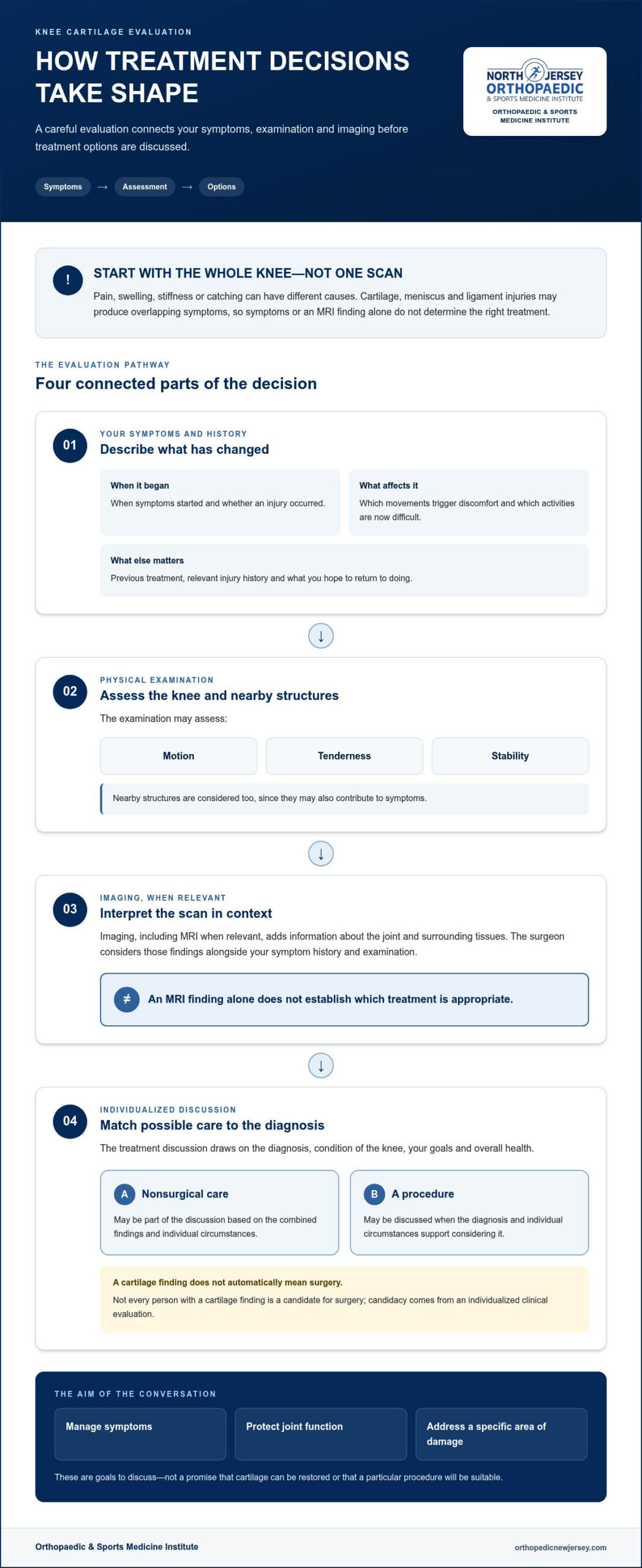
A treatment discussion starts with the whole knee, not an MRI image or a procedure name. A knee cartilage repair surgeon Lyndhurst NJ patients consult will consider how symptoms began, which activities are now difficult, any previous treatment, and relevant injury history. These details help frame the assessment and clarify what you hope to return to doing.
The right treatment depends on the specific diagnosis, the condition of the knee, and the patient’s goals and overall health. Candidacy is determined through an individualized clinical evaluation, not by a single symptom or scan result.
What happens during the knee evaluation?
The surgeon typically reviews when symptoms started, whether an injury occurred, which movements trigger discomfort, and how the problem affects daily activities. The physical examination may assess knee motion, tenderness, stability, and nearby structures that could also contribute to symptoms.
Imaging, including MRI when relevant, adds information about the joint and surrounding tissues. The surgeon interprets imaging findings alongside your symptom history and examination, not in isolation. A scan can help explain what may be happening, but it doesn’t establish which treatment is appropriate on its own.
How surgeons discuss treatment pathways
Based on the combined findings, the discussion may include nonsurgical care or a procedure. The appropriate path depends on the diagnosis and individual circumstances. Not every person with a cartilage finding is a candidate for surgery. The American Academy of Orthopaedic Surgeons provides an overview of cartilage restoration goals and considerations in its patient guide to articular cartilage restoration.
When discussing care, a surgeon can explain whether the goal is to manage symptoms, protect joint function, or address a specific area of damage, along with the considerations and limitations of potential approaches. Cartilage-preserving care is a general aim, not a promise that cartilage can be restored or that a particular procedure will be suitable. For patients researching regenerative options to maintain knee function, The Joint Preservation Center provides insights into joint preservation and orthobiologic approaches. For broader context on surgical planning and techniques, discuss how minimally invasive approaches relate to your diagnosis and treatment plan.
Patients from Lyndhurst and nearby communities can arrange a surgeon-led orthopedic knee evaluation at The Orthopaedic & Sports Medicine Institute in Nutley to discuss symptoms, findings, and potential next steps.
How to compare knee cartilage surgeons serving Lyndhurst, NJ
Comparing surgeons is less about choosing a procedure by name and more about understanding how the clinician assesses your knee and develops a plan. A board-certified orthopedic surgeon has relevant professional credentials, but credentials alone don’t show how clearly your diagnosis and options will be explained. Consider the full consultation, including experience evaluating knee injuries, clinical reasoning, communication, and follow-up planning.
Surgery isn’t automatically necessary for a cartilage finding. Whether to consider it depends on the diagnosis, symptoms, joint condition, and your individual circumstances. Use these criteria to guide a focused comparison:
Questions that clarify a surgeon’s treatment approach
Ask how your symptoms, examination, and imaging support the diagnosis. Find out what nonsurgical care may be appropriate and, if a procedure is considered, what risks, alternatives, and rehabilitation demands you should understand. You can also ask how progress would be monitored and follow-up planned. A useful conversation connects the answers to your specific findings and activity goals.
Why minimally invasive techniques are only one consideration
A less invasive technique may be considered when clinically appropriate, but incision size doesn’t replace an accurate diagnosis or individualized planning. The surgeon should explain what condition is being addressed and why the proposed approach fits your case. Technique alone can’t determine whether a treatment is suitable or what result to expect.
If you’re looking for a knee cartilage repair surgeon Lyndhurst NJ, The Orthopaedic & Sports Medicine Institute in Nutley serves patients from Lyndhurst and nearby communities. Its board-certified surgeon treats knee injuries and uses minimally invasive techniques as part of orthopedic care. Explore orthopedic care and evaluation as a step toward an informed discussion.
Preparing for a knee cartilage consultation near Lyndhurst
A little preparation can make an orthopedic visit more focused. If you’re meeting with a knee cartilage repair surgeon Lyndhurst NJ patients can consult, bring information that describes your symptoms and priorities. These notes support the clinical evaluation, but they don’t diagnose the cause of pain or replace the surgeon’s assessment.
What information helps the surgeon understand your knee symptoms?
Before the appointment, create a concise record and gather relevant materials. Include what you can, even if some details are approximate:
- Symptom timeline: Note when the problem began, whether it followed an injury, and how symptoms have changed.
- Triggers and changes: Record activities that worsen symptoms, whether swelling occurs, and any changes in knee motion.
- Daily impact: List affected work duties, sports, exercise, and routine activities, such as climbing stairs or walking.
- Injury and treatment history: Summarize relevant knee injuries and prior care, including treatments you’ve tried and how you responded.
- Records and medications: Bring prior imaging or reports when available, along with an up-to-date list of medications.
- Care goals: Identify what you most want to address, such as returning to a particular activity or managing limitations at work.
Clear, specific observations are more useful than trying to label the injury yourself. You don’t need to interpret an imaging report or determine whether cartilage is the source of symptoms. That requires review in the context of your history and examination.
What to discuss before deciding on treatment
Use the consultation to understand the reasoning behind the assessment and what the findings mean for your choices. Consider asking:
- How was the diagnosis reached, and which findings matter most?
- What treatment paths may be appropriate, including nonsurgical care?
- If a procedure is discussed, what benefits, risks, and alternatives should I understand?
- What rehabilitation demands might be involved, and how would follow-up and progress be assessed?
Ask for explanations in plain language and take notes if helpful. You can also clarify what the next step would be if you need time to consider the options. Preparing questions doesn’t commit you to treatment. It helps you take part in an informed decision.
Patients from Lyndhurst and nearby communities can arrange a focused knee evaluation at The Orthopaedic & Sports Medicine Institute in Nutley. Arrange a knee consultation to discuss your symptoms, records, and care goals with an orthopedic surgeon.
Knee Care at The Orthopaedic & Sports Medicine Institute
For Lyndhurst-area patients seeking focused orthopedic care for a knee injury, The Orthopaedic & Sports Medicine Institute in Nutley serves nearby communities. A board-certified surgeon treats knee injuries and uses minimally invasive techniques as part of orthopedic care. An evaluation can connect what you’re experiencing with the clinical findings and a discussion of appropriate next steps.
A surgeon-led approach to knee injury care
Knee symptoms can involve different structures, so treatment planning starts with understanding the individual problem. The practice’s focus on orthopedic and sports injury care supports a careful discussion of your knee, the activities affected, and your goals. A surgeon can review relevant history, examine the joint, and consider imaging where appropriate before discussing whether nonsurgical care or a surgical approach may fit the findings.
Minimally invasive techniques are part of the institute’s orthopedic care, but the method must be considered in relation to the diagnosis and your needs. The discussion isn’t a promise of a particular cartilage procedure or result. It’s an opportunity to understand the assessment, potential treatment considerations, and questions that matter to you.
Taking the next step from Lyndhurst
To make an evaluation more productive, bring prior knee imaging or reports when available, a list of medications, and a concise timeline of your symptoms. Note any relevant injury, activities that have become difficult, previous treatment, and what you hope to return to doing. These details give the surgeon useful context, but they don’t replace the examination or establish a diagnosis on their own.
During the consultation, you can discuss how the diagnosis was reached, which findings shape the care plan, and what options may be appropriate. If a procedure is considered, ask about its potential benefits and risks, alternatives, rehabilitation demands, and follow-up planning. A clear conversation can help you weigh decisions at a pace that feels informed, without assuming surgery is necessary.
If you’re looking for a knee cartilage repair surgeon Lyndhurst NJ, an individualized orthopedic consultation can help clarify your knee concerns and guide a discussion of care options. Request an orthopedic consultation with The Orthopaedic & Sports Medicine Institute.
Take the Next Step Toward Clearer Knee Care
Knee pain, swelling, or catching can have more than one cause, so symptoms alone can’t confirm cartilage damage. A careful evaluation brings together your history, physical examination, and relevant imaging. Treatment decisions then depend on the diagnosis, your knee’s condition, and the activities you want to return to. Surgery isn’t automatic, and a consultation can help clarify the options and considerations that apply to you.
For patients in Lyndhurst and nearby communities, The Orthopaedic & Sports Medicine Institute in Nutley provides specialized orthopedic and sports injury care. A board-certified surgeon treats knee injuries, with minimally invasive techniques used as part of orthopedic care. If you’re searching for a knee cartilage repair surgeon Lyndhurst NJ, an individualized discussion can help you understand your findings and consider an informed next step.
Request an orthopedic consultation to discuss your knee concerns with the practice. With clear information and surgeon-led guidance, you can move forward with greater confidence.
Frequently Asked Questions
Does knee cartilage damage always require surgery?
No, a cartilage finding doesn’t automatically mean surgery is needed. Treatment depends on the specific diagnosis, symptoms, joint condition, and how the problem affects your activities. A surgeon may discuss nonsurgical care or consider a procedure based on the evaluation. Ask how the recommended approach relates to your examination and goals, and what alternatives may be appropriate before making a decision.
How does a surgeon diagnose a knee cartilage injury?
A surgeon assesses the knee by reviewing your symptom history, examining the joint, and considering relevant imaging. They may ask when symptoms began, what movements aggravate them, and whether an injury or prior treatment is involved. The examination can assess motion, tenderness, stability, and related structures. Imaging provides additional detail, but findings are interpreted alongside your symptoms and physical examination.
Can knee cartilage repair help me return to sports?
Whether treatment can support a return to sports depends on the diagnosis, the condition of the knee, your sport, and individual treatment and rehabilitation factors. No procedure can guarantee a particular result or timeline. Discuss the movements your sport requires, your activity goals, potential risks, and rehabilitation demands with a surgeon. A plan should reflect your clinical findings, not just a general desire to resume athletics.
What should I bring to a knee cartilage consultation?
Bring prior knee imaging or reports when available, a current medication list, and a short timeline of your symptoms. Note any relevant injury, swelling or motion changes, activities that aggravate the knee, and treatments you’ve tried. It can also help to describe which work, sport, or daily activities matter most to you. These details inform the consultation, but they don’t replace the surgeon’s evaluation.
Is an MRI enough to decide whether knee cartilage repair is needed?
No, an MRI alone doesn’t determine whether treatment or surgery is appropriate. A surgeon considers imaging alongside your symptoms, medical and injury history, physical examination, and activity goals. A scan finding needs to be assessed in context rather than assumed to explain every symptom. Ask which imaging details matter, how they relate to the examination, and what other care options may be considered.
How do I choose a knee cartilage repair surgeon near Lyndhurst, NJ?
Look for a board-certified orthopedic surgeon who evaluates knee injuries and explains how symptoms, examination, and imaging inform the diagnosis. Consider whether the consultation covers nonsurgical care, procedural considerations, risks, rehabilitation, and follow-up. Credentials matter, but clear clinical reasoning and an individualized discussion matter too. Patients seeking a knee cartilage repair surgeon Lyndhurst NJ can consult at The Orthopaedic & Sports Medicine Institute in nearby Nutley.
What does minimally invasive knee surgery mean?
Minimally invasive surgery generally refers to techniques designed to perform a procedure through smaller incisions or with less disruption to surrounding tissue than some traditional approaches. The appropriate method depends on the diagnosis and clinical plan. Minimally invasive doesn’t mean risk-free or suitable for every condition. The Orthopaedic & Sports Medicine Institute in Nutley serves patients from Lyndhurst, Bloomfield, Clifton, Belleville, North Arlington, Kearny, and Verona.


