


What makes a shoulder surgeon the right fit: a high rating, or expertise and a treatment plan that address your specific condition? If you’re searching for a top rated shoulder surgeon Bloomfield NJ, it’s reasonable to want clear answers and to know that a consultation does not automatically mean surgery.
Shoulder pain can be related to rotator cuff injuries, bursitis, tendonitis, labral tears, arthritis, or sports-related injuries. An evaluation helps identify possible causes and clarify whether non-surgical care, rehabilitation, or a surgical procedure may be appropriate. The goal is an individualized plan, not a one-size-fits-all approach.
This guide covers shoulder conditions a specialist evaluates and what to consider when comparing expertise, credentials, and treatment options. You’ll also learn how care may include non-surgical treatment, minimally invasive solutions, or surgery when appropriate. Dr. Michael C. Russonella, D.O., a board-certified orthopaedic surgeon and sports medicine specialist, treats patients at the Orthopaedic & Sports Medicine Institute in Nutley, serving Bloomfield, Essex County, and nearby communities.
Key Takeaways
- When searching for a top rated shoulder surgeon Bloomfield NJ, consider shoulder-specific expertise and clear explanations of care options, not ratings alone.
- Shoulder pain, weakness, stiffness, or limited movement can have different causes. An evaluation helps connect symptoms and function with possible next steps.
- Non-surgical care, minimally invasive solutions, and surgery are distinct pathways. The appropriate approach depends on the individual evaluation.
- Before a consultation, note when symptoms began, which movements are affected, and how the problem changes your daily activities.
- Dr. Michael C. Russonella, D.O., provides shoulder care from Nutley for Bloomfield-area patients, with non-surgical and surgical approaches.
Choosing a Shoulder Surgeon Near Bloomfield, NJ: What “Top Rated” Should Mean
Shoulder pain can make everyday tasks, such as reaching overhead, getting dressed, or sleeping comfortably, more difficult. Choosing specialist care can feel uncertain, especially when search results use phrases like “top rated” without explaining what they mean. A high rating may help you find a practice, but it is not a diagnosis or a guarantee of a particular result.
When assessing a top rated shoulder surgeon Bloomfield NJ search result, look beyond the label. Consider whether the specialist evaluates conditions relevant to your concerns, explains findings in understandable terms, and discusses options in light of your health and goals. The shoulder has several connected structures and functions. This overview of human shoulder anatomy and conditions provides background, but an individual assessment is needed to interpret your symptoms.
What should patients look for in a shoulder surgeon?
Look for a fit between the physician’s expertise and your shoulder concern. Someone with pain after a sports injury may have different questions from a person experiencing persistent stiffness or symptoms associated with arthritis. A specialist should connect the evaluation to your concerns, rather than treating a rating as a substitute for understanding your case.
Clear communication matters, too. You should understand what the findings may indicate, which care options are being considered, and the potential benefits and limitations of those approaches. An individualized discussion may include non-surgical care and minimally invasive or surgical options when appropriate. Consulting a surgeon does not make surgery the automatic next step.
Credentials offer another useful point of reference. Dr. Michael C. Russonella, D.O., is a board-certified orthopaedic surgeon and sports medicine specialist. Orthopedic and sports medicine expertise can be relevant to athletes and non-athletes alike, since shoulder concerns may affect work, recreation, and everyday movement.
How do ratings fit into a care decision?
Reviews offer one perspective on a patient’s experience, but they cannot determine whether a particular treatment is right for you. The Orthopaedic & Sports Medicine Institute’s website highlights 89 Google reviews as “EXCELLENT.” This is feedback about the practice, not a prediction of an individual’s clinical outcome.
Consider ratings alongside more personal factors. During a consultation, notice whether your concerns are heard and whether explanations address your symptoms and goals. A thoughtful decision brings together communication, condition-specific expertise, and a shared discussion of options. You should leave with an understanding of the proposed next steps.
The Orthopaedic & Sports Medicine Institute is located in Nutley and serves Bloomfield, Essex County, and surrounding New Jersey communities. For Bloomfield-area patients, this means accessing shoulder evaluation and care at a nearby practice, with treatment planning focused on the individual rather than a “top rated” label alone.
Shoulder Conditions a Bloomfield-Area Orthopedic Surgeon Can Evaluate
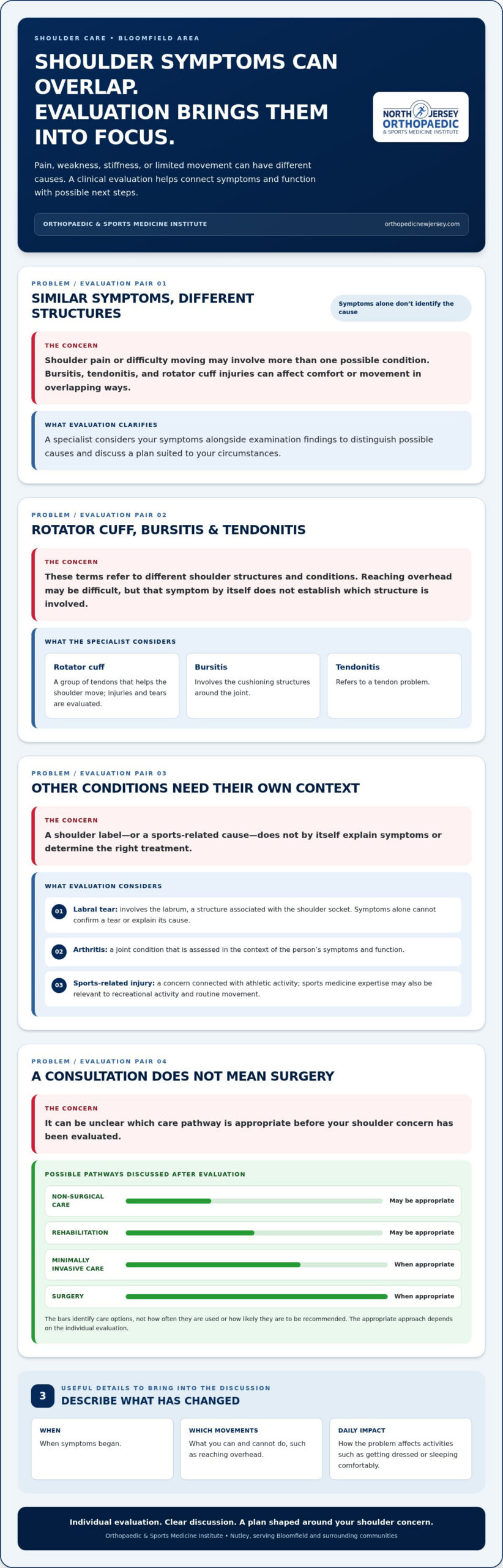
A shoulder evaluation connects your symptoms with how your shoulder moves and the findings from a clinical assessment. Pain, weakness, stiffness, or reduced function can have different causes, so symptoms alone cannot identify the problem. An evaluation helps a specialist consider possible explanations and discuss next steps without assuming every shoulder concern needs surgery.
The Orthopaedic & Sports Medicine Institute evaluates shoulder concerns including bursitis, tendonitis, rotator cuff injuries and tears, labral tears, arthritis, and sports-related injuries. These conditions are not interchangeable. The location and timing of discomfort, movements that are limited, and effects on daily activities can all help put the concern in context.
How rotator cuff and tendon problems may affect shoulder function
The rotator cuff is a group of tendons that helps the shoulder move. A rotator cuff injury or tear differs from bursitis, which involves the cushioning structures around the joint, and tendonitis, which refers to a tendon problem. These conditions can affect comfort or movement in overlapping ways, so a clinician’s assessment is needed to distinguish among them. NJOSMI evaluates these concerns and develops care around each patient’s circumstances.
For example, difficulty reaching overhead is worth mentioning, but it does not establish whether the rotator cuff, a tendon, or another structure is involved. Describe what you can and cannot do so the specialist can consider your symptoms alongside examination findings and discuss a suitable plan.
How labral tears, arthritis, and sports injuries differ
A labral tear involves the labrum, a structure associated with the shoulder socket. Symptoms alone cannot confirm a tear or explain its cause. Shoulder arthritis is a joint condition, while a sports-related injury describes a concern connected with athletic activity. Each requires assessment in its own context rather than a treatment decision based on a label alone.
Sports medicine expertise can be relevant whether someone participates in organized athletics, exercises recreationally, or is trying to return to routine activities. NJOSMI also provides rehabilitation protocols for sports injuries. Evaluation and discussion of next steps are individualized, taking account of the condition and the patient’s needs.
If you’re comparing a top rated shoulder surgeon Bloomfield NJ, understanding which conditions a specialist evaluates can make the care discussion more focused. Note when the concern occurs, which movements are affected, and how it changes daily function. These observations do not replace an evaluation, but they help explain what matters most to you. Bloomfield-area patients can explore shoulder care at NJOSMI, located in Nutley and serving Bloomfield and surrounding New Jersey communities.
Comparing Shoulder Treatment Options: Non-Surgical Care and Surgery
Shoulder care can follow different pathways. An evaluation helps determine which approaches may fit the condition and the patient’s circumstances. Non-surgical treatment, minimally invasive solutions, and surgical procedures are distinct options, not steps every patient must follow in sequence. The aim is to understand how each option relates to your diagnosis, daily needs, and goals.
This general comparison can help organize the discussion. It is not a treatment recommendation; a clinician determines which options are appropriate after evaluating the shoulder.
| Approach | General role | Discussion points |
|---|---|---|
| Non-surgical care | May address a shoulder concern without a procedure. Examples include physical therapy and injections. | Ask how an option relates to the evaluation and condition, what it is intended to address, and how its role will be assessed. |
| Minimally invasive solutions | May be considered as part of care for certain shoulder conditions. | Discuss why this approach may be relevant, what it involves, and how it compares with other options for your situation. |
| Surgical procedures | May be discussed when the evaluation and condition support considering a procedure. | Review the condition being treated, goals, alternatives, potential limitations, and rehabilitation planning. |
When non-surgical treatment may be part of the plan
Physical therapy, injections, and minimally invasive solutions may each have a role in shoulder care, but none is automatically suitable for every diagnosis or patient. The clinician’s evaluation guides whether an option fits the findings and your circumstances. Ask what the recommended approach is intended to address and how it relates to your goals, rather than assuming one treatment works for every shoulder problem.
For example, ask how a proposed non-surgical option connects to the condition identified during your assessment. Understanding the reasoning can help you compare approaches and take part in decisions about your care.
When a surgical procedure may be discussed
Surgery is one possible pathway, not an automatic consequence of seeking a surgeon’s opinion. If a procedure is under consideration, the discussion should address the specific shoulder condition, your goals, relevant alternatives, and rehabilitation planning. This context can clarify what decisions remain yours to make.
For condition-specific reading, the articles “Arthroscopic Rotator Cuff Repair in NJ: A Specialized Guide to Shoulder Recovery” and “Labral Tear Shoulder Treatment: A Specialist’s Guide to Recovery in NJ” address procedure-related topics. The right discussion depends on your individual evaluation. Patients considering a top rated shoulder surgeon Bloomfield NJ can explore shoulder care at NJOSMI, where care includes non-surgical and surgical approaches.
How to Prepare for a Shoulder Surgeon Consultation Near Bloomfield
A little preparation can help you explain what is affecting your shoulder and understand the options discussed. You do not need to arrive with a diagnosis. Focus on what has changed and what you hope to address.
What information can help guide the discussion?
Before your visit, make a few notes in your own words. A brief timeline and practical examples can help connect symptoms with their effect on daily function. Consider writing down:
- When the concern began and whether it has changed over time.
- Where you notice discomfort and how you would describe it.
- Which movements or activities affect your shoulder function.
- How the concern changes work, sleep, exercise, or routine tasks.
- Any relevant prior shoulder records or imaging you already have available.
These notes are a starting point, not a way to diagnose yourself. For example, mention that reaching overhead is difficult rather than concluding which structure may be involved. If a movement brings on symptoms, describe what happens and how it limits you. Do not force a movement that causes discomfort just to demonstrate it.
What questions help patients understand their options?
Clear questions can help you understand how the evaluation informs a care plan. You might ask:
- What findings help explain my shoulder concern?
- Which condition is being considered, and how does it relate to my symptoms and function?
- What non-surgical options may be appropriate for my situation, and why?
- Could a minimally invasive solution or surgical procedure be considered? What factors guide that decision?
- If a procedure is discussed, what alternatives and rehabilitation planning should I understand?
Ask the specialist to explain unfamiliar terms or clarify how a recommendation relates to your goals. If more than one approach is discussed, ask what distinguishes the options for your condition. Taking notes during the conversation can help you reflect on the information afterward.
A productive consultation is a discussion, not a commitment to surgery. The evaluation helps the clinician consider your symptoms, shoulder function, and relevant findings together. Your questions help ensure the plan addresses what matters in daily life. Bring your notes and any available records for context, but do not worry if you do not have prior imaging or paperwork.
If you’re looking for a top rated shoulder surgeon Bloomfield NJ, these preparation steps can help you take an active role in the conversation. The Orthopaedic & Sports Medicine Institute is in Nutley and serves Bloomfield and surrounding New Jersey communities. Explore shoulder care with NJOSMI to learn how an individualized evaluation can inform next steps.
Shoulder Care for Bloomfield, NJ: Meet the NJOSMI Specialist
For Bloomfield residents seeking shoulder care, the provider’s credentials and treatment approach are important considerations. Dr. Michael C. Russonella, D.O., is a board-certified orthopaedic surgeon and sports medicine specialist at The Orthopaedic & Sports Medicine Institute (NJOSMI). He evaluates shoulder concerns and discusses care options in relation to each patient’s condition and needs.
A focused approach to shoulder and sports medicine care
Orthopedic and sports medicine expertise can be relevant to shoulder concerns connected with athletics, exercise, work, or everyday activity. Athletes and non-athletes may share a diagnosis but have different goals and circumstances, so care is individualized rather than assumed to follow the same plan.
NJOSMI’s shoulder care includes comprehensive evaluations, non-surgical treatments, minimally invasive solutions, and surgical procedures. These approaches are distinct, and the evaluation helps guide which options may be relevant. The discussion can consider the shoulder condition alongside its effect on your activities, priorities, and function. Surgery is not an automatic outcome of meeting with a surgeon; it is one possible part of care when appropriate.
For sports-related injuries, the practice also provides rehabilitation protocols. Rehabilitation is part of the care discussion, particularly for patients working toward activity goals. The plan is shaped around the injury and the individual, rather than treating every shoulder concern as if it has the same demands or next steps.
Taking the next step from Bloomfield
NJOSMI is located in Nutley and serves Bloomfield, Essex County, and surrounding New Jersey areas, including Clifton, Belleville, Lyndhurst, North Arlington, Kearny, and Verona. This local presence gives patients in these communities access to shoulder evaluations and care. Dr. Russonella’s credentials and the practice’s shoulder-care focus provide a starting point for learning about available options.
If shoulder pain, weakness, stiffness, or reduced function is affecting your routine, an individualized evaluation can help clarify the concern and possible care pathways. Use the questions and observations you gathered to explain what matters most to you. The discussion can then focus on the findings, suitable options, and whether rehabilitation or another approach belongs in the plan.
Searching for a top rated shoulder surgeon Bloomfield NJ can be a first step toward condition-specific care, but the right fit also depends on your needs and the clarity of the treatment discussion. Bloomfield-area patients can explore shoulder care with NJOSMI and learn more about an evaluation with Dr. Russonella. Treatment is based on an individual assessment and discussion of appropriate options.
Take the Next Step Toward a Clearer Shoulder Care Plan
Choosing a top rated shoulder surgeon Bloomfield NJ is ultimately about finding care that addresses your individual concerns. You may want to manage discomfort during everyday tasks, return to an activity, or better understand what is limiting your shoulder. Naming your priorities can make the discussion more useful.
You do not need to have every answer before seeking an evaluation. Bring your questions and take time to understand how the specialist’s recommendations relate to your needs. A clear discussion can help you weigh options thoughtfully and make informed decisions about next steps.
Shoulder care begins with understanding your particular concern, not assuming which treatment you’ll need. Explore shoulder care and request an evaluation with NJOSMI to discuss your situation and possible care options.
Frequently Asked Questions
Is NJOSMI located in Bloomfield, NJ?
No. NJOSMI is located in Nutley and serves patients from Bloomfield and nearby communities, including Clifton, Belleville, Lyndhurst, North Arlington, Kearny, and Verona. For someone searching for a top rated shoulder surgeon Bloomfield NJ, the distinction is useful: the practice is nearby, but it is not physically located in Bloomfield.
Can I see a shoulder surgeon if I am not an athlete?
Yes. You do not need to play sports to seek an orthopedic evaluation. Shoulder concerns can affect routine activities such as reaching for a cupboard, lifting at work, or getting dressed. NJOSMI serves athletes and non-athletes and evaluates shoulder conditions including rotator cuff concerns, tendonitis, labral tears, and arthritis. The clinician’s assessment helps determine which next steps may fit your concern and circumstances.
Will a shoulder surgeon recommend surgery at every consultation?
No. A consultation does not mean surgery is inevitable. The clinician evaluates the shoulder and discusses options based on the condition and individual circumstances. NJOSMI provides non-surgical care, including physical therapy, injections, and minimally invasive solutions, as well as surgical procedures. If surgery is discussed, ask why it may be appropriate, what alternatives are relevant, and how rehabilitation relates to the proposed plan.
Can a shoulder surgeon evaluate pain after a work injury or motor vehicle accident?
Yes. NJOSMI serves workers’ compensation cases and motor vehicle accident victims, and its orthopedic care includes shoulder conditions. During an evaluation, describe how the injury happened, which shoulder movements are affected, and what tasks have become difficult. For example, note whether reaching, lifting, or carrying at work has changed. The assessment can help clarify the shoulder concern and possible care options, without determining insurance coverage or claim outcomes.
How do I know whether shoulder pain needs specialist evaluation?
Consider an orthopedic evaluation if pain, weakness, or limited movement is interfering with daily activities or sports. Difficulty reaching overhead or doing a usual task may be worth discussing with a specialist. Symptoms alone cannot identify the cause, since different shoulder conditions may produce similar concerns. An individualized assessment can help explain possible reasons for the problem and guide next steps instead of relying on self-diagnosis.
Does a minimally invasive shoulder procedure guarantee a faster recovery?
No. A minimally invasive procedure cannot guarantee a particular recovery speed or result. NJOSMI offers minimally invasive approaches, but whether one is appropriate depends on the shoulder condition and the patient’s care plan. Before deciding, ask what the proposed procedure is intended to address, which alternatives may apply, and how rehabilitation fits into care. These questions help set realistic expectations without assuming every patient’s recovery will be the same.


