Imagine you’re mid-set during a heavy bench press when a sharp, deep ache radiates through your shoulder, followed by an unsettling clicking sensation that makes you feel like the joint might just slip out of place. This isn’t just a minor strain; it’s a disruption that keeps you awake at night and leaves you questioning if you’ll ever return to your peak athletic performance. You’ve likely spent weeks wondering if simple rest or generic physical therapy will suffice, or if your injury requires a more sophisticated clinical approach.
We understand that the uncertainty of a shoulder injury can be as debilitating as the physical pain itself. When seeking labral tear treatment Nutley NJ residents deserve more than a one-size-fits-all solution. You need a precise, medically backed roadmap that addresses the specific pathology of your injury. This article provides a comprehensive look at how a board-certified orthopedic specialist utilizes advanced diagnostics and minimally invasive techniques to identify whether you’re facing a SLAP or Bankart tear. We’ll preview the journey from an accurate diagnosis to a specialized recovery plan designed to return you to weightlifting, sports, and overhead work with total confidence in your shoulder’s stability.
Key Takeaways
- Understand how the labrum acts as a stabilizing cuff for your shoulder joint and why a tear disrupts the essential suction cup mechanism of the socket.
- Learn why a board-certified specialist is essential for an accurate diagnosis and how specialized imaging ensures effective labral tear treatment Nutley NJ patients can trust.
- Explore our conservative-first approach, focusing on targeted physical therapy to strengthen the rotator cuff and stabilize the scapula before considering surgical intervention.
- Discover the advantages of minimally invasive arthroscopic repair, which utilizes smaller incisions and advanced technology to promote faster healing.
- Identify the critical milestones of your recovery journey, including the necessity of a 4–6 week protective phase and the transition to sport-specific strengthening.
What is a Labral Tear and Why Does it Cause Shoulder Instability?
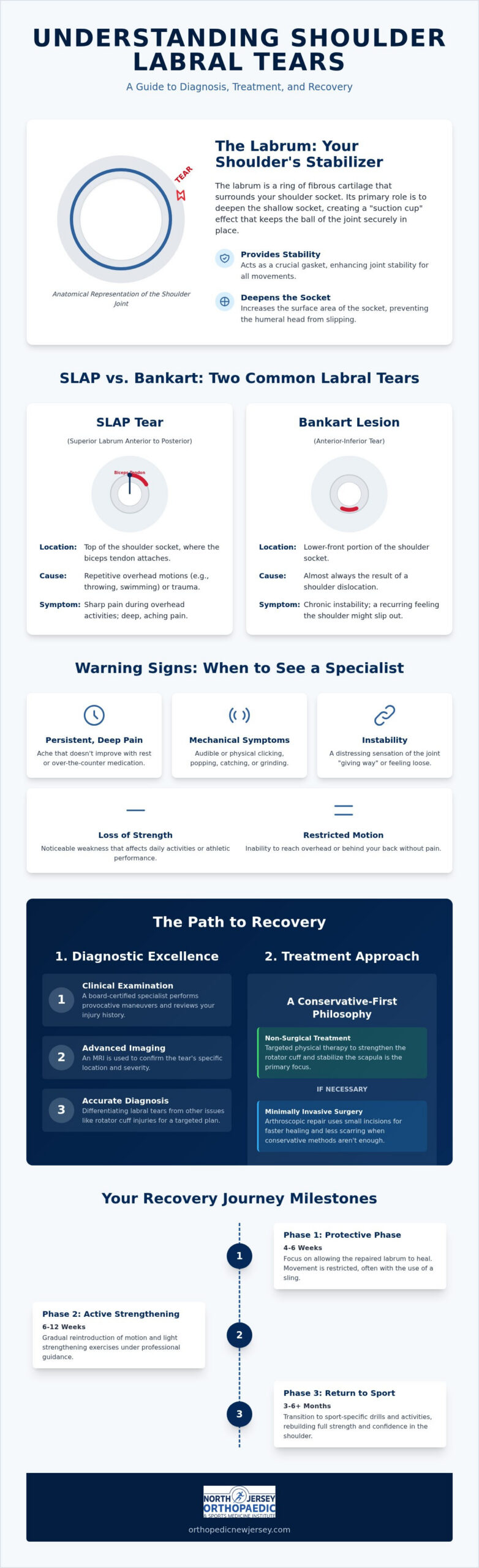
The shoulder is a ball-and-socket joint, but the socket itself is remarkably shallow. To provide necessary stability, a specialized ring of fibrous cartilage called the labrum surrounds the rim of the socket. Think of the labrum as a biological gasket or a “suction cup” that deepens the socket, ensuring the head of the humerus stays firmly centered. When this cartilage tears, that suction is compromised. This loss of integrity often leads to a feeling of “looseness” or instability that can hinder your daily activities.
For active individuals in the North Jersey area, these injuries are frequently the result of sudden trauma or repetitive stress. Whether it’s a fall onto an outstretched arm during a local hike or the cumulative wear from overhead gym routines, the damage is often felt as a deep, localized ache. Common symptoms include audible clicking, popping, and a distressing sensation of the joint “giving way” during movement. Seeking professional labral tear treatment Nutley NJ ensures that these mechanical issues are addressed before they lead to long-term joint degradation.
SLAP Tears vs. Bankart Lesions
Not every labral injury is the same. A SLAP tear (Superior Labrum from Anterior to Posterior) occurs at the top of the socket where the biceps tendon attaches to the bone. These are common among athletes who perform repetitive overhead motions, such as baseball pitchers or swimmers. In contrast, a Bankart lesion involves a tear in the lower portion of the labrum and is almost always the result of a shoulder dislocation. While SLAP injuries often present as sharp pain during overhead tasks, Bankart lesions are the primary cause of chronic instability and a recurring feeling that the shoulder might slip out of place.
Common Signs You Should See a Nutley Specialist
If your shoulder discomfort is interfering with your quality of life, it’s time to consult with a board-certified orthopedic surgeon. Look for these specific warning signs:
- Persistent, deep-seated pain that doesn’t improve with rest or standard over-the-counter anti-inflammatories.
- Mechanical symptoms such as catching, locking, or a grinding sensation when performing routine tasks.
- A noticeable loss of strength or a restricted range of motion that prevents you from reaching behind your back or overhead.
Expert care focuses on restoring the mechanical balance of the joint, preventing secondary issues like rotator cuff strain from developing over time. Accurate identification of the tear type is the first step toward a successful recovery.
Diagnostic Excellence: Identifying Your Injury in Nutley, NJ
Diagnostic precision is the cornerstone of effective orthopedic care. While many patients assume a standard scan provides all the answers, a truly accurate assessment of a Shoulder Labrum Tear begins with a comprehensive physical evaluation. A board-certified surgeon uses this clinical time to differentiate between primary labral pathology and secondary issues like rotator cuff tears or subacromial bursitis, which often present with overlapping symptoms. By reviewing your patient history, specifically the mechanism of injury, we can determine if the tear was an acute traumatic event or the result of chronic attrition. This distinction is foundational for any labral tear treatment Nutley NJ plan.
The Clinical Examination Process
The physical exam involves a series of provocative maneuvers designed to stress the labrum and reproduce your symptoms in a controlled environment. We utilize specific orthopedic tests, such as O’Brien’s active compression test and the Apprehension-Relocation test, to assess the integrity of the cartilage. Beyond just identifying pain, we evaluate shoulder laxity and muscle strength to see how the joint compensates for the injury. It’s also vital to rule out “referred” pain. In some cases, what feels like a shoulder issue actually stems from the cervical spine, requiring a different clinical focus entirely. If you’re experiencing persistent instability, scheduling a specialized shoulder evaluation is the most direct path to clarity.
Advanced Imaging in North Jersey
When clinical tests suggest a tear, we move to advanced imaging to confirm the location and severity. While a standard MRI is useful for many injuries, it can sometimes miss subtle labral defects. For Nutley patients, we often recommend an MRI Arthrogram (MRA). This process involves injecting a gadolinium-based contrast dye into the shoulder joint before the scan. The dye seeps into any tears or separations, making them highly visible on the monitor. We utilize 3T MRI technology, which offers superior resolution and signal-to-noise ratios compared to older machines. This high-definition view allows us to create a personalized treatment roadmap, ensuring that whether you need conservative management or a minimally invasive procedure, the plan is based on definitive data.
Non-Surgical Labral Tear Treatment: When Is It Enough?
At our Nutley practice, we prioritize a “Conservative First” philosophy for most shoulder injuries. While a tear is a physical disruption of the cartilage, many patients find significant relief through non-operative management. Initial labral tear treatment Nutley NJ residents receive often focuses on calming inflammation and restoring the mechanical balance of the joint. We utilize non-steroidal anti-inflammatory drugs (NSAIDs) or localized cortisone injections to manage acute symptoms, allowing you to participate more effectively in rehabilitation. For local athletes and industrial workers, activity modification is equally critical; this doesn’t mean stopping all movement, but rather avoiding the specific overhead or heavy lifting triggers that aggravate the torn tissue.
The Role of Specialized Physical Therapy
The primary goal of rehabilitation is to develop “dynamic stability.” Because the labrum can no longer provide its full “suction cup” effect, the surrounding muscles must compensate. Specialized physical therapy focuses on strengthening the rotator cuff and the scapular stabilizers to keep the humeral head centered in the socket. Patients often work through a progression of exercises, such as internal and external rotations with resistance bands and scapular “clocks” to improve posture and control. We typically recommend a dedicated course of 6 to 12 weeks of therapy. This window allows enough time to see if the shoulder can become asymptomatic through improved muscular support, as noted in resources regarding Shoulder Labral Tears Diagnosis & Treatment.
When Conservative Care Fails
While physical therapy is highly effective for many, it’s important to recognize its limitations. The labrum is a fibrocartilaginous structure with a notably poor blood supply, which means it cannot truly “heal” or reattach itself to the bone without surgical intervention. Conservative care is considered to have failed when you experience persistent night pain that prevents sleep, or if the shoulder continues to feel unstable despite improved muscle strength. Ignoring these “failed” markers can lead to long-term joint health issues, including the premature development of shoulder arthritis due to the constant micro-shifting of the joint. If your symptoms persist after a full course of therapy, it may be time to explore minimally invasive orthopedic surgery NJ options to physically repair the structural damage.
Minimally Invasive Arthroscopic Labrum Repair
When structural damage is too severe for physical therapy alone, advanced surgical intervention becomes necessary to restore the joint’s mechanical integrity. Modern labral tear treatment Nutley NJ focuses on arthroscopic techniques, which utilize high-definition cameras and specialized instruments through tiny portals. This approach significantly reduces tissue trauma compared to traditional open surgery, leading to less post-operative pain and a more efficient recovery. Most procedures are performed on an outpatient basis, allowing North Jersey patients to return home the same day to begin their healing journey in a comfortable environment.
The core objective of the procedure is to either debride (clean) frayed edges or physically reattach the torn cartilage to the glenoid bone. We utilize bio-absorbable suture anchors, which are small devices that secure the labrum back to its anatomical position. Over time, these anchors are naturally absorbed by the body as the biological bond between the cartilage and bone matures. This innovative methodology is central to our labral tear shoulder treatment philosophy, ensuring long-term stability without leaving permanent hardware in the joint.
The Arthroscopic Procedure Steps
- Step 1: Portal Creation. The surgeon introduces a high-definition arthroscope through a small incision, providing a clear view of the entire joint space.
- Step 2: Joint Preparation. We identify the exact nature of the tear and prepare the “bone bed.” This involves lightly abrading the bone to stimulate a healing response and ensure a strong bond for the reattached labrum.
- Step 3: Anchor Placement. Using specialized tools, bio-absorbable anchors are placed into the bone. High-strength sutures attached to these anchors are then looped through the labrum to “tack” it back into place.
- Step 4: Stability Verification. Before concluding, the surgeon manually tests the repair’s stability through a range of motion to ensure the joint is secure.
Surgical Innovation: SLAP vs. Bankart Repair
The technical nuances of the repair depend on the tear’s location. A SLAP repair focuses on the superior labrum, specifically where the long head of the biceps tendon attaches. We must carefully secure this “anchor point” to prevent pain during overhead activities. A Bankart repair, conversely, addresses the anterior-inferior labrum. This procedure restores the natural “bump” or bumper that prevents the humerus from slipping forward, which is critical for patients with a history of dislocations. If you’re ready to address chronic instability, it’s time to consult with our board-certified surgical team to discuss your options.
Recovery and Returning to Sport in North Jersey
Successful labral tear treatment Nutley NJ involves a disciplined, phased approach to rehabilitation. While the surgical repair physically reattaches the cartilage, the biological bond between the labrum and the glenoid bone takes several weeks to mature. During the first 4 to 6 weeks, wearing a sling is non-negotiable. This protection phase ensures that the bio-absorbable anchors and sutures aren’t stressed before the tissue has anchored itself. We coordinate closely with specialized physical therapists in Nutley and Clifton to ensure your post-operative protocol is followed with clinical precision, as the rehabilitation is just as critical as the surgery itself.
The Recovery Timeline
Recovery is a methodical progression. We monitor your milestones closely to ensure the joint is neither overstressed nor allowed to become excessively stiff. The timeline generally follows these stages:
- Weeks 0–6: Protection Phase. The primary goal is protecting the repair. You’ll engage in passive range of motion exercises where a therapist moves your arm for you, preventing scar tissue from locking the joint while the labrum heals.
- Weeks 6–12: Active Motion. You’ll begin using your own muscles to move the arm. This phase focuses on restoring a full range of motion and starting light isometric strengthening for the rotator cuff.
- Months 4–6: Functional Strengthening. This is the window for sport-specific training. We transition from general strength to the explosive or repetitive motions required for your specific activity, whether that’s pitching, swimming, or heavy bench pressing.
Why Specialized Care Matters for Nutley Athletes
Partnering with a board-certified specialist is essential for preventing “frozen shoulder,” a common complication where the joint capsule becomes pathologically tight. A guided protocol strikes the delicate balance between necessary rest and essential movement. Beyond the physical recovery, we also address the psychological aspect of returning to play. Overcoming the fear of re-injury is a major milestone, and it’s achieved through a transparent roadmap that proves your shoulder’s stability at every stage of the process. If you’re an athlete or an active adult in North Jersey, don’t let a lingering injury dictate your performance levels. Ready to get back in the game? Schedule your consultation in Nutley today.
Regain Confidence in Your Shoulder Performance
A labral tear doesn’t have to be a permanent barrier to your active lifestyle. Whether you’re managing a SLAP tear from overhead sports or instability from a Bankart lesion, the path to recovery starts with a precise diagnosis. As a board-certified orthopedic surgeon and minimally invasive specialist, we prioritize a clinical approach that respects the complex mechanics of your shoulder. By combining advanced 3T imaging with specialized labral tear treatment Nutley NJ residents can access expert care without leaving their community.
The journey from identifying your injury to completing a sport-specific strengthening program requires a dedicated partner. We are committed to providing the Nutley community with the modern surgical innovations and structured rehabilitation protocols needed for a successful return to play. If persistent pain or a feeling of instability is holding you back, it’s time to take the next step toward lasting joint health.
Schedule Your Labral Tear Consultation in Nutley with a trusted local provider today. We look forward to helping you return to the activities you love with a stable, pain-free shoulder.
Frequently Asked Questions
How do I know if my shoulder pain is a labral tear or just a strain?
A muscle strain typically involves superficial inflammation that improves with rest and anti-inflammatories over two weeks. In contrast, a labral tear often presents with mechanical symptoms like clicking, catching, or a deep, localized ache. If you feel your shoulder “slipping” during gym workouts or if the pain persists despite rest, it likely indicates a structural injury. A specialized physical exam is necessary to confirm the underlying pathology.
Can a labral tear heal on its own without surgery?
The labrum is a fibrocartilaginous structure with a very limited blood supply; it cannot biologically “knit” itself back together once torn. However, many patients achieve significant symptom relief through conservative labral tear treatment Nutley NJ residents often start with. While the tear remains, strengthening the surrounding rotator cuff muscles provides the dynamic stability needed to function without pain or the immediate need for surgical intervention in many cases.
What is the success rate for arthroscopic labral repair?
Success rates for arthroscopic repair are generally high, but timing is critical. Research indicates that patients with two or more instability episodes before a Bankart repair face a 9.7 times increased risk for recurrent instability after surgery. This is why we advocate for early intervention. Minimally invasive techniques allow for precise reattachment with lower complication rates, helping most patients return to their previous level of activity with a stable, secure joint.
How long is the recovery before I can lift weights again?
Returning to the weight room is a phased process. You’ll spend the first six weeks in a sling to protect the surgical repair. Light resistance training typically begins around the three-month mark, focusing on high-repetition, low-weight movements to rebuild muscular endurance. Most patients can safely return to heavy lifting or overhead pressing after six months of guided rehabilitation. Rushing this timeline can compromise the integrity of the bio-absorbable anchors.
Is an MRI always necessary to diagnose a labral tear?
While a skilled clinical exam can strongly suggest a tear, an MRI is usually necessary to confirm the diagnosis and plan a potential surgery. We often recommend an MRI Arthrogram, which uses contrast dye to highlight cartilage defects that a standard scan might miss. This high-resolution imaging allows us to visualize the exact location of the tear, ensuring your treatment plan is based on definitive anatomical data.
What happens if I leave a labral tear untreated?
Leaving a symptomatic tear untreated can lead to chronic shoulder instability and a higher risk of recurrent dislocations. Over time, the abnormal movement of the humeral head within the socket can cause secondary injuries, such as rotator cuff tears or early-onset arthritis. Addressing the injury early prevents these degenerative changes and preserves the long-term health of the joint, especially for active individuals who perform repetitive overhead tasks.
Do you treat athletes from Nutley High School or local colleges?
Yes, we regularly treat student-athletes from Nutley High School and surrounding colleges in Clifton and Bloomfield. Our practice is deeply rooted in the North Jersey community, providing specialized sports medicine care that addresses the unique demands of competitive athletics. We understand the pressures of the collegiate and high school seasons, and we work closely with local trainers to ensure every athlete receives a medically sound, efficient roadmap for recovery.
Will I need physical therapy even if I don’t have surgery?
Physical therapy is the cornerstone of non-surgical management. Even without a procedure, you must strengthen the rotator cuff and scapular stabilizers to compensate for the lost stability of the labrum. This “dynamic stability” is what allows you to remain asymptomatic during daily activities. Most patients require 6 to 12 weeks of structured therapy to achieve lasting results and avoid the progression of symptoms that might eventually require surgical repair.