Could an ACL tear still qualify for repair if the injury wasn’t recent? If you’re researching BEAR implant eligibility criteria Nutley NJ, you may want a clear answer about your tear pattern, age, and timing. These factors matter, but an online checklist can’t show whether the remaining ACL tissue is suitable for repair.
BEAR candidacy generally depends on confirming a partial or complete ACL tear and assessing whether enough ligament tissue remains attached to the tibia. Age and time since injury aren’t automatic exclusions under current indications, although skeletal maturity and tissue quality can affect a surgeon’s assessment. Be sure to disclose any allergy to bovine-derived products.
This checklist covers the main considerations and what an individualized orthopedic evaluation can clarify. You’ll also find which records to bring, questions to ask, and how a consultation in Nutley can help you understand whether BEAR Implant ACL repair may be an option for you.
Key Takeaways
- BEAR candidacy requires an individualized review; symptoms alone can’t establish whether repair is appropriate.
- The BEAR implant eligibility criteria Nutley NJ evaluation considers include tear pattern, remaining ACL tissue, skeletal maturity, and injury timing.
- BEAR repair isn’t the right option for every ACL tear. A surgeon can compare repair and reconstruction based on your clinical findings.
- Gather available MRI reports and images, details of prior treatment, and questions about your goals before an orthopedic consultation.
- A specialist evaluation in Nutley can help clarify your treatment options and whether BEAR Implant ACL repair may suit your injury.
BEAR Implant Eligibility in Nutley, NJ: What the Checklist Can, and Cannot, Tell You
A checklist can help you prepare for a treatment discussion, but it can’t determine whether your ACL is suitable for repair. The BEAR implant eligibility criteria Nutley NJ patients may find online are general screening considerations. A surgeon needs to assess your specific injury, imaging, and medical history before recommending an option.
What the BEAR Implant is designed to support
BEAR stands for bridge-enhanced ACL repair. The BEAR Implant is a collagen scaffold placed between the torn ends of the anterior cruciate ligament (ACL). Used with the patient’s blood, it helps create a bridge intended to support the body’s healing response. It doesn’t replace a careful surgical assessment or guarantee a particular result.
BEAR repair differs from ACL reconstruction, which typically uses a graft to replace the torn ligament. The choice depends on the injury and patient-specific factors, not on a claim that one procedure is best for everyone. For a focused explanation of the procedure, read the BEAR ACL repair overview. Patients comparing surgical approaches can also review this background on anterior cruciate ligament reconstruction.
Why an online checklist cannot confirm candidacy
Pain, swelling, or a feeling of instability can occur with an ACL injury, but symptoms don’t show whether the remaining ligament tissue is appropriate for BEAR repair. Under current indications, the tear and its anatomy must be evaluated. MRI findings, a physical examination, and relevant medical history all contribute to the decision.
Two people with similar symptoms may have different treatment options. Their tear patterns, remaining ligament tissue, other knee injuries, or health considerations may differ. An MRI report is only one part of the picture. The orthopedic surgeon interprets it alongside examination findings and the patient’s goals.
Use online information to organize questions, not to diagnose yourself or decide whether you qualify. A consultation with a board-certified orthopedic surgeon in Nutley can help clarify what the available findings show and whether BEAR repair or another approach merits discussion. The checklist is a starting point; the recommendation is individualized.
Which BEAR Implant Eligibility Factors Does a Surgeon Assess?
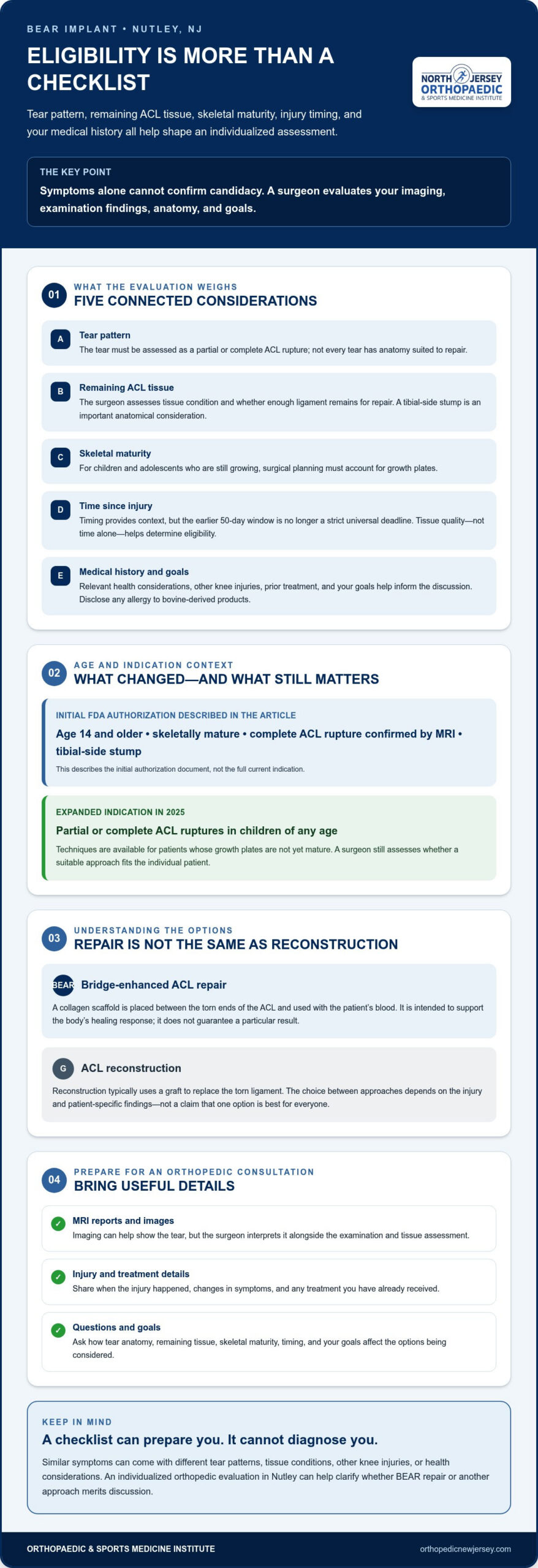
BEAR candidacy depends on more than age or the date of injury. A surgeon considers the tear pattern, condition and location of the remaining ACL tissue, skeletal maturity, time since injury, imaging, examination findings, and relevant medical history. The BEAR implant eligibility criteria Nutley NJ patients encounter online can help orient them, but current device labeling and a surgeon’s assessment guide an individual decision.
Tear pattern and remaining ACL tissue
The BEAR Implant is indicated for partial or complete ACL ruptures, but not every tear has anatomy suited to repair. The surgeon assesses whether the remaining ligament tissue can be used in the repair. One key anatomical consideration is whether an ACL stump remains attached to the tibia, the lower leg bone. MRI can help show the tear, but imaging alone can’t establish tissue quality or suitability. The surgeon interprets it alongside the clinical examination.
The FDA’s initial approval document for the BEAR Implant describes the original indication, including patients aged 14 and older who were skeletally mature and had a complete ACL rupture confirmed by MRI with a tibial-side stump. That document reflects the initial authorization, not the full current indication. The indication was expanded in 2025 to include partial or complete ACL ruptures in children of any age, with techniques for patients whose growth plates are not yet mature.
Age, skeletal maturity, and injury timing
Age alone doesn’t determine eligibility under the expanded indication. For children and adolescents who are still growing, skeletal maturity matters because surgical planning must account for growth plates. The surgeon can explain whether a technique appropriate to the patient’s stage of development is available and suitable.
Timing also needs context. The earlier 50-day window is no longer a strict universal deadline. According to the manufacturer, real-world experience indicates that ACL tissue quality, rather than time alone, determines eligibility. Still, time since injury can affect what the surgeon finds. Share the injury date and any changes in symptoms or treatment. Don’t assume that a delay automatically rules out repair or that an early evaluation guarantees eligibility.
Bring these details to a consultation so a specialist can review your anatomy and options. Patients in Nutley can learn about an orthopedic evaluation through the Nutley orthopedic practice.
When Might BEAR Repair Not Be the Best ACL Option?
A confirmed ACL tear doesn’t automatically make someone a candidate for BEAR repair. The surgeon needs to determine whether the ligament tissue and overall knee findings support this approach, and whether another treatment better fits the patient’s clinical picture. The BEAR implant eligibility criteria Nutley NJ patients find online are a starting point, not a personalized recommendation.
Factors that may lead a surgeon to discuss another approach
If the remaining ACL tissue isn’t suitable for repair, the surgeon may discuss reconstruction or another treatment plan. A known allergy to bovine-derived products is a contraindication because the implant is made from bovine collagen. Other knee injuries, medical history, and examination findings may also shape the recommendation. Their importance varies by patient, so they shouldn’t be treated as automatic exclusions without a clinical review.
Be cautious when reading eligibility details from older studies. The BEAR III trial eligibility criteria describe who could enroll in that particular study, not a universal current rule for every patient. For example, a study’s injury-timing limit shouldn’t be interpreted as a current deadline for BEAR repair. Current device labeling and a surgeon’s assessment are more relevant to an individual treatment discussion.
BEAR repair and ACL reconstruction are different options
BEAR is designed to support repair of the patient’s native ACL tissue. Reconstruction replaces the damaged ligament using graft tissue. Neither approach is universally best. The surgeon weighs anatomy, associated injuries, individual health factors, and treatment goals before discussing the available options.
| Decision factor | What the surgeon evaluates |
|---|---|
| ACL tissue and tear pattern | Whether the remaining ligament can support repair, based on imaging and examination. |
| Other knee injuries | Whether additional findings affect the overall treatment plan. |
| Medical history | Relevant conditions or allergies, including allergy to bovine-derived products. |
| Treatment approach | Whether repair, reconstruction, or another option is appropriate for the clinical findings. |
Use this comparison to guide a discussion, not to choose surgery independently. A specialist can explain how the findings apply to your knee and why each option may or may not be appropriate. To discuss BEAR repair and ACL treatment options, consider an orthopedic consultation in Nutley with The Orthopaedic & Sports Medicine Institute.
BEAR Implant Eligibility Checklist: What to Prepare Before a Nutley Consultation
Preparing for an orthopedic consultation can make the discussion more focused. Your records and notes give the surgeon context for reviewing your injury, but they can’t predict whether BEAR repair is appropriate. The BEAR implant eligibility criteria Nutley NJ patients are researching still need to be considered alongside an individual examination and clinical judgment.
Records and injury details to bring
Gather the records you already have. Don’t arrange new imaging unless a clinician recommends it. If available, bring:
- MRI materials: The written report and imaging files, such as a disc or access instructions for the imaging portal.
- Injury timeline: When and how the injury happened, what you noticed afterward, and whether your symptoms have changed.
- Treatment history: Details of care you’ve received for this injury, including activity changes, bracing, or other treatment.
- Health information: A current medication list, relevant medical conditions, and known allergies, especially to bovine-derived products.
If you can’t locate a report or imaging file, note where and when the scan was performed. The office can advise whether those records are available for review. A clear account of the injury and care to date can help the surgeon interpret the findings in context.
Questions to ask the orthopedic surgeon
Writing down questions ahead of time can help you leave with a clearer understanding of the recommendation. Consider asking:
- Which examination and imaging findings are most relevant to my BEAR candidacy?
- What does my MRI show about the tear and remaining ACL tissue?
- If BEAR repair isn’t recommended, what other treatment options may fit my findings, and why?
- What risks and uncertainties should I understand before deciding?
- What would recovery and rehabilitation involve for the recommended procedure?
- What are the next steps, including any additional assessment or records needed?
Ask the surgeon to explain unfamiliar terms and how each finding affects the options under consideration. If rehabilitation is part of the discussion, ask how the plan is tailored to the procedure and your progress rather than relying on a general timeline found online.
This checklist is a preparation tool, not a self-screening test. To review your injury records and discuss BEAR Implant ACL repair with an orthopedic specialist, arrange a Nutley orthopedic consultation.
How to Seek a BEAR Implant Evaluation Near Nutley, NJ
For patients considering BEAR repair, a specialist consultation is a practical next step toward understanding whether the procedure may be appropriate. The Orthopaedic & Sports Medicine Institute provides specialized orthopedic care in Nutley, including BEAR Implant ACL repair. Its board-certified surgeon treats knee injuries and can discuss options based on your individual findings.
What an individualized evaluation can clarify
An orthopedic assessment may include reviewing how and when the injury occurred, examining the knee, and considering available MRI images and reports. The surgeon uses this information to assess the ACL injury and determine which options warrant discussion. If your existing records don’t provide enough information, ask whether further assessment is appropriate. The evaluation process depends on your clinical situation.
A consultation can help you understand whether BEAR repair may be considered and which alternatives may fit your findings. It’s also an opportunity to discuss relevant health factors, potential risks, rehabilitation, and the questions that matter to you. General information about the procedure is available in this BEAR ACL repair overview. Reading about the treatment can help you prepare, but it can’t confirm candidacy or replace a surgeon’s assessment.
Take the next step in Nutley
If you live in Nutley or a nearby North Jersey community, bring any existing imaging and reports, a medication list, and notes about your injury and prior care. You don’t need to decide on a procedure before the appointment. The goal is to understand what your examination and records show and discuss appropriate options.
The BEAR implant eligibility criteria Nutley NJ patients find online can help frame that conversation, but an individualized evaluation is needed to assess your anatomy and treatment choices. Discuss candidacy and procedure availability directly with the practice, and contact your insurer about coverage as relevant. An online checklist can’t determine the answer.
To discuss your knee injury and request an orthopedic consultation, contact the practice about a BEAR Implant evaluation.
Take the Next Step Toward Clarity
BEAR candidacy depends on more than symptoms or a checklist. Tear pattern, remaining ACL tissue, skeletal maturity, timing, and other clinical findings all help shape the surgeon’s recommendation. Online information can prepare you for the discussion, but it can’t confirm whether repair is right for your knee.
If you’re weighing the BEAR implant eligibility criteria Nutley NJ patients commonly ask about, bring any available imaging, reports, and treatment history to an orthopedic consultation. The Orthopaedic & Sports Medicine Institute provides specialized orthopedic care in Nutley and offers BEAR Implant ACL repair. A board-certified surgeon treats knee and sports injuries and can review your findings with you.
For an individualized discussion of your injury and possible options, contact the practice to discuss a BEAR Implant evaluation. A clear conversation with a specialist can help you decide on your next step.
Frequently Asked Questions
Who is eligible for the BEAR Implant?
People with a partial or complete ACL rupture may be considered, but eligibility depends on the ligament’s anatomy and a surgeon’s evaluation. The remaining ACL tissue must be suitable for repair. The surgeon reviews imaging, examination findings, medical history, and other knee injuries. A known allergy to bovine-derived products is a contraindication because the implant is made from bovine collagen. An orthopedic assessment is needed to determine whether BEAR is appropriate for you.
Does a BEAR Implant require a specific type of ACL tear?
BEAR is indicated for partial or complete ACL ruptures, but not every tear pattern is suitable for repair. The surgeon assesses the location and condition of the remaining ligament, including whether an ACL stump remains attached to the tibia. MRI can help identify the tear, while the examination and clinical judgment help determine whether the tissue can support repair. Tear type alone doesn’t confirm candidacy.
Is there an age or skeletal-maturity requirement for BEAR surgery?
Current indications include adults, adolescents, and children with partial or complete ACL ruptures. Age alone doesn’t decide whether someone is a candidate. For children who haven’t reached skeletal maturity, surgical planning needs to account for growing bones and growth plates. The surgeon considers the patient’s development and injury anatomy when discussing whether BEAR or another treatment is appropriate. Ask how skeletal maturity affects the options in your specific case.
How soon after an ACL tear must BEAR surgery be considered?
There isn’t a universal 50-day deadline under current guidance. Earlier timing rules came from initial criteria, while current candidacy assessment places importance on ACL tissue quality rather than time alone. Still, tell the surgeon when the injury happened and describe any treatment or changes since then. A delay doesn’t automatically rule out BEAR, and an early assessment doesn’t guarantee eligibility. The surgeon must evaluate your current injury.
Can an MRI show whether I qualify for the BEAR Implant?
An MRI can help confirm an ACL tear and show relevant knee anatomy, but it can’t independently establish eligibility. The surgeon interprets the images alongside a physical examination, injury history, and medical information. Tissue condition and other findings may require clinical judgment beyond the written imaging report. Bring both the MRI report and image files to your appointment if available, and ask how each finding affects your treatment options.
What happens if I am not eligible for BEAR ACL repair?
If BEAR isn’t recommended, the surgeon can explain why and discuss other clinically appropriate options, which may include ACL reconstruction. The recommendation depends on your ligament anatomy, associated knee injuries, medical history, and treatment goals. Not being suited to one procedure doesn’t mean you have no treatment options. Ask the surgeon to compare the approaches, explain their risks, and outline what recovery and rehabilitation may involve for the option being considered.
Can I get a BEAR Implant evaluation in Nutley, NJ?
Yes. The Orthopaedic & Sports Medicine Institute provides specialized orthopedic care in Nutley and offers BEAR Implant ACL repair. A board-certified surgeon treats knee injuries and can discuss an orthopedic evaluation. Patients in nearby Bloomfield, Clifton, Belleville, Lyndhurst, North Arlington, Kearny, and Verona can contact the practice to ask about reviewing their injury, available imaging, and treatment options. An evaluation is needed to determine individual candidacy.