


Recurring knee pain is not a training problem to solve by guesswork. If you’re searching for a “knee pain when running specialist Nutley NJ,” you may be trying to work out whether the discomfort is a temporary response to activity or a sign that your knee needs closer evaluation. Changing your pace, shoes, or route may affect how your knee feels, but those adjustments can’t reliably identify the cause.
An orthopedic assessment can help clarify what may be contributing to your pain and guide appropriate next steps. Running-related knee symptoms have different possible causes, and a board-certified orthopedic surgeon who treats knee injuries can evaluate your symptoms in context. An evaluation does not mean surgery is necessary. Recommendations depend on the findings and your needs.
This article covers common reasons knee pain may occur during or after a run, signs that specialist care may be appropriate, and what to expect from an orthopedic evaluation in Nutley. You’ll also find practical details to bring to a consultation, such as when the pain began, what activities trigger it, and how it affects running or daily routines. The goal is to help you choose an informed next step, not diagnose yourself.
Key Takeaways
- Track where knee pain occurs and when it starts. These details can guide an assessment, but they can’t confirm a diagnosis on their own.
- Training changes, running mechanics, and tissue irritation may contribute to symptoms, so consider the full context rather than relying on self-assessment.
- Recurring or activity-limiting pain is a reason to consider specialist evaluation. An evaluation doesn’t automatically mean surgery.
- Before an appointment, note your symptoms, recent activity changes, and how the pain affects running and daily tasks.
- A knee pain when running specialist Nutley NJ can assess knee symptoms and discuss appropriate next steps based on the findings.
Knee Pain When Running: What the Location and Timing May Tell You
Recurring knee pain can interrupt training, affect how you move through the day, and leave you unsure whether to rest or seek help. The location and timing of discomfort are useful clues, but they can’t identify the cause by themselves. Several knee conditions can produce similar symptoms, so treat these patterns as details to share, not a way to diagnose yourself.
Where does running-related knee pain occur?
Notice whether discomfort is at the front of the knee, along the inner or outer side, or behind the joint. Front-of-knee pain, for example, can occur with patellofemoral pain syndrome, also known as runner’s knee, but that location alone doesn’t confirm the condition. Pain at the side or back of the knee can also have multiple explanations. An examination considers the whole picture, not just where it hurts.
Does pain during a run differ from pain afterward?
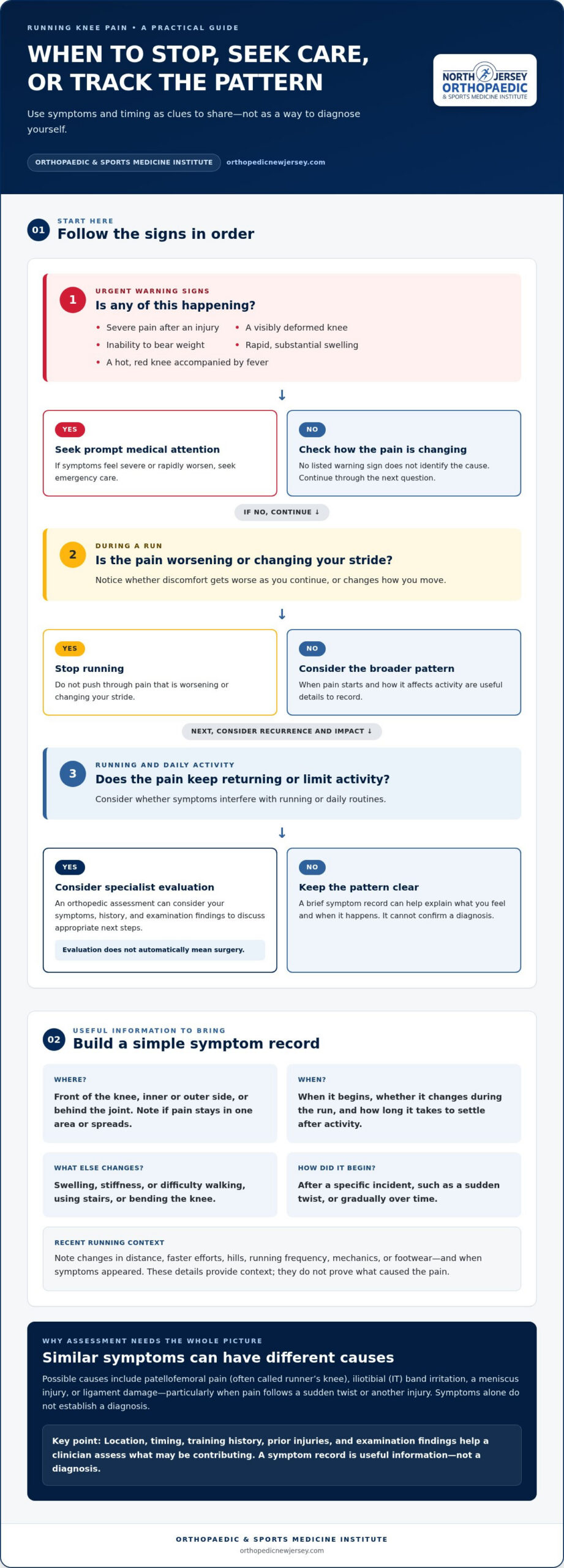
Record when discomfort begins, whether it changes as you continue, and how long it takes to settle after activity. Also note swelling, stiffness, or changes in how you walk. These details help describe how your knee responds to activity and whether symptoms affect daily function. A pattern across several runs is more informative than guessing at a diagnosis based on one run.
A brief record can make the pattern easier to explain. Include:
- Where the pain is and whether it stays in one area or spreads.
- When it starts, what makes it better or worse, and when it settles.
- Any swelling, stiffness, or difficulty walking, using stairs, or bending the knee.
- Whether the symptoms followed a specific incident or appeared gradually.
Stop running rather than pushing through pain that is worsening or changing your stride. Seek prompt medical attention for severe pain after an injury, a visibly deformed knee, inability to bear weight, or rapid, substantial swelling. A hot, red knee accompanied by fever also needs urgent assessment. If symptoms feel severe or rapidly worsen, seek emergency care. These signs don’t identify a particular injury, but they warrant timely professional evaluation.
For runners searching for a knee pain when running specialist Nutley NJ, a clear account of symptom location and timing can make an orthopedic assessment more informative. A specialist can consider those observations alongside your medical history and an examination to clarify possible causes and discuss next steps. Your notes don’t need to be exact or technical. Straightforward descriptions of what you feel and when it happens are a useful place to start.
Common Causes of Knee Pain When Running, and Why Symptoms Need Context
Knee pain during or after a run is a symptom, not a diagnosis. The same ache may have different explanations, and one condition can feel different from one runner to another. Training history, symptom location and timing, prior injuries, and examination findings all help a clinician assess what may be contributing.
Possible causes include patellofemoral pain, often called runner’s knee, and irritation involving the iliotibial (IT) band. Other possibilities include a meniscus injury or damage to a ligament, particularly when pain follows a sudden twist or another injury. These conditions are not interchangeable, and recognizing a name from a symptom description doesn’t establish that it’s the cause. For an overview of one common source of front-of-knee pain, see information from Johns Hopkins Medicine on runner’s knee.
How training changes and mechanics can affect the knee
Recent changes can provide useful context. You may have increased your distance, added faster efforts or hills, or started running more often. A change in running mechanics may also be relevant, but neither training nor form alone proves why pain developed. Footwear is another detail to discuss, not an automatic explanation. An individualized assessment considers these factors alongside your symptoms and physical findings.
When reviewing your recent running, note what changed and when symptoms appeared. For example, you might report that discomfort began after adding hill sessions, or that it occurs during longer runs but not shorter ones. That timing can help guide questions during an evaluation. It doesn’t confirm that the hill work or distance caused an injury, and it shouldn’t be used to assign blame to your form or shoes.
When an injury may need closer assessment
Swelling, a feeling that the knee may give way, locking or difficulty straightening it, and pain that begins suddenly after an incident can change the clinical picture. These signs don’t establish a meniscus or ligament injury, but they make the onset and the knee’s function especially important to describe. A clinician can use your history and examination to decide whether further testing is appropriate.
Symptom description is not diagnosis: pain, swelling, instability, and locking can guide an evaluation, but none confirms a specific injury without clinical assessment. The same caution applies when symptoms seem to match a condition you’ve read about online.
If symptoms keep returning or interfere with running and daily activity, a knee pain when running specialist Nutley NJ can assess your knee in context and discuss appropriate next steps. The Orthopaedic & Sports Medicine Institute provides specialized orthopedic and sports injury care in Nutley, where a board-certified surgeon treats knee injuries and uses minimally invasive techniques. Learn about an orthopedic assessment in Nutley as a step toward clarifying what may be causing your symptoms. An evaluation does not mean surgery is necessary.
When to See a Knee Pain Specialist for Running Symptoms in Nutley, NJ
It can be difficult to decide whether to keep adjusting your training or seek an evaluation, especially when knee pain comes and goes. Consider an orthopedic assessment if symptoms keep returning, are getting worse, or interfere with running, walking, stairs, or other usual activities. You don’t need to wait for a set number of days or weeks if pain is limiting your function or causing concern.
Signs it may be time to schedule an orthopedic evaluation
A specialist visit can help clarify possible causes and guide next steps. It doesn’t automatically mean surgery. Recommendations depend on your symptoms, examination, and individual situation. Seek prompt medical attention after a significant injury, particularly if you can’t bear weight, the knee is rapidly swelling, appears deformed, or locks and won’t straighten. A hot, red knee with fever also warrants prompt assessment. If symptoms are severe or rapidly worsening, seek emergency care.
For less urgent but recurring symptoms, consider arranging an evaluation rather than repeatedly testing the knee with runs that bring the pain back. This can be especially helpful when discomfort changes your stride or makes daily movement harder. A knee pain when running specialist Nutley NJ can assess your symptoms and discuss appropriate options without presuming surgery is needed. Runners in Nutley, Bloomfield, Clifton, Belleville, Lyndhurst, North Arlington, Kearny, and Verona can access local orthopedic care when symptoms persist or affect everyday function.
What happens during an orthopedic knee assessment?
The evaluation typically begins with a discussion of how symptoms started, what activities affect them, your recent training, prior injuries, and which movements or daily tasks are difficult. Share changes you’ve noticed, such as swelling, stiffness, or a feeling that the knee is unstable. Relevant medical records and prior imaging reports can add useful background, and the clinician will consider them alongside your current symptoms.
A physical examination helps assess knee movement and function. Depending on your situation, the clinician may examine how the knee bends and straightens and assess areas of tenderness or stability. No single finding necessarily explains every symptom, so your history and examination are considered together. Imaging isn’t automatic. Whether it’s useful depends on the clinical findings and your individual circumstances. The goal is to clarify what may be contributing to the pain and determine whether further assessment or care is appropriate.
Before leaving, make sure you understand the recommended next steps and what changes in your symptoms should prompt follow-up. An evaluation helps you make decisions with more complete information; it is not a commitment to a particular treatment. For runners in Nutley, Bloomfield, Clifton, and Belleville, specialized orthopedic care provides a local way to assess knee symptoms and discuss options based on the findings.
What to Do Before Your Knee Pain Specialist Appointment
A little preparation can make an orthopedic consultation more focused. You don’t need to arrive with a suspected diagnosis. Bring a clear account of what you’ve noticed, what has changed, and how your knee affects activities that matter to you. This information helps the specialist understand your concerns and discuss appropriate next steps.
Information to bring to the consultation
Gather relevant details before your visit, even if your notes are brief. Include prior knee injuries, treatments you’ve tried, and any existing imaging reports or medical records you can access. Describe symptoms in everyday language rather than trying to label the condition.
- Symptom pattern: Note where the pain occurs, when it begins, and whether it settles during rest or returns with activity.
- Training and daily function: Record recent changes in running distance, intensity, hills, or frequency, along with effects on walking, stairs, or other routine tasks.
- Relevant history: List previous knee injuries, treatment, and any imaging or clinical evaluations related to the current concern.
- Questions: Ask what the examination suggests, whether further testing may help, what care options are appropriate, and how to make activity decisions while symptoms are present.
Existing reports can provide helpful context, but they don’t replace a current assessment. If you don’t have copies, note where and when earlier imaging or treatment took place, if you remember. The goal is to give the specialist a useful overview, not to assemble a complete medical file on your own.
How to think about running while symptoms are present
There isn’t one return-to-running schedule that fits every knee problem. Avoid pushing through pain that is worsening or changing how you move. Pay attention to pain, swelling, and how well the knee functions, and discuss those changes with a clinician. If symptoms persist or worsen, seek individualized medical guidance rather than relying on a generic online exercise plan.
Until you’ve received guidance, make activity decisions cautiously and note how your knee responds to ordinary movement. You can ask which activities are appropriate for your situation and what changes should prompt follow-up. Don’t treat temporary improvement as proof that the underlying issue has resolved, especially if symptoms return when you resume running.
After an evaluation, the clinician can explain whether further testing or treatment options may be appropriate. If minimally invasive approaches are part of that discussion, this minimally invasive orthopedic surgery guide offers related context. Learning about an option doesn’t mean it’s recommended for you. Decisions should reflect your assessment and individual needs.
If recurring knee symptoms are affecting your training or daily activities, schedule an orthopedic evaluation to discuss your concerns and possible next steps.
Meet With a Knee Pain Specialist in Nutley, NJ
Recurring knee pain can make it difficult to know how to proceed with running. A specialist assessment can help clarify possible causes and bring the next steps into focus. The Orthopaedic & Sports Medicine Institute provides specialized orthopedic and sports injury care in Nutley, New Jersey, including evaluation and treatment of knee injuries.
A specialist-led approach to running-related knee pain
An evaluation draws on your symptom history and a physical examination. Details such as when the discomfort began, what activities affect it, and how the knee functions help the clinician consider possible explanations. The findings guide a discussion of care options suited to your situation. A visit is an opportunity to understand the clinical picture, not a commitment to surgery.
The institute’s board-certified surgeon treats knee injuries and uses minimally invasive techniques. Whether a particular technique is relevant depends on the diagnosis, symptoms, examination findings, and clinical judgment. Minimally invasive approaches don’t guarantee a particular result or recovery timeline. The goal is to consider the available options in light of your individual needs and make an informed plan together.
It’s reasonable to ask how the assessment informs the recommendation, what alternatives may be appropriate, and how your symptoms should shape activity decisions. Clear answers can help you understand why a particular next step is being considered. If further evaluation is appropriate, the clinician can explain its role in clarifying the diagnosis.
Local orthopedic care for Nutley and nearby communities
For runners in Nutley and nearby communities, including Bloomfield, Clifton, Belleville, Lyndhurst, North Arlington, Kearny, and Verona, specialized orthopedic care offers a local setting to discuss persistent or recurrent knee symptoms. If you’re searching for a knee pain when running specialist Nutley NJ, focus on an assessment that considers your symptoms and function rather than assuming a specific injury or treatment is already determined.
Every runner’s situation is different. A careful evaluation can help distinguish what is known from what still needs assessment, then guide a discussion of reasonable options. Surgery isn’t inevitable, and treatment recommendations depend on the findings and your circumstances. Explore orthopedic care in Nutley to learn more about the institute and take an informed next step for your knee concerns.
Take the Next Step Toward Clearer Answers
Knee pain doesn’t have to leave you guessing about every run. A thoughtful evaluation can help clarify what may be affecting your knee and which next steps fit your needs. Use that discussion to make informed choices without assuming that one specific treatment, or surgery, is inevitable.
If you’re searching for a knee pain when running specialist Nutley NJ, consider moving from online research to a personalized assessment. The right plan depends on your symptoms and clinical findings, and your questions and running goals belong in that conversation. Explore orthopedic care in Nutley to take a measured next step toward understanding your knee pain.
Frequently Asked Questions
Can running shoes cause knee pain?
Footwear may be one factor in knee discomfort, but shoes alone can’t establish its cause. A change in training load, individual biomechanics, or an injury may also contribute, sometimes in combination. For example, pain that starts after both a shoe change and a sudden increase in running doesn’t prove either change is responsible. If symptoms persist, recur, or limit activity, seek an evaluation rather than relying on a shoe change as the solution.
Does running downhill put more stress on the knees?
Downhill running changes the demands placed on your legs and may aggravate symptoms for some runners. That response doesn’t identify the underlying cause of knee pain. Note whether discomfort appears on descents, during uphill running, or on flat ground, and share the pattern during an assessment. If pain is significant or persistent, don’t rely on changing your route or training as a substitute for individualized medical guidance.
Can running form contribute to knee pain?
Movement patterns may be one part of understanding knee pain, but running form shouldn’t automatically be assumed to be the cause. Symptoms can have several contributors, including training changes or injury, and a gait adjustment isn’t a guaranteed fix. Rather than making a major form change on your own, note what you were doing when pain began and whether it returns during particular movements. Seek individualized guidance if it continues.
Will I need an MRI for knee pain when running?
No, an MRI isn’t automatically needed for every runner with knee pain. A clinician considers your history and physical examination to decide whether imaging could help answer a specific clinical question. The appropriate test depends on your presentation, including how symptoms began and what the examination shows. An MRI is one piece of information, not a complete assessment by itself. A knee pain when running specialist in Nutley, NJ can explain the reasoning for any recommended imaging.
Can knee pain from running go away on its own?
Some knee symptoms may improve, but improvement doesn’t establish the cause or rule out an injury. Pay attention to whether discomfort returns as you resume activity or starts affecting routine tasks such as walking or using stairs. Seek medical guidance if pain recurs, worsens, limits activity, or follows a significant injury. There’s no universal waiting period that suits every situation, so don’t delay care when symptoms are concerning.
Is knee pain after running different from pain during a run?
The timing can help describe the problem, but it can’t diagnose a condition by itself. Note whether discomfort starts while running, appears after you stop, or is noticeable later during ordinary activities, such as walking around your home. If you run in Nutley, Bloomfield, Clifton, Belleville, or nearby communities, bring that pattern to an orthopedic assessment if symptoms recur or interfere with function. Clear details help guide the conversation.


