


What if the right next step for an injury depends less on the sport you play and more on how pain affects your everyday life? If discomfort or reduced movement is disrupting exercise, work, or routine activities, it can be hard to know whether specialist care would help. A sports medicine doctor North Arlington NJ can evaluate a sports-related injury and help clarify what may be contributing to your symptoms.
It’s reasonable to want expert guidance close to home and a clear explanation of your options. At The Orthopaedic & Sports Medicine Institute in nearby Nutley, orthopedic sports injury care focuses on the injury, your activity level, and your recovery goals.
This article covers conditions sports medicine care may address, what to expect during an orthopedic evaluation, and how treatment planning can reflect your needs. You’ll also find practical ways to prepare for an appointment and take the next step toward understanding your injury.
Key Takeaways
- Persistent, recurring, or function-limiting pain may warrant a sports injury evaluation, particularly when it affects everyday movement.
- A sports medicine doctor North Arlington NJ can consider your symptoms, activity demands, and clinical findings to help clarify what may be causing the problem.
- Treatment recommendations depend on the diagnosis, your health, and your goals. Nonsurgical care or surgical evaluation may be considered where appropriate.
- Prepare by noting when symptoms began, which movements are difficult, any prior injuries, and what care you’ve already tried.
- The Orthopaedic & Sports Medicine Institute in Nutley provides orthopedic care for North Arlington and nearby communities, including Bloomfield, Clifton, Belleville, Lyndhurst, Kearny, and Verona.
When to See a Sports Medicine Doctor Near North Arlington, NJ
An injury can affect more than a workout. A knee that aches on stairs, a shoulder that limits reaching, or a tendon injury that makes work uncomfortable can disrupt training, recreation, and daily movement. If symptoms persist, repeatedly return when you resume activity, or keep you from your usual tasks, an orthopedic sports injury evaluation can help clarify what may be happening.
Sports medicine care isn’t only for competitive athletes. It may also be relevant to active adults, recreational players, and people whose work or routines involve regular physical demands. Sports medicine addresses activity-related health concerns, while orthopedic care focuses on the musculoskeletal system, including joints, bones, and tendons. Orthopedic sports medicine connects the effect an injury has on movement with an individualized assessment and care plan.
If you’re searching for a sports medicine doctor North Arlington NJ, a nearby specialist can help you understand your symptoms and discuss next steps. The Orthopaedic & Sports Medicine Institute in Nutley provides orthopedic and sports injury care for people from North Arlington, Bloomfield, Clifton, Belleville, Lyndhurst, Kearny, and Verona.
Which injuries and symptoms can an orthopedic sports medicine doctor assess?
The Institute treats knee, shoulder, and tendon injuries. Symptoms vary, and no single symptom identifies a specific injury. Pain may make running, lifting, reaching, or changing direction difficult. Weakness, restricted movement, or trouble returning to a familiar activity can also affect function. An evaluation considers these limitations alongside when and how they occur, rather than assuming that one symptom points to one diagnosis.
For example, a recreational player may notice shoulder discomfort while serving, or a runner may find that knee pain returns each time they restart a routine. The activity provides useful context, but assessment also depends on the person’s symptoms and clinical findings. An orthopedic sports medicine doctor evaluates the individual, not just the sport or movement.
When is specialist evaluation more useful than waiting it out?
A brief ache that settles as activity changes may not affect daily function. Ongoing or recurring symptoms deserve closer attention, especially if they repeatedly interrupt participation. Consider an assessment if discomfort returns, movement remains limited, or you’re changing ordinary tasks to work around the problem. A decline in function is a practical reason to seek an individual evaluation instead of continuing to guess at the cause.
A specialist can review how symptoms developed, which activities bring them on, and how they affect your goals. That conversation helps guide appropriate next steps. It doesn’t mean surgery is inevitable or that a particular treatment is guaranteed. If an injury is sudden and severe, or you’re concerned it needs immediate attention, seek urgent or emergency medical care. A routine orthopedic appointment is for evaluation and planning, not emergency response.
How a Sports Injury Evaluation Connects Symptoms to a Diagnosis
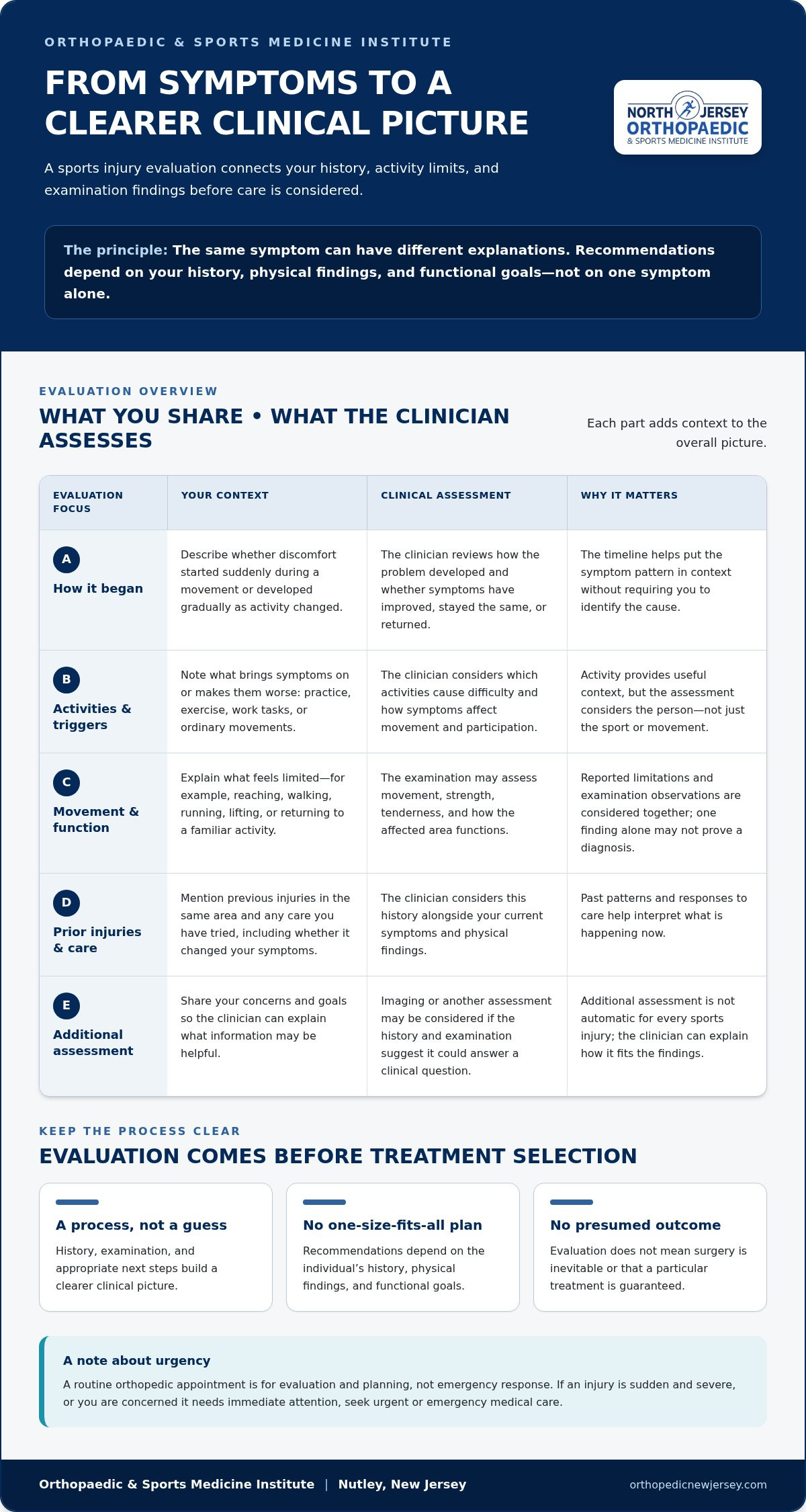
An orthopedic evaluation is a process, not a guess based on one symptom. The clinician learns how the problem developed and how it affects activity, examines the affected area, and considers appropriate next steps. Each part adds context. Pain during a particular movement, for example, matters alongside when it began, whether it is changing, and what the examination shows.
Knowing what to expect can make an appointment with a sports medicine doctor North Arlington NJ more purposeful. Evaluation comes before treatment selection because the same symptom can have different explanations. Recommendations depend on the individual’s history, physical findings, and functional goals. The aim is to build a clearer clinical picture, not to presume a specific injury or treatment.
What information helps explain a sports injury?
Before the examination, be ready to describe the timeline and circumstances. Did discomfort begin suddenly during a particular movement, or develop gradually as your activity changed? Has it improved, stayed the same, or returned after easing? Clear details help the clinician understand the pattern without requiring you to identify the cause.
Explain what makes symptoms worse or limits movement. Note whether the difficulty appears during practice, exercise, work tasks, or ordinary motions such as reaching or walking. Mention previous injuries in the same area and treatments you have tried, including whether they changed your symptoms. This context helps the clinician interpret your current concerns.
Why examination findings guide the next step
The physical examination may include assessing movement, strength, tenderness, and how the affected area functions. The clinician considers those observations together with your reported symptoms and activity history. A tender spot or restricted movement can provide useful information, but no single finding necessarily proves a diagnosis. The overall pattern guides clinical judgment.
Imaging or another assessment may be considered when the history and examination suggest it could help answer a clinical question. It isn’t automatic for every sports injury. The clinician can explain why additional information may be useful and how it fits with the examination findings. CDC surveillance research, including CDC data on sports injuries, provides broader context about injury patterns, but it can’t determine what is causing one person’s symptoms.
After reviewing the available findings, the clinician can explain what they suggest and discuss appropriate options, which may include further assessment or care. If you’re in North Arlington, Bloomfield, Clifton, Belleville, Lyndhurst, Kearny, or Verona and want an individualized orthopedic perspective, explore orthopedic sports injury care at The Orthopaedic & Sports Medicine Institute.
Sports Medicine Treatment Options: Matching Care to the Injury
Treatment planning starts with the clinical picture, not a preset pathway. Recommendations depend on the diagnosis, the injury’s characteristics, your overall health, and what you want to be able to do. A plan for someone focused on comfortable daily movement may differ from one for a recreational runner or competitive athlete. For anyone looking for a sports medicine doctor North Arlington NJ, an individualized discussion can clarify why options may differ.
Depending on the findings, care may involve modifying activities that aggravate symptoms and considering appropriate nonsurgical options. That doesn’t mean every injury requires complete rest or that the same approach suits everyone. The clinician can explain which movements may need adjustment and how the plan relates to your injury and goals. Progress and next steps should be guided by an individual assessment, not a general return-to-activity timeline.
How do activity goals influence a treatment plan?
Goals help define what function means for you. One person may want to manage daily tasks comfortably; another may hope to resume recreational exercise or meet the demands of competitive sport. The clinician considers these priorities alongside examination findings and the diagnosis, then discusses relevant care options. An individualized plan can account for the activities that matter without promising a particular return date or outcome.
In organized sports, injury patterns are also studied to inform broader understanding of athlete health. The NCAA Injury Surveillance Program offers context on tracking injuries across college sports, but population-level information doesn’t determine the right treatment for an individual. Recommendations depend on your presentation, health, and recovery goals.
When might orthopedic surgery be considered?
Surgery is one possible option, not an automatic consequence of seeing a specialist. If the diagnosis and injury characteristics warrant it, an orthopedic surgeon can discuss whether surgical evaluation is appropriate alongside other options. Knee, shoulder, and tendon injuries can differ substantially, so decisions need to reflect the specific findings and the person’s circumstances, not simply the sport involved.
The Orthopaedic & Sports Medicine Institute provides orthopedic care in Nutley for people from North Arlington and nearby communities. Its board-certified surgeon treats knee, shoulder, and tendon injuries, using minimally invasive techniques where appropriate. These techniques aren’t suitable for every case and don’t guarantee a particular recovery or return to sport. A discussion with the surgeon can clarify a proposed procedure’s purpose, its potential role, and other relevant options. For more detail, see this guide to minimally invasive orthopedic surgery.
Preparing for a Sports Medicine Appointment Near North Arlington
A little preparation can help you make the most of an orthopedic visit. Before meeting a sports medicine doctor North Arlington NJ, organize what you’ve noticed and what you want to understand. You don’t need to arrive with a diagnosis. A clear account of how symptoms affect your movement can help the clinician connect your concerns to the examination and discuss relevant next steps.
Start with the activities that matter most. You may want to lift comfortably, return to a recreational league, or manage work without changing how you move. Naming a specific goal gives the conversation a practical focus and helps frame treatment choices around your daily function and activity priorities.
What should you bring or write down before the visit?
Write down when symptoms began, whether they followed a particular incident or developed over time, and how they’ve changed. Include activities that aggravate the problem, movements that feel restricted, previous injuries, and treatments or evaluations you’ve had. Note relevant medicines and health details, too. If you have records or imaging from earlier care, bring what’s available so the clinician can consider it alongside your history and examination.
- A brief symptom timeline, including meaningful changes
- Activities or movements that worsen symptoms or limit function
- Past injuries, evaluations, and treatments related to the concern
- Relevant medicines, health information, and existing records or imaging
- The specific activities you hope to resume or manage more comfortably
Your notes don’t need to be lengthy. A few accurate details can make it easier to describe patterns you might otherwise forget during the visit.
Questions that can make the consultation clearer
Ask the clinician to explain unfamiliar terms or how examination findings inform recommendations. Clear questions can help you understand what is known, what may need further assessment, and how different options relate to your priorities. Consider writing questions down so you can return to them during the discussion.
- What do my history and examination findings suggest?
- Would further evaluation or imaging be appropriate, and what would it help clarify?
- How do the care options relate to my daily activities and longer-term goals?
- What should recovery planning take into account, and how will progress be assessed?
Recovery planning is individual. Rather than expecting a guaranteed date for returning to a sport or activity, ask what factors will guide decisions as your function changes. This can help set realistic expectations while leaving room for recommendations tailored to your findings and response to care.
The Orthopaedic & Sports Medicine Institute in Nutley provides specialized orthopedic and sports injury care for people in North Arlington and nearby communities, including Bloomfield, Clifton, Belleville, Lyndhurst, Kearny, and Verona. If an injury is interfering with your routine, request an orthopedic evaluation to discuss your concerns and goals.
Choosing Local Sports Medicine Care: A Clear Next Step for North Arlington
Deciding what to do about an injury can feel uncertain, especially when pain begins to affect work, exercise, or routine movement. A practical approach is to notice how the problem affects you, seek an orthopedic evaluation when symptoms persist or limit function, understand the options that fit your findings, and make a care plan around your goals. The aim is informed decision-making, not assuming every injury needs the same treatment.
For people searching for a sports medicine doctor North Arlington NJ, The Orthopaedic & Sports Medicine Institute in Nutley provides specialized orthopedic and sports injury care. Its board-certified surgeon evaluates and treats knee, shoulder, and tendon injuries, with care guided by each patient’s clinical presentation and priorities.
What makes a local orthopedic sports medicine visit relevant?
Sports-related problems can affect the musculoskeletal system and interfere with more than athletic performance. An orthopedic visit focuses on understanding the injury and its effect on movement, then discussing appropriate next steps. That perspective can be useful whether your goal is to manage daily tasks, resume recreational activity, or work toward a sport-specific demand. Recommendations follow an individualized evaluation rather than the assumption that a particular injury always calls for one treatment.
The practice is based in Nutley and serves people from North Arlington and nearby communities, including Bloomfield, Clifton, Belleville, Lyndhurst, Kearny, and Verona. Its surgeon treats knee, shoulder, and tendon concerns, using minimally invasive techniques where appropriate.
How to take the next step with the institute
Before seeking an evaluation, consider what you want the clinician to understand: where symptoms occur, how they affect function, and which activity you hope to resume. You don’t need to know the diagnosis. Sharing that context helps frame the discussion, while the clinician’s assessment can clarify the injury and inform a realistic care plan.
Learn about the institute’s orthopedic and sports injury care, then take the next step by describing your concern and functional goals. A focused evaluation can help clarify the findings and relevant treatment options. If you’re ready to discuss an orthopedic concern, contact the institute.
Take the Next Step Toward More Confident Movement
An evaluation can be a starting point for informed decisions, not a commitment to a particular treatment. Explain what you need your body to do, raise concerns about the options, and ask how progress will be assessed. That shared understanding can make an injury easier to manage by grounding the plan in your health and priorities.
If you’re looking for a sports medicine doctor North Arlington NJ, consider taking the next step when pain or limited function is holding you back. Bring your questions and explain which activities you hope to return to. A focused discussion can help you understand what the findings mean and which choices may fit your situation.
Request an orthopedic sports injury evaluation at The Orthopaedic & Sports Medicine Institute in Nutley to discuss your concerns and goals. The practice serves North Arlington, Bloomfield, Clifton, Belleville, Lyndhurst, Kearny, and Verona.
Frequently Asked Questions
Can a sports medicine doctor help if I am not a competitive athlete?
Yes. Sports medicine can be relevant to recreational exercisers and active people whose physical activities cause or aggravate discomfort. You might seek an evaluation if knee pain affects walks around North Arlington, shoulder symptoms interfere with household tasks, or a tendon concern makes exercise difficult. The focus is how the problem affects movement and your goals, not whether you compete or belong to a team.
Do I need a referral to see a sports medicine doctor in New Jersey?
Referral requirements depend on your health insurance plan and coverage, so there isn’t one answer for every New Jersey patient. Review your plan documents or call the member-services number on your insurance card to ask whether a referral is required for specialist care. If a clinician has already evaluated you, you can also ask whether they recommend sending relevant notes or records.
Will a sports medicine doctor always recommend surgery for an injury?
No. Seeing an orthopedic specialist doesn’t mean you’ve agreed to surgery. The clinician evaluates your concern and discusses options that fit the findings and your circumstances. If surgery is raised, ask what it is intended to address, what alternatives may be appropriate, and which factors influence the decision. The discussion can help you understand the reasoning and consider your preferences before making care decisions.
Can a sports medicine doctor evaluate an old injury that still hurts?
Yes. A longstanding injury or recurring discomfort can still be assessed, especially if it has changed or now interferes with activities you previously managed. For example, an old shoulder problem might become noticeable again after a change in exercise, or an earlier knee injury may affect how you handle stairs. Share what has changed over time, including periods when symptoms eased, to give the clinician useful context.
What should I bring to a sports medicine appointment?
Bring any relevant records or imaging you already have, along with a current list of medicines and health details that may affect care. If you track workouts or symptoms, a brief log can help show patterns, such as discomfort that appears after a certain movement. Wear clothing that allows the affected area to be examined comfortably. You can also write down questions so you don’t have to rely on memory during the visit.
Does a sports medicine evaluation include imaging?
Not necessarily. Imaging may be considered when it could help answer a clinical question; it isn’t an automatic part of every evaluation. The clinician may first review your history and examine the affected area, then decide whether additional assessment is useful. If you’ve had imaging before, bring the records if available. Ask what a recommended study could clarify and how its findings would be considered alongside the examination.
When should an athlete seek emergency care for an injury?
Seek emergency care for a serious or potentially life-threatening injury, such as one involving severe bleeding, an obvious deformity, loss of consciousness, difficulty breathing, or a suspected head or neck injury. Don’t wait for a routine specialist appointment if symptoms seem urgent or rapidly worsen. For immediate danger, contact emergency services. A sports medicine evaluation is for specialist assessment and care planning, not emergency response.


