


What if the first step toward relief isn’t deciding on surgery, but understanding what’s causing your pain? If you’re searching for an orthopedic surgeon accepting new patients Kearny NJ, you need more than a directory listing. Look for a specialist whose focus matches your concern and who can explain your options without assuming that a procedure is necessary.
The Orthopaedic & Sports Medicine Institute in Nutley serves patients from Kearny and nearby communities. Its board-certified orthopedic surgeon focuses on knee, shoulder, and tendon conditions. Care starts with an individual evaluation. The surgeon may review your medical history, assess your movement and strength, and consider imaging such as X-rays before discussing next steps. This article explains what to look for in a local practice, how to prepare as a new patient, and how specialized care, including minimally invasive techniques when appropriate, may fit into treatment planning. Patient forms are available on the practice website to help you prepare for your first visit.
Key Takeaways
- Choose a specialist whose clinical focus matches the affected area and your symptoms, rather than relying on rankings alone.
- A first consultation gives you a chance to discuss symptoms, activity limits, and examination findings. It doesn’t automatically mean surgery.
- Before requesting care, note when symptoms began, what activities are affected, and any prior evaluations or treatment. Bring relevant records or imaging reports if available.
- The Orthopaedic & Sports Medicine Institute serves Kearny-area patients seeking an orthopedic surgeon accepting new patients Kearny NJ, with a focus on knee, shoulder, and tendon concerns.
Seeking an Orthopedic Surgeon Near Kearny, NJ? Start With the Right Kind of Care
Pain that returns or an injury that interferes with everyday movement can make it difficult to know which specialist to see. An orthopedic surgeon evaluates conditions affecting the musculoskeletal system, including bones, joints, muscles, and tendons. An evaluation helps clarify the concern and discuss possible care. It doesn’t commit you to surgery. If you’re looking for an orthopedic surgeon accepting new patients Kearny NJ, start by matching your symptoms and the affected area with a practice’s clinical focus.
The Orthopaedic & Sports Medicine Institute is a specialized orthopedic and sports medicine practice in Nutley serving nearby communities, including Kearny. Its board-certified surgeon evaluates knee, shoulder, and tendon concerns. Orthopedic surgery covers a broad range of musculoskeletal conditions, but the appropriate next step depends on an individual assessment. The practice uses minimally invasive techniques when appropriate. An evaluation helps determine which care options may fit your needs.
An orthopedic consultation assesses your symptoms, physical function, and potential care options. It gives the surgeon a basis for understanding your concern instead of assuming a procedure is needed. This can be helpful when you want clarity but aren’t sure what your symptoms mean.
When is an orthopedic evaluation appropriate?
Consider a planned specialist evaluation when joint or tendon symptoms persist, recur, or limit activities such as walking, reaching, lifting, or playing sports. A clinician can consider where discomfort occurs, which movements affect it, and how it changes your daily function. The purpose is to clarify the concern, not to diagnose yourself from a symptom list.
- Symptoms that continue despite changes to your usual activities
- Recurring discomfort or stiffness around a joint or tendon
- Difficulty with routine movements or exercise
A scheduled orthopedic visit is different from emergency care. A sudden injury involving severe pain, an obvious deformity, uncontrolled bleeding, or inability to use the affected limb may require immediate emergency services. Don’t wait for a routine specialist appointment when urgent care is needed.
What local patients should know about the institute
For Kearny-area residents, the institute offers a focused local option for orthopedic and sports medicine evaluation at its Nutley practice. Its clinical focus includes knee, shoulder, and tendon conditions. This can help you narrow your search by the body area and functional problem you want assessed. The surgeon’s evaluation then helps determine what care may be appropriate.
The practice is accepting new patients, and patient forms are available on its website to complete at home before a first visit. If your concern involves a knee, shoulder, or tendon, request an evaluation to discuss your symptoms and possible next steps. You don’t need to decide in advance that surgery is the answer. The purpose of specialist care is to assess the problem and consider options based on your individual needs.
What Happens During a First Orthopedic Consultation?
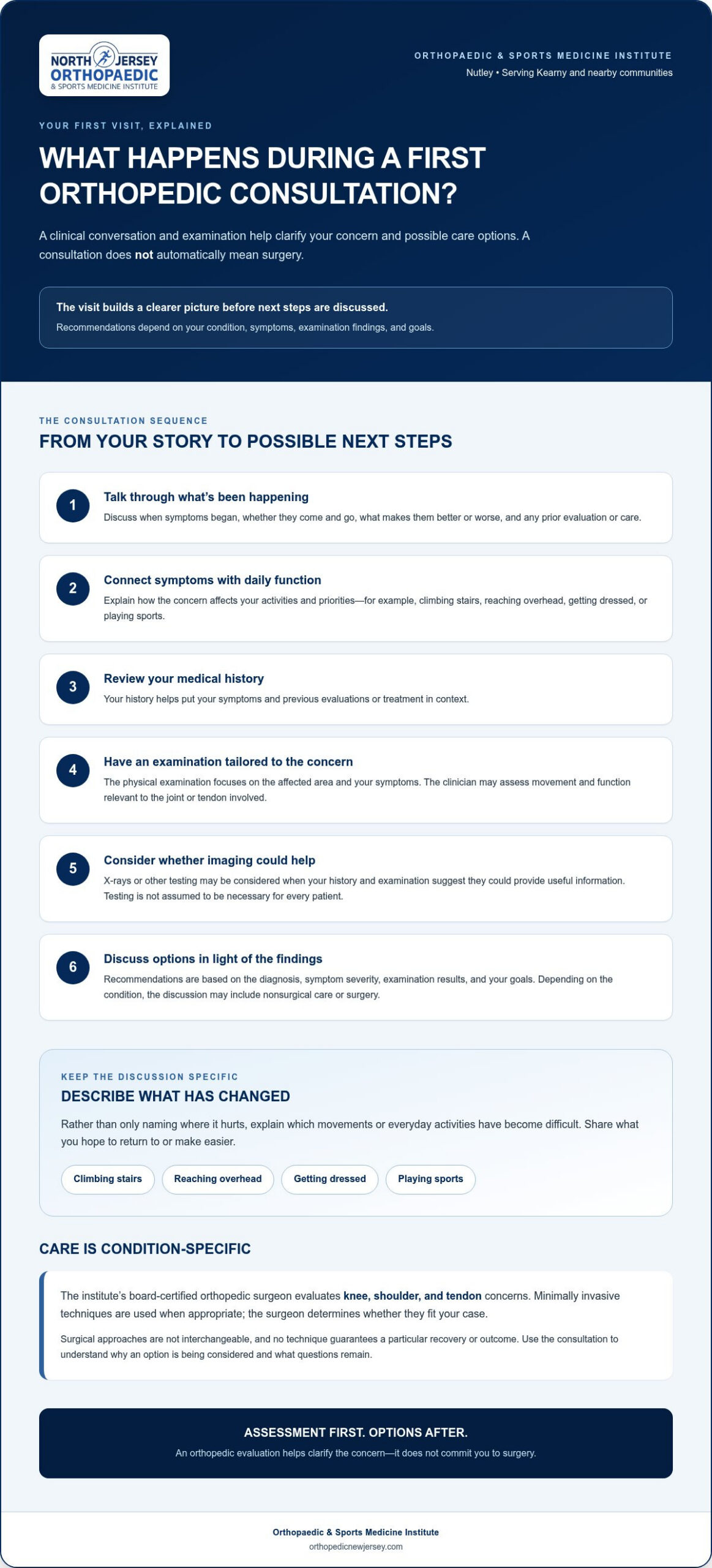
A first orthopedic consultation is a clinical conversation followed by an examination, not an automatic decision to operate. The surgeon works to understand your symptoms, how they affect your movement, and what the findings may indicate. You can also explain your priorities, such as returning to an activity or making everyday tasks easier.
Treatment recommendations follow an evaluation of your condition, symptoms, and examination findings. Imaging or other tests may help answer a clinical question, but they aren’t assumed to be necessary for every patient. The visit helps build a clearer picture before you discuss appropriate next steps.
How the surgeon evaluates a joint or tendon concern
The conversation may cover when symptoms began, whether they come and go, what makes them better or worse, and any prior evaluation or care. The surgeon will also want to know how the concern affects daily activities, from climbing stairs to reaching overhead or playing sports. Your medical history helps put those details in context.
The physical examination is tailored to the affected area and your symptoms. For a shoulder concern, for example, the clinician may assess movement and function in that region. A knee or tendon evaluation focuses on the relevant anatomy. X-rays or other testing may be considered if your history and examination suggest they could provide useful information. The decision depends on your individual concern.
How treatment options are discussed
After considering the available findings, the surgeon can make recommendations based on the diagnosis, symptom severity, examination results, and your goals. Depending on the condition, the discussion may include nonsurgical care or surgery. Use the consultation to understand why an option is being considered and what questions remain before you make a decision.
Surgical techniques aren’t interchangeable. An approach that fits one condition may not suit another. The Orthopaedic & Sports Medicine Institute uses minimally invasive techniques when appropriate, but the surgeon determines whether they are relevant to your case. No technique guarantees a particular recovery or outcome.
Make the conversation specific by describing what has changed. Instead of saying only that your shoulder hurts, explain whether reaching a shelf or getting dressed has become difficult. If you’re seeking an orthopedic surgeon accepting new patients Kearny NJ, the institute’s board-certified surgeon evaluates knee, shoulder, and tendon concerns. Kearny-area patients can request an orthopedic evaluation to discuss their symptoms and care options.
How to Choose an Orthopedic Surgeon Near Kearny Without Relying on Rankings Alone
Rankings and online ratings can help you find names, but they can’t tell you whether a surgeon’s clinical focus matches your concern. Compare the affected area, the practice’s relevant expertise, and how clearly the clinician explains the evaluation. Use directories as a starting point, then look for details that help you understand the care being considered.
| What to compare | Questions to consider | Institute context |
|---|---|---|
| Clinical focus | Does the practice identify the body areas or conditions it evaluates? | The board-certified surgeon focuses on knee, shoulder, and tendon concerns. |
| Relevant condition | Does that focus relate to the reason you’re seeking care? | Patients can seek evaluation for concerns involving those areas. |
| Local access | Does the practice serve your community, and where is it based? | The institute is in Nutley and serves nearby Kearny-area communities. |
| Consultation expectations | Is care based on an individual assessment rather than an assumed procedure? | The surgeon evaluates the concern and considers appropriate care options. |
Which details help you assess clinical fit?
Match your reason for seeking care with the practice’s stated orthopedic focus. For example, someone with a shoulder concern can look for a clinician who evaluates shoulder conditions, while a tendon problem calls for attention to that area. The Orthopaedic & Sports Medicine Institute’s board-certified surgeon evaluates knee, shoulder, and tendon concerns, offering Kearny-area patients a focused local option.
Look for information that explains what an evaluation involves and how findings guide next steps. Ratings can describe other patients’ experiences, but they don’t replace a clinical assessment of your symptoms. When considering sports medicine care, check whether the specialist’s focus aligns with the injury or activity-related concern you want assessed.
What minimally invasive care means in context
Minimally invasive techniques generally refer to surgical approaches intended to limit the size of surgical access or disruption to surrounding tissue. The term alone doesn’t show whether a technique is appropriate for a particular diagnosis or predict an individual’s recovery. Selection depends on the condition being treated and the surgeon’s clinical judgment.
The institute uses minimally invasive techniques when appropriate. A useful discussion connects the proposed approach to your diagnosis and explains why it may be considered. Learn more about the principles in this guide to minimally invasive orthopedic surgery.
If you’re searching for an orthopedic surgeon accepting new patients Kearny NJ, focus on how well the practice’s expertise aligns with your concern, not just where it appears in search results. A relevant clinical focus and an individualized evaluation give you a more meaningful basis for discussing care options than a ranking alone.
Preparing to Request a New Orthopedic Appointment
A little preparation can help you describe your concern clearly when requesting care. You don’t need to know the diagnosis or have every record in hand. Start with what has changed and how it affects you. The Orthopaedic & Sports Medicine Institute serves Kearny-area patients, and its website provides patient forms you can complete at home before a first visit.
What information can make the first conversation clearer?
Before requesting an appointment, jot down a few details. A brief timeline and practical examples can help you explain the issue without trying to diagnose it yourself.
- Symptom timeline: Note when the problem began, whether it started suddenly or gradually, and whether it has changed.
- Affected area: Identify the joint, tendon, or body region involved, including whether symptoms affect one or both sides.
- Triggers and limits: Describe movements or activities that worsen the concern and what has become difficult, such as lifting, walking, or reaching.
- Previous care: List relevant prior injuries, evaluations, treatments, and medications.
- Your goals: Write down what you hope to return to or manage, along with the questions you want answered.
Be specific where possible. “My knee hurts” gives less context than explaining that discomfort began after an activity and now makes stairs difficult. You don’t need to estimate severity in medical terms. Describe what you notice and how it affects daily life.
What should you bring to the consultation?
Gather useful information you already have, but don’t postpone urgent care while searching for paperwork. If available, bring relevant medical records, imaging reports, identification, insurance information, and a current medication list. Existing images or reports may provide context. Don’t arrange new imaging or change treatment just to prepare unless a clinician has advised you to do so.
A short, prioritized question list can also keep the visit focused. You might ask what the examination findings suggest, whether additional testing is appropriate, and what care options may fit your situation. If you have several concerns, start with the one that most affects your function.
To request care, use the practice’s website and complete the available patient forms. Provide clear contact details and a concise description of the affected area and primary concern. The institute is accepting new patients, but submitting a request doesn’t guarantee a particular appointment date.
Insurance benefits and referral requirements can differ by plan. Review your plan’s specialist-care rules and any referral process that may apply to you. Coverage depends on your individual policy. Kearny-area patients can request an appointment with the institute and share the information they’ve gathered. If symptoms suggest an emergency, seek immediate emergency services rather than waiting for a scheduled consultation.
Kearny-Area Orthopedic Care: Request an Evaluation With the Institute
For Kearny-area patients looking for a focused orthopedic evaluation, The Orthopaedic & Sports Medicine Institute provides specialized orthopedic and sports medicine care at its Nutley practice. The practice serves nearby communities, including Kearny, and is accepting new patients. Its board-certified orthopedic surgeon evaluates knee, shoulder, and tendon concerns, helping patients connect a specific musculoskeletal problem with relevant specialist care.
An evaluation is the starting point for understanding your concern, not a commitment to surgery. The surgeon considers your symptoms and clinical findings before discussing recommendations. Minimally invasive techniques are part of the practice’s approach when appropriate, but whether a technique fits depends on your diagnosis and clinical judgment. No treatment approach guarantees a particular result.
Which orthopedic concerns does the practice address?
The institute focuses on knee, shoulder, and tendon conditions, including concerns associated with sports and other physical activity. Its orthopedic and sports medicine care may be relevant when pain, injury, or reduced function involves one of these areas. Treatment recommendations follow an individual assessment, so the same symptom or diagnosis may not call for the same approach in every patient.
For shoulder conditions, the practice offers rotator cuff repair, shoulder arthritis treatment, and labral tear treatment. For eligible ACL injuries, its offerings include bridge-enhanced ACL repair using the BEAR® Implant. These address distinct clinical concerns and aren’t interchangeable procedures. An evaluation helps determine which options are appropriate to discuss for your condition.
What is the next step for Kearny-area patients?
If you’re considering an orthopedic surgeon accepting new patients Kearny NJ, use the institute’s website to request an orthopedic consultation. Describe the affected area and how the concern limits your usual activities. Relevant prior evaluations or treatment details can provide additional context. A request begins the process, but it doesn’t guarantee a particular appointment date or determine which treatment will be recommended.
The consultation gives the surgeon an opportunity to assess your concern and discuss findings and care options with you. Recommendations are individualized, and an assessment doesn’t mean surgery is required. Ask about the reasoning behind a recommendation and how it relates to your goals. Request an orthopedic consultation with the institute to discuss your orthopedic care options.
Take the Next Step Toward a Clearer Care Plan
You don’t need to have every answer before seeking specialist care. Start by identifying what you want help understanding: the cause of a recurring symptom, its effect on your routine, or the options for addressing it. This can make the conversation more purposeful and give you a clearer basis for deciding what to do next.
If you’re looking for an orthopedic surgeon accepting new patients Kearny NJ, consider moving from online research to an individual assessment. You don’t need to arrive with a treatment already chosen. The goal is to have your concern evaluated and discuss care options in light of your needs.
Request an orthopedic consultation with The Orthopaedic & Sports Medicine Institute to take the next step. Bring your questions, explain what matters most to you, and discuss a path forward based on your evaluation.
Frequently Asked Questions
Is an orthopedic surgeon the right doctor for joint or tendon pain?
An orthopedic surgeon can evaluate concerns involving joints and tendons, but whether specialist care is appropriate depends on your symptoms and how they affect function. For example, recurring knee discomfort that limits walking may merit assessment. A clinician can consider the location, duration, and context of the problem. Sudden severe symptoms or a serious injury call for urgent evaluation rather than waiting for a routine appointment.
Can I see an orthopedic surgeon without a referral in New Jersey?
Referral requirements can depend on your insurance plan, coverage type, and the practice’s appointment process. Review your plan documents or contact your insurer to learn whether a referral or specific network rules apply to you. A referral is an administrative or coverage requirement, not a measure of whether your symptoms deserve clinical attention. If symptoms are urgent, seek appropriate care rather than delaying it to resolve paperwork.
How much does an orthopedic consultation cost?
There isn’t one general consultation fee that determines what every patient will pay. Costs may depend on the services involved and your insurance benefits, including any applicable deductible or copayment. Before the visit, review your plan’s specialist-care benefits and contact your insurer with questions about your individual responsibility. The practice website is a place to begin an appointment request and review current patient information.
What should I bring to my first orthopedic appointment?
Bring identification, insurance information, and a current medication list, along with relevant records you already have. A dated note about symptom changes can be useful, such as when discomfort began and which movements now cause difficulty. If imaging reports are available, bring them for context. You don’t need to obtain new imaging just to prepare, and gathering paperwork should never delay urgent medical care.
Do orthopedic surgeons always recommend surgery?
No. Seeing an orthopedic surgeon doesn’t mean you’ve agreed to an operation or that surgery will be recommended. The clinician considers the diagnosis, examination findings, symptoms, and your goals before discussing possible care. Depending on the condition, options may include nonsurgical approaches or surgery. You can ask what each option is intended to address, what considerations apply, and how the recommendation relates to your situation.
When should I seek urgent care instead of a routine orthopedic appointment?
Seek emergency help for a life-threatening emergency, major trauma, severe uncontrolled pain, or symptoms that may pose an immediate threat to your health. A scheduled orthopedic consultation isn’t a substitute for emergency evaluation. For a concerning new injury or rapidly worsening symptoms, use appropriate local urgent or emergency services rather than waiting for a routine appointment. If you’re unsure how urgent a situation is, contact local emergency resources for guidance.
Does the institute treat patients from Kearny, NJ?
Yes. The Orthopaedic & Sports Medicine Institute in Nutley serves Kearny and nearby communities, including Bloomfield, Clifton, Belleville, Lyndhurst, North Arlington, and Verona. Its board-certified surgeon evaluates knee, shoulder, and tendon concerns. If you’re searching for an orthopedic surgeon accepting new patients Kearny NJ, use the institute’s website to request a consultation and review its patient information. Recommendations follow an individual clinical assessment.


