


Choosing an orthopedic specialist for runners Nutley NJ starts with more than finding someone who treats sports injuries. A useful evaluation considers where your pain occurs, how it affects everyday movement, and what you hope to do next. If a knee or tendon injury is interrupting training, you may be wondering whether specialist care is appropriate and how to make informed decisions about treatment.
Those concerns deserve an individualized discussion, not assumptions about the injury or a fixed recovery timeline. In Nutley, the Orthopaedic & Sports Medicine Institute provides orthopedic and sports injury care, including evaluation of knee and tendon concerns by a board-certified surgeon. A focused assessment can help clarify what may be contributing to your symptoms and which options are appropriate to discuss.
This guide explains what an orthopedic evaluation for a running injury may involve, how to compare care based on clinical focus and communication, and how your running goals can inform the conversation. You’ll also find practical guidance for taking a next step in Nutley, with nearby communities including Bloomfield, Clifton, Belleville, Lyndhurst, North Arlington, Kearny, and Verona.
Key Takeaways
- Persistent, recurring, worsening, or function-limiting running pain can be a reason to consider an orthopedic assessment.
- A focused evaluation may include discussing symptoms and goals, a physical examination, review of findings, and a conversation about appropriate options.
- When comparing care, look for relevant orthopedic experience, clear explanations, and communication that considers your activity goals.
- Prepare for your visit by noting when symptoms began, what activity changes affect them, and which daily movements or running goals matter to you.
- An orthopedic specialist for runners Nutley NJ can assess knee or tendon concerns and discuss next steps in light of your individual presentation.
When Should a Runner in Nutley See an Orthopedic Specialist?
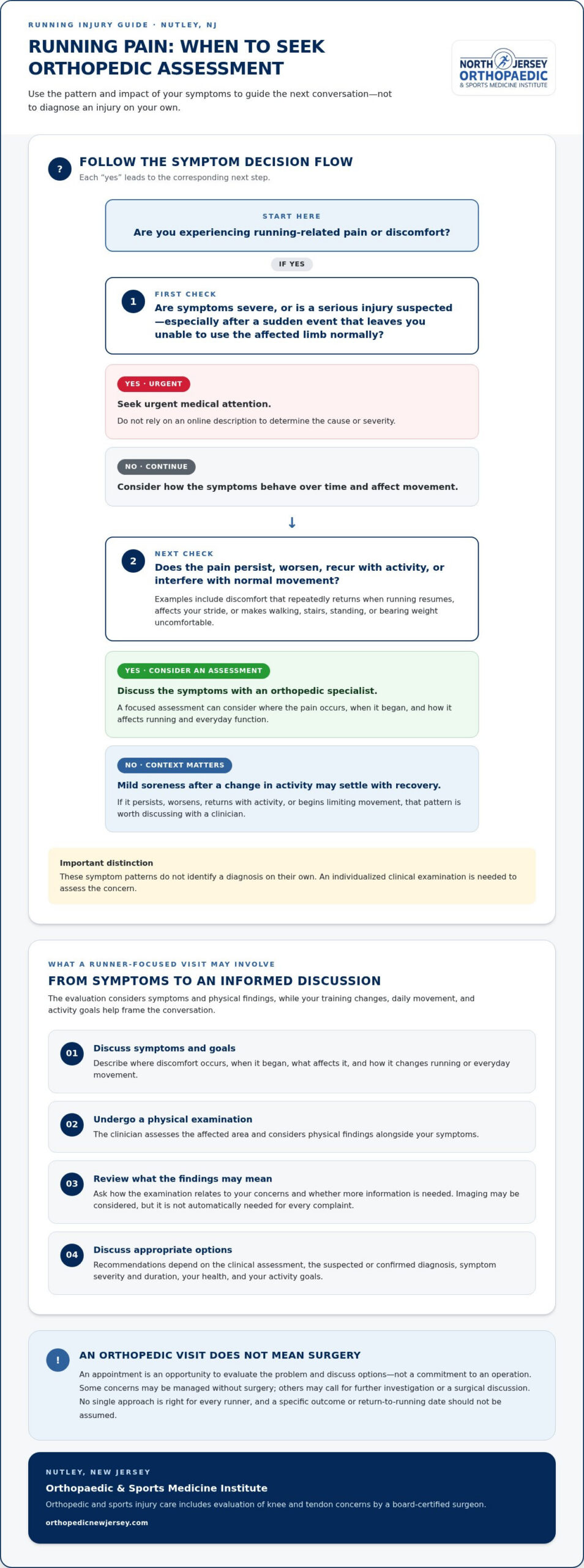
Running pain can disrupt more than a training plan. It may make stairs, walking, or standing uncomfortable and leave you unsure whether to keep exercising. Mild soreness after a change in activity may settle with recovery, but pain that persists, returns with runs, worsens, or limits everyday movement deserves closer attention. An assessment can help clarify what may be contributing to your symptoms without assuming a particular injury.
Which running-related symptoms deserve attention?
Consider seeking clinical evaluation if knee, tendon, ankle, or other joint discomfort keeps recurring, becomes more intense, or affects your stride or ability to bear weight comfortably. Discomfort that eases with rest but repeatedly returns when you resume running is also worth discussing with a clinician. These patterns don’t identify a diagnosis on their own. An individualized examination can consider where the pain occurs, when it began, and how it affects function.
Sports-related pain warrants clinical evaluation when it persists, worsens, recurs with activity, or interferes with normal movement. Seek urgent medical attention for severe symptoms or a suspected serious injury, especially after a sudden event that leaves you unable to use the affected limb normally. Don’t rely on an online description to determine the cause or severity.
For a runner looking for an orthopedic specialist for runners Nutley NJ, the focus should be on a careful assessment of the affected area and how symptoms relate to training and daily activity. Orthopedic surgery is one part of the broader orthopedic field, which addresses musculoskeletal conditions. Seeing an orthopedic specialist does not, by itself, mean an operation is needed.
Does seeing an orthopedic specialist mean surgery?
No. An appointment is an opportunity to evaluate the problem and discuss options, not a commitment to undergo surgery. Recommendations depend on the examination, the suspected or confirmed diagnosis, the severity and duration of symptoms, and individual factors such as your health and activity goals.
Some concerns may be managed without an operation, while others may call for further investigation or a surgical discussion. No single approach is appropriate for every runner, and the evaluation helps guide that conversation. Ask how the findings relate to your symptoms, what options may be appropriate, and how each could affect your activities. A thoughtful discussion should make room for your questions without promising a specific outcome or return-to-running date.
At the Orthopaedic & Sports Medicine Institute in Nutley, a board-certified surgeon evaluates orthopedic and sports-related concerns, including knee and tendon injuries. The next step is an informed conversation about what you’re experiencing and what the clinical findings may mean for your care.
What Does a Runner-Focused Orthopedic Evaluation Involve?
An orthopedic evaluation assesses symptoms and physical findings before a clinician recommends treatment. For runners, the conversation should include more than where it hurts. Training changes, daily function, and the activities you hope to return to can all help frame the assessment. An orthopedic specialist for runners Nutley NJ can use these details to understand your concerns and discuss appropriate next steps without assuming one cause or treatment in advance.
The visit generally follows a clear sequence:
- Discuss symptoms and goals: Explain where discomfort occurs, when it began, what affects it, and how it changes your running or everyday movement.
- Undergo an examination: The clinician assesses the affected area and considers your symptoms alongside physical findings.
- Review what the findings may mean: Ask how the examination relates to your concerns and whether more information is needed.
- Discuss options: Recommendations are individualized and depend on the clinical assessment and your circumstances.
How should runners describe pain and training changes?
Before the appointment, note the symptom’s location, when it began, how long it has lasted, and which activities ease or aggravate it. Include changes in training, such as a different route or running schedule, as well as changes in walking, stair use, or other daily activities. These details provide context, not proof of a single cause. Describe return-to-running or other activity goals as priorities for discussion, not as an expected result.
A useful account can be specific without being technical. Explain whether discomfort appears during a run, afterward, or during an ordinary task, and whether the pattern has changed. If knee discomfort is part of the concern, Mayo Clinic’s overview of Runner’s Knee (Patellofemoral Pain Syndrome) describes one possible source of knee symptoms. A reference page can offer background, but it can’t establish what is causing an individual runner’s pain.
How are examination findings used to discuss next steps?
Symptoms are interpreted alongside the physical examination, rather than in isolation. Depending on the clinician’s assessment and your individual presentation, imaging may be considered to help clarify the concern. It isn’t automatically needed for every complaint. The decision depends on what the history and examination indicate.
After reviewing the findings, the clinician can explain what they suggest, whether additional assessment is appropriate, and which care options may be considered. Recommendations should reflect the clinical picture and patient-specific factors, including the activities that matter to you. Ask questions if a term or proposed next step is unclear. Understanding the reasoning can help you take part in an informed decision without presuming that surgery is either necessary or avoidable.
The Orthopaedic & Sports Medicine Institute provides orthopedic and sports injury care in Nutley, including evaluation of knee and tendon concerns. If persistent symptoms are affecting your running or everyday movement, an orthopedic evaluation in Nutley can be a practical next step for discussing your symptoms and goals.
How to Compare Orthopedic Care for Runners Near Nutley
For runners, comparing care means looking beyond a general sports medicine message. Consider whether the orthopedic care is relevant to your concern, whether the evaluation process is explained clearly, and whether the clinician discusses options in light of your activity goals. The Orthopaedic & Sports Medicine Institute provides orthopedic and sports injury care in Nutley. Its board-certified surgeon treats knee and tendon injuries, concerns that can affect runners.
| Factor | What to look for | How it helps you assess care |
|---|---|---|
| Relevant injury experience | Orthopedic care that addresses the affected area and type of concern, such as knee or tendon symptoms. | Relevant experience can make the discussion more focused on your presentation and activity needs. |
| Evaluation clarity | A clear explanation of how symptoms and examination findings inform possible next steps. | You can better understand what is known, what may need further assessment, and why an option is being discussed. |
| Communication | Direct answers to questions and a conversation that makes space for your training and daily-function goals. | Clear communication helps you take part in decisions without assuming a specific treatment or timeline. |
| Local access | A location that makes it practical to seek orthopedic care from your community. | Nutley-based care may be relevant for local runners and people in nearby areas. |
Which care factors matter when choosing a local specialist?
A board-certified orthopedic surgeon has met board-specific professional requirements, which can be one meaningful qualification to consider. The credential doesn’t guarantee a particular diagnosis or outcome, so it’s also useful to understand how the clinician approaches your concern and explains the reasoning behind recommendations. At the Orthopaedic & Sports Medicine Institute, a board-certified surgeon provides specialized orthopedic care in Nutley and treats knee, shoulder, and tendon injuries.
Local relevance can matter when arranging an evaluation around work, family, or training. If you’re in Bloomfield, Clifton, Belleville, Lyndhurst, North Arlington, Kearny, or Verona, Nutley is a nearby location to consider for orthopedic care. Geographic convenience is one factor to weigh alongside relevant clinical care and clear communication.
What should runners understand about treatment approaches?
Treatment recommendations depend on the specific injury, examination findings, and individual circumstances. Some conditions may call for discussion of nonsurgical options, while selected problems may lead to a procedural conversation. Minimally invasive techniques may be relevant to certain procedures, but they aren’t appropriate for every injury or every patient. The clinician’s assessment guides whether they belong in a treatment discussion.
For readers comparing an orthopedic specialist for runners Nutley NJ, the key is to understand why a proposed approach fits the clinical findings and personal goals. The institute uses minimally invasive techniques when appropriate. Its minimally invasive orthopedic surgery guide explains this approach in more detail.
How to Prepare for an Orthopedic Visit About Running Pain
A little preparation can make it easier to describe what has changed and what you need help understanding. You don’t need to know the medical name for a problem or determine its cause before the visit. Bring a clear account of your symptoms, activity changes, and functional concerns. The clinician will decide which examination or diagnostic steps are appropriate based on your presentation.
Use this checklist to organize the details:
- Symptom timeline: Note when the discomfort began, whether it started suddenly or gradually, and how it has changed over time.
- Location and pattern: Identify where you feel it and whether it appears during a run, afterward, or during another activity.
- Activity changes: Record changes to your running routine or other activities around the time symptoms began. This context may help guide the discussion, but it doesn’t establish a cause.
- Functional effect: Describe any difficulty with ordinary movement, such as walking, using stairs, or standing for a period of time.
- Questions and concerns: Write down what you want clarified, including questions about evaluation, treatment choices, or how symptoms may affect your activities.
What information helps make the discussion more specific?
Describe the pattern in your own words. For instance, note whether discomfort is becoming more frequent, changes with a particular activity, or affects movement outside your runs. If you’ve reduced or paused training, explain when and why. These observations give the clinician useful context without asking you to interpret the symptoms or select a treatment yourself.
How can runners discuss return-to-running goals?
State what you hope to return to, whether that’s comfortable daily movement, short runs, or a particular type of training. Then ask how the examination findings relate to those goals and what factors would guide activity progression. The appropriate plan and timing depend on the specific condition and clinical advice. A goal helps shape the conversation but doesn’t guarantee a particular date or outcome.
Clear questions can make the discussion more useful. Consider asking what the findings may mean, whether further diagnostic steps are appropriate, which options may be considered, and what signs should prompt you to revisit the plan. A sports medicine clinic guide near Montclair can also provide context as you think about local sports injury care.
If running pain is affecting your training or everyday movement, bring your symptom notes and goals to an orthopedic evaluation in Nutley. Schedule an orthopedic evaluation to discuss your concerns with the Orthopaedic & Sports Medicine Institute.
Orthopedic Care for Runners in Nutley, NJ: Your Next Step
Choosing a next step starts with the pattern of your symptoms, not a guess about the injury. Consider whether discomfort is persistent, recurring, or interfering with running or everyday movement. A clinical evaluation can help interpret those concerns, while relevant orthopedic expertise and your personal activity goals shape the discussion about possible care. No checklist can determine a diagnosis or predict when you’ll return to running, but it can help you arrive prepared to make an informed decision.
How does local orthopedic care support an informed decision?
An in-person discussion gives you the opportunity to explain what you’re experiencing and hear how examination findings may relate to your symptoms. You can ask about the reasoning behind recommended next steps and how your goals fit into the conversation. This can help you understand what is known and what options may be appropriate, without presuming a particular treatment.
The Orthopaedic & Sports Medicine Institute provides orthopedic and sports injury care in Nutley for runners and other local residents. Its board-certified surgeon treats knee and tendon injuries, areas that may be relevant to running-related concerns. Runners in Nutley and nearby communities, including Bloomfield, Clifton, Belleville, Lyndhurst, North Arlington, Kearny, and Verona, can consider this local expertise when seeking an assessment of orthopedic symptoms.
What should runners expect from a first step toward care?
An appointment is a chance to discuss symptoms, review clinical findings, and consider possible next steps. Recommendations depend on the individual evaluation and other relevant factors. A consultation doesn’t presume surgery. Treatment decisions should follow the clinical assessment, with any procedural approach discussed only when it is appropriate to the specific concern.
If a running injury involves a suspected or diagnosed ACL tear, the clinician can discuss the findings and relevant treatment considerations. For background on one ACL repair approach, see the BEAR® Implant ACL repair guide in New Jersey. The relevance of any approach depends on the individual case. Reading about a procedure isn’t a substitute for clinical advice.
For your consultation, bring a brief symptom timeline and be ready to describe what you hope to do, from comfortable daily movement to returning to a particular level of running. Ask how the clinical findings relate to those goals and what factors will guide recommendations. The answers should reflect your situation, not a guaranteed recovery schedule or return-to-sport date.
If pain is affecting your training or daily activities, request an orthopedic consultation with the Orthopaedic & Sports Medicine Institute in Nutley. A conversation with a specialist can help you understand your evaluation and consider a practical next step.
Take a Clear Next Step Toward Understanding Your Running Pain
Persistent pain can make every run feel uncertain. You don’t need to decide what the injury is or what treatment you need before seeking an evaluation. Use what you’ve noticed to start a focused conversation about your symptoms, activity goals, and options.
For runners seeking an orthopedic specialist for runners Nutley NJ, the Orthopaedic & Sports Medicine Institute offers local orthopedic and sports injury care. Its board-certified surgeon treats knee, shoulder, and tendon injuries, with minimally invasive techniques used when appropriate. An evaluation can help clarify the clinical picture and support an informed discussion. It can’t guarantee a particular treatment or return-to-running timeline.
Consider taking the next step if pain is interfering with training or everyday movement. A consultation gives you the opportunity to discuss your concerns directly and understand what may be appropriate for your individual situation. Request an orthopedic consultation in Nutley to discuss your symptoms and goals with the Orthopaedic & Sports Medicine Institute.
Frequently Asked Questions
Can I keep running if my knee hurts?
It depends on the pain and how it affects your movement, so there isn’t a safe answer for every runner. If running makes discomfort worse, changes your stride, or leaves you struggling with ordinary movement afterward, pause the activity that aggravates it and seek clinical guidance. Severe pain, major swelling, or inability to bear weight warrants urgent medical attention. Don’t use pain alone to decide that an injury is harmless.
Do runners need a referral to see an orthopedic specialist in New Jersey?
Referral requirements can depend on your health insurance plan and how your care is arranged. Before booking, review your plan’s referral rules or contact your insurer to ask whether a referral or authorization is needed for an orthopedic consultation. If you’re in Nutley or nearby communities such as Bloomfield, Clifton, Belleville, Lyndhurst, North Arlington, Kearny, or Verona, having your insurance details available can help you clarify the administrative steps.
Can a running injury heal without surgery?
Some running-related injuries may be managed without surgery, while others may require a surgical discussion. The appropriate approach depends on the specific condition, its severity, examination findings, and individual health factors. An evaluation can help explain which options are relevant to your situation. Don’t assume that rest alone will resolve an injury or that surgery is inevitable. A clinician can discuss the reasoning behind recommendations and answer questions about alternatives.
How soon should I see a specialist for running-related pain?
Consider arranging an evaluation if pain persists, keeps returning, worsens, or interferes with normal activities, rather than waiting for it to disrupt more of your routine. Note whether discomfort appears at a particular point in a run or affects walking afterward. That detail may help explain the pattern. Seek urgent medical care for severe symptoms or a suspected serious injury. An online description can’t determine how serious your symptoms are.
Can an orthopedic specialist evaluate a runner’s tendon injury?
Yes. An orthopedic specialist can assess tendon-related symptoms by considering their location, history, effect on movement, and examination findings. For example, describe whether discomfort occurs during a run, with stairs, or when walking, and whether it limits normal activity. Those details help guide an individualized assessment, but they don’t establish a diagnosis on their own. An orthopedic specialist for runners Nutley NJ can discuss tendon concerns as part of orthopedic and sports injury care.
How long does it take to return to running after an orthopedic injury?
There isn’t one timeline that applies to every orthopedic injury. Return depends on the condition, its severity, the treatment approach, and how function progresses during recovery. Ask the clinician what signs or abilities will help guide the decision, and whether the plan should change if symptoms return with activity. Avoid using another runner’s recovery as your benchmark. Your own clinical findings and medical advice should guide decisions about increasing activity.
What happens during an orthopedic appointment for running pain?
The clinician will ask about your symptoms and relevant health history, then assess the affected area through an examination. Depending on the findings, additional diagnostic steps may be considered. Bring a list of medications, previous injuries or treatments, and questions you want answered. If you have records or imaging from earlier care, ask whether they would be useful to share. This information can provide context for the discussion without predetermining the diagnosis.


