The safest recovery plan is the one written for your specific procedure, not a general timeline. If you’re looking for post-op instructions for knee surgery Kearny NJ, use your surgeon’s discharge plan as your primary reference. Instructions can differ depending on the operation, and general guidance shouldn’t replace directions from your surgical team.
It’s understandable to have questions once you’re home. Is this level of pain or swelling expected? How should you care for the incision? Which activities are safe, and when should you call for help? This checklist can help you organize your instructions, keep track of changes, and recognize symptoms that warrant prompt attention. Keep your surgeon’s directions at the center of every decision.
Here are practical points to clarify about medication, wound care, activity, and physical therapy, along with warning signs to discuss with your care team. Recovery doesn’t follow the same schedule for every knee procedure, so follow-up matters. The Orthopaedic & Sports Medicine Institute provides specialized orthopedic care in Nutley for patients in Kearny and nearby communities. Care is led by board-certified orthopaedic surgeon and sports medicine specialist Dr. Michael C. Russonella, D.O.
Key Takeaways
- Recovery guidance depends on the specific knee procedure and your surgeon’s plan, so use your discharge instructions as your primary reference.
- Use the home-care checklist to organize questions about medication, incision care, and activity without changing prescribed directions on your own.
- Know which worsening symptoms call for prompt contact with your surgical team and which may require emergency evaluation.
- Keep a simple record of symptoms and questions, and follow your surgeon’s directions for follow-up and rehabilitation.
- Use this guide to make sense of post-op instructions for knee surgery Kearny NJ and understand how specialized orthopedic care can help address recovery questions.
Post-op instructions for knee surgery: why your procedure matters
Post-operative instructions are the plan for caring for your knee after a specific procedure. They explain home care, activity restrictions, and follow-up. The plan reflects the operation performed and your surgeon’s guidance, as well as individual factors that may affect recovery. Two people who have had knee surgery can receive different instructions, even if both procedures involve the same joint.
That distinction matters because “knee surgery” includes a range of operations. Arthroscopy, a ligament procedure, and knee replacement use different surgical approaches, so their care directions may differ. General descriptions can’t establish your personal restrictions or expected recovery. For background, Knee replacement surgery describes a different category of procedure from arthroscopy or ligament surgery. Use your own written plan, not a general overview, to guide your care.
This checklist helps patients looking for post-op instructions for knee surgery Kearny NJ organize home care, identify questions, and keep track of follow-up. It supports, but never replaces, the discharge instructions from your surgical team. If a general checklist differs from your procedure-specific plan, follow the plan provided by your team and ask them to clarify anything that’s uncertain.
Which knee surgery instructions apply to your operation?
Use the written instructions issued for your own operation. Directions for an arthroscopic procedure may not apply to ligament surgery or knee replacement, and a relative’s experience may not match yours. Don’t assume a restriction, wound-care step, or activity recommendation applies to every knee procedure. If paperwork seems generic, look for details identifying your procedure and ask your surgical team which directions apply to your care.
What to confirm before leaving surgical care
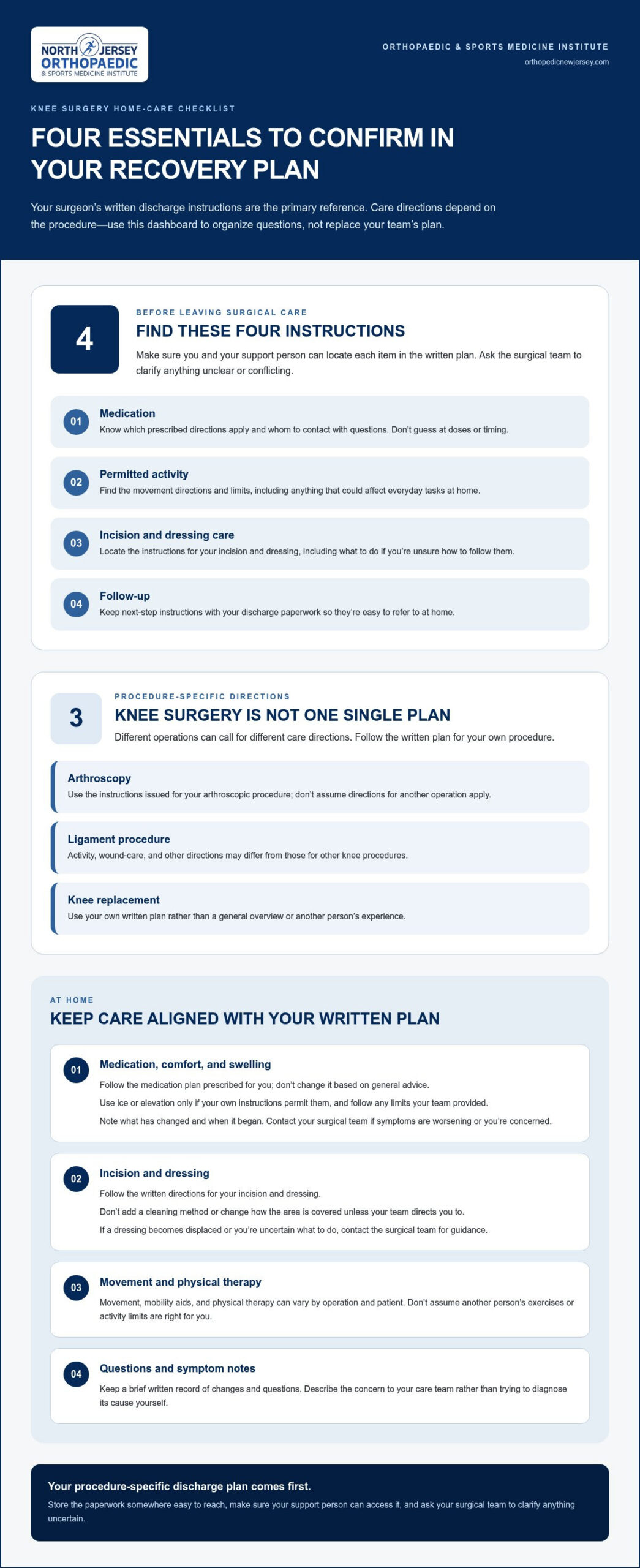
Before going home, make sure you and your support person can find the written plan and locate its directions for medication, permitted activity, incision care, and follow-up. If an instruction is unclear or conflicts with another, ask the surgical team to explain it before you leave. Having the answer in writing can make it easier to follow the plan at home.
- Medication: Know which plan was prescribed and whom to ask about questions or changes. Don’t guess at dosing or adjust the plan based on general advice.
- Activity: Find the directions describing permitted movement and any limits. Clarify anything that could affect everyday tasks at home.
- Incision care: Locate the instructions for your incision and any dressing, including what to do if you’re unsure how to follow them.
- Follow-up: Keep the next-step instructions with your discharge paperwork so you can refer to them when planning care.
Store the paperwork somewhere easy to reach, and make sure the person helping you can access it too. Clear, procedure-specific directions give you and your support person a shared reference when recovery questions come up.
Knee surgery home-care checklist: medication, incision, and activity
At home, use your discharge paperwork as a practical reference. Don’t fill in missing details with general advice. The checklist below can help you compare your routine with the plan your surgical team provided. The NHS guidelines for knee replacement recovery offer general information about that procedure, but they aren’t a substitute for instructions tailored to your operation and circumstances.
Medication, comfort, and swelling questions
Follow the medication plan prescribed for you. If you’re unsure what a direction means, have a concern about a medication, or notice symptoms worsening, contact your surgical team rather than changing the plan on your own. Don’t use another person’s medication or rely on general online advice to make treatment decisions.
- Medication plan: Check that you understand which directions apply to each prescribed medication and whom to contact with questions. Don’t guess at doses or timing.
- Comfort measures: Use measures such as ice or elevation only if your own instructions permit them, and follow any limits your team provided.
- Changes in symptoms: Note what has changed and when it began. Contact the surgical team if symptoms are getting worse or you’re concerned about how you’re responding to the plan.
A brief written record can make it easier to describe a concern clearly when you speak with the team. Note the question you have rather than trying to diagnose the cause yourself.
Incision care, movement, and physical therapy
Wound care and activity directions are specific to your procedure. Follow the written instructions for your dressing and incision. Don’t add a cleaning method or change how the area is covered unless your team directs you to. Movement, mobility aids, and physical therapy can also vary by operation and patient. Don’t assume another person’s exercises or activity limits are right for you.
- Incision and dressing: Check your paperwork for the directions that apply to your incision. If a dressing becomes displaced or you’re uncertain what to do, contact the surgical team for guidance.
- Movement and support: Follow the restrictions provided for your procedure. Use a mobility aid only as directed, and ask for clarification if you’re unsure how the instructions apply to everyday movement.
- Therapy: Attend or begin rehabilitation only as directed by your surgical team. Follow the instructions you were given rather than starting exercises from a general guide.
For post-op instructions for knee surgery Kearny NJ patients can use this checklist to identify questions, not to replace clinical judgment. Keep your discharge paperwork accessible and note anything that isn’t clear. The Orthopaedic & Sports Medicine Institute provides specialized orthopedic care in Nutley for patients from Kearny and surrounding communities.
When to call after knee surgery: warning signs and uncertainty
A change in how your knee looks or feels after surgery can raise understandable questions. Online information can describe general warning signs, but it can’t determine whether a symptom is expected after your procedure or in your recovery. Use your discharge plan to guide whom to contact and how. Don’t wait for a routine follow-up if a symptom is severe, rapidly worsening, or feels urgent.
For additional general context, MedlinePlus knee replacement recovery instructions discuss recovery and warning signs after knee replacement. That guidance is specific to knee replacement. Don’t use it to decide what applies after a different operation or to replace your surgical team’s instructions.
Changes to report to the surgical team
Contact your surgical team promptly about concerning changes around the incision or symptoms that are getting worse. Examples include increasing redness or swelling, new or worsening drainage, or another change that concerns you. A symptom alone can’t confirm an infection or another complication, so describe what you observe and let the clinical team advise you.
- Describe the change: Explain what looks or feels different and whether it’s worsening. If helpful, write down when you first noticed it.
- Follow your discharge plan: Use the contact instructions provided for post-operative questions. If you’re unsure which route to use, follow the plan’s guidance for urgent concerns.
- Share relevant details: Have your procedure and discharge paperwork available, and mention any accompanying symptoms or changes in how you feel.
Don’t try to manage a concerning incision change by adding wound-care steps that aren’t in your instructions. If you’re unsure whether a change needs attention, contacting the surgical team is safer than relying on a general checklist to judge it.
When symptoms may need emergency attention
Some symptoms need emergency evaluation rather than a message left for routine follow-up. Chest pain or difficulty breathing after surgery are emergency concerns. Seek emergency help immediately if either occurs. Severe or sudden symptoms also warrant urgent assessment, especially if you feel acutely unwell or can’t safely wait for a response from the surgical team.
- Seek emergency help: Get immediate evaluation for chest pain, difficulty breathing, or another severe and sudden symptom.
- Contact the surgical team promptly: Report worsening incision changes, concerning drainage, or symptoms that are significantly worsening, following the contact directions in your discharge plan.
- When unsure: If you can’t tell whether the situation is an emergency, seek urgent medical help rather than delaying care while searching online.
These post-op instructions for knee surgery Kearny NJ are a general response checklist, not a way to diagnose symptoms. Your operation and care plan matter. When a change concerns you, describe what you’re experiencing to a qualified clinician and follow their guidance.
Knee surgery recovery checklist: follow-up, records, and daily planning
A simple record can make follow-up visits more focused. Keep your discharge paperwork in one place, and add notes as questions or changes come up. This won’t replace your care team’s guidance, but it can help you share relevant details and understand how the plan applies to your recovery.
Prepare for follow-up after knee surgery
Bring your discharge instructions and a concise list of concerns to follow-up. Your notes can help you explain what has changed and ask for clarification without relying on memory alone. The care team can consider your questions in the context of your procedure and individual recovery plan.
- Record symptoms: Note what you’ve noticed, when it began, and whether it has changed. Include concerns you want to discuss, even if they seem minor.
- Track medication questions: Write down uncertainty about your prescribed plan or concerns you want to raise. Don’t alter medication based on your notes or general information.
- Capture care-team directions: After a conversation, record the instructions you were given and any next steps. If you’re unsure you understood, ask for clarification.
- Plan follow-up and rehabilitation: Keep appointments and participate in rehabilitation only as directed by your surgical team. Don’t add or change therapy activities based on someone else’s experience.
For arthroscopy-specific context, the arthroscopic knee surgery recovery guide discusses that procedure. Use it as general background, not as a replacement for your own discharge instructions or follow-up guidance.
Plan support around your own restrictions
Practical planning can make it easier to follow your instructions at home. Use your team’s restrictions as your guide when arranging help. Ask a support person to assist with tasks your plan makes difficult, such as carrying items or getting to follow-up, rather than assuming everyone needs the same level of assistance.
- Set up household help: Identify routine tasks you may need assistance with, and arrange support that fits your actual activity limits.
- Coordinate transportation: Plan how you’ll get to appointments according to the directions you received. Don’t assume you’re ready to drive; follow your clinician’s guidance.
- Keep instructions accessible: Store paperwork where you and your support person can refer to it when questions arise.
Patients reviewing treatment approaches can explore this minimally invasive orthopedic surgery guide for related context. It doesn’t determine the right care or activity plan after your operation. The Orthopaedic & Sports Medicine Institute provides specialized orthopedic care in Nutley for patients in Kearny and nearby communities.
Knee surgery follow-up near Kearny, NJ: specialized orthopedic guidance
Discharge instructions are the starting point for recovery, but questions can arise as you put them into practice. A direction that seems straightforward on paper may feel less clear when you’re managing daily tasks, tracking a new symptom, or preparing for follow-up. The right answer depends on the operation performed and the care plan created for you. General online guidance can’t determine whether an individual change is expected.
Why individualized knee surgery guidance matters
Orthopedic evaluation and follow-up help put recovery questions into clinical context. The surgical approach, your symptoms, and your clinician’s recommendations all inform how instructions apply to you. Bring specific questions rather than trying to match your experience to someone else’s recovery story. For example, ask how a written restriction applies to a daily activity or what your plan advises if a symptom changes. Your care team can clarify the guidance based on your procedure and clinical plan.
An individualized approach is especially useful when information seems to conflict. A general checklist can help you organize concerns, but it can’t account for details of your operation or medical circumstances. Keep following the directions provided by your treating team, and contact them when a question affects how you should proceed. No checklist or follow-up conversation can guarantee a particular recovery speed or outcome, but clear communication can help you understand the next steps in your plan.
Orthopedic care serving Kearny and nearby communities
For patients in Kearny and surrounding communities, The Orthopaedic & Sports Medicine Institute provides specialized orthopedic and sports injury care in Nutley. Dr. Michael C. Russonella, D.O., is a board-certified orthopaedic surgeon and sports medicine specialist. The practice provides comprehensive orthopedic evaluations and care informed by each patient’s concerns and circumstances.
If you’re seeking post-op instructions for knee surgery Kearny NJ, remember that your own surgical team’s directions remain central. Bring your discharge paperwork and a concise list of questions to follow-up, including anything you’re unsure how to apply. This gives the clinical discussion a clear focus and connects your concerns to your procedure and care plan.
The Orthopaedic & Sports Medicine Institute serves patients in Nutley and nearby communities, including Kearny, Bloomfield, Clifton, Belleville, Lyndhurst, North Arlington, and Verona. If you need individualized orthopedic guidance, explore the practice’s orthopedic care and discuss relevant knee concerns with the team. An individualized evaluation can help clarify questions in the context of your needs, without relying on a generic recovery timeline or advice intended for a different procedure.
Take your next recovery question to the care team
Recovery is easier to approach when your next step is clear. If part of your plan is difficult to apply, note the specific situation and ask how your instructions address it. That keeps the conversation focused on your procedure and care plan, rather than advice intended for someone else. This checklist is a reference, not a substitute for directions from your surgical team.
For patients searching for post-op instructions for knee surgery Kearny NJ, useful follow-through starts with keeping the written plan close and bringing unresolved questions to the appropriate clinician. You don’t need to interpret every change on your own. A clear question can help your care team explain what to do next or whether you should seek further evaluation.
For orthopedic concerns, explore specialized orthopedic care at NJOSMI in Nutley. Keep following your surgeon’s instructions, and take each stage one step at a time.
Frequently Asked Questions
Can I follow general online instructions instead of my knee surgeon’s discharge plan?
No. General information can help you prepare questions, but it can’t account for your operation or individual care plan. Incision care, medication directions, activity limits, and rehabilitation may differ between procedures and patients. If online advice conflicts with your paperwork, follow your surgical team’s directions and ask them to explain anything unclear. Use this guide to organize questions, not to make changes to your care.
What should I do if my knee incision looks different after surgery?
Follow your procedure-specific incision and dressing instructions, and contact your surgical team about changes that concern you. Worsening redness, drainage, or another unexpected change warrants prompt clinical guidance. Don’t try to diagnose the cause by appearance alone or apply creams, ointments, or other products unless your care plan directs you to. If symptoms are severe or sudden, seek emergency evaluation rather than waiting for routine follow-up.
Can I shower after knee surgery?
That depends on your procedure, incision, dressing, and discharge directions. Check the written instructions for bathing and dressing care before showering. Don’t assume advice intended for another patient applies to you. Avoid soaking the incision or changing a dressing unless your care plan specifically permits it. If the instructions don’t clearly address showering, contact your surgical team for guidance before deciding what to do.
When can I drive after knee surgery?
There isn’t one driving timetable that fits every patient. Discuss driving with your surgical team and follow the restrictions in your care plan, which should account for your operation, mobility, medication effects, and ability to control the vehicle safely. Don’t drive while impaired or against your clinician’s directions. Arrange transportation for appointments or essential trips until your team advises that driving is appropriate for you.
Is swelling normal after knee surgery?
Some swelling may occur during recovery, but its significance depends on your procedure and circumstances. Follow your own care plan for managing it, and contact your surgical team if swelling worsens, concerns you, or occurs with other unexpected changes. Online information can’t assess your individual symptoms. Seek emergency evaluation for severe symptoms, including chest pain or difficulty breathing, rather than waiting for a routine appointment.
When should physical therapy start after knee surgery?
Start exercises or formal therapy only when and as directed by your surgical team. The timing and type of rehabilitation depend on your operation and clinical plan, so a program meant for another patient may not be appropriate. If your discharge paperwork doesn’t explain what to do next, contact the team for clarification before starting exercises. Follow any guidance you receive about appointments and activity between sessions.
What should I do if my medication causes a concern after knee surgery?
Follow the prescribed directions and contact your surgical team or the appropriate prescribing clinician about side effects, possible interactions, or other medication questions. Don’t stop or change a prescribed plan without medical guidance. Keep the medication container or an accurate medication list available when you call, and describe what you noticed and when it began. For severe or sudden symptoms, seek emergency help.