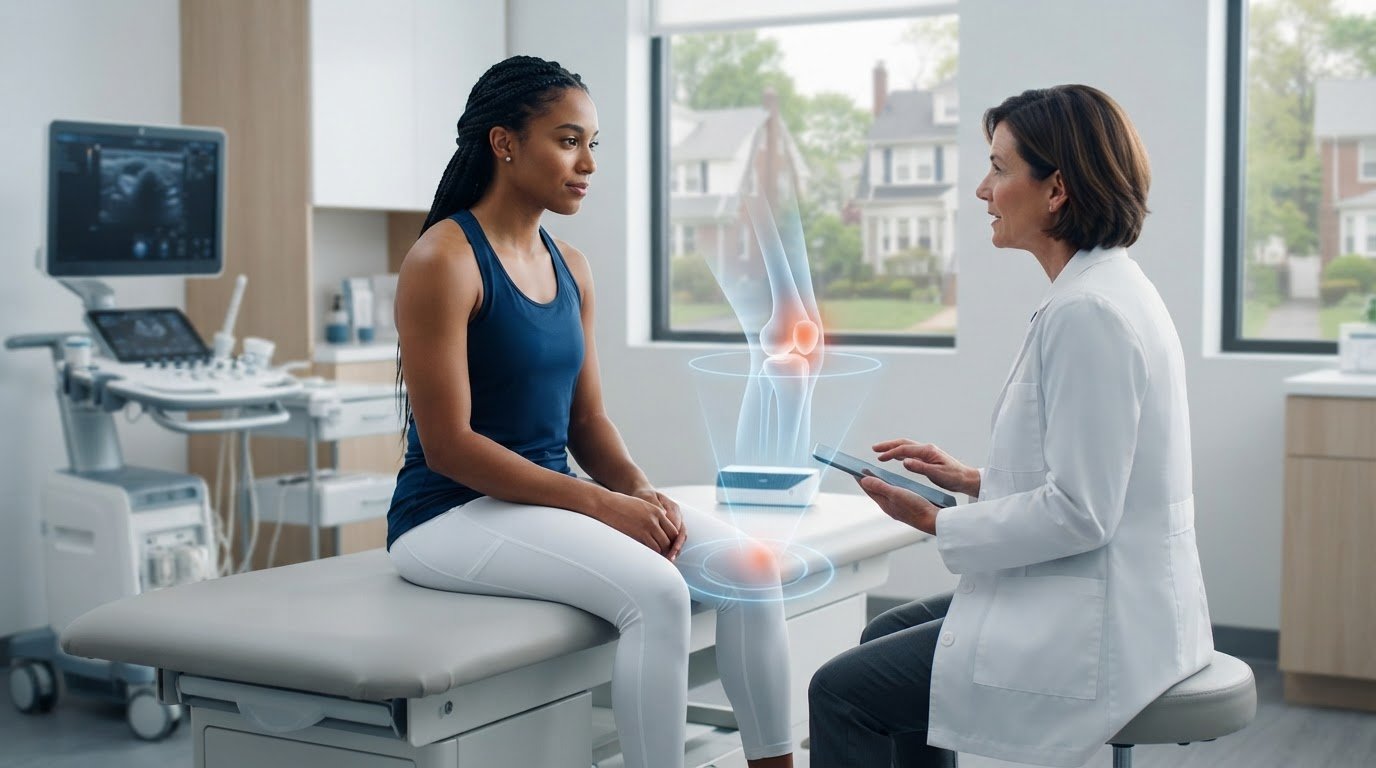
Could knee pain, clicking, or swelling mean you’ve torn a meniscus, or might another problem be causing your symptoms? If you’re looking for signs of a torn meniscus Nutley NJ, remember that symptoms can raise suspicion but can’t confirm a diagnosis on their own. Pain with twisting, stiffness, swelling, or a knee that catches or feels unstable are reasons to pay attention, especially when they interfere with walking or daily activities.
A suspected tear doesn’t automatically mean surgery. An orthopedic evaluation can help clarify what’s causing the symptoms and how the knee is functioning. A clinician may ask how the pain began, examine your knee, and consider imaging to investigate the diagnosis.
This article covers symptoms that may point to a meniscus injury, how clinicians assess a suspected tear, and what care options may be considered. At the Orthopaedic & Sports Medicine Institute in Nutley, NJ, a board-certified surgeon provides orthopedic care guided by clinical evaluation, with treatment tailored to the individual.
Key Takeaways
- Joint-line pain, swelling, stiffness, catching, or limited motion may occur with a meniscus injury, but symptoms alone can’t confirm a tear.
- The signs of a torn meniscus Nutley NJ can vary depending on how an injury happened and the tear’s pattern.
- An orthopedic evaluation starts with your injury history and a physical examination; imaging may help clarify the findings.
- Care is guided by clinical findings and may include activity changes and clinician-directed rehabilitation. Surgery isn’t automatic.
- For an assessment, note when symptoms began, which activities affect them, how they’ve changed, and bring prior imaging if available.
Signs of a Torn Meniscus in Nutley, NJ: Symptoms to Notice
Knee pain after a twist, pivot, or demanding activity can be unsettling, especially if swelling or clicking follows. These symptoms can occur with a meniscus tear, but they can also have other causes. The signs of a torn meniscus Nutley NJ are clues to discuss with a clinician, not a way to diagnose yourself.
The meniscus is a crescent-shaped pad of cartilage in the knee that helps cushion the joint and distribute forces between the thighbone and shinbone. Each knee has an inner and outer meniscus. A tear may cause pain or interfere with comfortable movement, but symptoms vary from person to person. A brief click, for example, does not by itself prove that the meniscus is damaged.
Common symptoms that may accompany a meniscus tear
Pain may be felt along the inner or outer joint line, where the thighbone and shinbone meet. It may become more noticeable when bending, squatting, or turning on a planted leg. Some people also notice tenderness around that part of the knee, although pain location alone can’t identify the injured structure.
Swelling may develop after an injury, but its timing and intensity vary. Stiffness can make it uncomfortable to bend the knee fully, while reduced motion may affect walking, getting up from a chair, or using stairs. A catching sensation can also occur. Clicking without pain or movement limits, however, may have causes unrelated to a tear. For a broader overview of possible causes and symptoms, see meniscus tear information.
When knee symptoms need prompt attention
A knee that feels stuck or cannot fully straighten should be assessed promptly, particularly if the loss of motion persists. Seek prompt medical assessment for severe pain or an inability to bear weight. Don’t force the knee through a painful block or rely on repeated self-tests to determine what is injured.
Some situations call for emergency medical services rather than routine appointment scheduling. If a knee injury is accompanied by a visible deformity, a foot that becomes numb or cold, or severe symptoms that feel like an emergency, seek urgent medical care. For less acute but persistent symptoms, an orthopedic assessment in Nutley can help clarify what may be causing the discomfort and what steps are appropriate. Take meaningful changes in pain, swelling, or motion seriously without assuming they confirm a meniscus tear.
How Meniscus Tear Symptoms Can Differ by Injury Pattern
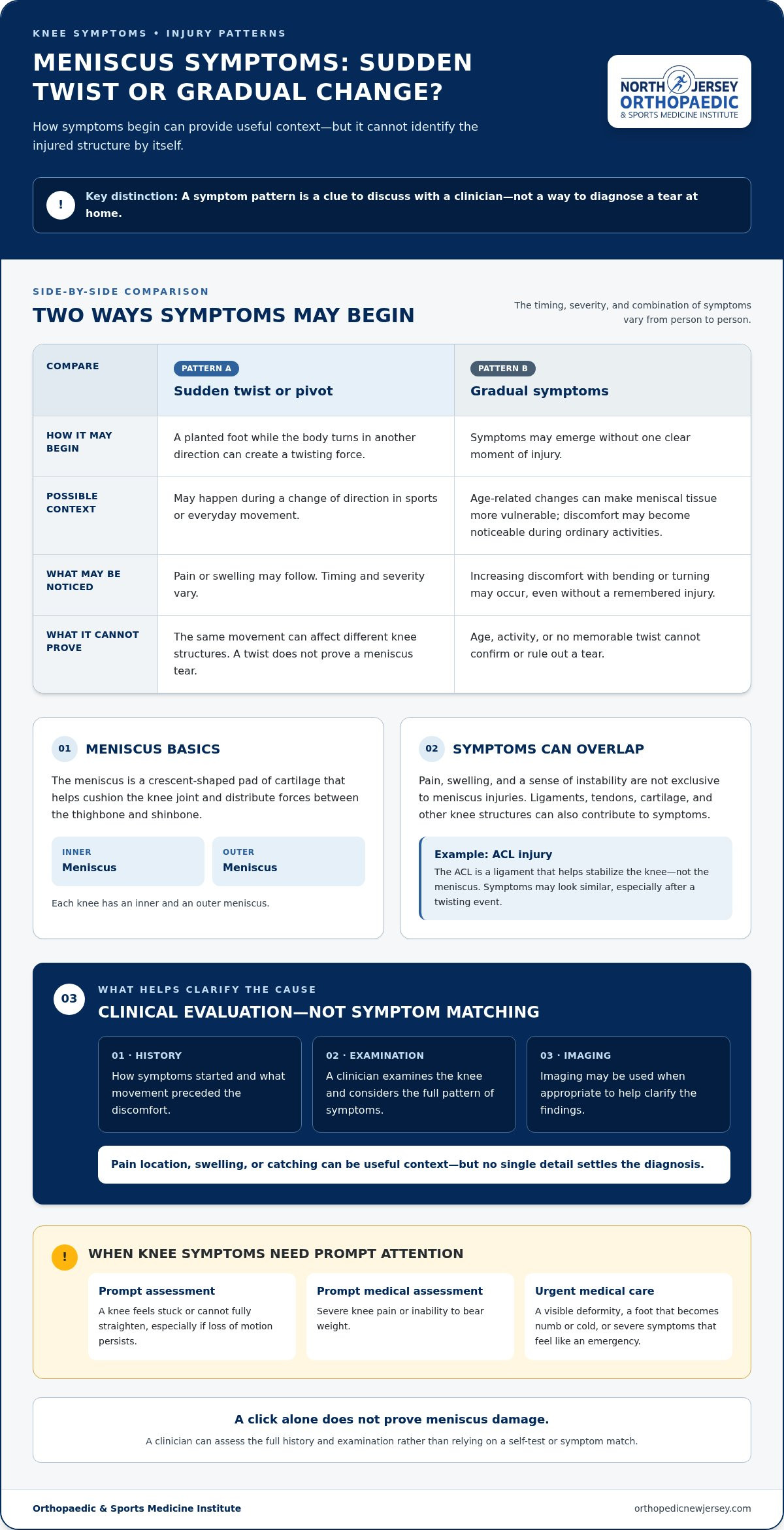
How knee symptoms begin can provide useful context, but it can’t identify the injured structure by itself. Some meniscus tears are associated with a sudden pivot or twist; others develop gradually without one clear moment of injury. The signs of a torn meniscus Nutley NJ can overlap with symptoms of other knee problems, so a clinician’s examination is more informative than comparing your experience with a checklist.
Sudden twisting injury versus gradual knee symptoms
For example, a planted foot while the body turns in another direction during a change of direction in sports or everyday movement can create a twisting force. Pain or swelling may follow. The timing and severity vary, and the same movement can affect different knee structures. It doesn’t prove that a meniscus tear occurred.
Not every tear follows a distinct accident. Meniscal tissue can become more vulnerable to age-related changes, and symptoms may emerge gradually during ordinary activities. Someone might notice increasing discomfort with bending or turning without recalling a specific injury. Age, activity, or the absence of a memorable twist cannot confirm or rule out a tear.
The tear’s location and pattern may also influence how the knee feels. One person may mainly notice pain at the inner or outer joint line, while another may experience catching or reduced motion. These differences are clues, not a reliable way to determine the tear’s shape or severity at home. The Mayo Clinic torn meniscus symptoms overview also describes how symptoms and causes can vary.
Meniscus symptoms compared with other knee injuries
Pain, swelling, and a sense of instability aren’t exclusive to meniscus injuries. Ligaments, tendons, cartilage, and other structures can also contribute to knee symptoms. An anterior cruciate ligament (ACL) injury, for example, affects a ligament that helps stabilize the knee, not the meniscus. Symptoms may look similar, especially after a twisting event, so comparing symptoms alone can be misleading.
Other details can help guide an assessment: what movement preceded the discomfort, where the pain is located, whether swelling developed, and whether the knee feels limited or unstable. No single detail settles the question. A clinician considers the full history and examination, and may use imaging when appropriate, rather than relying on a self-test or symptom match.
For separate information about ACL injuries and bridge-enhanced repair, see the BEAR Implant ACL repair guide. If ongoing knee symptoms make everyday movement difficult, an orthopedic assessment can help clarify their cause. The Orthopaedic & Sports Medicine Institute provides specialized orthopedic care in Nutley, where a board-certified surgeon can evaluate orthopedic injuries and help guide next steps.
How an Orthopedic Specialist Evaluates a Suspected Meniscus Tear in Nutley
Recognizing possible symptoms is only the beginning. If you’re searching for signs of a torn meniscus Nutley NJ, an orthopedic evaluation can help distinguish a meniscus injury from other causes of knee pain. Diagnosis is clinician-led: the provider considers how symptoms started, examines how the knee moves and functions, and decides whether imaging could add useful information. A symptom checklist or maneuver performed at home can’t establish the diagnosis.
What to expect during the knee examination
The visit typically begins with a discussion of when symptoms appeared and what you were doing at the time. The clinician may ask whether pain followed a twist or developed gradually, where discomfort is strongest, whether swelling occurred, and which activities are now difficult. Details such as trouble bending, walking, or using stairs help explain how the problem affects daily function.
During the physical examination, the clinician may assess tenderness around the knee, range of motion, and stability. They may also move or position the leg to evaluate how the joint responds. No single maneuver proves a meniscus tear: pain or discomfort during a test can have more than one explanation. The findings are considered alongside your history and overall knee function, rather than treated as a stand-alone result.
When imaging may help clarify the diagnosis
Imaging is considered in context, not automatically for every episode of knee pain. X-rays can show bones and help assess joint changes, but they don’t provide a detailed view of the meniscus. An MRI can show soft tissues, including structures within the knee, and may be considered when examination findings or ongoing symptoms make that information useful.
Each type of imaging answers different questions. The clinician weighs the examination, symptom history, and clinical context to decide whether imaging is appropriate and which study may help. Images are interpreted alongside the patient’s symptoms and examination, since a finding needs to be considered in relation to the reason for the visit.
- History: Helps establish when symptoms began, what activity preceded them, and how they have changed.
- Examination: Provides information about tenderness, motion, and stability.
- Imaging: May add detail about bones or soft tissues when clinically useful.
The examination shows how the knee behaves; imaging can reveal structures that a physical exam cannot directly show. Together, these sources of information help guide an assessment and next steps, rather than relying on symptoms alone.
For broader context on local orthopedic and sports medicine care, the sports medicine clinic guide near Montclair explains considerations related to specialized care. In Nutley, an orthopedic assessment with a board-certified surgeon can help clarify the cause of knee symptoms and inform an individualized plan based on clinical findings.
Meniscus Tear Treatment Options: Matching Care to the Findings
A suspected tear doesn’t automatically mean surgery. Care depends on symptoms, examination and imaging findings, tear characteristics, and the person’s health and activity needs. For readers researching signs of a torn meniscus Nutley NJ, the key point is that treatment decisions follow clinical evaluation, not symptoms alone or an MRI report in isolation.
Some people may be managed without a procedure, while persistent symptoms or particular injury findings may prompt a discussion of procedural options. The goal is to consider how the knee is functioning and choose an approach that fits the individual. A clinician can explain what each option involves and what limitations or recovery considerations may apply.
When nonsurgical care may be considered
Depending on the evaluation, care may include temporarily modifying activities that aggravate the knee and clinician-directed rehabilitation. The plan can be adjusted to symptoms and function rather than relying on a generic exercise routine. Rehabilitation may focus on restoring comfortable movement and supporting daily activity, but progress and results vary. Discuss medication or specific exercises with a clinician who understands your health and injury findings.
Activity modification doesn’t necessarily mean stopping all movement indefinitely. A clinician can help identify which activities may need adjustment while symptoms are assessed and managed. Changes in pain, swelling, or mobility can help guide follow-up and whether the plan should be reconsidered.
When a procedure may enter the discussion
A procedure may be discussed when symptoms and clinical findings indicate it could be appropriate. The tear’s location and pattern, the degree of discomfort or functional limitation, and the patient’s circumstances all matter. Two people with similar symptoms may therefore receive different recommendations. Neither repair nor removal of tissue is automatically suitable for every tear.
In general terms, meniscus repair aims to bring torn tissue together so it can heal. Partial meniscectomy removes a limited portion of damaged tissue when a clinician determines that approach is appropriate. The choice requires an individualized assessment, and a procedure does not guarantee a particular result. The minimally invasive orthopedic surgery guide offers broader context about procedural approaches.
- Nonsurgical care may involve clinician-guided activity changes and rehabilitation.
- Procedural care may be considered based on symptoms, examination, and the tear’s characteristics.
Clear answers about the options can make a treatment decision feel more manageable. An orthopedic evaluation in Nutley can connect symptoms and clinical findings to an individualized plan. Read about orthopedic evaluation to learn more about possible next steps.
When to Seek Meniscus Care from an Orthopedic Specialist in Nutley
Knee symptoms that continue to interfere with walking, work, exercise, or everyday tasks are a good reason to seek an orthopedic assessment. Consider arranging an evaluation if pain or swelling persists, your range of motion remains limited, or symptoms keep returning when you resume normal activities. You don’t need to know whether the meniscus is involved before seeking guidance. An assessment can help clarify what may be causing the problem and discuss appropriate next steps.
If symptoms are severe or you can’t bear weight, seek prompt medical attention rather than waiting for a routine appointment. For ongoing but less urgent concerns, keeping track of how the knee changes can help make a clinical visit more productive.
Preparing for an orthopedic appointment
A short timeline is often more useful than trying to remember every detail on the spot. Note when symptoms began, whether a particular movement or event came before them, and how they’ve changed since. Include practical details, such as which activities aggravate the knee and whether discomfort affects walking, stairs, work, or sleep.
Bring prior imaging reports or relevant medical records if they’re available. You can also write down questions about the examination or possible next steps. These notes don’t diagnose an injury, but they help the clinician understand your experience and connect it with the examination findings.
- Onset: When symptoms started and whether there was a specific event.
- Changes: How pain, swelling, or movement has changed over time.
- Function: Activities that have become difficult or uncomfortable.
- Records: Prior imaging or other relevant medical information, if available.
Finding local orthopedic guidance in North Jersey
People in Nutley and nearby communities, including Bloomfield, Clifton, Belleville, Lyndhurst, North Arlington, Kearny, and Verona, can seek orthopedic evaluation at the Orthopaedic & Sports Medicine Institute in Nutley, New Jersey. The practice provides specialized orthopedic and sports injury care, including care for knee injuries. A board-certified surgeon can assess the available clinical information and explain which options may fit the findings.
An evaluation is a step toward understanding the problem, not a commitment to surgery. Treatment decisions depend on individual symptoms and clinical findings, and care may involve different approaches. Preparing a clear account of your symptoms can make the discussion more focused and useful.
Learn more about orthopedic and sports injury care in Nutley.
Take the Next Step Toward Clearer Answers
If you’re searching for signs of a torn meniscus Nutley NJ, uncertainty is a reason to seek clarity, not to assume the worst. You don’t have to identify the exact injury or decide on treatment before an evaluation. A focused conversation about your knee can help you understand what may be affecting it and which next steps make sense for your situation.
At the Orthopaedic & Sports Medicine Institute, specialized orthopedic care is provided in Nutley by a board-certified surgeon. The practice also uses minimally invasive techniques as part of its orthopedic approach. Any care plan should reflect the clinical findings and your needs, giving you a clearer basis for decisions about moving forward.
Schedule an orthopedic evaluation in Nutley to discuss your knee symptoms and possible next steps.
Frequently Asked Questions
Can a torn meniscus heal on its own?
Some people find that symptoms improve with time and appropriate nonsurgical care, but improvement doesn’t prove the torn tissue has healed. Whether healing is possible depends on factors such as the tear’s characteristics and the individual’s circumstances. If knee pain, swelling, locking, or restricted movement persists, arrange a clinical evaluation. A clinician can assess what may be causing the symptoms and discuss whether continued observation or another approach is appropriate.
Is knee clicking always a sign of a torn meniscus?
No. Clicking can have several causes, and an occasional painless click doesn’t by itself diagnose a meniscus tear. Pay attention to whether it occurs with pain, swelling, a sensation that the knee catches or locks, or difficulty moving normally. If clicking keeps happening alongside these symptoms or interferes with daily activities, an orthopedic assessment can help clarify what’s going on without relying on self-diagnosis.
Can you walk with a torn meniscus?
Walking ability varies. Some people can walk despite pain or stiffness, while others have substantial difficulty with ordinary movement. Being able to bear weight doesn’t rule out a tear, and difficulty walking doesn’t identify its cause. Notice whether you’re changing how you walk, avoiding stairs, or struggling with routine tasks. Ongoing symptoms or a marked limit on function warrant clinical assessment.
Does an X-ray show a torn meniscus?
A standard X-ray doesn’t directly show the meniscus because it’s soft tissue. X-rays can help clinicians assess bones and certain joint changes; an MRI may be considered to evaluate soft tissues. For example, an X-ray may help answer a bone-related question, while an MRI can provide different information about structures within the knee. The clinician chooses imaging based on the examination and interprets results in context.
Can a meniscus tear happen without a sports injury?
Yes. A tear can follow a sudden twisting movement, but some develop gradually as meniscal tissue changes over time. You don’t need to recall a sports injury for symptoms to deserve attention. Knee pain that appears during everyday tasks, such as standing from a chair, can also have causes other than a meniscus tear. If symptoms persist or limit your routine, seek a clinical assessment rather than trying to identify the injury yourself.
What can happen if a meniscus tear is left untreated?
Outcomes vary. Some people improve, while others continue to have pain or movement limitations, depending on the tear and individual factors. An untreated tear doesn’t inevitably worsen, so it isn’t possible to predict the course from symptoms alone. Discuss persistent discomfort with an orthopedic clinician, especially if the knee locks or daily activities remain difficult. Patients in Nutley, Bloomfield, Clifton, Belleville, Lyndhurst, North Arlington, Kearny, and Verona can seek local orthopedic guidance.