Could the right next step for shoulder pain be an evaluation, not a decision about surgery? If pain or restricted movement is disrupting daily activities, it’s understandable to wonder whether arthroscopic shoulder surgery in Verona, NJ, could help or whether another treatment should come first. The answer depends on what’s causing your symptoms, how your shoulder functions, and what treatment you’ve already tried.
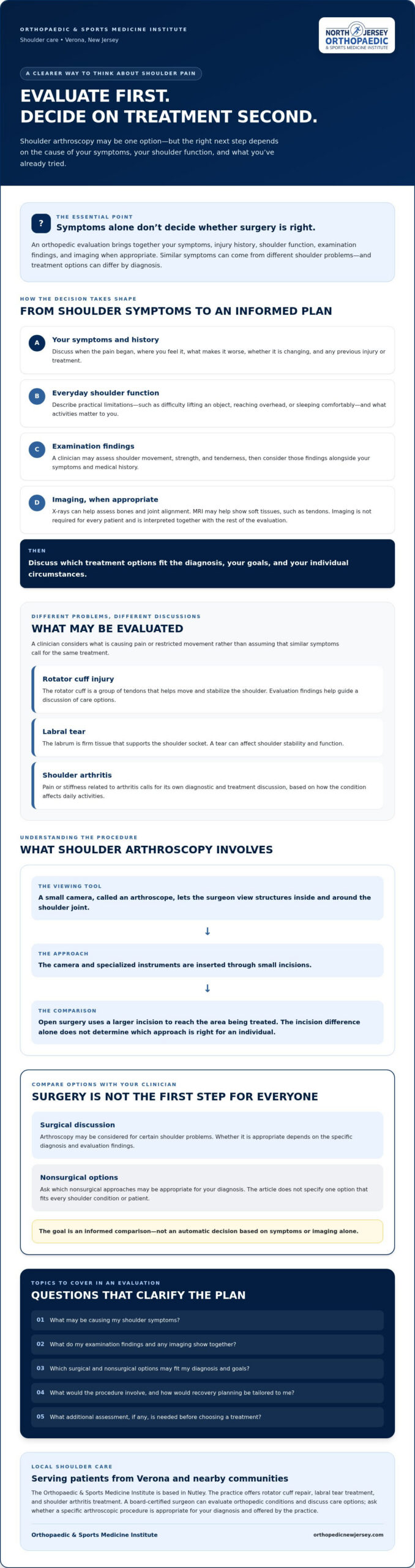
A careful diagnosis comes before choosing a procedure. During an orthopedic evaluation, a surgeon may review your symptoms and medical history, examine shoulder movement and strength, and consider imaging to understand the problem. Treatment options differ for rotator cuff injuries, labral tears, and shoulder arthritis. Surgery isn’t the first step for every patient.
This article explains what shoulder arthroscopy involves, when it may be considered, and what to ask about alternatives and recovery. It also explains how patients from Verona can discuss shoulder care with The Orthopaedic & Sports Medicine Institute, based in Nutley, and connect an evaluation with appropriate treatment options.
Key Takeaways
- Shoulder arthroscopy uses a small camera and instruments through small incisions. Whether it may be appropriate depends on the shoulder problem being treated.
- An evaluation brings together your symptoms, injury history, shoulder function, examination findings, and imaging when appropriate.
- Compare surgical and nonsurgical options with a clinician based on your diagnosis, goals, and individual circumstances.
- When considering arthroscopic shoulder surgery in Verona, NJ, ask what the procedure involves, what alternatives may be appropriate, and how recovery planning will be tailored to you.
- The Orthopaedic & Sports Medicine Institute is based in Nutley and serves patients from Verona and nearby communities seeking to discuss shoulder treatment options.
Arthroscopic shoulder surgery Verona NJ: when is it considered?
Persistent shoulder pain, difficulty reaching overhead, or limited movement after an injury can make ordinary tasks challenging. It’s natural to wonder whether surgery could help, but symptoms alone can’t determine whether arthroscopy is appropriate. An orthopedic evaluation can help identify the source of the problem and consider treatment options in light of your shoulder’s condition and your goals.
What does shoulder arthroscopy involve?
Shoulder arthroscopy is a surgical procedure that uses an arthroscope, a small camera, and specialized instruments inserted through small incisions. The camera lets a surgeon view structures inside and around the shoulder joint. A joint is where bones meet, tendons connect muscles to bones, and the labrum is a ring of firm tissue that helps support the shoulder socket.
Arthroscopy uses smaller incisions than open surgery, which involves a larger incision to reach the area being treated. That difference doesn’t mean one approach is right for everyone. The appropriate technique depends on the diagnosis and the treatment being considered. For a general overview of arthroscopic surgery, readers can review how this approach is used across different joints and conditions.
Which shoulder problems may lead to a surgical discussion?
A rotator cuff injury or a labral tear may prompt a conversation about treatment options. The rotator cuff is a group of tendons that helps move and stabilize the shoulder. The labrum supports the socket, so a tear can affect shoulder stability and function. Whether surgery is considered depends on the specific injury and evaluation findings. Learn more about the procedure in this arthroscopic rotator cuff repair guide.
Shoulder arthritis calls for its own diagnostic and treatment discussion. The right next step depends on what’s causing pain or stiffness and how the condition affects daily activities. A surgeon can explain which options may fit the diagnosis instead of assuming that similar symptoms call for the same treatment.
For people researching arthroscopic shoulder surgery Verona NJ, The Orthopaedic & Sports Medicine Institute is based in Nutley and serves patients from Verona and surrounding communities. The practice offers rotator cuff repair, labral tear treatment, and shoulder arthritis treatment. A board-certified surgeon can evaluate orthopedic conditions and discuss care options. Ask whether a specific arthroscopic procedure is appropriate for your diagnosis and offered by the practice.
How a surgeon evaluates shoulder pain before recommending arthroscopy
A recommendation for shoulder surgery begins with understanding the problem, not choosing a procedure. During an evaluation, a surgeon considers how symptoms began, which movements are affected, whether there was an injury, and what treatments you’ve tried. These details help distinguish conditions that can feel similar but may call for different care.
What happens during a shoulder evaluation?
The discussion may cover when the pain started, where you feel it, which activities make it worse, and whether symptoms are changing. Be specific about practical limitations, such as trouble lifting an object, reaching overhead, or sleeping comfortably. The clinician may also ask about previous injuries and treatments, including whether they helped.
A physical examination may assess shoulder movement, strength, and tenderness. The clinician considers these findings alongside your symptoms and medical history, then determines whether imaging or further assessment is appropriate. No single symptom or examination finding automatically establishes that surgery is the right choice.
How imaging helps clarify the diagnosis
Imaging can provide additional information when clinically indicated. X-rays can help assess bones and joint alignment, while magnetic resonance imaging (MRI), which uses magnetic fields and radio waves to create detailed images, may help show soft tissues such as tendons. An MRI isn’t required for every patient, and imaging results need to be considered alongside symptoms and examination findings.
If you’ve had prior imaging, bring the reports and, if available, the images themselves. Relevant medical records and a list of treatments you’ve tried can also make the discussion more complete. The surgeon can explain what the findings mean, whether further assessment is needed, and how the diagnosis relates to your concerns and goals. The American Academy of Orthopaedic Surgeons offers an overview of when shoulder arthroscopy is recommended, including the role of diagnosis and treatment options.
Diagnosis guides treatment: the same shoulder symptoms can have different causes, and each cause may call for a different plan. That’s why an evaluation considers symptom duration, daily function, injury history, examination findings, and imaging when appropriate, rather than relying on a scan or symptom alone.
If you’re exploring arthroscopic shoulder surgery in Verona, NJ, you can discuss the evaluation and treatment options with a board-certified surgeon at The Orthopaedic & Sports Medicine Institute in Nutley. The practice serves patients from Verona and nearby communities. Learn more about the orthopedic practice serving Verona-area patients.
Arthroscopic surgery or nonsurgical care: how shoulder options compare
A shoulder diagnosis doesn’t automatically mean surgery is needed. Treatment choices depend on what’s causing the symptoms, how much they interfere with daily activities, your goals, and the clinician’s assessment. For some conditions, nonsurgical care may be discussed. For others, a surgeon may consider whether an operation could address the diagnosed problem. There isn’t one pathway for every shoulder condition.
When might nonsurgical treatment be discussed first?
Depending on the diagnosis and individual circumstances, a clinician may discuss options such as modifying activities that aggravate symptoms, medication, or physical therapy. These approaches have different purposes and considerations. Ask what each option is intended to address and how its effects will be assessed. Nonsurgical treatment can’t be assumed to resolve symptoms or prevent surgery in every case.
Describe which tasks are difficult and what matters most to you, such as returning to a particular activity or managing discomfort during everyday movement. That context can help the clinician explain how possible options align with your needs, along with their limitations and what to consider if symptoms continue.
When might arthroscopic treatment enter the conversation?
Arthroscopic treatment may be discussed for selected shoulder conditions, but a diagnosis alone doesn’t establish that it’s appropriate. A surgeon considers symptoms, examination findings, imaging when relevant, and treatments already tried. A rotator cuff injury and a labral tear affect different structures, so the treatment discussion depends on the specific findings and how they relate to pain or reduced function. Read more in this labral tear shoulder treatment guide.
Before deciding, ask the surgeon to explain the purpose of a proposed procedure, what alternatives may be suitable, and what recovery could involve for your diagnosis. MedlinePlus also provides information about recovering from shoulder arthroscopy, which can help you prepare questions about postoperative care. General educational information is not a substitute for guidance based on your examination and medical history.
If you’re considering arthroscopic shoulder surgery Verona NJ, a consultation can help clarify the diagnosis and compare options without assuming surgery is necessary. The Orthopaedic & Sports Medicine Institute is based in Nutley and serves patients from Verona and nearby communities. Learn more about the orthopedic team serving Verona-area patients, and ask whether a specific arthroscopic procedure is appropriate for your condition and offered by the practice.
Preparing for shoulder arthroscopy and planning recovery
When a surgeon and patient are considering arthroscopy, preparation means understanding the proposed procedure and planning for care afterward. Follow the care team’s instructions, and make sure they know your medical history, current medications, allergies, and relevant health conditions. Don’t change or stop medication unless your clinician tells you to.
Practical arrangements matter, too. Ask what transportation and at-home help may be recommended, and plan ahead for tasks that could be difficult while your shoulder is recovering. The details depend on the procedure and your circumstances. For a broader overview of minimally invasive approaches, see this minimally invasive orthopedic surgery guide.
Questions to ask before scheduling surgery
Clear answers can help you make an informed decision. Before scheduling, consider asking:
- What diagnosis would the procedure address, and how do the examination and imaging findings support it?
- What alternatives are reasonable for my condition, and what are the potential benefits and material risks of each option?
- Which personal or medical factors could affect the expected result or influence the plan?
- What preparation should I follow, and will I need transportation or help at home after the procedure?
Ask the surgeon to explain unfamiliar terms and how the proposed treatment relates to your priorities, such as improving a particular daily activity. Before deciding how to proceed, make sure you understand the procedure’s purpose and the alternatives.
What should patients clarify about recovery?
Recovery isn’t identical for every patient. It can vary with the diagnosis, the procedure performed, and individual factors, so another person’s experience isn’t a reliable schedule for your care. Ask when follow-up begins, whether physical therapy may be part of your plan, and how the team will guide your progress.
Clarify how you’ll receive instructions for wound care, medication, and activity restrictions. Ask which changes or concerns should prompt you to contact the care team, and whom to reach with questions. Keep the instructions accessible at home so anyone helping you can follow the same guidance.
If you’re considering arthroscopic shoulder surgery Verona NJ, discussing preparation and recovery with a surgeon can help you understand what a plan may involve for your diagnosis. The Orthopaedic & Sports Medicine Institute is based in Nutley and serves patients from Verona and nearby communities. Discuss shoulder treatment options with the orthopedic team.
Discuss arthroscopic shoulder surgery near Verona with a local orthopedic team
The next step is a conversation focused on your diagnosis, treatment choices, and what you hope to regain in daily life. A shoulder evaluation can help clarify whether arthroscopy is relevant to your condition, what alternatives may be considered, and what further information is needed. A diagnosis doesn’t automatically mean surgery is appropriate.
The Orthopaedic & Sports Medicine Institute is based in Nutley, New Jersey, and serves patients from Verona and nearby communities. A board-certified surgeon provides orthopedic care, and the practice’s shoulder-related offerings include rotator cuff repair, labral tear treatment, and shoulder arthritis treatment. Ask whether a specific arthroscopic procedure is offered and whether an evaluation may be appropriate for your concerns.
What to bring to an orthopedic appointment
A little preparation can help you use the appointment well. Bring a concise timeline of your symptoms, including when they began and how they affect your activities. Note any injury, previous treatment, and whether it helped. Have relevant medical history and a current medication list available, along with prior imaging reports or other records you can access.
Consider writing down questions in advance, such as:
- What diagnosis best explains my symptoms, and what findings support it?
- What nonsurgical options may be appropriate for my condition?
- If surgery is discussed, what benefits, risks, and alternatives should I understand?
- What might preparation and recovery involve, including follow-up and activity guidance?
How to take the next step from Verona, NJ
Before making plans, confirm the Nutley office location and current appointment details directly with the practice. During a consultation, you can discuss your symptoms and goals, review relevant findings, and ask whether shoulder arthroscopy is a reasonable option to consider. The conversation can also clarify which approaches match the diagnosis, without assuming surgery is necessary.
If you’re researching arthroscopic shoulder surgery Verona NJ, start with the questions that matter most to your situation. A clear discussion can help you understand the diagnosis and make an informed decision about what to do next. Contact the practice to discuss shoulder care.
Take the next step toward a clearer shoulder care plan
Deciding whether to consider surgery starts with understanding what’s behind your shoulder symptoms. An evaluation can connect the diagnosis with appropriate options, clarify what nonsurgical care may involve, and help you prepare questions about risks and recovery. A shoulder problem doesn’t automatically call for an operation.
For those researching arthroscopic shoulder surgery Verona NJ, The Orthopaedic & Sports Medicine Institute in Nutley serves Verona and nearby communities, including Bloomfield, Clifton, Belleville, Lyndhurst, North Arlington, and Kearny. A board-certified surgeon provides orthopedic care, including rotator cuff repair and labral tear treatment. Ask the practice whether an evaluation fits your concerns and whether a specific procedure is offered.
Bring your questions and relevant records, and use the conversation to understand the choices for your individual diagnosis. Contact the practice to discuss shoulder care.
Frequently Asked Questions
Is arthroscopic shoulder surgery always necessary for a rotator cuff tear?
No. A rotator cuff tear doesn’t automatically mean surgery is needed. The decision depends on the tear, symptoms, examination findings, activity goals, and response to other treatment. An orthopedic evaluation can help connect the diagnosis with appropriate options. Before deciding, ask the surgeon to explain potential benefits, material risks, and alternatives, including whether nonsurgical care may be reasonable in your circumstances.
How long does recovery from arthroscopic shoulder surgery take?
Recovery varies with the condition treated, the procedure performed, and individual health and rehabilitation factors. There isn’t one timeline that applies to every patient. Ask your surgeon what milestones may guide your progress, when follow-up and physical therapy may begin, and which activities may need to be limited. Follow the care team’s instructions for your situation rather than comparing your recovery with someone else’s.
What happens during arthroscopic shoulder surgery?
During arthroscopic surgery, a surgeon uses a small camera and specialized instruments inserted through small incisions to view and treat selected structures in or around the shoulder. The exact steps depend on the diagnosis and planned procedure. Before surgery, ask the care team to explain the intended treatment, anesthesia plan, material risks, and recovery expectations in language you understand. The procedure should be discussed in relation to your evaluation findings.
Can shoulder problems improve without arthroscopic surgery?
Some shoulder conditions may be managed without surgery, depending on the diagnosis, symptoms, and clinical assessment. A clinician may discuss activity changes, medication, or physical therapy when appropriate. These options aren’t suitable for every condition, and outcomes vary. Ask which approaches fit your circumstances, how progress will be assessed, and when to return for reassessment if symptoms persist or shoulder function changes.
How do I know whether I need shoulder surgery?
Pain or restricted movement alone can’t determine whether surgery is needed. A clinician considers your history, physical examination, diagnosis, imaging when appropriate, and response to previous treatment. The discussion should address alternatives, possible benefits and risks, and your activity goals. If you’re researching arthroscopic shoulder surgery Verona NJ, an orthopedic evaluation can help clarify what’s causing your symptoms and which options may be appropriate.
Can I see an orthopedic surgeon near Verona, NJ, for shoulder pain?
The Orthopaedic & Sports Medicine Institute is based in Nutley and serves patients from Verona and nearby communities, including Bloomfield, Clifton, Belleville, Lyndhurst, North Arlington, and Kearny. A board-certified surgeon provides orthopedic care, with offerings that include rotator cuff repair and labral tear treatment. Contact the practice directly to confirm current office details and appointment availability, and ask whether an evaluation may help assess your shoulder symptoms.
What should I ask a surgeon before arthroscopic shoulder surgery?
Ask what diagnosis the procedure would address, why it’s being considered, and what alternatives may be reasonable. Discuss expected benefits, material risks, and factors that could affect your individual outcome. Clarify preparation instructions, follow-up, rehabilitation, activity restrictions, and whom to contact with concerns. You can also ask how the proposed plan relates to your personal goals. Clear answers help you make an informed decision with your care team.