What if pain that’s limiting your workouts or daily activities needs more than extra rest? If you’ve searched “sports injury clinic near me Clifton,” you may be trying to figure out whether an orthopedic specialist can evaluate the injury and explain what to do next. That uncertainty is understandable, especially when local results include orthopedic practices, urgent injury clinics, and rehabilitation centers.
A specialist evaluation can help clarify what may be contributing to pain or reduced function and whether further assessment or treatment should be considered. The Orthopaedic & Sports Medicine Institute, based in nearby Nutley, serves Clifton-area patients with care from a board-certified surgeon for knee, shoulder, and tendon injuries. Treatment depends on the individual injury and clinical findings, and surgery isn’t necessary for every condition.
This article explains which sports injuries may benefit from orthopedic evaluation, what an appointment can help clarify, and what treatment paths may be considered. You’ll also learn how the practice’s care for ACL and rotator cuff conditions connects to specialist treatment, so you can plan a clear next step without assuming a diagnosis or outcome.
Key Takeaways
- A sports injury evaluation considers your symptoms, activity limitations, and relevant history to help clarify what may be causing the problem.
- Searching for a sports injury clinic near me Clifton can lead to different types of care; this article explains how specialist orthopedic evaluation fits into the picture.
- Orthopedic treatment discussions may include nonsurgical approaches or procedures, depending on the diagnosis, injury characteristics, and your goals.
- Make your next step more productive by noting when symptoms began, which movements are affected, your activity goals, and any care you’ve already received.
- The Orthopaedic & Sports Medicine Institute serves Clifton from nearby Nutley, with a board-certified surgeon who treats knee, shoulder, and tendon injuries.
Sports Injury Clinic Near Clifton, NJ: When Orthopedic Evaluation Can Help
Pain can make a familiar run, workout, or everyday movement feel uncertain. You may want to return to activity safely, but first need to understand what’s causing the problem and whether it calls for specialist attention. A search for a sports injury clinic near me Clifton can bring up orthopedic practices, injury clinics, and physical therapy locations. Knowing their roles can help you identify the kind of care you’re seeking.
A sports injury clinic evaluates musculoskeletal problems related to physical activity and guides appropriate treatment. Sports injuries aren’t limited to competitive athletes: runners, gym-goers, recreational players, and active people can also experience joint or tendon problems. A broad overview of sports injury types and causes can provide context, but it can’t determine what’s behind your individual symptoms.
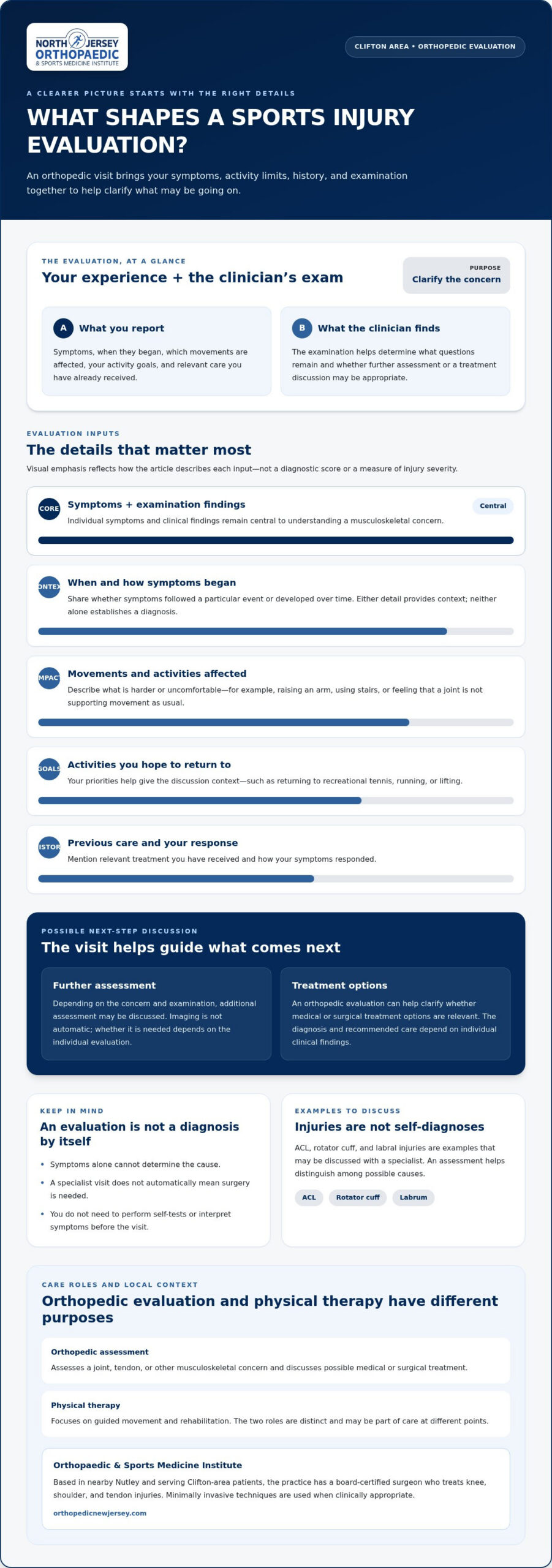
Orthopedic evaluation assesses a joint, tendon, or other musculoskeletal concern to clarify the problem and discuss medical or surgical treatment options. Physical therapy focuses on guided movement and rehabilitation. These roles are distinct, though they may be part of care at different points. An orthopedic assessment can help determine whether the concern needs specialist medical attention and what next steps may be appropriate. It doesn’t automatically mean surgery is needed.
Which sports injuries may need an orthopedic specialist?
Consider professional assessment when pain persists, a joint feels unstable, or reduced function interferes with exercise or daily activities. The Nutley-based practice treats knee, shoulder, and tendon injuries. An ACL injury, rotator cuff problem, or labral injury may be examples to discuss with a specialist, not diagnoses to make based on symptoms alone. An evaluation can help distinguish among possible causes and guide the next step.
Why Clifton residents may look beyond general injury care
When an injury affects a joint or tendon, an orthopedic perspective can help connect symptoms and activity limitations with the structures involved and potential treatment paths. That’s different from assuming every injury needs the same type of care. The Orthopaedic & Sports Medicine Institute is based in Nutley and serves Clifton and other North Jersey communities. Its board-certified surgeon treats knee, shoulder, and tendon injuries, using minimally invasive techniques when clinically appropriate.
For someone comparing local results, the key question is what kind of assessment can clarify the injury. A rehabilitation-focused visit and an orthopedic evaluation have different purposes. If symptoms are ongoing, instability is affecting activity, or function has declined, a specialist assessment can help establish whether an orthopedic treatment discussion is relevant. The diagnosis and recommended care depend on individual clinical findings.
What Happens During a Sports Injury Evaluation Near Clifton?
A first orthopedic visit is a clinical assessment, not a promise of a particular test or immediate diagnosis. The clinician gathers information about the injury, reviews how it affects movement and activity, and considers relevant prior care. These details help shape the examination and determine whether further assessment or a treatment discussion may be appropriate. Searching for a sports injury clinic near me Clifton may bring up different types of care, but an orthopedic evaluation focuses on understanding a musculoskeletal concern and its possible medical or surgical implications.
Sports injury research can help explain why careful assessment matters. The NCAA’s sports injury prevention and data program tracks injury patterns in collegiate athletics. Such population-level information provides context, but it can’t identify the cause of one person’s pain. Individual symptoms and clinical findings remain central to an orthopedic assessment.
How symptoms, activity, and injury history inform the assessment
The clinician may ask when symptoms began, whether they followed a particular event, and which movements make them worse or limit activity. A sudden change during a game and discomfort that develops over time provide different context, but neither alone establishes a diagnosis. The clinician may also ask what activities matter most to you, such as returning to recreational tennis, running, or lifting.
Be ready to describe practical limitations: trouble raising an arm, discomfort with stairs, or a sense that a joint isn’t supporting movement as usual. Mention relevant prior treatment and how symptoms responded. You don’t need to perform self-tests or interpret symptoms before the visit; those details are best considered alongside the clinician’s examination.
How the evaluation can guide next-step discussions
Examination findings help the clinician decide what questions remain and what next steps may be useful. Depending on the concern, additional assessment may be discussed. Imaging isn’t automatic, and whether it’s needed depends on the individual evaluation. The goal is to build a clearer understanding of the injury rather than assume one test or treatment suits every patient.
An orthopedic treatment plan should reflect the injury, the individual evaluation, and the patient’s goals. Findings may lead to a discussion of nonsurgical care, a procedure, or further assessment before options are considered. If a procedure is relevant, factors such as the affected structure and injury characteristics inform the conversation. Learn more about minimally invasive orthopedic surgery and how this approach may be considered when clinically appropriate.
For Clifton-area patients, The Orthopaedic & Sports Medicine Institute provides orthopedic care from its Nutley practice. If persistent symptoms or activity limitations raise questions about a knee, shoulder, or tendon injury, explore orthopedic sports injury care. The evaluation guides the discussion, but it doesn’t predetermine a diagnosis or outcome.
Sports Injury Treatment Options: Matching Orthopedic Care to the Injury
After an orthopedic evaluation, the next conversation is about which care paths may fit the findings. A search for a sports injury clinic near me Clifton may surface providers with different focuses, so it helps to know that orthopedic care can include discussions about nonsurgical approaches as well as procedures. Neither path is automatic. The diagnosis, injury characteristics, and your activity goals all matter.
The comparison below describes the focus of each discussion, not a treatment recommendation. Your clinician can explain which options are relevant to your situation.
| Discussion | What it may focus on | What guides the conversation |
|---|---|---|
| Evaluation-led nonsurgical care | Whether the injury can be managed without a procedure, and what medical care or activity adjustments may be considered. | Clinical findings, symptoms, functional limits, and personal goals. |
| Procedure options | Whether a surgical approach may be appropriate for the identified injury. | The affected structure, injury characteristics, and expected considerations of the procedure. |
These categories aren’t competing promises or fixed steps. A clinician may recommend additional assessment before discussing a path, and treatment can depend on how the injury affects function. The practice offers minimally invasive orthopedic surgery, but it isn’t a universal recommendation. Whether it’s appropriate depends on the individual clinical assessment and the procedure being considered.
When a nonsurgical treatment discussion may be appropriate
Not every sports injury requires surgery. After reviewing the examination findings, the treating clinician may discuss whether nonsurgical care is appropriate and how it relates to the patient’s symptoms and goals. For example, a person hoping to resume recreational activity may have different priorities from someone whose work requires repeated lifting. The discussion should explain the reasoning and relevant next steps, rather than assume one approach fits every injury.
When a procedure may enter the treatment discussion
If the evaluation identifies an injury for which surgery may be considered, the clinician can explain the relevant procedure and how the injury’s features inform that choice. The Orthopaedic & Sports Medicine Institute offers BEAR® Implant ACL repair and rotator cuff repair, as well as treatment for shoulder arthritis and labral tears. These are distinct conditions, and treatment discussions depend on individual findings. Seeking an orthopedic assessment doesn’t mean a procedure is necessary.
For more detail about one specific ACL treatment, the BEAR® Implant ACL repair guide explains the approach. In any procedure discussion, ask how the diagnosis, your functional priorities, and the characteristics of the injury relate to the options being considered. This keeps the decision focused on your case without assuming a guaranteed result or fixed recovery timeline.
Finding Sports Injury Care Near Clifton: Preparing for Your Next Step
Once you decide to seek an orthopedic opinion, a little preparation can make it easier to explain what has changed and what you hope to do next. If you’re searching for a sports injury clinic near me Clifton, consider the type of care you need and the clinician’s focus. For a joint or tendon concern, clear notes about symptoms and activity limits can make the consultation more informative.
What information to bring to an orthopedic consultation
You don’t need to arrive with a diagnosis. A concise account of the injury and its effect on your routine gives the clinician useful context. Before the visit, consider noting:
- When symptoms began and whether they followed a specific incident or developed gradually.
- Which movements or activities bring on discomfort, and what tasks have become difficult.
- Your activity goals, such as returning to a sport, exercise routine, or demanding daily task.
- Relevant medical history, medications, and any treatment you’ve already received.
- Existing reports or images, if you already have them.
Keep the timeline simple. For example, note whether symptoms have stayed consistent, changed, or returned after activity. You can also write down questions, such as what the evaluation may clarify or what options could be discussed. These notes support the conversation; they don’t replace the clinician’s assessment or establish a diagnosis on their own.
How to think about location and specialist fit
Location is one consideration, but the type of expertise matters too. The Orthopaedic & Sports Medicine Institute is based in Nutley and serves patients from Clifton and surrounding North Jersey communities, including Bloomfield, Belleville, Lyndhurst, North Arlington, Kearny, and Verona. Its focus includes orthopedic and sports injury care for knee, shoulder, and tendon concerns. A board-certified surgeon provides care, and minimally invasive techniques may be considered when clinically appropriate.
When reviewing local search results, keep the difference between an orthopedic consultation and a rehabilitation-focused service in mind. An orthopedic evaluation centers on assessing a musculoskeletal injury and considering medical or surgical treatment options. A therapy visit has a different focus. The institute provides orthopedic evaluation and treatment for sports-related injuries. For additional context on specialist care in the neighboring area, explore this sports medicine clinic guide near Montclair.
Seek emergency services rather than a routine orthopedic appointment for a severe or potentially life-threatening injury. For concerns that aren’t emergencies but continue to affect movement or activity, an orthopedic consultation can help clarify what’s going on. If you’re ready to discuss a sports-related orthopedic concern, request an orthopedic evaluation.
Orthopedic Sports Injury Care Near Clifton at The Orthopaedic & Sports Medicine Institute
For active people in Clifton and nearby North Jersey communities, specialist orthopedic care is available close by in Nutley. The Orthopaedic & Sports Medicine Institute provides orthopedic and sports injury care for patients seeking an assessment of a knee, shoulder, or tendon concern. A board-certified surgeon provides care, with attention to the specific injury and how it affects a person’s activities.
A specialist focus for knee, shoulder, and tendon injuries
Sports injuries can affect more than performance. Pain or limited movement may also complicate exercise, work, or ordinary daily tasks. The practice treats knee, shoulder, and tendon injuries, offering an orthopedic perspective for active patients with these concerns. An evaluation can help clarify what may be contributing to symptoms and whether medical or surgical treatment discussions are relevant.
A specialist assessment doesn’t mean every injury calls for a procedure. Treatment recommendations depend on clinical findings, injury characteristics, and individual priorities. A person hoping to resume a recreational activity may have different goals from someone whose job involves repeated physical demands. Sharing those priorities helps the clinician understand what function matters most and shape a relevant discussion.
The institute offers orthopedic care for ACL and shoulder conditions. Minimally invasive techniques are among the surgeon’s capabilities and may be considered when clinically appropriate. The method of care depends on the condition and evaluation; no approach should be assumed before an individual assessment. This distinction matters for anyone searching sports injury clinic near me Clifton and comparing orthopedic care with services focused on other aspects of injury support.
Take the next step toward an orthopedic assessment
Choosing a nearby practice can make it easier to focus on the important question: what kind of specialist assessment fits the concern? The Orthopaedic & Sports Medicine Institute is based in Nutley and serves Clifton and surrounding North Jersey communities. Its orthopedic and sports injury care, provided by a board-certified surgeon, is available for knee, shoulder, and tendon issues affecting activity or daily function.
Review the practice’s orthopedic services and consider how they relate to your concern. If you’re ready to discuss an injury, arrange a consultation with the institute. Bring a clear account of your symptoms and the activities you hope to return to. The evaluation can guide a discussion of appropriate next steps without presuming a diagnosis, procedure, or outcome.
Take a Clear Step Toward Your Next Activity
Choosing care is also an opportunity to define what you want help with. Before moving forward, think about the activity or everyday movement you most want to make easier, and what questions would help you understand your options. That focus can make a specialist conversation more personal and useful, without assuming what diagnosis or treatment you’ll need. A search for a sports injury clinic near me Clifton is a starting point; your next step can be a focused discussion about your own goals and concerns.
If ongoing pain or reduced function is holding you back, you don’t have to decide on a treatment path alone. An orthopedic consultation can help you understand the clinical considerations and discuss appropriate next steps. Request an orthopedic consultation with The Orthopaedic & Sports Medicine Institute to begin that conversation. Bring clear questions and discuss the activities that matter to you.
Frequently Asked Questions
Does a sports injury clinic treat people who are not competitive athletes?
Yes. Sports injury care can be relevant to anyone whose active routine leads to a musculoskeletal concern, not only athletes on organized teams. For example, a recreational cyclist with persistent knee discomfort or a person who lifts weights and has shoulder pain may want an orthopedic assessment. If you searched for a sports injury clinic near me Clifton, consider whether you need evaluation of a joint or tendon problem, regardless of your competition level.
Can I see an orthopedic specialist for a sports injury even if I have not had imaging?
Yes. You can seek an orthopedic assessment without having had imaging first. The clinician can review your symptoms and examine the affected area to determine what additional assessment, if any, may be useful. If you already have reports or images from earlier care, bring them so they can be considered in context. Don’t assume a particular scan is necessary or arrange one solely because you’re preparing for a consultation.
Does every sports injury need surgery?
No. Surgery is not necessary for every sports injury, and symptoms alone don’t determine whether a procedure is appropriate. The clinician considers the diagnosis, the structures involved, the injury’s characteristics, and your priorities before discussing possible care. For instance, two people with shoulder pain may have different underlying issues and different treatment considerations. An orthopedic consultation helps establish which options are relevant to your case, without guaranteeing a specific treatment or result.
What should I bring to a sports injury consultation?
Bring any existing medical reports or imaging related to the injury, plus a current list of medications and relevant medical conditions or allergies. If another clinician has evaluated the problem, note their name and any care already discussed. It can also help to write down questions you don’t want to forget, such as what the evaluation suggests and what decisions may come next. These details help keep the conversation focused on your health history and concerns.
Is The Orthopaedic & Sports Medicine Institute located in Clifton, NJ?
No. The Orthopaedic & Sports Medicine Institute is based in Nutley, New Jersey, and serves patients from Clifton and nearby North Jersey communities. Care is provided by a board-certified surgeon for knee, shoulder, and tendon injuries. The practice’s Nutley location serves patients from Clifton and surrounding communities.
When should a sports injury be treated as an emergency?
Seek emergency services for a severe or potentially life-threatening injury rather than waiting for a routine orthopedic appointment. Examples include a serious injury with heavy bleeding, loss of consciousness, trouble breathing, or another immediate threat to health. For an injury that isn’t an emergency but continues to limit movement or activity, an orthopedic evaluation may help clarify next steps. If you’re uncertain about immediate danger, contact emergency services for urgent guidance.