What if the standard advice to wait weeks for your knee swelling to subside is actually the one thing preventing you from a graft-free recovery? For many athletes and active residents in Essex County, seeking an ACL tear diagnosis Bloomfield NJ is often met with the assumption that a traditional reconstruction is the only path forward. However, the physiological window for modern, restorative treatments is narrow, making the speed and accuracy of your initial evaluation more critical than ever.
We understand the frustration of sudden instability and the fear that a surgical recovery will sideline you for a year or more. It’s common to feel caught between the hope of a simple sprain and the reality of a tear. You deserve a clear, professional roadmap. This article will show you how a board-certified specialist uses advanced diagnostics to provide the certainty you need while opening the door to innovative, patient-centered solutions.
You’ll learn about the specific clinical tests used to confirm a rupture, the role of high-resolution imaging, and why the BEAR® implant offers a revolutionary alternative to traditional grafts. We’ll outline exactly how a precise diagnosis within the first 50 days can change your long-term outcome and provide a direct path to reclaiming your mobility.
Key Takeaways
- Identify the critical clinical signs of a ligament rupture, such as immediate swelling and the “pop” sensation, to understand why early intervention is vital for recovery.
- Learn the precise steps involved in a professional ACL tear diagnosis Bloomfield NJ, from manual stability tests to the interpretation of high-resolution MRI scans.
- Discover how to prepare for your specialist consultation by organizing your medical history and imaging to ensure an efficient and accurate evaluation.
- Explore advanced recovery options like the BEAR® Implant, which allows for native ligament healing and may reduce the long-term risk of osteoarthritis.
- Understand the importance of seeing a board-certified specialist who can differentiate between a standard sprain and a complex tear requiring modern intervention.
Recognizing the Signs: When to Seek an ACL Tear Diagnosis in Bloomfield
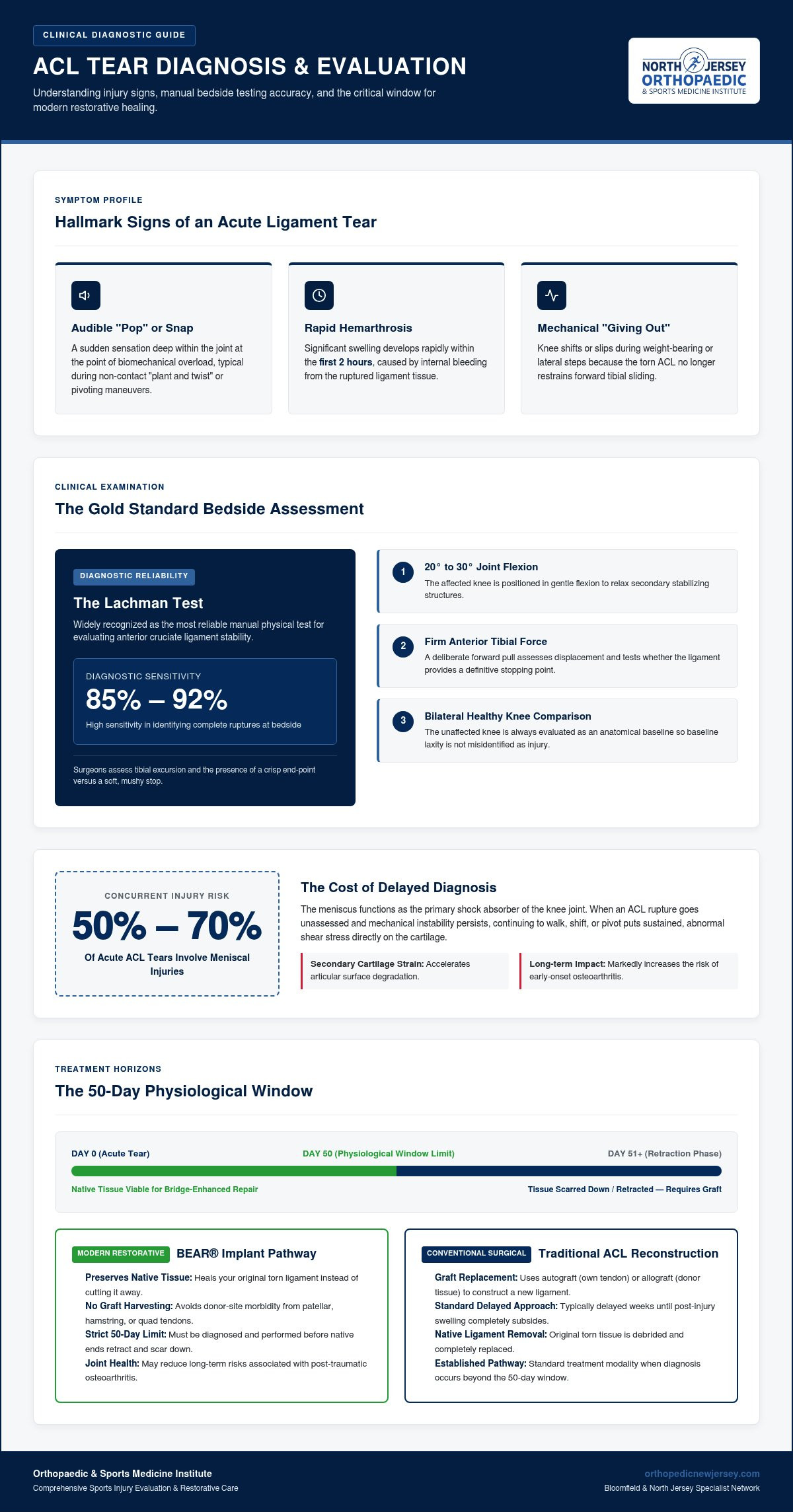
The moment an anterior cruciate ligament injury occurs, the symptoms are often distinct and distressing. For many athletes, the first indicator is an audible “pop” or a snapping sensation deep within the joint. This is frequently followed by a rapid onset of swelling, known medically as hemarthrosis, which typically develops within the first two hours. Unlike a minor strain, this swelling is caused by internal bleeding from the torn ligament and signifies a significant disruption of the knee’s internal environment. If you experience these symptoms while playing at local fields like Watsessing Park, seeking a professional ACL tear diagnosis Bloomfield NJ is the first step toward a proper recovery.
Another hallmark sign is the feeling of the knee “giving out” or shifting during weight-bearing or lateral movements. This instability occurs because the ACL is no longer providing the necessary tension to keep the tibia from sliding forward. While pain may subside after a few days, the underlying mechanical instability remains. Continuing to walk or pivot on an undiagnosed tear can lead to secondary damage, particularly to the meniscus, which acts as the knee’s shock absorber. Research indicates that between 50% and 70% of acute ACL tears occur concurrently with meniscal injuries, making a timely evaluation essential to preserve joint health.
Common Injury Scenarios in North Jersey Sports
Injuries often occur during high-intensity activities common in North Jersey’s recreational and high school sports leagues. Most ACL ruptures are non-contact injuries resulting from a sudden change in direction or a “plant and twist” maneuver. For a detailed anterior cruciate ligament tear overview, one can see how these biomechanical stresses overwhelm the ligament’s tensile strength. Whether it’s a pivoting injury on the soccer pitch or a sudden deceleration during a trail run, the mechanism usually involves a combination of rotation and valgus stress on the knee.
The Urgency of Early Specialist Evaluation
Delaying an ACL tear diagnosis Bloomfield NJ can complicate the recovery process. A board-certified orthopedic surgeon is trained to differentiate between a simple collateral ligament sprain and a complete ACL rupture through specific manual tests. Early evaluation is especially critical if you’re interested in modern restorative options like the BEAR® Implant, which requires surgery within a specific physiological window, typically within 50 days of the injury. Prompt diagnosis also prevents the development of chronic instability, which significantly increases the risk of early-onset osteoarthritis. By visiting a specialist near Bloomfield quickly, you ensure that your treatment plan is based on the current state of your native ligament tissue before it begins to retract or scar down.
The Clinical Exam: How Specialists Diagnose ACL Tears
When you arrive for an ACL tear diagnosis Bloomfield NJ, the process begins with a structured clinical history rather than immediate imaging. A board-certified surgeon will meticulously reconstruct the moment of injury to determine if the force was contact-based or a non-contact pivoting event. This mechanism often dictates the likelihood of associated trauma. Next, the specialist performs a visual inspection for joint effusion. Significant swelling within the joint capsule suggests internal bleeding, which is a common indicator of a ligamentous rupture. Crucially, the surgeon always compares the affected limb to your healthy knee. This “control” allows for a precise measurement of what constitutes normal laxity for your specific anatomy, ensuring that natural flexibility isn’t mistaken for injury-induced instability.
The Lachman Test: The Gold Standard for ACL Integrity
The Lachman test is widely regarded as the most reliable bedside maneuver for assessing the integrity of the anterior cruciate ligament. During this exam, the surgeon flexes the knee to approximately 20 to 30 degrees and applies a firm anterior force to the tibia. According to MedlinePlus ACL injury and diagnostic guidance, this physical assessment helps determine if the ligament provides a definitive “end-point.” A soft or mushy feel indicates a full-thickness rupture. This test boasts a sensitivity of 85% to 92% and a specificity of up to 98%, making it far more accurate than the traditional anterior drawer test, which can be hindered by acute hamstring spasms.
The Pivot Shift Test and Range of Motion Assessment
While the Lachman test checks for forward sliding, the pivot shift test evaluates complex rotational stability. It’s considered pathognomonic for an ACL tear, meaning a positive result almost certainly confirms the injury. During the maneuver, the specialist looks for a characteristic “clunk” as the joint reduces under stress. This test has a high specificity of 97% to 99%, though it can be difficult to perform in the first few days post-injury if the patient is guarding. The specialist also assesses your full range of motion, as deficits in extension can signal a displaced meniscus tear or a “cyclops lesion.” Identifying these nuances helps determine if you’ve suffered the “unhappy triad,” which involves concurrent damage to the ACL, medial collateral ligament (MCL), and the medial meniscus. If you’re experiencing instability, you should consult a specialist to establish an accurate clinical roadmap for recovery.
Advanced Imaging: MRI vs. Clinical Findings
While a physical exam provides immediate feedback on joint laxity, a definitive ACL tear diagnosis Bloomfield NJ requires advanced imaging to map the internal damage. X-rays are typically the first imaging modality used, not to see the ligament itself, but to rule out avulsion fractures. A specific sign called a Segond fracture, where a small bone fragment is pulled off the lateral tibia, is often pathognomonic for an ACL rupture. However, the Magnetic Resonance Imaging (MRI) scan remains the gold standard for soft tissue evaluation. It allows the surgeon to visualize “bone bruises” or kissing contusions on the lateral femoral condyle and posterior tibial plateau. These bruises, present in over 80% of acute ruptures, act as a “black box” recording, confirming the violent shifting of bones that occurred during the injury.
Even with high-resolution scans, clinical correlation is paramount. A scan might show an intact ligament that has actually lost its functional tension, or it might suggest a tear that the patient’s knee has naturally compensated for. Your surgeon’s hands-on assessment of stability is just as vital as the radiologist’s report. The scan provides the map, but the physical exam provides the context of how that map affects your daily mobility and athletic performance.
What an MRI Reveals About Your Knee
An MRI provides a cross-sectional view of the knee’s internal morphology, allowing for a precise grading of the injury. According to the AAOS clinical guide to ACL injuries and treatment, these scans are essential for identifying concomitant injuries that may not be apparent during a physical exam. The specialist utilizes these images to evaluate:
- Partial vs. Complete Ruptures: Determining if any fibers remain in continuity or if the ligament is entirely displaced.
- Meniscal Integrity: Checking both the medial and lateral meniscus for “bucket-handle” or radial tears that require concurrent repair.
- Chondral Damage: Identifying shearing injuries to the articular cartilage that could lead to long-term joint degradation.
- Collateral Ligaments: Assessing the health of the MCL and LCL to determine if a multi-ligament reconstruction is necessary.
MRI Accuracy and Potential Pitfalls
Imaging isn’t infallible. In chronic cases, the ACL stump can scar down to the posterior cruciate ligament (PCL), creating a “false negative” where the ligament appears present on a scan but provides no functional stability. For patients pursuing an ACL tear diagnosis Bloomfield NJ with the goal of receiving a BEAR® Implant, high-resolution imaging is non-negotiable. The surgeon must evaluate the quality and length of the remaining ligament stump to ensure there is enough native tissue for the implant to facilitate biologic healing. Our Nutley office coordinates directly with local imaging centers to ensure that the specific sequences required for advanced restorative surgery are captured accurately.
Preparing for Your ACL Consultation near Bloomfield, NJ
Once you’ve identified the signs of injury and recognized the need for a professional ACL tear diagnosis Bloomfield NJ, your formal consultation serves as the bridge to recovery. This meeting is a critical juncture where your clinical symptoms and imaging findings are synthesized into a definitive treatment plan. To maximize the efficiency of your visit, come prepared with a clear record of your injury timeline. Specifically, document the exact date of the trauma and the progression of your swelling over the first 48 hours. This information is vital because certain advanced treatments, such as the BEAR® Implant, are time-sensitive and rely on the specific physiological state of your native ligament tissue.
If you’ve already visited an urgent care center or a local imaging facility in Bloomfield, ensure you have your MRI and X-ray data ready. While a radiologist’s written report is helpful, your surgeon needs to review the actual raw images on a disc or through a digital portal. This allows for a more nuanced interpretation of the tear’s location and the quality of the remaining ligament fibers. Our facility in Nutley is conveniently located just minutes from central Bloomfield, providing easy access via Franklin Avenue or the Garden State Parkway for patients seeking high-level orthopedic expertise without a long commute.
Questions to Ask Your Orthopedic Surgeon
Your consultation is a collaborative process. Use this time to understand the modern surgical landscape and how it applies to your specific lifestyle goals. You should feel empowered to ask detailed questions regarding your candidacy for newer, less invasive techniques. Consider asking:
- “Based on the quality of my ligament stump, am I a candidate for the BEAR® Implant or is traditional reconstruction more appropriate?”
- “What is my projected risk of a re-tear given my specific sport, age, and activity level?”
- “How soon can I begin ‘prehabilitation’ to restore my range of motion and reduce swelling before the procedure?”
What to Bring to Your First Appointment
Being organized helps your specialist focus entirely on your clinical evaluation and diagnostic needs. Please ensure you have the following items ready for your visit to our Nutley office:
- Insurance and Referrals: Have all current insurance cards and any necessary referral forms from your primary care provider or insurance carrier.
- Clinical History: A list of any previous knee injuries, surgeries, or chronic musculoskeletal conditions that might affect your surgical recovery.
- Proper Attire: Wear loose-fitting clothing, such as athletic shorts, that allows the surgeon to easily examine both knees and assess your gait.
- Medication List: Provide a complete list of current medications, including any anti-inflammatories or supplements you’ve taken since the injury.
If you are ready to move forward with a definitive ACL tear diagnosis Bloomfield NJ and explore advanced recovery options, you can schedule your consultation with our board-certified team today.
Beyond Diagnosis: Modern ACL Treatment Pathways
Once the ACL tear diagnosis Bloomfield NJ is finalized, the focus shifts to selecting a recovery pathway that aligns with your functional demands. For sedentary patients with minimal instability, conservative management through intensive physical therapy may be sufficient. Most active individuals, however, require surgical intervention to restore joint stability. Modern orthopedics has moved toward minimally invasive techniques that prioritize joint preservation and faster rehabilitation. The goal is no longer just to repair the knee, but to return the patient to their pre-injury level of performance with the least amount of surgical trauma possible.
Traditional ACL reconstruction typically involves replacing the torn ligament with a graft, often harvested from your own hamstring or patellar tendon. While effective, this “gold standard” involves creating a secondary surgical site to obtain the graft tissue. The precision of your initial diagnostic grade determines whether you require a full reconstruction or if you’re a candidate for restorative procedures that utilize your body’s natural healing potential. A board-certified surgeon will evaluate the quality of your remaining tissue to determine which graft or repair type is most appropriate for your specific anatomy.
The BEAR® Implant: A New Standard for ACL Repair
The Bridge-Enhanced ACL Restoration (BEAR) Implant represents a paradigm shift in sports medicine. Instead of replacing the ligament with a graft, this technique uses a bio-absorbable protein scaffold to bridge the gap between the torn ends. This allows the native tissue to heal itself. This approach preserves the original nerve endings and blood supply, which are often lost in traditional reconstruction. This innovative option is only available through surgeons with specialized training in restorative biologics. You can learn more about this procedure by reading our pillar article on BEAR® Implant ACL Repair in New Jersey.
The Importance of a Specialized Sports Medicine Clinic
Choosing a board-certified specialist near Bloomfield ensures that your recovery protocol is tailored to the specific mechanics of your injury. A dedicated clinic provides a seamless transition from the initial diagnostic phase to postoperative care and high-level athletic training. For local residents, having access to a high-level consultant in Nutley means world-class care is available right in your community. For guidance on selecting the right provider, explore our specialist’s guide to choosing a sports medicine clinic near Montclair.
Ultimately, the success of any treatment pathway rests on the accuracy of the initial evaluation. A thorough ACL tear diagnosis Bloomfield NJ doesn’t just name the injury; it identifies the specific anatomical characteristics that dictate which modern intervention will yield the best long-term outcome for your knee health.
Reclaiming Your Stability and Performance
Accurate identification of a ligament rupture is the foundation of a successful return to sport. A thorough clinical evaluation combined with advanced imaging allows for a precise understanding of your knee’s mechanical state. Securing an expert ACL tear diagnosis Bloomfield NJ within the first few weeks of injury is particularly vital if you wish to explore native ligament healing rather than traditional reconstruction.
Modern orthopedics offers sophisticated alternatives to the standard surgical model. Whether you’re a candidate for the BEAR® implant or require a minimally invasive reconstruction, the right path starts with a specialist who understands the latest biologic advancements. Our board-certified orthopedic surgeon is a specialist in BEAR® implant technology and a minimally invasive surgery expert dedicated to patient-centered recovery and long-term joint health.
Take the first step toward a graft-free future and schedule your ACL evaluation in Nutley today. Your journey back to the field or the trail doesn’t have to be defined by outdated surgical standards. We’re here to provide the direct, expert guidance you need to move forward with confidence.
Frequently Asked Questions
Can an ACL tear be diagnosed without an MRI?
An ACL tear can often be identified through a physical examination, though an MRI remains the standard for formal confirmation. Specialists use manual maneuvers like the Lachman test to assess ligament laxity with high clinical precision. While these tests provide immediate evidence of instability, the MRI helps visualize the specific grade of the rupture and any concurrent meniscal damage. This comprehensive approach ensures your ACL tear diagnosis Bloomfield NJ is accurate before finalizing a recovery plan.
How long after an injury should I wait to get a diagnosis in Bloomfield?
You should seek a specialist evaluation as soon as possible, ideally within the first few days following the injury. Early assessment is critical because the window for certain restorative treatments, like the BEAR implant, typically closes within 50 days of the acute event. Delaying your visit can lead to increased joint inflammation or secondary damage. Residents in the Bloomfield area can access our Nutley facility quickly to establish a clear timeline for their recovery.
Does a partial ACL tear always require surgery?
Not every partial ACL tear requires surgical intervention. The decision depends on your knee’s functional stability and your desired activity level. Some patients can manage a partial tear through structured physical therapy and prehabilitation. However, for athletes returning to pivoting sports, even a partial tear may necessitate stabilization. Modern options now include using the BEAR implant for partial ruptures to preserve the remaining native fibers and maintain the joint’s natural proprioceptive nerve endings.
What is the difference between an ACL sprain and a tear?
In medical terms, a tear is actually a severe form of a sprain. Ligament injuries are graded from one to three. A Grade 1 sprain involves minor stretching, while a Grade 3 sprain is a complete functional tear. While the terms are often used interchangeably in casual conversation, a tear usually implies a loss of structural integrity that requires specialized orthopedic care. Differentiating between these grades is a key part of a professional ACL tear diagnosis Bloomfield NJ.
Is the BEAR implant better than traditional ACL reconstruction?
The BEAR implant and traditional reconstruction serve different recovery goals. Traditional methods replace the ligament with a graft, which is a reliable, time-tested approach. The BEAR implant acts as a bridge to help your native ligament heal itself, preserving your original tissue and reducing the risk of long-term osteoarthritis. The better option depends on the quality of your remaining ligament stump and how quickly you seek treatment after the initial injury occurs.
Will insurance cover my ACL diagnosis and MRI near Bloomfield?
Most major insurance providers cover diagnostic evaluations and MRIs, though they often require prior authorization. Under New Jersey’s 2025 regulations, carriers must issue decisions on non-urgent diagnostic requests within 72 hours. This significantly reduces the waiting period for imaging at local centers near Bloomfield. Our office assists patients by providing the necessary clinical documentation to help navigate these insurance requirements and ensure that your ACL tear diagnosis Bloomfield NJ moves forward without unnecessary delays.
How soon can I walk after an ACL injury?
Most patients can begin limited weight-bearing within a few days of the injury, provided they use a supportive brace and crutches. Your ability to walk depends on the severity of the initial swelling and whether you’ve also damaged your meniscus or collateral ligaments. It’s important to avoid unassisted walking if the knee feels unstable or gives out. A specialist will provide a specific weight-bearing progression based on your unique clinical findings and pain tolerance levels.