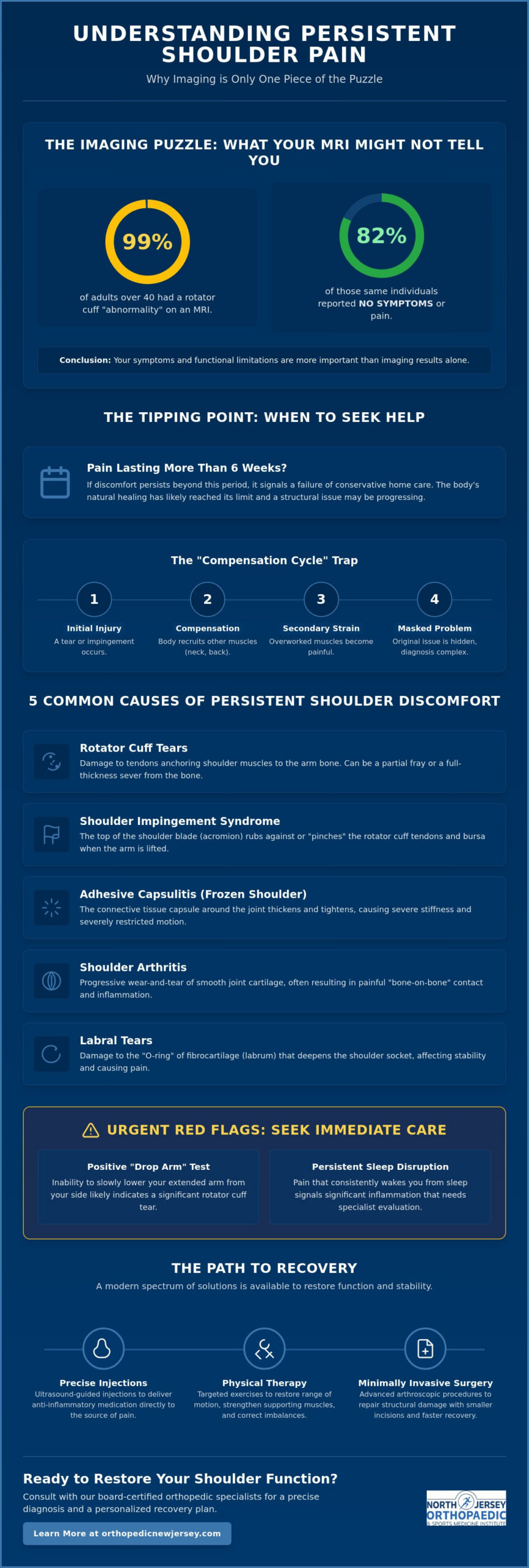
Did you know that in a study of adults over 40, 99% had at least one “abnormality” on an MRI of their rotator cuff, yet 82% of those individuals reported no symptoms? This startling statistic highlights a vital clinical reality; your imaging results are only one piece of the puzzle. If you’re struggling with shoulder pain that won’t go away, the focus must shift from a picture on a screen to how your body actually functions in your daily life.
It’s exhausting to lose sleep because you can’t lie on your affected side, or to feel a sharp, stabbing sensation when reaching for a seatbelt or an overhead shelf. We understand the silent fear that a nagging injury might become a permanent limitation. This article will help you identify the underlying causes of your persistent discomfort and clarify when it’s time to transition from home remedies to specialized orthopedic treatment. We’ll examine the diagnostic red flags and the modern, minimally invasive solutions available to restore your range of motion and provide the security of a professional recovery plan.
Key Takeaways
- Understand why discomfort lasting more than six weeks indicates a failure of conservative home care and how the “compensation cycle” may lead to secondary muscle strain.
- Identify the structural pathologies, such as rotator cuff tears or impingement syndrome, that are frequently the root cause of shoulder pain that won’t go away.
- Learn to recognize urgent clinical red flags, including the “Drop Arm” test and persistent sleep disruption, that signal a need for immediate specialist intervention.
- Explore a modern spectrum of treatment options ranging from precise, ultrasound-guided injections to advanced, minimally invasive surgical procedures.
- Discover the clinical advantages of consulting board-certified orthopedic specialists who utilize cutting-edge methodologies to restore joint function and stability.
Why Shoulder Pain That Won’t Go Away Requires Medical Attention
Many patients assume that if they didn’t experience a sudden fall or a traumatic impact, their discomfort is merely a temporary strain. However, shoulder pain that won’t go away for longer than four to six weeks is rarely a simple muscle pull; it often signals a structural issue that rest alone cannot resolve. Clinical experience shows that persistent discomfort is a diagnostic signal that the body’s natural healing mechanisms have reached their limit.
When the primary joint is compromised, the body instinctively enters a “Compensation Cycle.” To protect the injured area, you may unknowingly recruit muscles in the neck, upper back, and even the opposite arm to perform routine tasks. This cycle creates secondary strain and postural imbalances, often masking the original injury and making the eventual diagnosis more complex. Relying on a board-certified orthopedic surgeon ensures you receive a precise evaluation of these mechanical failures before they lead to widespread musculoskeletal dysfunction.
The Difference Between Acute Soreness and Chronic Pathology
Identifying the “tipping point” between a minor strain and chronic pathology is essential for long-term joint health. Acute soreness usually plateaus and improves within a few days of rest. In contrast, chronic issues involve a persistent inflammatory response that becomes counterproductive. Instead of facilitating repair, long-term inflammation can degrade local tendons and contribute to common shoulder problems such as bursitis or tendinopathy. Furthermore, if you immobilize the arm for too long to avoid pain, you risk developing adhesive capsulitis, commonly known as “Frozen Shoulder,” where the joint capsule thickens and severely restricts your range of motion.
When Home Remedies (RICE) Stop Being Effective
The standard RICE protocol, rest, ice, compression, and elevation, is an excellent first-line response for acute injuries, but it has distinct limitations. While ice and over-the-counter anti-inflammatories can manage symptomatic swelling, they cannot reattach a torn tendon or resolve a mechanical impingement. Many patients attempt to “push through” the discomfort, which often transitions a manageable partial tear into a significant full-thickness rotator cuff tear that requires more intensive intervention. Chronic shoulder pain is a failure of conservative management to restore function within six weeks. When you reach this threshold, continuing with home care alone may inadvertently allow the underlying injury to progress. Consulting a joint pain specialist in North Jersey at this stage can help identify the precise structural issue and prevent further deterioration.
5 Common Causes of Persistent Shoulder Discomfort
When you experience shoulder pain that won’t go away, the underlying issue is typically structural rather than purely inflammatory. The shoulder is the most mobile joint in the human body, relying on a complex network of tendons, ligaments, and cartilage to maintain stability. Understanding the specific causes of shoulder pain is the first step toward a targeted recovery plan. Five primary conditions account for the majority of chronic shoulder dysfunction:
- Rotator Cuff Tears: These involve damage to the tendons that anchor the shoulder muscles to the humerus. Tears are classified as partial, where the tendon is frayed, or full-thickness, where the tissue is completely severed from the bone.
- Shoulder Impingement Syndrome: This occurs when the acromion, the top edge of the shoulder blade, rubs against or “pinches” the rotator cuff tendons and bursa during arm elevation.
- Adhesive Capsulitis (Frozen Shoulder): A condition characterized by the thickening and tightening of the connective tissue surrounding the glenohumeral joint, leading to severe stiffness.
- Shoulder Arthritis: The progressive degradation of the smooth cartilage that lines the joint, often resulting in “bone-on-bone” contact.
- Labral Tears: Damage to the labrum, the “O-ring” of fibrocartilage that deepens the shoulder socket and provides essential stability.
Rotator Cuff and Labral Injuries
Distinguishing between a labral tear and a rotator cuff injury requires a precise clinical evaluation. While both cause significant discomfort, a rotator cuff repair candidate often presents with profound weakness when lifting the arm. Labral tears frequently manifest as a “catching” or “popping” sensation during movement. These structural tissues possess a limited blood supply, which means they rarely heal independently. Modern orthopedic care utilizes minimally invasive arthroscopic techniques to debride or reattach these tissues through small incisions, promoting a faster return to function. If you suspect a structural tear, consulting a specialist at The Orthopaedic & Sports Medicine Institute can provide the diagnostic clarity needed to prevent further joint degradation.
Degenerative Changes and Arthritis
For many residents in our Nutley community, persistent irritation is the result of long-term degenerative wear. As the cartilage in the glenohumeral joint thins, the body often produces osteophytes, or bone spurs, to compensate for the instability. These spurs can create mechanical friction, leading to the sharp pain experienced when reaching overhead or the dull ache that disrupts sleep. Fortunately, shoulder arthritis surgery options have evolved significantly. We now prioritize joint preservation and advanced resurfacing techniques that allow patients to maintain their active lifestyles without the limitations of chronic pain. Addressing these changes early is vital for preventing the total loss of joint mobility.
Red Flags: When Your Shoulder Pain is an Urgent Issue
While many musculoskeletal issues resolve with conservative care, certain symptoms act as clinical “red flags” that require immediate orthopedic evaluation. If you are dealing with shoulder pain that won’t go away, monitoring for a loss of mechanical function is just as critical as tracking the intensity of the discomfort itself. These warning signs often indicate that the underlying pathology has progressed beyond the point where the body can compensate.
The ‘Night Pain’ Indicator
Persistent pain during rest is a primary indicator of structural joint issues. When you lie on the affected side, you increase the pressure within the subacromial space, which houses the rotator cuff tendons and bursa. This compression often results in a deep, boring ache that prevents more than four hours of continuous sleep. Chronic sleep deprivation from pain doesn’t just cause fatigue; it actively hinders the body’s natural inflammatory regulation and tissue repair processes. Persistent night pain is one of the most reliable clinical predictors of a rotator cuff pathology or other common causes of shoulder pain.
Loss of Function vs. Presence of Pain
Orthopedic surgeons often find that a loss of range of motion is more clinically significant than the presence of pain alone. If you cannot lift your arm above shoulder height, or if you fail the ‘Drop Arm’ test, where you cannot control the arm’s descent from an elevated position, it suggests a significant mechanical failure. Losing ‘passive’ range of motion, where the joint remains stiff even when an examiner moves the arm for you, often points to adhesive capsulitis or advanced joint degeneration. Structural damage can exist even if the pain level is manageable during the day.
Beyond mobility, you should observe the physical appearance of the shoulder area. Noticeable muscle wasting or “hollowing” around the shoulder blade, known as atrophy, occurs when the muscles are no longer recruited properly due to a chronic tear or nerve inhibition. Additionally, neurological symptoms like numbness, tingling, or weakness radiating down the arm require urgent attention. These signals suggest the pathology may be affecting the nerves of the brachial plexus, necessitating a specialized diagnostic approach to prevent permanent deficits. An experienced joint pain specialist in North Jersey can evaluate these neurological warning signs and determine whether advanced imaging or immediate intervention is warranted.
The Treatment Spectrum: From Injections to Minimally Invasive Surgery
Addressing shoulder pain that won’t go away requires a strategic progression from conservative management to advanced clinical interventions. While many patients begin their recovery journey with general physical therapy, a definitive resolution often necessitates a more specialized orthopedic approach. We utilize a data-driven treatment spectrum designed to restore joint integrity while minimizing patient downtime, moving beyond temporary symptom masking toward long-term structural stability.
Non-Surgical Interventions That Work
Before considering a surgical path, we often employ ultrasound-guided injections to provide immediate symptomatic relief and diagnostic clarity. Corticosteroid injections are highly effective for reducing acute inflammation in the subacromial space, providing a “window of opportunity” for physical therapy to be more effective. For patients seeking biologic alternatives, Platelet-Rich Plasma (PRP) injections utilize the body’s own growth factors to stimulate a healing response in frayed or chronically irritated tendons. We typically implement a “PT First” strategy, monitoring progress over a strictly defined window. If we don’t observe a measurable increase in functional range of motion or a significant reduction in night pain within six weeks, it serves as a clinical indicator that the pathology may require more than just rehabilitative exercise. Managing expectations is vital; non-operative recovery is a methodical process that demands consistency and professional oversight to be successful.
The future of orthopedic care lies in the intersection of traditional mechanics and advanced biology. We are seeing a shift toward procedures that prioritize tissue preservation and natural healing. For instance, the principles behind the Bridge-enhanced ACL repair (BEAR® Implant) in the knee, which uses a biologic scaffold to facilitate the body’s own healing, are informing how we approach the future of ligament and tendon repair in the shoulder. These biologic options aim to not just replace or reattach tissue, but to foster a more robust, natural regenerative environment within the joint.
Minimally Invasive Surgical Excellence
When structural damage is too extensive for conservative care, modern arthroscopic techniques offer a path to recovery without the trauma associated with traditional open surgery. By utilizing small incisions and high-definition cameras, we can perform precise rotator cuff and labral repairs with minimal disruption to the surrounding healthy tissue. Our Nutley-based practice integrates these cutting-edge methodologies to ensure local residents receive the same level of care as professional athletes. These advancements allow for a significantly faster rehabilitation phase, helping you transition from chronic discomfort to active performance. We adhere to the high clinical standards found at a leading sports medicine clinic Montclair NJ residents trust, ensuring every patient has a tailored physical therapy protocol to secure their surgical outcomes. If you’re ready to move beyond temporary fixes, consult with our board-certified specialists to evaluate your candidacy for these modern interventions.
Expert Shoulder Care at The Orthopaedic & Sports Medicine Institute
Resolving shoulder pain that won’t go away requires more than just general medical advice; it demands the precision of board-certified surgical expertise. At The Orthopaedic & Sports Medicine Institute, located in Nutley, NJ, we provide a high-level clinical environment where advanced diagnostic technology meets patient-centered care. Our practitioners bring a unique perspective to joint health, applying the same rigorous standards used for high-level athletes to every local resident seeking relief. This dual focus ensures that whether you’re looking to return to competitive sports or simply want to lift your groceries without discomfort, your treatment is rooted in the latest orthopedic advancements.
Your first consultation is designed to be a thorough diagnostic experience. We don’t rely on surface-level assessments. Instead, we utilize state-of-the-art digital imaging and comprehensive physical evaluations to identify the exact source of your dysfunction. This allows us to move beyond broad categorizations and develop a personalized plan tailored to your specific anatomical needs and lifestyle goals. We prioritize minimally invasive techniques for our patients in Bloomfield and Clifton, ensuring that surgical intervention, when necessary, involves the least amount of disruption to your daily life.
A Trusted Resource for the Nutley Community
Our commitment to the region extends beyond the walls of our clinic. We function as a dedicated community resource for patients in Kearny, Belleville, and Lyndhurst, providing accessible follow-up care that’s essential for a successful recovery. We understand that orthopedic excellence isn’t just about the procedure itself; it’s about the continuity of care. To achieve this, we coordinate closely with local physical therapists to ensure your rehabilitation protocol is seamless and effective. This integrated approach combines clinical precision with genuine empathy, fostering a sense of security throughout your healing journey.
Next Steps: Reclaiming Your Active Lifestyle
Living with persistent discomfort isn’t a requirement of the aging process or a necessary consequence of an old injury. Every day spent “waiting for it to get better” is a day lost to limited mobility and interrupted sleep. We encourage you to stop managing the symptoms and start addressing the cause. By choosing a specialist who understands the complexities of the shoulder joint, you take the first definitive step toward reclaiming your independence and active lifestyle. Don’t let shoulder pain that won’t go away dictate your future.
Schedule your consultation with our Nutley orthopedic specialists today.
Restore Your Mobility and Restful Sleep
Persistent discomfort in the shoulder joint is more than a daily frustration; it’s a clinical signal that your body’s compensatory mechanisms are overextended. We’ve explored how structural issues like rotator cuff tears and impingement syndrome rarely resolve through rest alone. By recognizing red flags like chronic night pain and loss of function early, you can prevent the progression of degenerative wear and secondary complications like frozen shoulder. If you’re struggling with shoulder pain that won’t go away, transitioning to professional orthopedic intervention is the most effective way to preserve your joint health.
At The Orthopaedic & Sports Medicine Institute, our board-certified orthopedic surgeons have spent over a decade serving the Nutley, Bloomfield, and Clifton communities. We specialize in minimally invasive techniques that prioritize your recovery and long-term stability. You don’t have to accept a limited range of motion or interrupted sleep as a permanent reality. Our team provides the diagnostic precision and advanced treatment options necessary for a full recovery. Book Your Specialized Shoulder Evaluation in Nutley Today and take the first step toward reclaiming your active lifestyle.
Frequently Asked Questions
Can shoulder pain go away on its own after three months?
Shoulder pain that won’t go away for three months is classified as chronic and is unlikely to resolve without professional clinical intervention. By this stage, the initial inflammatory phase has passed, and the persistence of symptoms usually indicates a structural abnormality or a failed healing response. Seeking a specialized evaluation is essential to prevent secondary issues such as muscle atrophy or joint stiffness.
Is it a rotator cuff tear or just a strained muscle?
A strained muscle typically shows significant improvement within two to four weeks of rest and basic home care. If you experience profound weakness, a catching sensation, or shoulder pain that won’t go away despite rest, it likely points to a rotator cuff tear. Structural tears require diagnostic imaging, such as an MRI, to distinguish them from simple soft tissue strains and to determine the extent of the damage.
How do I know if I need surgery for my shoulder pain?
The necessity for surgery is determined by the severity of your functional loss and your response to conservative therapies. If a full-thickness tear is present or if six to twelve weeks of targeted physical therapy and injections fail to restore your range of motion, surgery may be the most predictable path to recovery. We prioritize joint preservation and only recommend operative intervention when structural integrity is compromised.
What is the best sleeping position for someone with persistent shoulder pain?
The optimal sleeping position involves lying on your back or on the unaffected side with a pillow tucked under the injured arm to provide support. This positioning prevents the shoulder from dropping forward or rotating internally, which reduces tension on the rotator cuff tendons. Avoiding the side-sleeper position on the painful shoulder is vital to minimize subacromial pressure and prevent nocturnal inflammation from disrupting your rest.
Why does my shoulder pain feel worse at night?
Nocturnal pain is often more intense because the horizontal position changes the subacromial space’s mechanics, increasing pressure on sensitive tissues. Without the benefit of gravity to pull the humerus down, the joint can compress the inflamed bursa and tendons. Additionally, the lack of daily distractions makes you more aware of the deep, boring ache associated with chronic joint pathology and persistent inflammation.
Do you offer minimally invasive shoulder surgery in Nutley, NJ?
Yes, we provide advanced minimally invasive shoulder surgery at our Nutley facility for patients throughout North Jersey. Our board-certified surgeons utilize arthroscopic techniques, which involve small incisions and specialized cameras to repair rotator cuff and labral tears. This modern approach reduces surgical trauma to the surrounding muscles, which typically results in less postoperative pain and a more efficient rehabilitation process.
Can physical therapy fix a torn rotator cuff without surgery?
Physical therapy can effectively manage the symptoms of a partial tear by strengthening the surrounding deltoid and scapular stabilizers to compensate for the injury. However, physical therapy cannot physically reattach a tendon that has been completely severed from the bone. For full-thickness tears in active individuals, a surgical repair is often necessary to restore the mechanical strength required for overhead activities and daily function.
What should I bring to my first orthopedic consultation in North Jersey?
You should bring any recent imaging studies, such as X-rays or MRI scans, preferably on a CD or digital drive, to your first consultation. It’s also helpful to provide a detailed list of previous treatments, including the duration of physical therapy and the dates of any past injections. Having this clinical history allows our specialists to develop a more precise and efficient diagnostic plan for your recovery.