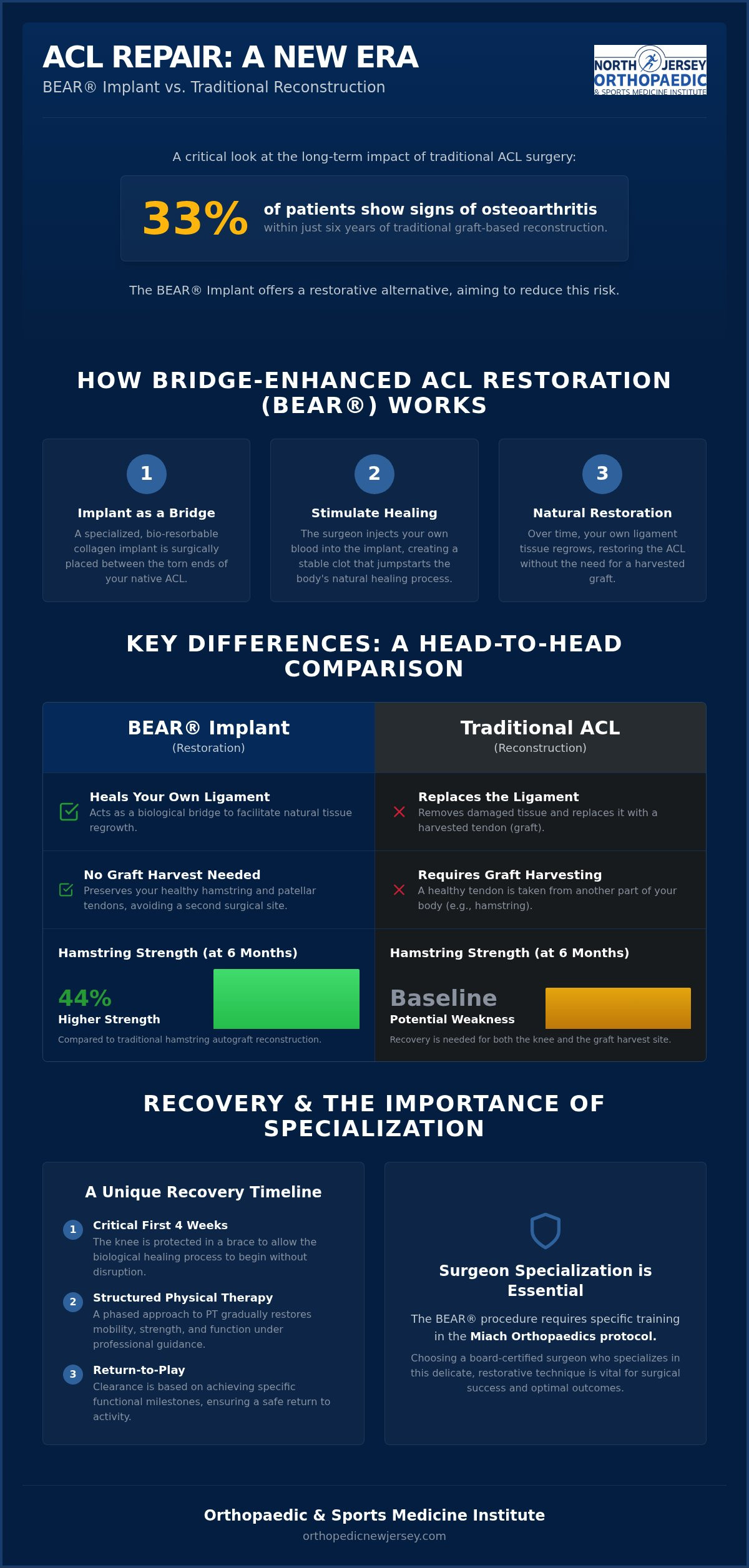
Did you know that 33% of patients who undergo traditional ACL reconstruction show signs of osteoarthritis within just six years of their procedure? This staggering statistic highlights the long-term trade-offs often associated with conventional graft-based surgeries. If you’re an athlete or an active resident looking for a BEAR implant surgeon North Arlington NJ, you’re likely seeking a solution that prioritizes the future health of your joint. Modern orthopaedics has evolved beyond simply replacing a torn ligament; we now have the technology to facilitate the body’s own healing process through restorative intervention.
We understand the apprehension that comes with “harvesting” a healthy hamstring or patellar tendon to serve as a graft. It’s a process that can leave you questioning if your knee will ever regain its natural sensation. This article explains how the Bridge-enhanced ACL repair (BEAR® Implant) utilizes a bio-resorbable protein scaffold to heal your native ACL without a traditional graft. By choosing this restorative approach, you can aim for a faster return to activity and a drastically reduced risk of post-traumatic osteoarthritis. We’ll examine the clinical data behind this 2026 FDA-labeled breakthrough and how our specialized care near North Arlington offers a bridge between established medical wisdom and the future of surgical innovation.
Key Takeaways
- Learn how the BEAR® Implant acts as a biological bridge, utilizing your own blood to stimulate the natural restoration of your native ligament.
- Compare the benefits of restorative surgery over traditional reconstruction, including the elimination of graft harvesting and a reduced risk of long-term joint degradation.
- Discover why consulting a specialized BEAR implant surgeon North Arlington NJ is essential for accessing the specific Miach Orthopaedics protocols required for surgical success.
- Understand the unique post-operative recovery timeline, including the critical first four weeks of bracing and the structured phased approach to physical therapy.
- Explore how a board-certified specialist in minimally invasive techniques can provide a patient-centered path from initial diagnosis to final return-to-play clearance.
Finding a Specialized BEAR Implant Surgeon in North Arlington, NJ
The Bridge-Enhanced ACL Restoration (BEAR) implant represents a paradigm shift in modern sports medicine. It is the first FDA-cleared technology that enables the body to heal its own torn ligament rather than replacing it with a donor or autograft. For athletes and active residents in the North Jersey area, finding a qualified BEAR implant surgeon North Arlington NJ is the first step toward a more natural recovery. This procedure isn’t a standard reconstruction; it’s a delicate biological intervention that requires specific training in the Miach Orthopaedics protocol to ensure the implant is positioned perfectly to facilitate native tissue regrowth.
Why Surgeon Specialization Matters for ACL Repair
Choosing a surgeon who specializes in this technique is vital because the BEAR procedure differs significantly from traditional methods. While conventional surgery involves drilling tunnels to anchor a substitute graft, the BEAR protocol focuses on the meticulous placement of a bovine-derived collagen sponge between the torn ends of the ACL. A board-certified surgeon must evaluate your candidacy with precision, looking at the specific location of the tear and the quality of the remaining tissue. They act as a steward of the knee’s biological environment, injecting your own blood into the sponge to jumpstart the healing process. This technical nuance requires a surgeon who understands the intricacies of regenerative medicine and the latest advancements in surgical restoration.
Local Access for North Arlington and Kearny Residents
Proximity to your surgical center is more than a matter of convenience; it’s a clinical advantage. During the first two weeks following surgery, the initial “insult” to the joint is at its peak, and travel stress can hinder early recovery. Having your BEAR implant surgeon North Arlington NJ located within the same corridor as your home means fewer long car rides that can cause stiffness, swelling, or discomfort.
Our practice is situated near familiar local landmarks like Riverside County Park, making it easily accessible for those living in North Arlington, Kearny, or Lyndhurst. This local presence simplifies the intensive initial follow-up phase and allows for seamless coordination with local physical therapy providers. When you choose a specialist focused on minimally invasive orthopedic surgery NJ, you’re opting for a care model that prioritizes both advanced technology and patient comfort. We ensure that every step, from the initial diagnostic MRI to post-operative bracing, is handled with the professional precision that residents of the North Jersey community expect.
The Science of Bridge-Enhanced ACL Restoration: How It Works
The BEAR implant represents a departure from traditional “replacement” surgery. Instead of removing the damaged tissue, a BEAR implant surgeon North Arlington NJ uses a specialized bovine-derived collagen sponge to act as a biological bridge. This sponge is meticulously placed between the two torn ends of the ACL. Once secured, the surgeon injects the patient’s own fresh blood into the scaffold. This creates a stable, protected clot that serves as a catalyst for the body’s natural healing response. It’s a sophisticated method of “restoration” that utilizes your own biology to knit the ligament back together.
Clinical data highlights the functional advantages of this approach. Studies have shown that patients treated with the BEAR implant demonstrated 44% higher hamstring muscle strength at the six-month mark compared to those who underwent traditional autograft reconstruction. Because no healthy tendon is “harvested” from the hamstring or patella, the surrounding musculature remains intact. This preservation of local anatomy is a primary reason why many local athletes are scheduling consultations to discuss their restorative options.
The Biological Bridge: A New Era of Healing
The collagen sponge isn’t a permanent fixture in your knee. It functions as a temporary scaffold that encourages cell migration and tissue remodeling. Over time, your body populates this scaffold with native cells, which begin the work of building new ligamentous tissue. As the new ACL forms and gains strength, the sponge is naturally resorbed by the body. This avoids the “dead tissue” concerns occasionally associated with allografts, where a donor ligament may not fully integrate or could potentially fail due to a lack of biological compatibility.
Preserving Proprioception and Knee Intelligence
One of the most significant, yet often overlooked, benefits of native ligament healing is the preservation of proprioception. Proprioception is your brain’s ability to sense the position and movement of your knee without you having to look at it. The native ACL is rich with nerve endings that provide this essential feedback. Traditional reconstruction often severs these neurological connections, leading to a knee that feels “mechanical” or “foreign” to the patient.
By keeping the original ligament fibers, the BEAR procedure maintains the neurological bridge between the joint and the brain. This “knee intelligence” is critical for high-level athletic performance, agility, and balance. For patients in North Arlington who want to return to sports with a knee that feels natural and responsive, this neurological preservation is a game-changer. It doesn’t just repair a mechanical tear; it restores the complex communication system that allows for fluid, confident movement on the field or court.
BEAR® Implant vs. Traditional ACL Reconstruction: Key Differences
Traditional ACL reconstruction is fundamentally a replacement surgery. It involves removing the damaged ligament and substituting it with a graft, typically harvested from your own hamstring or patellar tendon. While this approach provides stability, it introduces a “second injury” to the leg. A BEAR implant surgeon North Arlington NJ focuses instead on restoration, utilizing the native tissue you already have. However, candidacy for this advanced procedure is time-sensitive. To ensure there is sufficient healthy tissue for the collagen sponge to bridge, the surgery must be performed within 50 days of the initial injury.
The following table provides a direct comparison between these two surgical philosophies:
| Feature | Traditional Reconstruction | BEAR® Implant |
|---|---|---|
| Graft Source | Hamstring or Patellar Autograft | No Graft Required |
| Surgical Sites | Two (Knee and Donor Site) | One (Knee Only) |
| Osteoarthritis Risk | 33% at 6 Years | 5.7% at 6 Years |
| Eligibility Window | Flexible (Months to Years) | Strictly within 50 Days |
Avoiding Graft Harvesting Complications
Harvesting a healthy tendon to replace a damaged one isn’t without consequences. Surgeons refer to the resulting pain or weakness as “donor site morbidity.” For many patients, the graft site becomes a secondary source of chronic discomfort or permanent strength deficits. Because the BEAR procedure uses a bio-resorbable scaffold, it eliminates the need for this second surgical site. This simplifies the early stages of rehabilitation. You don’t have to manage the healing of a harvested hamstring while simultaneously trying to regain range of motion in the joint itself.
Long-Term Joint Health and Arthritis Prevention
The primary concern with traditional reconstruction is the high rate of early-onset arthritis. Even when the surgery is successful and the knee is stable, the altered mechanics of a graft can lead to joint degradation. Verified clinical data from 2026 shows that the risk of post-traumatic osteoarthritis is significantly lower with the BEAR implant. While 33% of reconstruction patients show signs of arthritis after six years, only 5.7% of BEAR patients face the same diagnosis.
By choosing a BEAR implant surgeon North Arlington NJ, you’re investing in the preservation of your native anatomy. Maintaining the original ligament fibers helps keep your knee kinematics as close to normal as possible. This isn’t just about returning to sports today; it’s about ensuring your joint remains healthy and functional ten or twenty years down the road.
Recovery and Physical Therapy for North Arlington Patients
Recovery from a BEAR implant ACL repair New Jersey requires a methodical commitment to a specific rehabilitation protocol. Unlike traditional reconstruction, where the graft is strong on day one but the body must eventually “incorporate” it, the BEAR procedure relies on protecting a delicate biological bridge while it matures into a functional ligament. This process demands close synergy between your BEAR implant surgeon North Arlington NJ and your physical therapist. They work in tandem to ensure the healing tissue isn’t overloaded too early, which could compromise the restoration. Success in this phase is measured by patience and adherence to the phased protection of the joint.
To ensure a smooth transition from the surgical suite to your home in North Arlington or Kearny, preparation is essential. We recommend patients complete this recovery checklist before their procedure date:
- Clear wide paths in your home to accommodate crutches or a knee scooter.
- Set up a “recovery station” on the ground floor to avoid stairs during the first week.
- Stock your freezer with ice packs or secure a cold compression unit to manage swelling.
- Arrange for a driver for follow-up visits, as you won’t be able to drive while using the required bracing.
The Critical First Six Weeks
The first month is defined by protection. You’ll be in a specialized brace, often locked in extension or limited to a specific range of motion, and will follow weight-bearing restrictions for the first four weeks. This period isn’t about pushing limits. It’s about allowing the collagen sponge to transform into a stable, vascularized tissue. Your therapist will focus on early quad activation exercises, such as muscle setting and straight leg raises, to prevent atrophy without stressing the repair site. Transitioning from crutches to full weight-bearing happens gradually, typically between weeks four and six, based on your surgeon’s assessment of your biological healing.
Milestones for Returning to Sport
As you move into the strengthening phase, the focus shifts toward functional movement. Around months four to six, most patients begin jogging and light plyometric work. However, clearing a patient for “cutting” sports requires rigorous functional testing. This isn’t just about the time elapsed since surgery. It’s about strength symmetry and movement quality. One of the unique advantages of native healing is the “natural feel” of the joint. Because the original nerve endings are preserved, patients often report higher confidence during these late-stage milestones. This neurological feedback helps overcome the psychological hurdles that often plague athletes returning from traditional reconstruction.
If you’re ready to explore a restorative path for your knee, schedule a consultation at our North Jersey office to discuss your eligibility for the BEAR protocol.
Why Choose The Orthopaedic & Sports Medicine Institute for Your ACL Repair
Choosing where to undergo a restorative procedure is a decision that impacts your mobility for decades. The Orthopaedic & Sports Medicine Institute combines high-level surgical precision with a local, community-focused approach. Our board-certified specialists are recognized leaders in minimally invasive orthopedic surgery NJ, ensuring every patient receives care that prioritizes tissue preservation. We don’t just treat an isolated injury; we guide you through a comprehensive recovery arc, from the initial diagnostic imaging to the final milestone of return-to-play clearance. Our philosophy is rooted in the belief that the best surgery is the one that restores your natural anatomy with the least amount of disruption.
Expertise in Complex Knee Restoration
Our practice has spent years serving the competitive athletic community of North Jersey. We understand the unique demands placed on high-school and collegiate athletes who need more than just a stable joint; they need a knee that feels natural during explosive movements. This commitment to innovation is why we’ve embraced the BEAR implant as a primary option for native ligament healing. Our expertise isn’t limited to the knee; we apply the same advanced, patient-centered principles to labral tear shoulder treatment and other complex sports injuries. By staying at the forefront of orthopedic technology, we provide our patients with alternatives to traditional methods that often involve longer recoveries and higher long-term risks.
Schedule Your Consultation Near North Arlington
Convenience plays a significant role in surgical success, especially during the frequent follow-up visits required by the BEAR protocol. Our Nutley office is strategically located for residents in North Arlington, Lyndhurst, and Kearny. Whether you’re coming via Route 21 or Passaic Avenue, you’ll find that elite-level surgical care is just minutes away. This proximity reduces the logistical burden on patients and their families, allowing you to focus entirely on your rehabilitation and physical therapy milestones.
If you’ve recently suffered a knee injury, time is your most valuable asset. As established in previous sections, the eligibility window for a BEAR restoration is strictly limited to 50 days post-injury. To make the most of your first visit with a BEAR implant surgeon North Arlington NJ, please bring any recent MRI discs and a detailed history of your injury. We’ll perform a thorough clinical evaluation to determine if your tear location and tissue quality make you a candidate for this breakthrough technology. Don’t wait for the surgical window to close. Contact our office today to take the first step toward a graft-free recovery and a return to the activities you love.
Secure the Future of Your Knee Health
The transition from traditional ACL replacement to native restoration marks a significant advancement in orthopedic medicine. By choosing the BEAR® Implant, you’re prioritizing the preservation of your own anatomy and the neurological intelligence of your joint. This decision is a long-term investment in preventing joint degradation and maintaining the natural agility required for high-level performance. Because the eligibility window for this procedure is limited to 50 days following your injury, timely action is critical to ensuring your candidacy for this graft-free alternative.
Finding a specialized BEAR implant surgeon North Arlington NJ allows you to access this cutting-edge care without the stress of long-distance travel. Our practice offers the expertise of a board-certified orthopedic surgeon with specialized BEAR® implant training at a convenient North Jersey location. We’re dedicated to guiding you through every phase of this biological healing journey, from the initial diagnostic review to your final return to activity. Don’t let a ligament tear dictate your future mobility when restorative options are within reach.
Schedule a BEAR Implant Consultation with Our North Jersey Specialists
Your journey back to peak performance starts with a single specialized evaluation.
Frequently Asked Questions
Is the BEAR implant better than traditional ACL reconstruction for athletes?
The BEAR implant offers specific functional advantages for athletes, including the preservation of native nerves for superior proprioception and 44% higher hamstring strength compared to autografts. Traditional reconstruction is a reliable standard, but the BEAR protocol avoids donor site morbidity and significantly reduces the risk of post-traumatic osteoarthritis. Many athletes prefer the natural feel of the restored ligament, which can improve psychological readiness and agility during high-level cutting movements on the field.
How long do I have after my injury to get the BEAR implant surgery?
Timing is critical for this procedure; you must undergo the surgery within 50 days of your initial ACL injury. This strict window ensures that the remaining native ligament tissue is still viable and hasn’t retracted or scarred excessively. If you exceed this 50-day limit, the collagen sponge may not have sufficient tissue to bridge. Consulting a BEAR implant surgeon North Arlington NJ immediately after injury is essential to preserve your restorative options.
Does insurance in New Jersey typically cover the BEAR implant procedure?
Most major insurance providers in New Jersey cover the BEAR implant procedure, as it is FDA-cleared and supported by extensive clinical data. However, coverage specifics vary by plan and provider. Our office helps patients verify their benefits and navigate the pre-authorization process. Since 2026, the updated FDA label regarding reduced osteoarthritis risk has further encouraged payers to recognize the long-term health benefits and cost-effectiveness of native ligament restoration over traditional graft methods.
What are the main risks associated with the BEAR implant compared to a graft?
Every surgical procedure carries risks, such as infection or stiffness. For the BEAR implant, recent 2026 data shows a re-tear rate of approximately 5%, which is comparable to traditional reconstruction. The primary risk of the BEAR procedure is the potential for the ligament not to heal fully across the scaffold. Conversely, traditional reconstruction carries the unique risk of donor site morbidity, which includes permanent weakness or chronic pain at the graft harvest site.
Will I need a brace after BEAR surgery, and for how long?
Yes, you’ll need to wear a specialized knee brace for approximately six weeks following the procedure. During the first four weeks, the brace is typically locked in extension or restricted to a specific range of motion to protect the maturing biological bridge. This protocol is more restrictive than traditional reconstruction because the healing tissue is initially delicate. Adhering to these weight-bearing and movement limitations is vital for the collagen sponge to successfully facilitate healing.
Can a BEAR implant be used for a revision ACL surgery if my first one failed?
The BEAR implant isn’t currently indicated for revision ACL surgery if a previous reconstruction has failed. This restorative technology requires the presence of your original native ligament tissue to facilitate healing. In a revision scenario, the native ligament has typically been removed and replaced with a graft, meaning there’s no tissue for the collagen sponge to bridge. For failed reconstructions, our board-certified surgeons utilize advanced minimally invasive techniques to perform complex secondary reconstructions.
How do I find a certified BEAR surgeon in the North Arlington and Kearny area?
Residents of the North Arlington and Kearny area can find specialized care at The Orthopaedic & Sports Medicine Institute in nearby Nutley. Our practice features a board-certified BEAR implant surgeon North Arlington NJ who has completed specific training in the Miach Orthopaedics protocol. Choosing a local specialist ensures you have easy access to the frequent follow-up appointments and coordinated physical therapy required during the intensive first six weeks of the restorative healing process.
What happens if the BEAR implant fails to heal the ligament?
If the BEAR implant fails to heal the ligament, the option for traditional ACL reconstruction remains fully available. One of the primary benefits of this restorative approach is that it doesn’t “burn any bridges.” Because no tunnels were drilled for a graft and no tendons were harvested, the knee anatomy remains largely intact. This allows your surgeon to perform a standard reconstruction using a hamstring or patellar tendon graft if the native restoration doesn’t meet stability goals.