What if the persistent, dull ache keeping you awake at night isn’t just a sign of aging, but a specific mechanical failure that modern surgical biology can precisely restore? For many individuals in North Jersey, the inability to reach overhead or the fear of permanent mobility loss creates a heavy burden on daily life. We understand that shoulder pathology is both a physical and emotional challenge, affecting everything from your professional productivity to your basic comfort. If you’re considering arthroscopic rotator cuff repair NJ, you’re likely searching for a solution that prioritizes long-term joint health through advanced, minimally invasive intervention.
This guide provides a comprehensive look at the clinical foundations of rotator cuff injuries and the specialized techniques used to address them. You’ll learn how board-certified specialists utilize arthroscopy to achieve success rates between 75% and 90%, offering a more precise alternative to traditional open procedures. We’ll also preview the structured recovery process, detailing the 9 to 12 month rehabilitation timeline required to restore full strength. By the end of this article, you’ll have a clear roadmap for navigating your surgical options and reclaiming a life defined by movement rather than pain.
Key Takeaways
- Learn the anatomical differences between partial and full-thickness tears and how specialized diagnostics determine the most effective surgical intervention.
- Discover how arthroscopic rotator cuff repair NJ utilizes 5mm portals and high-definition cameras to minimize tissue disruption and enhance surgical precision.
- Understand the critical biological knitting period in Phase 1 of recovery and how it sets the foundation for restoring active range of motion.
- Identify the logistical and clinical advantages of receiving specialized shoulder care from a board-certified orthopedic surgeon within your North Jersey community.
- Gain a clear understanding of the modern shift toward minimally invasive techniques that aim to restore shoulder strength and eliminate chronic pain.
Understanding Rotator Cuff Tears and the Role of Arthroscopic Repair
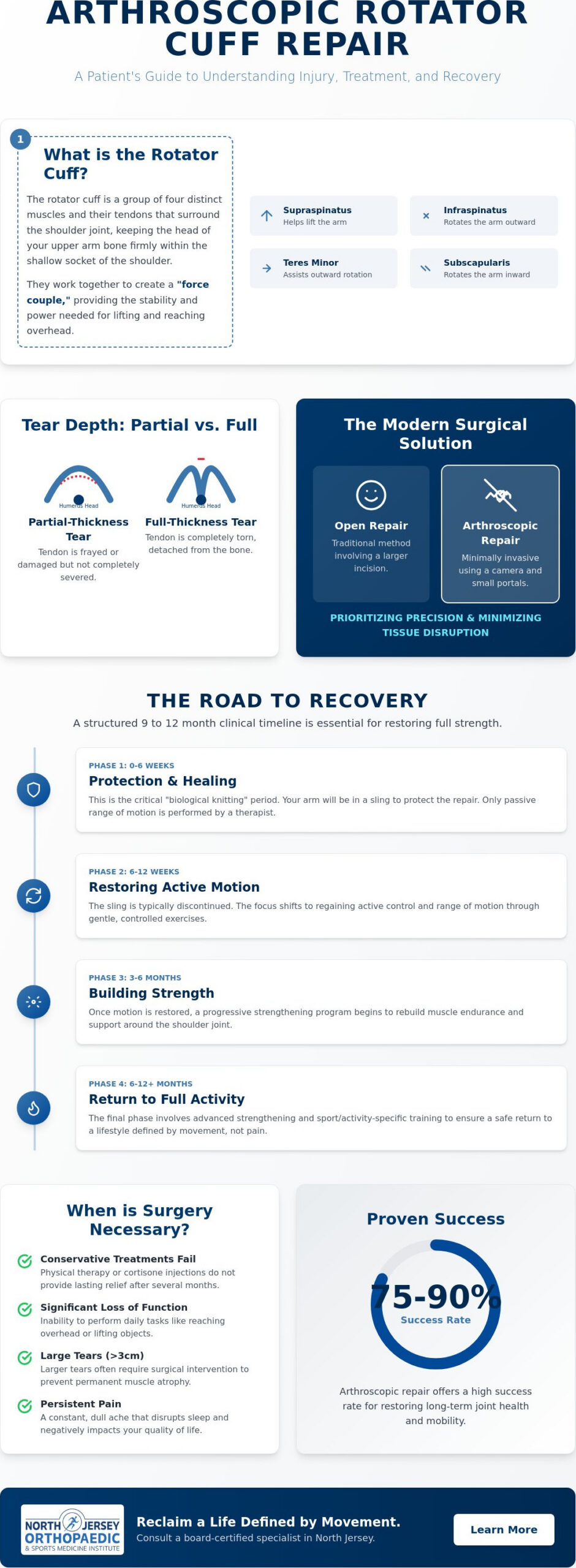
Arthroscopic rotator cuff repair is a specialized, minimally invasive surgical method designed to reattach torn tendons to the head of the humerus. This procedure represents a significant advancement in arthroscopic surgery, allowing for anatomical restoration through small, precision incisions. For patients seeking arthroscopic rotator cuff repair NJ, the clinical objective is to restore the shoulder’s intricate mechanics. The rotator cuff is the primary dynamic stabilizer of the glenohumeral joint.
The cuff consists of four distinct muscles: the supraspinatus, infraspinatus, teres minor, and subscapularis. These muscles don’t just move the arm; they work together to create a “force couple.” This mechanical balance pulls the humeral head into the glenoid socket, providing the stability needed for lifting power and overhead reaching. When one or more of these tendons tear, this balance is disrupted, often leading to weakness and compensatory pain in the neck or upper back.
Acute vs. Chronic Shoulder Injuries
Injuries generally fall into two categories, though they often overlap. Acute tears are typically the result of sudden trauma, such as a fall onto an outstretched arm or a sports-related collision common among active North Jersey residents. Chronic degeneration, on the other hand, involves long-term wear that gradually weakens the tendon fibers over time. We frequently see “acute-on-chronic” tears in our community. This occurs when a tendon that was already weakened by age-related wear suffers a sudden, definitive tear during a routine activity. These cases require immediate orthopedic evaluation to prevent the retraction of the tendon, which can make later repair more complex.
When is Shoulder Surgery Deemed Necessary?
Surgery isn’t always the first step, but it becomes essential when specific clinical markers are met. Most specialists recommend intervention if conservative treatments, such as cortisone injections or targeted physical therapy, fail to provide relief after several months. Large tears exceeding 3 cm or those involving a significant loss of function often necessitate a surgical approach to prevent permanent muscle atrophy. Understanding when is surgery necessary for a torn rotator cuff can help you make a more informed decision about your care pathway. If you’re experiencing a persistent ache that prevents sleep or limits your ability to work, it’s vital to know when to see an orthopedic surgeon for shoulder pain. When conservative measures fail, arthroscopic rotator cuff repair NJ becomes the gold standard for restoring joint integrity and long-term mobility.
Anatomy of a Tear: Grading Severity and Diagnostic Standards
Understanding the specific architecture of a tendon injury is the first step in clinical decision-making. Not all tears are identical, and the surgical strategy for rotator cuff repair surgery depends heavily on the depth and shape of the tissue damage. Incomplete fraying, known as a partial-thickness tear, often involves the bursal or articular surface of the tendon. These cases may not require structural anchors; instead, they often respond well to debridement, where the surgeon “cleans up” the frayed edges to stimulate a natural healing response.
Full-thickness tears represent a complete separation of the tendon from the humeral head. In more complex scenarios, we encounter massive or retracted tears where the tendon has pulled back significantly from its original attachment point. These cases are clinically distinct because the muscle can begin to undergo fatty infiltration or atrophy if left untreated for too long. For patients exploring arthroscopic rotator cuff repair NJ, identifying these nuances early is critical for a successful outcome. The shape of the tear also dictates our technical approach. Crescent tears are typically small and easily pulled back to the bone, while U-shaped and L-shaped tears require “margin convergence” techniques to reduce tension before the tendon is anchored.
Clinical Grading of Tendon Damage
We utilize a standardized grading system to categorize the severity of the damage. Grade 1 involves minimal fraying with less than 3mm of tissue depth affected, usually maintaining structural integrity. Grade 2 is a partial tear involving less than 50% of the tendon’s thickness. Once a tear reaches Grade 3, it is considered a high-grade partial or full-thickness tear. At this stage, biological healing without surgical intervention is unlikely, and mechanical restoration is usually required to prevent the tear from expanding.
The Gold Standard: Diagnostic Imaging in NJ
Precise diagnosis begins with a tiered imaging approach. While X-rays cannot visualize the rotator cuff tendons directly, they are essential for identifying bone spurs or calcific tendonitis that may be causing “impingement.” The MRI remains the gold standard for visualizing soft tissue, allowing us to measure precise tear dimensions and assess the health of the surrounding muscle. For some patients, we also utilize dynamic ultrasound. This cost-effective tool provides a real-time assessment of tendon movement, allowing the clinician to see exactly how the tissue behaves during rotation. If you are experiencing loss of strength, consulting with board-certified specialists in NJ can help you secure the advanced imaging needed for an accurate diagnosis.
The Evolution of Shoulder Surgery: Arthroscopic vs. Open Repair
Modern orthopedic medicine has largely transitioned away from the invasive “open” procedures that were once the standard of care. Today, arthroscopic rotator cuff repair NJ is performed through several 5mm portals, which are small enough to be closed with a single suture. This technological evolution is driven by high-definition arthroscopy cameras that provide a panoramic view of the glenohumeral joint. Surgeons can now inspect the labrum and biceps tendon with greater clarity than was ever possible through a traditional open incision, ensuring that secondary issues are addressed during the same procedure.
To secure the tendon back to its native bone, we utilize specialized hardware known as suture anchors. These tiny devices, often made of bio-composite materials that the body eventually absorbs, act as stable anchor points within the humerus. High-strength sutures then bridge the tendon to these anchors, creating the mechanical stability required for biological knitting to occur. In 2026, a significant advancement in our practice is the integration of biologic augmentation. For patients with poor tissue quality, we may use extracellular matrix patches or growth factor concentrates to provide a scaffold for new cell growth. This “biological boost” is particularly effective for chronic tears where the tendon has thinned over time. Patients who want to understand how these techniques compare across different joint conditions can explore our comprehensive guide to minimally invasive orthopedic surgery in NJ, which covers the full spectrum of biology-first surgical approaches available in 2026.
Benefits of Minimally Invasive Arthroscopy
The primary advantage of this minimally invasive approach is the preservation of the deltoid muscle. In traditional open surgery, the deltoid is often split or detached to reach the rotator cuff, which can lead to prolonged weakness and a more painful recovery. Arthroscopy avoids this muscle disruption entirely. Patients typically experience significantly less postoperative pain and minimal scarring. For residents in Nutley and Clifton, this precision usually translates to an outpatient experience, allowing most individuals to return home the same day of their procedure.
When is a ‘Mini-Open’ Approach Used?
While arthroscopy is the preferred method for most injuries, some clinical scenarios require a “mini-open” approach. This technique balances the superior visualization of arthroscopy with the direct structural access of a small incision, typically 3 to 5 cm in length. We often consider these surgical treatment options when handling massive, retracted tears that require complex tendon transfers. Intraoperative decision-making remains fluid; if the surgeon discovers that the tissue quality is exceptionally poor or the tear is too large for anchors alone, the mini-open approach ensures the most durable and reliable mechanical fix.
The Road to Recovery: A Clinical Timeline for North Jersey Patients
The outcome of your arthroscopic rotator cuff repair NJ is fundamentally tied to the biological timeline of tendon-to-bone healing. While the surgical anchors provide immediate mechanical fixation, the actual integration of tissue requires a methodical approach to movement. We divide this recovery into three clinical phases, ensuring that the repair is never compromised by premature loading. For a more detailed breakdown of these milestones, read our Rotator Cuff Surgery Recovery: A Complete 2026 Patient Guide.
Phase 1 (Weeks 0 to 6) focuses entirely on protection. During this window, biological knitting occurs, where the tendon re-establishes its connection to the humerus. Patients remain in a sling and perform only passive range of motion exercises, where a therapist or a pulley moves the arm without the patient’s muscles engaging. Phase 2 (Weeks 6 to 12) marks the transition to active-assisted motion. You’ll begin to use your own muscle power to guide the arm through functional tasks like eating or dressing. Finally, Phase 3 (Months 3 to 6+) involves gradual resistance training. This is when we rebuild the lifting power and endurance necessary for a return to sports or manual labor.
Postoperative Pain and Sleep Management
Managing the immediate 24 to 48 hours after surgery is critical for patient comfort. We often utilize regional nerve blocks to numb the shoulder area, which significantly reduces the need for oral narcotics. Once the block wears off, ice therapy becomes your primary tool for controlling inflammation and pain. Many patients struggle with nocturnal throbbing during the first month. We recommend an upright sleeping position, often in a recliner or propped with multiple pillows, to reduce pressure on the joint. Strict adherence to the sling is the most important factor in preventing early re-tears. It’s not just about comfort; it’s about immobilizing the joint so the biological repair remains undisturbed.
Coordinating with Local Physical Therapists
Successful rehabilitation relies on a tight communication loop between your Nutley surgeon and your physical therapist. We provide specific protocols that dictate exactly when to progress to the next level of activity. It’s a common mistake to try and “push through pain” during the first twelve weeks. In rotator cuff recovery, pain is a signal that the healing tissue is being overstressed. You should contact your specialist immediately if you notice red flags such as sudden, sharp pain, excessive swelling, or an unexplained loss of passive motion. If you’re ready to start your journey toward a pain-free life, schedule an evaluation with our North Jersey team today.
Specialized Rotator Cuff Care in Nutley: Why Local Expertise Matters
Selecting a board-certified orthopedic surgeon within your own community offers more than just logistical convenience. It ensures your arthroscopic rotator cuff repair NJ is managed by a specialist who understands your specific lifestyle and functional goals. Residents of Nutley, Bloomfield, and Clifton shouldn’t have to navigate the stress and traffic of commuting to major city hospitals to receive world-class care. Working with a dedicated shoulder pain specialist in Nutley, NJ provides a seamless bridge between diagnostic evaluation, surgical intervention, and the long-term rehabilitation process. This continuity of care is vital for maintaining the strict communication loop with local physical therapists. Staying local also reduces the physical strain of travel during the sensitive first few weeks of Phase 1 recovery.
The Orthopaedic & Sports Medicine Institute Advantage
Our clinical philosophy is built on a patient-centered model that prioritizes joint preservation. We specialize in complex shoulder reconstruction and sports-related tendon injuries, utilizing advanced arthroscopic techniques to preserve as much healthy tissue as possible. Before recommending surgery, we often explore non-surgical “pre-hab” programs. This approach strengthens the surrounding musculature, which can improve surgical outcomes and accelerate the Phase 2 and Phase 3 recovery milestones. Having integrated diagnostic imaging and surgical planning under one roof in Nutley eliminates the fragmentation of care often found in larger hospital systems. This unified approach ensures that every detail of your tear’s anatomy is factored into a personalized surgical plan that accounts for your age, activity level, and biological healing potential.
Preparing for Your Shoulder Consultation
Preparation is key to a productive orthopedic evaluation. When you arrive for your consultation, please bring any previous imaging, such as MRI discs or X-ray reports, along with a detailed list of functional limitations. Be ready to discuss how your shoulder pain affects specific tasks like reaching into a cabinet, lifting groceries, or sleeping on your side. We encourage patients to be active participants in their care journey. Having a clear understanding of your goals allows us to tailor the arthroscopic approach to your specific needs.
You should ask your surgeon specific questions about their arthroscopic techniques and typical success rates, including:
- What is the specific shape and grade of my tear?
- Is my tissue quality a candidate for biologic augmentation?
- How many arthroscopic repairs do you perform annually?
- What are the specific success rates for my type of injury?
Take the first step toward restoring your shoulder strength and achieving pain-free sleep. Schedule Your Shoulder Consultation in Nutley Today.
Restoring Your Quality of Life Through Precision Orthopedics
The path to shoulder recovery begins with a precise understanding of your injury’s unique anatomy and a commitment to a structured, biological healing process. By choosing advanced minimally invasive techniques, you’re opting for a method that preserves muscle integrity and prioritizes a faster return to your daily routines. This specialized approach ensures that the repair is mechanically sound while setting the stage for long-term joint stability and pain-free sleep.
Navigating the complexities of arthroscopic rotator cuff repair NJ doesn’t have to involve the stress of long commutes to major city hospitals. Our board-certified orthopedic surgeons specialize in modern surgical interventions, providing dedicated care to residents throughout Nutley, Bloomfield, and Clifton. We are committed to guiding you through every phase of recovery, from the initial diagnostic imaging to the final milestones of strength building. You don’t have to accept chronic pain or limited mobility as a permanent part of your life. Schedule Your Shoulder Consultation in Nutley Today to begin your journey toward a stronger, more functional future. We look forward to helping you reclaim the active lifestyle you deserve.
Frequently Asked Questions
Can a rotator cuff tear heal on its own without surgery?
Full-thickness tears cannot biologically heal on their own because the tendon lacks the blood supply necessary to bridge the gap back to the bone. While small partial-thickness tears may respond to conservative management and physical therapy, a complete detachment requires mechanical intervention to restore function. Without surgery, these tears are prone to expansion, which can lead to permanent muscle changes over time.
How long does an arthroscopic rotator cuff repair surgery take?
A typical arthroscopic rotator cuff repair NJ procedure usually takes between 90 minutes and two hours to complete. The exact duration depends on the specific architecture of the tear and whether additional procedures, such as labral repair or bicep tenodesis, are required. Most patients are monitored in the recovery suite for several hours before being cleared to return home the same day.
Is rotator cuff repair considered a major surgery?
Yes, rotator cuff repair is considered a major orthopedic procedure because it involves the structural restoration of the shoulder’s primary dynamic stabilizers. Although the use of 5mm arthroscopic portals makes it minimally invasive, the underlying biological healing of the tendon to the bone is a significant process. This requires a dedicated multi-month commitment to rehabilitation to ensure a successful long-term outcome.
What happens if I leave a torn rotator cuff untreated?
Leaving a tear untreated often leads to progressive tendon retraction and fatty infiltration of the muscle. As muscle fibers are replaced by fat, they lose their ability to contract, which may eventually render the tear irreparable. Additionally, the chronic instability caused by a missing tendon can accelerate the development of shoulder arthritis, eventually requiring more complex interventions like joint replacement.
When can I drive again after arthroscopic shoulder surgery?
Most patients can resume driving between six and twelve weeks after surgery, provided they are no longer using the sling and have discontinued narcotic pain medications. You must have sufficient active range of motion and strength to safely handle a steering wheel during emergency maneuvers. Your surgeon will provide specific clearance based on your individual healing progress during follow-up appointments.
What is the success rate for rotator cuff repair in 2026?
Current clinical data for 2026 indicates that overall success rates for rotator cuff repairs range between 75% and 90%. However, these outcomes are highly dependent on the initial severity of the injury. While small and medium tears show high rates of structural healing, massive tears may have lower success rates near 40%, emphasizing the importance of early diagnosis and specialized surgical techniques.
How do I know if my pain is a rotator cuff tear or just bursitis?
While both conditions cause shoulder pain, a rotator cuff tear is typically characterized by significant weakness and a deep, nocturnal ache that prevents sleep. Bursitis is primarily an inflammatory condition of the fluid-filled sac in the shoulder and often responds to rest and anti-inflammatory injections. A board-certified specialist uses clinical strength testing and MRI imaging to definitively distinguish between these two pathologies.
Will I need physical therapy even if I don’t have surgery?
Physical therapy is a cornerstone of treatment even if surgery is not immediately recommended. Targeted rehabilitation helps restore the force couple balance of the shoulder, allowing the remaining healthy muscles to compensate for a partial tear. This non-surgical approach can help up to 90% of patients with minor impingement or small tears avoid the operating room entirely through proper strengthening. For patients who are uncertain about their options, reviewing a detailed guide on when surgery is necessary for a torn rotator cuff can help clarify whether conservative care or surgical intervention is the right path forward.