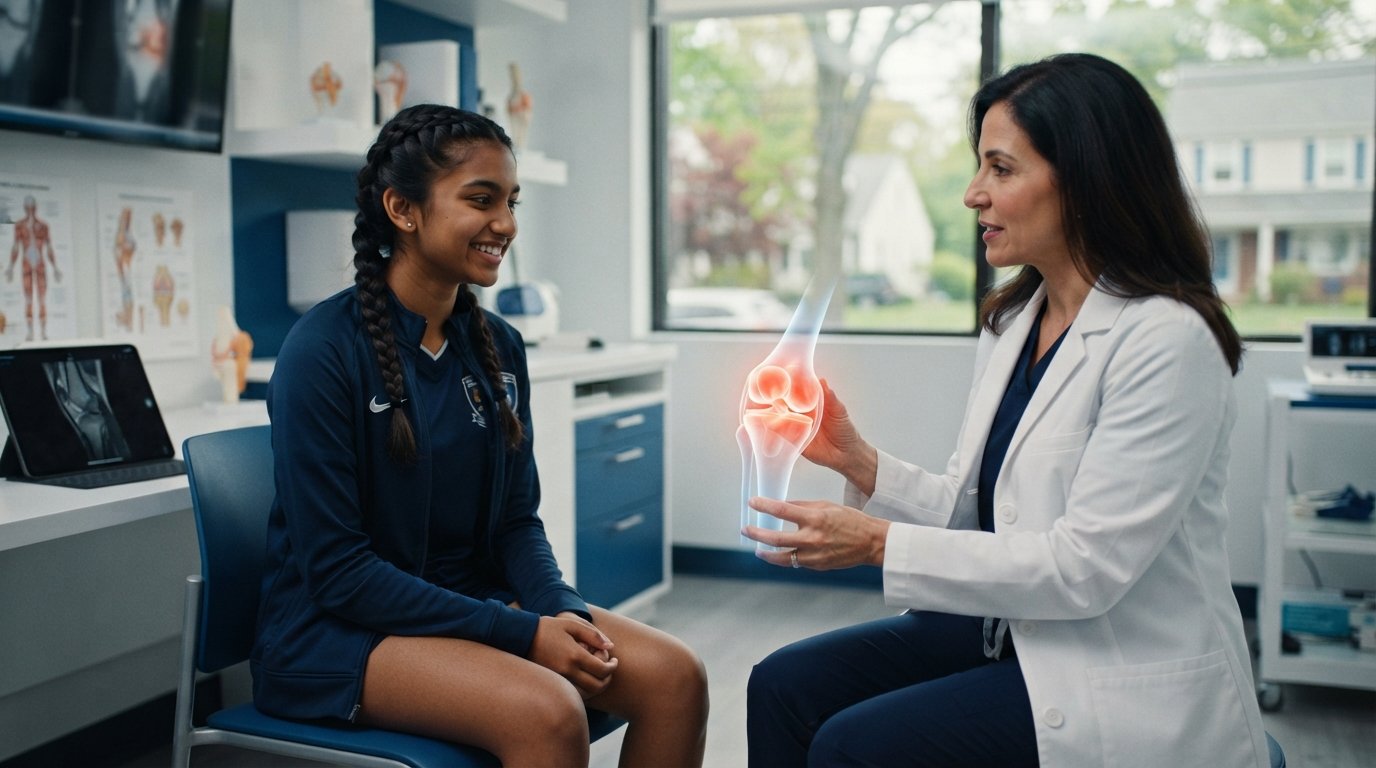
The most advanced treatment for a young athlete’s torn ACL isn’t a stronger synthetic graft, but rather the preservation of the ligament they were born with. When your child faces a season-ending injury, finding the best sports medicine doctor for young athletes Nutley NJ becomes an urgent priority that extends far beyond the current season. You’re likely balancing the immediate desire to see them back on the field with a deep-seated fear of permanent joint damage or growth plate complications. It’s a heavy burden, especially when you’re navigating the complex choice between traditional reconstruction and modern restorative methods.
We understand that adolescent athletes aren’t just small adults; their developing skeletons require a specialized clinical approach that respects open growth plates and prioritizes long-term joint health. This article will help you identify a local expert who utilizes cutting-edge techniques to protect your child’s athletic future. You’ll discover how to secure a clear diagnosis that preserves native anatomy, the specific benefits of the BEAR® Implant for young patients, and the essential steps for a fast but safe return to play. By focusing on advanced recovery now, you can ensure your student-athlete stays active for years to come.
Key Takeaways
- Learn why young athletes require a specialized clinical approach that protects open growth plates and accounts for skeletal immaturity.
- Discover the essential credentials to look for, including board certification and fellowship training, when selecting the best sports medicine doctor for young athletes Nutley NJ.
- Understand the revolutionary benefits of the BEAR® Implant, which allows the ACL to heal itself without the need for traditional tendon grafts.
- Get a clear preview of the diagnostic process and how a thorough consultation ensures a precise treatment plan for a safe return to play.
- Explore how minimally invasive techniques and native healing strategies can preserve your child’s joint health for their entire athletic career.
Why Adolescent Sports Medicine Requires a Specialized Approach
Adolescent sports medicine is a focused sub-specialty that addresses the unique physiological and developmental needs of skeletally immature patients. Unlike general orthopedics, specialized sports medicine for teens requires a deep understanding of how a body in flux responds to high-impact stress. This field bridges the gap between pediatric care and adult orthopedics, ensuring that treatments don’t just fix a current injury but also protect the patient’s future physical potential.
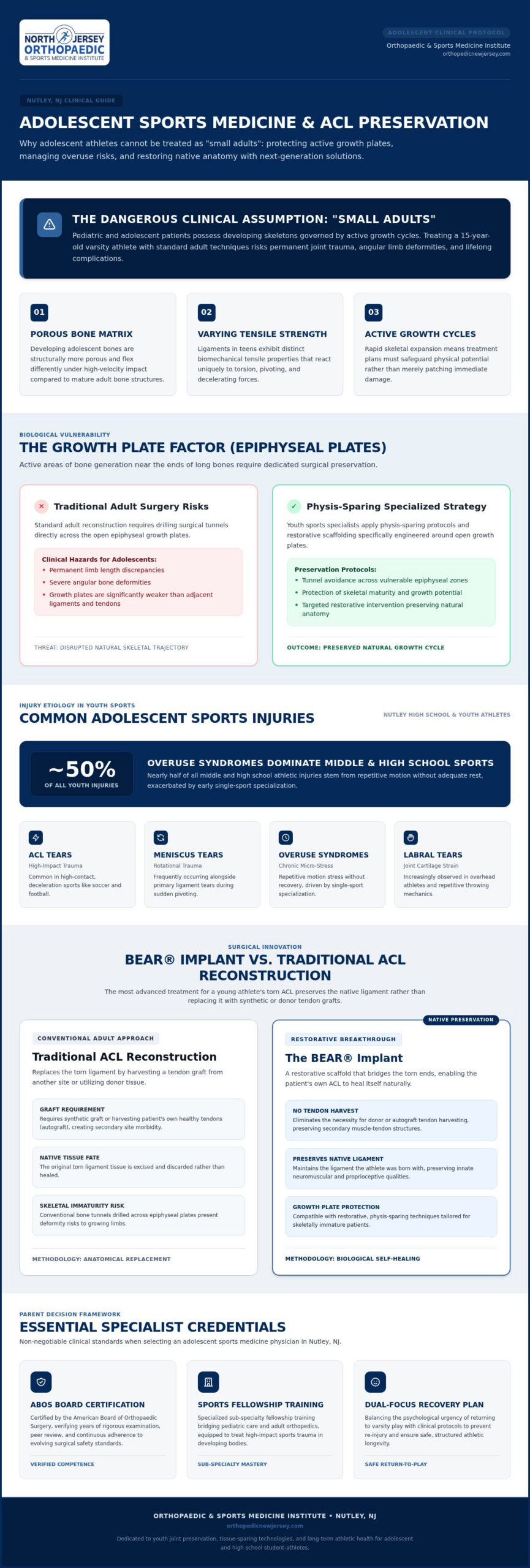
Pediatric and adolescent patients are frequently mischaracterized as “small adults.” This is a dangerous clinical assumption. Their bones are more porous. Their ligaments have different tensile strengths. Their bodies are governed by active growth cycles. Identifying the best sports medicine doctor for young athletes Nutley NJ involves finding a practitioner who recognizes these biological distinctions. A specialist knows that a treatment plan for a 15-year-old high school quarterback must differ significantly from the plan for a 45-year-old weekend warrior.
In a competitive environment like Nutley’s high school sports scene, an injury isn’t just a physical setback; it’s a disruption of identity. The pressure to return to the field can lead to anxiety or a rush to play before the body is ready. A dedicated specialist provides empathetic care that balances this desire with the clinical necessity of a safe, structured recovery. They act as a consultant for both the parent and the student, guiding them through the psychological and physical hurdles of rehabilitation.
The Growth Plate Factor in Youth Injuries
Growth plates, or epiphyseal plates, are areas of active new bone growth near the ends of long bones in children and teens. They are significantly weaker than the surrounding ligaments and tendons. Traditional adult surgical techniques often involve drilling tunnels across these plates, which can lead to permanent limb length discrepancies or angular deformities. A specialist utilizes physis-sparing techniques or restorative scaffolds to ensure surgical intervention never compromises a child’s natural growth trajectory.
Common Adolescent Injuries: Beyond the Sprain
Teen athletes in Nutley often face a mix of acute traumatic events and overuse syndromes. While ACL tears and meniscus injuries are common in high-contact sports like football or soccer, labral tears are increasingly seen in overhead athletes. Overuse injuries account for nearly 50% of middle and high school athletic injuries, often stemming from single-sport specialization. Whether it’s a sudden tear on the turf or chronic pain from repetitive motion, the best sports medicine doctor for young athletes Nutley NJ will differentiate between these causes to create a targeted, non-disruptive treatment plan.
- ACL Tears: High-impact trauma common in soccer and football.
- Meniscus Injuries: Often occurring alongside ligament tears during pivoting.
- Overuse Syndromes: Chronic stress from repetitive motion without adequate rest.
- Labral Tears: Common in athletes involved in throwing or overhead sports.
Choosing the Best Sports Medicine Doctor for Your Child
Selecting the right specialist is a high-stakes decision for parents. The best sports medicine doctor for young athletes Nutley NJ should possess a specific combination of elite credentials and a focus on advanced, tissue-sparing technology. While local clinics may offer general care, an adolescent athlete needs a practitioner who understands the long-term implications of treating common youth sports injuries during a period of rapid skeletal development. You aren’t just looking for a fix; you’re looking for a strategy that preserves your child’s joint health for decades.
The Importance of Board Certification
Board certification serves as a primary indicator of surgical competence and ethical standards. When a surgeon is board-certified by the American Board of Orthopaedic Surgery, they’ve completed years of rigorous training followed by comprehensive examinations and peer evaluations. For pediatric and adolescent patients, this credential is non-negotiable. It confirms the doctor stays current with evolving medical standards and safety protocols. You can verify a physician’s status through the New Jersey Division of Consumer Affairs to ensure your child is in expert hands.
Minimally Invasive vs. Traditional Surgery for Teens
The approach to surgical intervention has shifted toward minimally invasive orthopedic surgery NJ. Traditional open surgeries require large incisions that disrupt significant amounts of healthy muscle and tissue. In contrast, minimally invasive techniques use arthroscopic tools and tiny portals to repair damage. For a teenager, the benefits are practical and clinical. Smaller incisions mean less visible scarring, which is often a psychological concern for young patients. More importantly, these techniques reduce post-operative pain and the subsequent reliance on heavy pain medications.
Beyond surgical skill, evaluate whether the practice offers the latest restorative technologies. A specialist who provides the BEAR® Implant demonstrates a commitment to native ligament preservation rather than just replacement. Proximity also plays a role in successful outcomes. Frequent follow-up appointments and physical therapy sessions are more manageable when the office is located near Nutley, Bloomfield, or Clifton. Choosing a local authority ensures your child receives a consistent continuum of care without the stress of long commutes. If you’re ready to explore advanced recovery options, consulting with a board-certified specialist is the first step toward a safe return to the field.
Treatment Innovation: BEAR® Implant vs. Traditional ACL Reconstruction
Traditional ACL reconstruction has historically relied on autografts, which involve harvesting a patient’s own hamstring or patellar tendon, or allografts using donor tissue. While these methods are established, they require the complete removal of the damaged ligament and its replacement with a substitute. This process often leads to donor-site morbidity, where the area harvested becomes permanently weakened or prone to chronic pain. The BEAR implant ACL repair New Jersey offers a different path. It focuses on restoration rather than replacement, allowing the body to bridge the gap in its own anatomy.
For an adolescent athlete, the preservation of the native ACL is a significant clinical advantage. The original ligament is rich in mechanoreceptors that provide essential proprioception, or joint-position sense. When a graft is used, these nerve endings are lost. This can affect the “feel” of the knee during complex athletic movements like pivoting or jumping. Finding the best sports medicine doctor for young athletes Nutley NJ ensures your child has access to these advanced options that prioritize long-term joint health and natural biomechanics.
How the BEAR® Implant Works
The BEAR® (Bridge-Enhanced ACL Restoration) device is a bio-engineered, bovine-derived collagen sponge. During a minimally invasive procedure, the surgeon inserts the sponge between the two torn ends of the ACL. The device is then saturated with the patient’s own blood to stabilize a healing clot. This scaffold acts as a biological bridge, allowing the torn ends of the ligament to grow back together rather than being discarded. The body fully resorbs the collagen scaffold within roughly 8 weeks, leaving behind a restored, functional native ligament.
Who is a Candidate for BEAR®?
Candidacy for this procedure is highly specific and requires a prompt evaluation. The most critical factor is the “golden window” of timing; the surgery must generally occur within 50 days of the injury to ensure the tissue remains viable for healing. The patient must also have a sufficient ACL stump remaining attached to the tibia, as confirmed by a high-resolution MRI. For Nutley student-athletes, this is often the preferred choice because it avoids the harvest-site tendon weakness that can plague traditional reconstruction. Accurate sports injury diagnosis and rehabilitation protocols are necessary to confirm if this restorative technique is the most effective path forward for your child’s specific injury.
- Tissue Preservation: No healthy tendons are harvested from the patient’s body.
- Native Healing: The body restores its own original ligament tissue.
- Proprioception: Nerve endings are preserved, maintaining better joint awareness.
- Clinical Timing: Must be addressed within the first 50 days post-injury.
What to Expect During Your Consultation in Nutley
The initial consultation is a pivotal moment in your child’s recovery journey. It’s where clinical expertise meets personalized care. A comprehensive diagnostic process begins with a detailed physical examination and a thorough review of the patient’s athletic history. The best sports medicine doctor for young athletes Nutley NJ will combine these findings with high-resolution imaging, such as MRI or X-rays, to pinpoint the exact nature of the injury. This methodical approach ensures that no underlying issues, like secondary meniscus damage, are overlooked.
Transparency during this phase is essential. A specialist shouldn’t just provide a diagnosis; they should provide an education. They’ll guide you through the imaging results, explaining the anatomical implications of the injury in plain language. This level of detail is a clear indicator of a practitioner who values informed consent and shared decision-making. For a student-athlete, understanding the “why” behind their treatment plan can significantly reduce the anxiety associated with being sidelined.
Questions Every Parent Should Ask
As a parent, you act as the primary advocate for your child’s health. Don’t hesitate to ask probing questions about the surgeon’s specific experience with adolescent patients. Inquire about the annual volume of repairs they perform on skeletally immature joints. You should also ask for specific safety metrics regarding their return-to-play protocols. Finally, discuss the long-term outlook for the joint. A successful outcome isn’t just about the next season; it’s about preventing early-onset arthritis and ensuring the joint remains functional for a lifetime.
Navigating the Nutley and North Jersey Healthcare Landscape
Choosing a local specialist offers significant logistical advantages. When your child is balancing schoolwork at Nutley High School with a demanding rehabilitation schedule, proximity matters. An office located near Franklin Avenue or Hengerer Park makes frequent follow-up checks and coordination with local physical therapists in Bloomfield and Clifton seamless. You can avoid the stress of navigating traffic to major city hospitals for routine appointments, allowing your child to focus entirely on their recovery.
Our team is dedicated to providing the high-level expertise your student-athlete deserves right here in the community. If you’re ready to begin the diagnostic process with a board-certified specialist, schedule your consultation today to discuss the most advanced treatment options available.
Why The Orthopaedic & Sports Medicine Institute is Nutley’s Choice
The Orthopaedic & Sports Medicine Institute stands as the premier destination for families seeking the best sports medicine doctor for young athletes Nutley NJ. Our practice is built on a foundation of elite, board-certified expertise and a deep commitment to the local community. We don’t just treat injuries; we manage the athletic futures of students who live and play in our own backyard. By combining high-level surgical skill with a patient-centered philosophy, we ensure that every young athlete receives a personalized recovery plan tailored to their specific developmental needs.
Our lead surgeon brings years of specialized training to every case, focusing on techniques that prioritize the body’s natural ability to heal. We advocate for minimally invasive methods and native tissue preservation whenever possible. This clinical focus isn’t just about modernizing surgery; it’s about reducing the physiological burden on a growing body. We believe in transparency and education, taking the time to guide parents through the complexities of orthopedic care so they can make informed decisions with confidence.
A Community-Focused Specialist
Being a private, specialized practice allows us to offer a level of continuity that large hospital systems often struggle to maintain. When you visit our Nutley office, you’re consulting with a team that understands the competitive landscape of North Jersey scholastic sports. Our history of treating local athletes from Kearny to Verona has established us as a trusted resource for families in Clifton, Bloomfield, and beyond. For those currently evaluating their options, choosing the best sports medicine clinic near Montclair, NJ involves looking for this exact blend of clinical precision and community dedication.
Next Steps for Your Athlete’s Recovery
The path back to competition begins with a focused, diagnostic consultation. We’ve streamlined our process to ensure that your child receives an accurate diagnosis and a clear treatment roadmap as quickly as possible. It’s vital to remember that timing is a critical factor in restorative medicine. For injuries like ACL tears, the eligibility window for the BEAR® Implant is approximately 50 days from the date of injury. Missing this window can limit your child’s options to traditional reconstruction methods.
We’re here to provide the reassurance and expert guidance your family needs during a stressful time. Our goal is to bridge the gap between a season-ending injury and a safe, successful return to play. By choosing a local specialist who prioritizes native healing and long-term joint health, you’re giving your student-athlete the best chance at a resilient future. Reach out to our Nutley office today to schedule a consultation and take the first step toward a complete recovery.
Securing Your Athlete’s Physical Future
Adolescent athletes require a clinical approach that respects their unique physiology and active growth plates. By prioritizing native ligament preservation and minimally invasive techniques, you don’t just fix a current injury; you protect your child’s long-term mobility. Identifying the best sports medicine doctor for young athletes Nutley NJ is the most critical step in ensuring a recovery that avoids the pitfalls of traditional, graft-based reconstructions. Our practice offers the specialized expertise needed to navigate these complex decisions with confidence.
Led by a board-certified orthopedic surgeon, our team is a specialized BEAR® Implant provider dedicated to the student-athlete community. Our local Nutley, NJ office provides the high-level care usually reserved for professional athletes, right in your neighborhood. Don’t let a season-ending injury dictate your child’s future athletic potential. If you’re ready to explore advanced restorative options, Schedule a Consultation with our Nutley Sports Medicine Expert today. We’re here to help your athlete return to the sport they love, stronger and more resilient than before.
Frequently Asked Questions
How do I know if my child needs a sports medicine specialist or a general pediatrician?
You should consult a specialist when your child experiences persistent joint pain, swelling, or a mechanical “popping” sensation after an athletic event. While pediatricians manage overall health, the best sports medicine doctor for young athletes Nutley NJ has specific training in adolescent biomechanics and growth plate safety. This expertise is vital for preventing long-term damage in active students from Nutley or Clifton. We focus on the intricate relationship between developing bones and high-impact athletic stress.
Is the BEAR® Implant safe for teenagers with open growth plates?
Yes, the BEAR® Implant is safe and FDA-cleared for skeletally immature patients, including children and adolescents. Our clinical approach utilizes an all-epiphyseal fixation technique, which allows the ligament to heal without crossing or disrupting the open growth plates. This restoration method is a significant advancement for young athletes in the North Jersey area who want to avoid the risks associated with traditional adult-style surgical tunnels and graft harvesting.
What are the signs of a labral tear in a young overhead athlete?
Overhead athletes in Nutley, such as baseball pitchers or swimmers, often report deep shoulder pain or a “catching” sensation. You might notice your child losing throwing velocity or accuracy, or they may describe a “dead arm” feeling during competition. A labral tear treatment plan begins with a precise diagnostic evaluation to differentiate between simple muscle strain and structural damage. Early intervention is key to preserving the shoulder’s long-term stability and function.
How long is the typical recovery time before a student can return to sports?
Recovery timelines are highly individualized and depend on the specific injury and treatment method. For restorative procedures like the BEAR® Implant, athletes generally follow a strict 9-month protocol before returning to pivoting or contact sports. However, physical therapy often begins within days of the procedure. Our goal for student-athletes in Bloomfield and Lyndhurst is a safe return to play that prioritizes joint longevity over a rushed, risky timeline.
Does minimally invasive surgery really lead to a faster recovery for teens?
Minimally invasive surgery typically results in a faster initial recovery because it minimizes trauma to the surrounding healthy tissue. By using smaller incisions and arthroscopic technology, we reduce post-operative swelling and pain. This allows young patients in Kearny and North Arlington to begin functional rehabilitation sooner than they would after traditional open surgery. It’s an excellent option for teenagers who need to balance their recovery with their academic and social schedules.
What should I bring to my child’s first orthopedic consultation in Nutley?
For your first visit to our Nutley office, please bring any previous imaging on a CD, such as X-rays or MRIs, along with the corresponding radiologist reports. It’s also helpful to provide a detailed history of the injury and a list of current medications. Preparing a few specific questions about your child’s athletic goals will help the best sports medicine doctor for young athletes Nutley NJ create a more targeted and effective treatment plan.
Can an ACL tear heal without traditional reconstruction surgery?
Yes, the BEAR® Implant allows an ACL tear to heal without the need for a traditional tendon graft. Unlike reconstruction, which replaces the torn ligament with tissue from the hamstring or a donor, this restorative technique uses a collagen scaffold to bridge the gap. This allows the body to regrow its own native ligament tissue. This innovation is particularly beneficial for Nutley student-athletes who want to avoid the weakness caused by harvesting healthy tendons.
Why is native ligament preservation so important for young athletes?
Native ligament preservation is essential because it maintains the original nerve endings and mechanoreceptors responsible for proprioception. This “joint-position sense” allows an athlete to feel the knee’s movement more naturally during complex maneuvers. By keeping the original tissue, we also avoid donor-site morbidity, such as chronic kneeling pain or hamstring weakness. This approach supports a more resilient joint as the young athlete matures into adulthood in the North Jersey community.