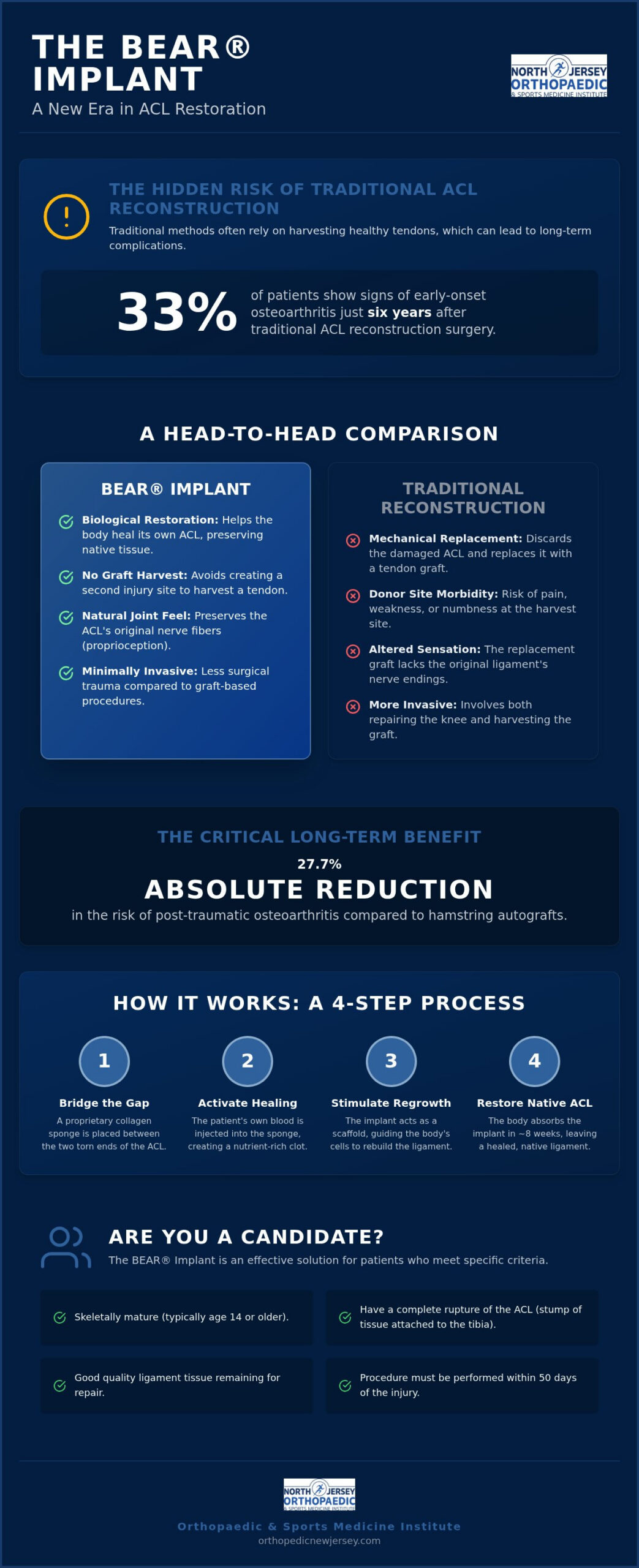
Did you know that 33% of patients show signs of early-onset osteoarthritis just six years after undergoing traditional ACL reconstruction? For many athletes in Northern New Jersey, the fear of long-term joint decay is often as stressful as the initial injury itself. If you’re concerned about donor site pain or losing the natural feel of your knee, consulting a BEAR implant surgeon Clifton NJ residents can rely on could change your recovery trajectory. This advanced approach focuses on biological restoration rather than mechanical replacement.
It’s understandable to feel anxious about the limitations of traditional grafts, especially when you want to return to peak performance without future complications. You’ll discover how the FDA-cleared BEAR® Implant facilitates the healing of your native ACL, offering a 27.7% absolute reduction in the risk of post-traumatic osteoarthritis compared to hamstring autografts. This guide provides a comprehensive look at the procedure, from patient eligibility to the timeline for returning to the field. You’ll learn exactly how this minimally invasive technology bridges the gap between established surgical wisdom and the future of sports medicine.
Key Takeaways
- Learn why Clifton athletes are moving toward biological restoration rather than traditional ACL reconstruction to preserve their native anatomy.
- Understand how a BEAR implant surgeon Clifton NJ utilizes a collagen-based sponge and your own blood to stimulate natural ligament healing.
- Compare the benefits of this minimally invasive procedure against traditional autografts, focusing on reduced surgical trauma and natural joint feel.
- Identify the specific criteria for candidate eligibility, including the types of ACL tears and tissue quality requirements that respond best to bridge-enhanced repair.
- Discover the advantages of receiving care from a board-certified specialist at a practice conveniently located for residents in the Clifton and Nutley areas.
Why Clifton Athletes are Choosing BEAR Implant Surgeons
For athletes in North Jersey, an ACL tear once meant a definitive choice: replace the ligament with a tendon graft or face permanent instability. Today, a medical paradigm shift is occurring. Sports medicine is rapidly moving away from mechanical “replacement” and toward biological “restoration.” Central to this evolution is Bridge-Enhanced ACL Restoration (BEAR), a sophisticated technique that enables the body to heal its own damaged tissue. By consulting a specialized BEAR implant surgeon Clifton NJ residents can access a procedure that uses a proprietary collagen sponge and the patient’s own blood to act as a scaffold for natural ligament regrowth. The primary objective is to facilitate the healing of the native ACL, avoiding the invasive harvesting of healthy tendons from other parts of the body.
The Problem with Traditional ACL Grafts
Standard reconstruction methodologies rely heavily on autografts, where a healthy tendon is harvested from the patient’s own hamstring, quadriceps, or patellar tendon. This process frequently results in donor site morbidity, which manifests as persistent pain, localized weakness, or sensory loss at the harvest site. Beyond immediate recovery concerns, the long-term prognosis for traditional reconstruction can be troubling. Data shows that 33% of patients exhibit signs of early-onset osteoarthritis only six years after their procedure. Native tissue is inherently superior for long-term knee health because it maintains the complex mechanoreceptors responsible for proprioception, the body’s ability to sense joint position and movement.
The Local Advantage: Specialized Care in the Clifton Area
Selecting a BEAR implant surgeon Clifton NJ athletes can easily reach is a strategic decision for long-term success. Our practice in Nutley serves as a premier destination for those seeking advanced sports medicine without the commute to NYC. Proximity to local landmarks like Main Avenue and Route 3 simplifies the logistics of the frequent post-operative assessments required during the first few months of healing. This accessibility ensures that patients don’t skip vital checkups due to travel fatigue. Receiving care from a board-certified specialist who understands the local athletic community allows for a more personalized, patient-centered recovery journey. We work closely with North Jersey physical therapists to create a synchronized rehabilitation network, ensuring that your transition from surgery to the playing field is methodical and medically sound.
How the BEAR® Implant Restores Your Native ACL
The BEAR® procedure represents a departure from traditional mechanical reconstruction. Instead of discarding the damaged ligament, a BEAR implant surgeon Clifton NJ uses a bio-restorative approach to encourage the body’s innate healing response. This technique relies on a sophisticated bovine-derived collagen sponge. Unlike a traditional graft, which acts as a permanent substitute, this implant is temporary. It provides the necessary structure for your own cells to rebuild the ligament from within. This technology, developed at Boston Children’s Hospital, has transformed how we approach sports injuries in North Jersey.
The Science of the Collagen Scaffold
During the procedure, the surgeon places the collagen sponge between the two torn ends of the ACL. This sponge is then “activated” when the surgeon injects a small amount of the patient’s own blood into it. This creates a stable, nutrient-rich clot that bridges the gap. The BEAR implant serves as a bridge that facilitates natural cellular migration across the injury site. Over a period of approximately eight weeks, the body naturally resorbs the collagen material. As the scaffold dissolves, it’s replaced by the patient’s own native ligament tissue. This biological timeline ensures that the final result is a healed version of your original anatomy, not a foreign or harvested tendon. Because the implant is absorbed, no foreign material remains in the joint long-term.
Preserving the ACL’s Nerve Fibers
One of the most significant advantages of this restoration is the preservation of the knee’s complex internal sensors. The native ACL is more than just a stabilizer; it is densely packed with mechanoreceptors. These microscopic nerve fibers are responsible for proprioception, which is your brain’s ability to sense the position and movement of the joint. When a surgeon performs a traditional reconstruction, these original nerve fibers are lost. By contrast, the BEAR procedure maintains these vital connections. This allows for a “natural-feeling” knee that many athletes find superior when returning to high-impact sports. If you are experiencing symptoms of an ACL tear, consulting a board-certified specialist in Clifton can help you determine if this restorative path is right for you.
The surgical technique itself is minimally invasive. It typically involves small incisions and arthroscopic guidance, which often results in less immediate post-operative trauma compared to the extensive harvesting required for autografts. This refined methodology prioritizes the integrity of the surrounding joint structures, setting the stage for a methodical recovery. A qualified BEAR implant surgeon Clifton NJ can guide you through the diagnostic process to ensure your tear is compatible with this specific biological scaffold.
BEAR Implant vs. Traditional ACL Reconstruction: A Comparison for Clifton Patients
Choosing between traditional reconstruction and biological restoration is a pivotal decision for any athlete. For decades, the gold standard was ACL reconstruction, which involves replacing the torn ligament with a graft harvested from the patient’s own hamstring, quadriceps, or patellar tendon. While effective for restoring stability, this method creates a secondary surgical site and permanently alters the knee’s mechanics. By consulting a BEAR implant surgeon Clifton NJ athletes can now consider a procedure that eliminates donor site morbidity entirely. The difference lies in how the joint functions after healing; restoration aims to return the knee to its pre-injury state rather than providing a mechanical substitute.
Biological Repair vs. Mechanical Replacement
Maintaining your native ligament is crucial for long-term joint health. Traditional grafts often lead to permanent weakness at the harvest site, which can impact an athlete’s explosive power or speed. More importantly, the native ACL contains specialized nerve endings that communicate the knee’s position to the brain. This “natural feel” is often lost in reconstruction, leading to a joint that feels stiff or disconnected. Choosing minimally invasive orthopedic surgery in NJ allows patients to preserve these mechanoreceptors. Research indicates that this biological approach offers a 27.7% absolute reduction in the risk of post-traumatic osteoarthritis compared to traditional hamstring autografts, addressing a major concern for young athletes.
Recovery Timelines Compared
The recovery path for the BEAR implant is methodical and requires disciplined participation. During the first six weeks, patients typically use a specialized brace to protect the healing ligament as the collagen scaffold facilitates tissue growth. While the initial phases focus on protection, the later milestones align closely with traditional reconstruction. A specialized BEAR implant surgeon Clifton NJ will emphasize that while the early weeks are more restrictive, the long-term functional benefits are substantial. Local high school and amateur athletes can generally expect a return to high-impact sports and pivoting activities around nine months post-surgery. However, success depends heavily on strict adherence to a structured physical therapy protocol. Unlike a graft that is strong on day one but weakens as it incorporates, the BEAR implant starts as a scaffold and becomes stronger as your own tissue matures. This biological timeline demands patience but offers the reward of a joint that retains its original anatomy and sensory capabilities.
Candidate Selection and the Recovery Timeline in North Jersey
Success with bridge-enhanced restoration depends heavily on proactive diagnostic steps. For many patients, the 50-day window following an injury is a critical period for evaluation. While recent clinical insights suggest that tissue quality is the ultimate determining factor for eligibility, early consultation remains vital. This timeframe allows a BEAR implant surgeon Clifton NJ to assess the internal environment of the knee before significant scar tissue forms or the ACL stump begins to retract. If you’ve recently sustained a knee injury during a local game or at the gym, seeking a specialized evaluation in Nutley is the first step toward biological repair.
Are You a Candidate for the BEAR Implant?
The BEAR® procedure is indicated for patients aged 14 and older who are skeletally mature. Eligibility is primarily determined by the nature of the ACL tear. The implant requires a complete tear where the ACL stump is still attached to the tibia, as this tissue provides the biological foundation for the repair. During your clinical exam at our Nutley office, we utilize high-resolution MRI and physical diagnostic tests to confirm the integrity of the native ligament tissue. Candidates should be motivated individuals who are committed to a structured, long-term rehabilitation program. If your ACL tissue is too degraded or the injury occurred several months ago, traditional reconstruction may still be the more appropriate path for joint stability.
The 4 Phases of BEAR Recovery
The biological healing process follows a methodical schedule that differs slightly from traditional graft recovery. Because we are growing new tissue rather than relying on a transplanted tendon, the early stages prioritize protection. Local athletes in the Clifton and Nutley area must work closely with specialized physical therapists to navigate these four distinct milestones:
- Phase 1 (Weeks 0-6): This phase focuses on protection. Patients use a specialized brace and follow limited weight-bearing instructions to allow the collagen scaffold to stabilize the blood clot and initiate cellular migration.
- Phase 2 (Weeks 6-12): Once the initial healing is confirmed, the focus shifts to restoring a full range of motion. We begin gentle muscle activation exercises to prevent atrophy in the quadriceps and hamstrings.
- Phase 3 (Months 3-9): During this period, the new ligament tissue matures. Patients progress to advanced strengthening and begin linear running protocols. This is where proximity to your surgical team for regular checkups becomes a significant advantage.
- Phase 4 (9+ Months): The final phase involves a return to pivoting sports and full activity. We use objective strength testing to ensure the joint can handle the demands of competitive sports.
Adhering to this timeline is non-negotiable for a successful outcome. The proximity of our practice to local rehab centers makes it easier for patients to maintain the necessary frequency of visits without the stress of a long commute. If you’re ready to explore a restorative approach to your recovery, schedule a consultation with our board-certified surgeon to discuss your eligibility for the BEAR® procedure.
Expert ACL Restoration at The Orthopaedic & Sports Medicine Institute
The Orthopaedic & Sports Medicine Institute serves as a central hub for advanced musculoskeletal care in Northern New Jersey. We understand that an ACL injury is a life-altering event for an athlete, requiring a balance of surgical precision and empathetic guidance. By choosing a BEAR implant surgeon Clifton NJ residents gain access to a practitioner who values the long-term integrity of the native joint. Our practice is built on a foundation of clinical excellence and a commitment to utilizing the most recent technological breakthroughs in sports medicine. We prioritize a diagnostic mindset that values accuracy over brevity, ensuring every patient receives a tailored recovery plan.
Why Trust Our Board-Certified Surgeon?
Board certification is more than a title; it’s a constant anchor for our authority and a guarantee of professional standards. Our surgeon has extensive experience in minimally invasive knee procedures, which is critical for the success of the BEAR® protocol. We don’t just perform surgeries; we lead patients through a comprehensive recovery journey. This dedication to forward-thinking care is why we offer BEAR implant ACL repair in New Jersey as a primary solution for qualified candidates. By focusing on the body’s natural healing capacity, we provide an alternative to the more disruptive traditional methods that rely on donor grafts. Our expertise bridges the gap between established medical wisdom and the future of specialized orthopedics.
Schedule Your Clifton-Area Consultation
Your path to recovery begins with a thorough diagnostic evaluation at our state-of-the-art facility in Nutley. During your first visit, we’ll review your MRI results with methodical care to determine the exact nature of your ACL tear. It is vital to have this assessment performed as soon as possible after the injury to preserve the widest range of surgical options. We’ll discuss both restorative and non-surgical pathways, ensuring you have a clear understanding of the risks and benefits associated with each. Our office is conveniently located for residents of Clifton, Belleville, and Kearny, making it a local resource for those who want world-class care without traveling into the city. We prioritize transparency and education. You’ll leave your consultation with a structured plan tailored to your specific athletic goals and physical requirements. Finding a specialized BEAR implant surgeon Clifton NJ athletes can trust is the first step toward reclaiming your active lifestyle.
Reclaim Your Athletic Future with Native ACL Restoration
The transition from traditional mechanical reconstruction to biological restoration represents a significant advancement for North Jersey athletes. By choosing a BEAR implant surgeon Clifton NJ residents can rely on, you’re prioritizing the long-term health of your knee joint. This procedure doesn’t just provide a substitute; it facilitates the natural healing of your own native tissue, preserving the vital nerve endings that maintain joint stability and a natural feel. Data showing a 27.7% absolute reduction in the risk of post-traumatic osteoarthritis highlights why this restorative path is becoming the preferred choice for active individuals.
Our board-certified orthopedic surgeon specializes in minimally invasive knee surgery, providing expert care right here in the Nutley, Clifton, and Bloomfield area. We’re dedicated to helping you navigate the critical early stages of injury assessment and the methodical recovery process that follows. Don’t let an ACL tear dictate your future performance or lead to early-onset joint decay. Take the first step toward a more resilient recovery by exploring your eligibility for this cutting-edge technology.
Schedule a Consultation with our BEAR Implant Surgeon to discuss your personalized restoration plan. We’re here to guide you back to the sports and activities you love with confidence and professional support.
Frequently Asked Questions
Is the BEAR implant better than traditional ACL surgery?
The BEAR implant offers distinct biological advantages over traditional reconstruction by facilitating the restoration of your native ligament. Unlike a graft, which acts as a mechanical replacement, this procedure enables your body to heal itself, resulting in a 27.7% absolute reduction in the risk of post-traumatic osteoarthritis. Many athletes find the natural feel and preserved proprioception superior to the stiffness sometimes associated with tendon harvesting. Consult a BEAR implant surgeon Clifton NJ families trust to evaluate which method aligns with your long-term joint health goals.
How long do I have to wait to get the BEAR implant after my injury?
While early protocols emphasized a 50-day surgical window, current clinical experience suggests that the quality of the ACL tissue is the primary factor for eligibility. It’s essential to undergo a diagnostic MRI as soon as possible after the injury. Early evaluation allows our board-certified surgeon in Nutley to assess the ACL stump before significant retraction or scarring occurs. Delaying your consultation may limit your options, so we recommend scheduling an appointment shortly after your initial injury occurs.
Does insurance cover the BEAR implant procedure in New Jersey?
Most major insurance providers in New Jersey cover the BEAR implant and its associated surgical costs as of August 2026. However, individual plan coverage can vary significantly based on your specific policy and employer group. We recommend contacting your insurance carrier directly to confirm benefits for the BEAR procedure. Our administrative staff at The Orthopaedic & Sports Medicine Institute can assist you in providing the necessary documentation for your pre-authorization process to ensure your coverage is verified before surgery.
Can the BEAR implant be used for a partial ACL tear?
Yes, the FDA expanded the indications for the BEAR implant in March 2025 to include both complete and partial ACL tears. This is a significant development for patients who still have partial stability but require biological assistance to heal the damaged fibers. If your MRI reveals a high-grade partial tear with an attached stump, you may be an ideal candidate for this restorative technique. Our surgeon will review your imaging to confirm if your specific tear pattern is compatible with the collagen scaffold.
What is the failure rate of the BEAR implant compared to a graft?
Clinical trials have demonstrated that the BEAR implant is non-inferior to traditional reconstruction using a hamstring autograft. While it’s a newer technology, the failure rates are comparable to established methods when patients strictly follow the rehabilitation protocol. The primary difference lies in the long-term health of the joint. By preserving your native anatomy, you’re potentially reducing the risk of early-onset osteoarthritis, which affects 33% of traditional reconstruction patients within only six years of their surgery.
Will I need a brace after BEAR implant surgery?
Protection is a critical component of the recovery process, and you’ll typically need to wear a specialized brace for the first six weeks following surgery. This brace limits your range of motion and protects the delicate collagen scaffold while your body initiates the healing process. During this initial phase, you’ll also have specific weight-bearing restrictions to follow. As you progress into the second phase of your recovery, your physical therapist will guide you in gradually transitioning away from the brace as muscle activation improves.
Where can I find a BEAR implant surgeon near Clifton, NJ?
Residents of Clifton, Nutley, and Bloomfield can find specialized care at The Orthopaedic & Sports Medicine Institute. Our Nutley office is conveniently located for those seeking a BEAR implant surgeon Clifton NJ athletes can reach without traveling into New York City. We provide board-certified expertise in minimally invasive techniques, ensuring that local patients have access to the latest advancements in sports medicine. Proximity to our office simplifies the frequent checkups and rehabilitation visits required for a successful surgical outcome.
How soon can I return to sports like soccer or football after a BEAR repair?
Most athletes can expect to return to high-impact, pivoting sports like soccer or football approximately nine months after the procedure. This timeline is comparable to traditional reconstruction but requires strict adherence to a multi-phase physical therapy program. We use objective strength and stability testing to ensure your new ligament has matured sufficiently to handle competitive play. Your recovery speed depends on your individual biological response and your commitment to the strengthening exercises prescribed by your clinical team during the maturation phase.