What if you could repair your torn ACL using your own natural ligament instead of harvesting a healthy tendon from elsewhere in your body? For many dedicated athletes in Kearny, the prospect of traditional reconstruction brings a heavy sense of anxiety. You likely fear the long, painful recovery times and the permanent loss of proprioception that often follows a graft. It’s frustrating to think that the highest level of orthopedic innovation might require a stressful commute into New York City. Consulting with a specialized BEAR implant surgeon Kearny NJ residents can access locally changes that narrative completely.
We understand that preserving your native anatomy is the gold standard for long-term joint health. This article will demonstrate how the revolutionary BEAR® implant acts as a bridge to help your body heal its own tissue, potentially reducing your risk of post-traumatic osteoarthritis by 27.7 percent. You’ll learn about the strict 50-day window for eligibility and how our board-certified approach in Nutley brings world-class sports medicine right to your doorstep. We’ll outline the methodical recovery process and the clinical advantages of choosing restoration over traditional replacement.
Key Takeaways
- Understand the shift from traditional ACL reconstruction to biological restoration using the BEAR® implant, which preserves your native ligament tissue.
- Learn how this bio-engineered collagen sponge acts as a bridge, allowing your body to knit its own ACL back together without a donor tendon graft.
- Discover why choosing a specialized BEAR implant surgeon Kearny NJ residents can visit in nearby Nutley may lead to faster recovery of quadriceps strength.
- Identify the critical importance of board certification and fellowship training when selecting a specialist for advanced, minimally invasive knee restoration.
- Find out how to access cutting-edge orthopedic care just minutes from Kearny, avoiding the need for lengthy commutes to specialized centers in NYC.
Understanding Your ACL Repair Options in Kearny, New Jersey
Kearny is a community that lives and breathes sports. From the high-intensity soccer matches at Harvey Field to competitive high school athletics across North Jersey, the risk of an Anterior Cruciate Ligament (ACL) tear is a constant reality. For decades, a complete tear meant a total replacement of the ligament through reconstruction. However, modern orthopedic science has shifted toward restoration. Working with a qualified BEAR implant surgeon Kearny NJ residents can trust means exploring a biological alternative that prioritizes healing over replacement. This approach is particularly relevant given that there are approximately 400,000 ACL injuries in the U.S. annually, many affecting the active youth and adult populations in our local area.
What is the BEAR® Implant?
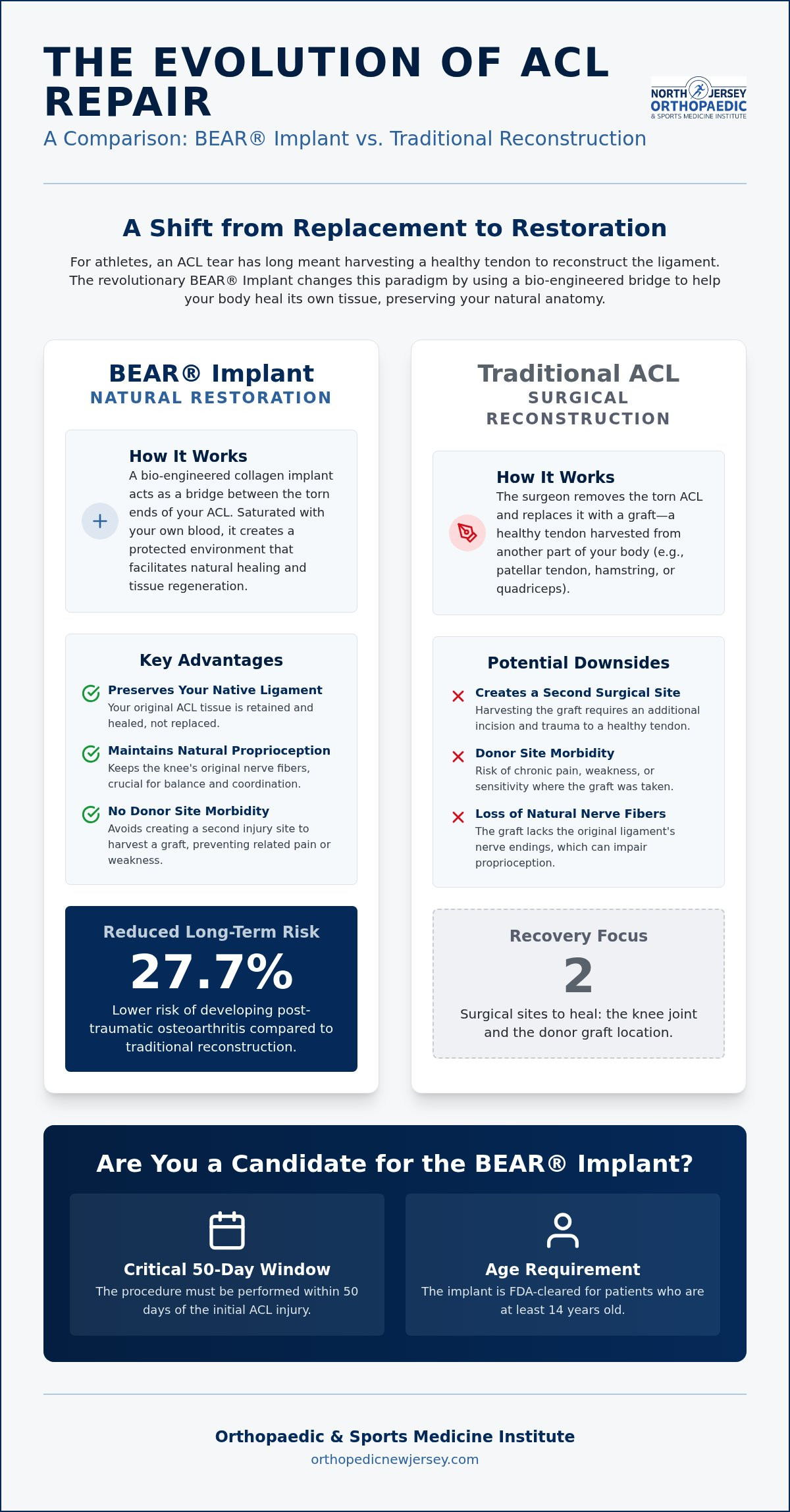
The BEAR implant represents a significant departure from thirty years of surgical convention. It is a bio-engineered, bovine-derived collagen sponge designed to facilitate Bridge-Enhanced ACL Restoration (BEAR). Unlike a graft, which replaces the torn tissue, this implant acts as a temporary scaffold. During the procedure, the surgeon secures the implant between the torn ends of the ACL and saturates it with the patient’s own blood. This creates a nutrient-rich biological bridge that allows the two ends of the ligament to knit back together naturally. The FDA has cleared this technology for patients at least 14 years old, offering a sophisticated solution that the body eventually resorbs within about eight weeks as the native tissue heals.
Why Traditional Reconstruction May Not Be the Only Path
Standard ACL reconstruction involves an autograft, where a surgeon harvests healthy tissue from your own hamstring, quadriceps, or patellar tendon. While effective, this method creates a secondary surgical site. Many patients experience donor site morbidity, which includes persistent weakness or chronic pain where the graft was taken. This is a significant concern for athletes who don’t want to compromise one part of their leg to fix another. By consulting with an expert BEAR implant surgeon Kearny NJ athletes can ensure they are candidates for this tissue-sparing technique.
Choosing restoration allows you to keep your native ligament. This preservation is vital for maintaining the knee’s natural proprioception, which is the sensory feedback that helps athletes balance and coordinate complex movements. By avoiding a graft, you eliminate the trauma of harvesting healthy tissue. For the active population in Kearny, this means a chance to return to the field with a knee that retains its natural mechanical feel and long-term stability.
How the BEAR® Implant Facilitates Natural ACL Healing
A qualified BEAR implant surgeon Kearny NJ residents trust begins the procedure using minimally invasive arthroscopic techniques. This involves small incisions that reduce trauma to the surrounding knee structures. Unlike traditional surgery, where the torn ligament ends are removed, this method preserves the existing tissue to create a foundation for repair. The process is designed to be less disruptive than a graft harvest, focusing entirely on the restoration of your original anatomy.
The Role of Your Own Blood in the Healing Process
The primary reason a torn ACL cannot heal on its own is the presence of synovial fluid within the joint capsule. This fluid prevents a stable blood clot from forming between the torn ends of the ligament. Without a clot, the body’s natural healing cascade never begins. The BEAR implant solves this by acting as a protective environment that holds the patient’s own blood in place. The “Biological Bridge” is a specialized collagen scaffold that stabilizes the blood clot while the body resorbs the implant and replaces it with native tissue. Research listed in the BEAR Implant vs. Standard ACL Reconstruction study confirms that this approach effectively bridges the gap between torn fibers to facilitate natural regeneration.
Preserving the Native Nerve Fibers
One of the most significant advantages of this restoration is the preservation of native nerve fibers. These fibers are responsible for proprioception, which is your brain’s ability to sense the position and movement of your knee. When a surgeon uses a donor graft, these original neural pathways are lost. This often results in a “mechanical” or “numb” feeling during high-impact activities like football or soccer. By keeping the original ligament intact, you maintain the natural nerve feedback required for elite athletic performance and balance. Evaluating your injury with a board-certified orthopaedic specialist ensures you don’t miss the critical 50-day window for this technology. Consulting a specialized BEAR implant surgeon Kearny NJ athletes recommend can help you regain that natural knee feel that traditional reconstruction lacks.
Comparing Outcomes: BEAR® Implant vs. Standard ACL Reconstruction
The primary clinical difference between traditional reconstruction and restoration lies in the preservation of healthy tissue. Standard ACL surgery requires an autograft, which involves harvesting a portion of your patellar tendon or hamstring. This process effectively creates a second surgical site that must heal alongside the knee joint. In contrast, the BEAR procedure eliminates the need for a graft harvest, significantly reducing overall surgical trauma. By avoiding a donor site, patients often report less localized pain in the weeks following the operation. Consulting a BEAR implant surgeon Kearny NJ athletes rely on ensures that the focus remains entirely on the biological repair of the original ligament rather than managing multiple injury sites.
Muscle recovery is another area where restoration shows distinct advantages. Clinical data suggests that patients undergoing the BEAR procedure may experience faster recovery of quadriceps strength compared to those receiving traditional hamstring autografts. This is a critical factor for Kearny soccer players and football athletes who require explosive power and stability to return to their sport safely. Because the procedure is less disruptive to the surrounding musculature, the initial phase of rehabilitation focuses on protecting the healing ligament rather than recovering from the trauma of a graft harvest.
Recovery Milestones and Physical Therapy
The rehabilitation timeline for the BEAR implant is specific and requires a disciplined approach. Unlike traditional reconstruction, which might allow for earlier weight-bearing, the BEAR protocol typically involves a stricter six-week bracing phase to protect the “biological bridge” while it solidifies. During this period, physical therapy is mandatory and follows a methodical progression. Local athletes must commit to a specialized program, often coordinated with regional providers like JAG Physical Therapy, to ensure the healing tissue is not overstressed. While the initial restrictions are more conservative, the goal is a more robust long-term outcome, with a full return to competitive sports generally expected between 9 and 12 months post-surgery.
Long-Term Knee Stability and Health
One of the most compelling reasons to choose restoration is the potential for improved long-term joint health. According to the FDA-approved BEAR® Implant clinical data, this technology may offer a 27.7 percent absolute reduction in the risk of post-traumatic osteoarthritis compared to traditional methods. Long-term studies have shown that six years after surgery, BEAR patients had only a 5.7 percent incidence of osteoarthritis, while those with traditional hamstring grafts faced a 33 percent incidence. This preservation of the native ACL helps maintain the original anatomy and biomechanics of the knee, which is the gold standard for minimally invasive orthopedic surgery NJ specialists. By choosing a BEAR implant surgeon Kearny NJ residents can access, patients are investing in the future health of their joints, not just a short-term fix.
Criteria for Selecting a Specialized Orthopedic Surgeon in North Jersey
Selecting a specialist for a biological restoration is a decision that requires careful scrutiny of professional credentials. For patients in Hudson and Essex counties, finding a qualified BEAR implant surgeon Kearny NJ residents can trust begins with verifying board certification. This certification ensures the practitioner has met rigorous national standards for orthopedic knowledge and surgical skill. Because the BEAR procedure is a technical departure from traditional methods, additional specialization is required to ensure the best possible outcome for your knee.
Fellowship training in sports medicine is a critical differentiator. This advanced year of study focuses specifically on the complex biomechanics of the knee and the latest minimally invasive techniques. Surgeons who have completed this training are better equipped to handle the nuances of ligament restoration. Additionally, because the BEAR implant is a proprietary technology, the surgeon must be specifically trained and certified by Miach Orthopaedics. This specialized training ensures the surgeon has mastered the specific tensioning and placement techniques necessary to create a successful biological bridge between the torn ends of the ACL.
Why Local Expertise Matters for Kearny Patients
Choosing a surgeon located in the Kearny, Nutley, or Bloomfield area offers significant logistical advantages. The recovery from a BEAR procedure involves a strict six-week bracing phase that requires frequent post-operative checkups. Residents in North Arlington and Lyndhurst benefit from shorter travel times; this reduces the physical stress of commuting while immobilized. A local specialist often maintains a direct, collaborative relationship with regional physical therapy providers. This synergy ensures your rehabilitation protocol is executed exactly as the surgeon intended, providing a seamless transition from the operating room to the gym.
Questions to Ask Your Surgeon During the Consultation
During your initial evaluation, it’s essential to advocate for your own recovery by asking targeted questions. A transparent specialist will welcome the opportunity to discuss their experience and your specific candidacy. Consider the following queries during your visit:
- How many BEAR procedures have you performed, and what are your typical patient outcomes?
- Am I a candidate based on my specific tear type and the time elapsed since my injury?
- What does your specific post-operative protocol look like, and how does it differ from traditional reconstruction?
- How do you coordinate with local physical therapists to monitor my progress during the first six months?
If you are ready to discuss your options with a BEAR implant surgeon Kearny NJ athletes trust, you can schedule a consultation with our board-certified team to determine the best path for your recovery journey.
Personalized Knee Recovery at The Orthopaedic & Sports Medicine Institute
The Orthopaedic & Sports Medicine Institute is dedicated to providing the most advanced minimally invasive options for our community. We understand that an ACL injury isn’t just a clinical diagnosis; it’s a significant disruption to your daily life and long-term athletic goals. Our practice prioritizes a patient-centered approach that balances high-level surgical expertise with empathetic guidance. By focusing on modern interventions like the BEAR® implant, we provide a path toward recovery that respects your body’s natural anatomy and promotes biological healing.
Accessing this level of specialized care doesn’t require a stressful journey into Manhattan or Jersey City. Our Nutley office is strategically located just minutes from Kearny. Whether you’re traveling via Route 21 or taking Passaic Avenue, you can reach our board-certified specialists quickly and easily. This proximity is vital not only for the initial surgery but for the consistent, high-frequency follow-up care that a successful ACL restoration demands. We take pride in being a dedicated community resource for residents across Essex and Hudson counties.
Advanced ACL Repair Close to Kearny
As a premier BEAR implant ACL repair New Jersey provider, our practice is at the forefront of native ligament healing. We’ve seen firsthand how this technology allows athletes to return to their active North Jersey lifestyles with greater confidence in their knee’s stability. Choosing a BEAR implant surgeon Kearny NJ residents can access locally means you’re working with a team that understands the specific needs of our community’s athletes. We focus on the precision of the procedure to ensure the biological bridge is correctly established, setting the stage for a robust and natural recovery.
Scheduling Your Consultation in Nutley
The first step in your recovery journey is a comprehensive diagnostic evaluation. During your consultation, our board-certified surgeon will conduct a thorough physical exam and a detailed MRI review to determine if you meet the specific criteria for the BEAR procedure. Timing is a critical factor in this decision. Because the procedure relies on the quality of your existing ligament tissue, it’s best to seek an evaluation as soon as possible following your injury to ensure you remain within the optimal treatment window.
Reaching our facility from Kearny, Bloomfield, or North Arlington is straightforward, allowing you to focus on your health rather than the logistics of travel. Our goal is to provide a seamless experience from your first diagnostic appointment through your final physical therapy milestone. If you’re ready to explore a graft-free alternative to traditional surgery, schedule your ACL consultation today and take the first step toward restoring your natural knee function with a specialist who understands your goals.
Restoring Your Natural Athletic Potential in Kearny
The shift from traditional ACL reconstruction to biological restoration represents a significant advancement in modern sports medicine. By choosing the BEAR® implant, you prioritize the preservation of your native ligament and the maintenance of natural knee proprioception. This approach not only eliminates the trauma associated with harvesting a tendon graft but also offers a documented reduction in long-term osteoarthritis risk. Accessing this level of sophisticated care is now more convenient than ever for local athletes.
Consulting with a specialized BEAR implant surgeon Kearny NJ residents can visit in nearby Nutley ensures you don’t have to sacrifice quality for proximity. Our board-certified orthopedic surgeon is a specialist in native ligament restoration, dedicated to serving Kearny and North Arlington athletes with the latest minimally invasive techniques. We focus on getting you back to your pre-injury activity levels with a knee that feels natural and stable.
Your journey toward a full, natural recovery begins with an expert evaluation. We are committed to guiding you through every milestone, from initial diagnosis to your final return to sport. Book Your BEAR® Implant Consultation in Nutley today and take the first step toward reclaiming your active lifestyle.
Frequently Asked Questions
Is the BEAR implant better than traditional ACL reconstruction?
While traditional reconstruction is a successful standard, the BEAR procedure offers unique biological advantages that many find superior for long-term health. It preserves your native tissue and avoids the pain associated with a graft donor site. Clinical data indicates a 27.7 percent reduction in the risk of post-traumatic osteoarthritis. The choice depends on your injury type and the timing of your diagnosis with a BEAR implant surgeon Kearny NJ residents can consult locally.
Am I a candidate for the BEAR implant surgery in Kearny?
Candidacy depends on several specific clinical factors. You must be at least 14 years old and skeletally mature with a confirmed complete ACL tear. Crucially, the ACL tissue must still be attached to the shinbone to allow for successful restoration. A detailed MRI review is necessary to evaluate the quality of the remaining ligament. Because this procedure relies on your body’s natural healing response, your overall health and activity goals are also factored into the final decision.
How long does it take to return to sports after a BEAR procedure?
Athletes typically expect a full return to competitive sports between 9 and 12 months post-surgery. While the initial recovery phase involves stricter bracing and weight-bearing restrictions than traditional methods, the goal is a more robust biological repair. A comprehensive, multi-phase physical therapy program is mandatory for a successful outcome. This timeline ensures the native ligament has sufficiently matured to withstand the high-impact demands of competitive sports like soccer, football, or basketball in the North Jersey area.
Does insurance cover the BEAR implant in New Jersey?
Yes, as of June 2026, most major insurance providers in New Jersey officially cover the BEAR implant procedure. This includes Medicare and prominent commercial plans throughout the state. Our office in Nutley works closely with patients from Kearny and North Arlington to verify specific plan coverage and authorizations. While coverage is now widespread, we always recommend a direct verification with your provider to understand any specific deductibles or out-of-pocket requirements for specialized orthopedic care.
What are the risks associated with the BEAR implant?
The risks are comparable to those of traditional ACL reconstruction, including infection, stiffness, or surgical failure. Specifically, the BEAR implant has a re-tear rate of approximately 5 percent, which aligns with standard surgical outcomes. There is also a possibility that the body may not respond optimally to the biological scaffold. However, because there is no second surgical site for a graft harvest, certain risks like donor site morbidity and chronic harvest-site weakness are effectively eliminated.
How soon after an ACL tear must the BEAR surgery be performed?
There is a critical 50-day window following the initial injury within which the BEAR surgery must be performed. This strict timeline exists because the native ACL tissue begins to degrade and retract shortly after a complete tear. For the implant to act as an effective bridge, the remaining ligament fibers must be healthy and accessible. If you suspect an ACL injury, seeking an immediate evaluation with a BEAR implant surgeon Kearny NJ athletes trust is vital.
Will I need a brace after BEAR implant surgery?
Yes, a specialized bracing protocol is a mandatory component of the recovery process. Patients generally wear a brace for approximately six weeks following the procedure to protect the healing ligament as it knits back together. During this initial phase, weight-bearing is more restricted compared to traditional reconstruction methods. This conservative approach ensures the biological bridge remains stable while the body resorbs the collagen implant and replaces it with your own natural tissue during the first eight weeks.
Where can I find a BEAR implant surgeon near Kearny or Nutley?
Specialized care is available at The Orthopaedic & Sports Medicine Institute in Nutley, New Jersey. Led by a board-certified orthopedic surgeon, our practice serves the local communities of Kearny, North Arlington, and Bloomfield. We focus on advanced, minimally invasive techniques like the BEAR procedure to help local athletes recover without the need for a donor graft. Our facility is conveniently located near major routes like Passaic Avenue, making high-level orthopedic restoration accessible close to home.