What if the most effective way to repair your joint involves doing as little disruption to your healthy tissue as possible? It’s a common misconception that a larger incision necessarily equates to a more thorough or “better” repair. When you’re weighing the options of minimally invasive vs traditional orthopedic surgery, you’re really choosing between two distinct philosophies of care. One relies on wide surgical access, while the other prioritizes a tissue-sparing approach that uses advanced imaging and specialized instruments to protect your surrounding anatomy.
We recognize that facing any procedure brings a natural sense of anxiety regarding post-operative pain and the time you’ll spend away from work or sports. You want the confidence that comes from a high-level clinical outcome without the burden of a long hospital stay. This guide provides a professional comparison of techniques, recovery milestones, and clinical results to help you determine the best path for your musculoskeletal health. We’ll explore how modern innovations, which have fueled a 9% growth in the minimally invasive market, are shifting the standard of care toward faster healing, minimal scarring, and a more efficient return to the activities you enjoy.
Key Takeaways
- Compare the foundational methods of surgical access, contrasting traditional open incisions with the precision-targeted portals used in modern orthopedic procedures.
- Discover how high-definition arthroscopic technology provides a magnified view of the joint, allowing for surgical accuracy that often exceeds traditional direct visualization.
- Assess the recovery advantages of minimally invasive vs traditional orthopedic surgery, specifically regarding reduced post-operative pain and the preservation of healthy surrounding tissue.
- Learn which patient-specific variables, including anatomical health and the nature of the injury, influence the selection of a minimally invasive surgical path.
- Gain insight into cutting-edge solutions like the BEAR® Implant, a specialized method for ACL repair that avoids the invasiveness of traditional donor grafts.
Defining the Approaches: Traditional Open vs. Minimally Invasive Surgery
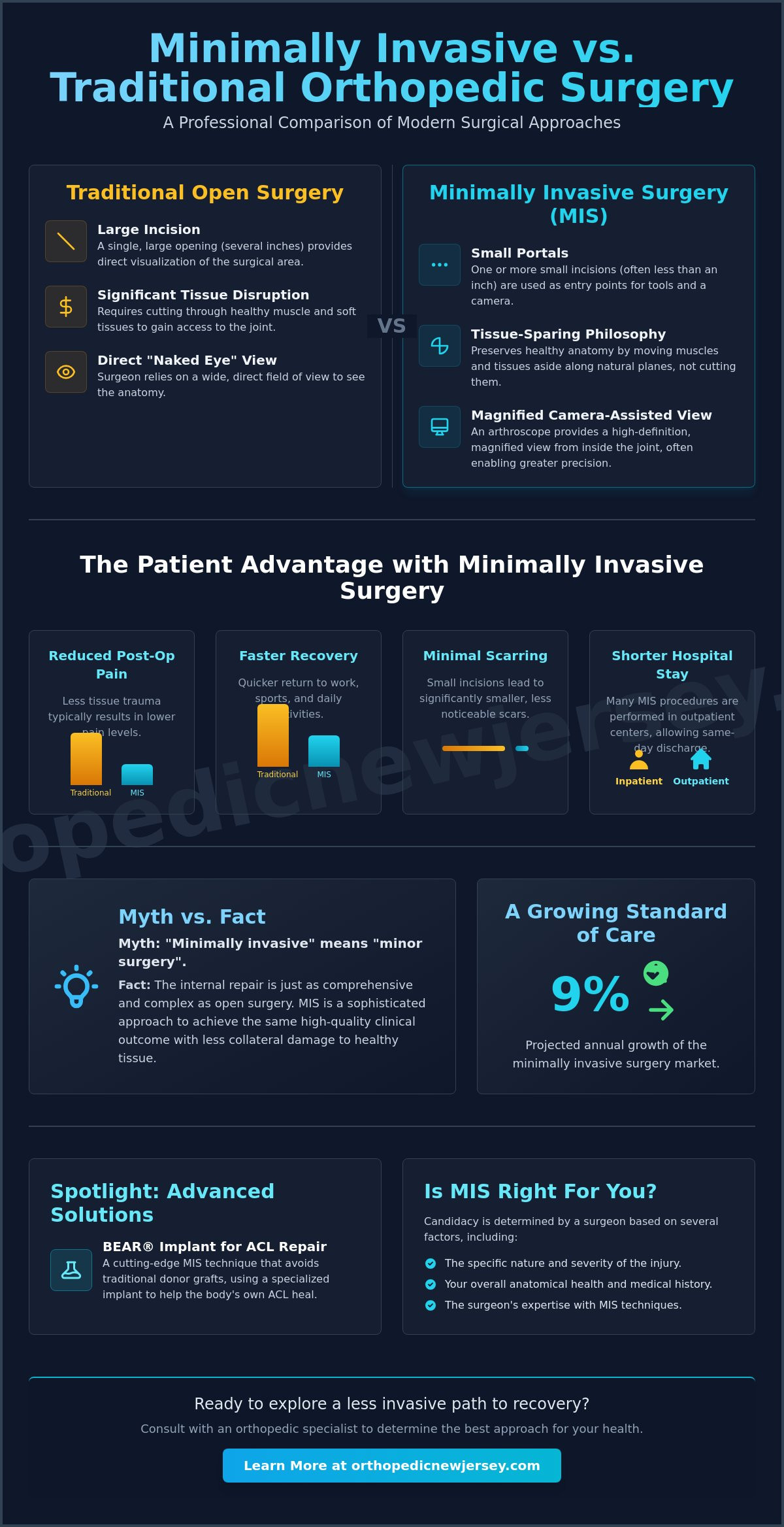
Choosing a surgical path often starts with a fundamental comparison: minimally invasive vs traditional orthopedic surgery. Traditional open surgery has historically relied on a single, large incision to provide the surgeon with direct visualization of the joint. This wide access allows for a broad field of view, which was once the only reliable way to ensure complex anatomical repairs were executed with professional precision. However, modern surgical techniques have fundamentally changed this requirement by allowing us to see more through far less disruption.
In contrast, Minimally invasive surgery (MIS) utilizes one or more small incisions, often less than an inch long. The primary difference lies in how the surgeon accesses the internal anatomy; it’s a strategic choice between direct sight and camera-assisted precision. This approach isn’t just about the aesthetics of a smaller scar. Minimally invasive surgery is a technique that minimizes soft tissue disruption while achieving the same corrective goals as open surgery.
The Philosophical Shift in Orthopedics
For decades, the open approach was the undisputed gold standard for complex orthopedic repairs. Surgeons required a wide field of view to identify anatomical landmarks and ensure the proper placement of implants or sutures. If a practitioner couldn’t see the entire joint with their own eyes, the procedure was often deemed less predictable. Technological advancements in high-definition imaging and fiber optics have since made MIS a viable, and often preferred, alternative. This evolution has facilitated a significant move from traditional inpatient-only care to outpatient-focused surgical models. Many patients now undergo advanced repairs in specialized Ambulatory Surgery Centers (ASCs) and return home the same day, a transition driven by both clinical efficiency and improved patient safety profiles. This shift is reflected in the global market for these procedures, which is projected to grow at a rate of 9% over the next five years as more patients and providers embrace tissue-sparing methods.
Common Misconceptions About “Small” Incisions
Patients often assume that smaller incisions are only suitable for minor injuries or simple joint debridement. This is a common myth. The internal repair performed through a small portal is often identical in quality, strength, and durability to one performed through a large opening. In many cases, the magnification provided by the arthroscopic camera allows for even greater precision than the naked eye can achieve alone. Clarifying this is essential for setting realistic patient expectations. You should remember that “minimally invasive” does not mean “minor surgery.” While the approach is significantly less traumatic to the surrounding skin, vascular structures, and muscle groups, the surgical work inside the joint is just as sophisticated and comprehensive as traditional methods. You aren’t sacrificing the quality of the fix; you’re simply choosing a more refined way to reach the site of the injury.
The Mechanics of Minimally Invasive Techniques
The distinction between minimally invasive vs traditional orthopedic surgery is fundamentally defined by the technological interface between the surgeon and the patient’s anatomy. In a traditional approach, surgical access requires a significant incision to provide a direct line of sight, which often necessitates cutting through healthy muscle and connective tissue. Modern MIS utilizes a muscle-sparing philosophy. Instead of transecting these vital structures, we move tissues aside along natural planes. This preservation of the vascular supply and muscular integrity is the primary engine behind the faster recovery times and lower pain levels patients experience.
Arthroscopy: The Eyes of the Surgeon
The arthroscope is a high-definition, fiber-optic camera that provides a magnified view of the joint’s interior. This technology offers a level of visualization that often surpasses the naked eye. For complex procedures like Minimally Invasive Orthopedic Surgery at Yale and other leading institutions, seeing the joint from the inside out is critical. It allows us to identify subtle labral tears or fraying in the rotator cuff that might be obscured in an open surgical field. Because the joint remains mostly closed during the procedure, there’s also significantly less exposure of internal tissues to ambient air, which naturally reduces the risk of post-surgical infection.
Instrumentation and Precision
Precision work requires specialized instrumentation designed to operate through narrow portals. These micro-tools allow for intricate suturing and bone-shaping with extreme accuracy. We’ve also seen a transition from bulky metal hardware to bio-absorbable anchors that the body eventually replaces with natural tissue. Accuracy is further enhanced through modern digital integration. Specifically, robotic-assisted MIS increases accuracy in joint alignment, with research indicating a 34% reduction in complications compared to traditional manual methods.
While these techniques are highly effective in orthopedic care, the same principles of precision and minimal disruption are applied across various surgical disciplines. For instance, the Brisbane Hernia Clinic utilizes advanced laparoscopic and robotic-assisted methods to provide specialized care for patients requiring hernia repair, emphasizing the broad benefits of minimally invasive technology.
- High-Definition Visualization: Magnified views allow for the detection of minute tissue damage.
- Specialized Micro-Tools: Instruments are engineered for high-precision work within tight anatomical spaces.
- Tissue Preservation: Portals allow access without the need for extensive muscle detachment.
Mastering these advanced tactile skills requires more than standard residency; it demands dedicated surgical fellowship training. This specialized education ensures the practitioner can navigate the joint using a two-dimensional screen while maintaining perfect three-dimensional spatial awareness. The learning curve for these procedures is steep, making the choice of a board-certified expert essential for a successful outcome. If you’re exploring these options, consulting a specialist in minimally invasive orthopaedic surgery ensures your care is guided by this level of technical expertise and modern methodology.
Direct Comparison: Outcomes, Recovery, and Risks
When evaluating minimally invasive vs traditional orthopedic surgery, the decision often rests on the immediate physical impact and the speed of the recovery cycle. Traditional surgery often requires a 10 to 12-inch incision to ensure the surgeon has adequate visual and physical access to the joint. Minimally invasive techniques reduce this footprint to just 1 or 2 inches. This drastic reduction is about more than aesthetics; it fundamentally limits blood loss and surgical trauma through superior vascular preservation. While traditional procedures typically require a 2 to 3-day hospital stay for monitoring, MIS is frequently performed in an outpatient setting, allowing you to return home the same day.
Pain management also differs significantly between the two approaches. Because there’s less nerve disruption and soft tissue damage in a portal-based procedure, MIS patients often report lower narcotic requirements during their initial healing phase. This reduction in pharmaceutical intervention is a key goal for modern orthopedic care, as it minimizes side effects and allows for a clearer, more focused recovery period.
- Incision Size: 10–12 inches (Traditional) vs. 1–2 inches (MIS).
- Blood Loss: Significant reduction in MIS due to tissue-sparing techniques.
- Hospitalization: 2–3 days (Traditional) vs. Same-day discharge (MIS).
- Pain Levels: Lower narcotic needs for MIS patients due to reduced surgical trauma.
The Recovery Timeline
The acceleration of the recovery cycle is perhaps the most visible benefit of the minimally invasive approach. Many MIS patients are encouraged to walk the same day as their procedure. This early mobilization is possible because the primary structural muscles haven’t been detached or transected. Consequently, physical therapy and range-of-motion exercises can begin much sooner, which helps prevent the joint stiffness often associated with traditional open repairs. While long-term outcomes at the one-year mark are often comparable for both techniques, the journey to that restoration is typically much smoother and faster with a tissue-sparing approach.
Potential Risks and Limitations
MIS isn’t a universal solution for every patient. Traditional open surgery remains the safer, more effective choice for complex revision procedures or cases involving severe joint deformity where a wide surgical field is mandatory for patient safety. The “learning curve” is another critical factor. Because MIS relies on indirect visualization through a camera, the surgeon’s specialized fellowship training and experience are paramount to a successful result. You should also be aware of specific, albeit low, risks such as localized nerve irritation near the portal sites, which is a unique consideration for portal-based surgery. A transparent discussion with a board-certified specialist is the best way to weigh these factors against your specific anatomical needs.
Determining Candidacy: Is MIS Right for You?
The choice between minimally invasive vs traditional orthopedic surgery is never a one-size-fits-all decision. It’s a clinical determination based on a personalized diagnostic journey. While the benefits of smaller incisions are compelling, your biological profile and the specific pathology of your injury dictate the most effective surgical path. We evaluate several patient-specific factors to ensure a successful outcome, including your Body Mass Index (BMI), previous surgical history, and bone quality. For instance, significant scar tissue from a previous open procedure might limit the visibility required for a portal-based approach, making a traditional incision the safer, more predictable option.
The nature of the injury itself also plays a vital role. Acute ligament or tendon tears are often ideal candidates for “keyhole” techniques. However, chronic degenerative conditions involving severe bone loss or complex joint deformities may require the wider access of traditional surgery to ensure perfect implant alignment. Your lifestyle goals are equally important. Athletes often prioritize the accelerated return-to-activity timelines associated with tissue-sparing methods, while more sedentary patients may have different recovery priorities. In Nutley and across North Jersey, the shift toward outpatient care in Ambulatory Surgery Centers has made MIS increasingly accessible for those who meet these clinical criteria.
Questions to Ask Your Orthopedic Surgeon
Navigating your surgical options requires transparency and detailed information. During your consultation, consider using this checklist to evaluate the proposed approach:
- “What percentage of your cases for this specific injury are performed minimally invasively?”
- “What is the risk of converting from MIS to an open procedure mid-surgery if the anatomy is more complex than expected?”
- “How does your specific approach preserve my surrounding muscles and tendons compared to a traditional method?”
The Role of Diagnostic Imaging
Modern surgical planning relies heavily on high-resolution diagnostic imaging. Advanced MRI and CT scans act as a precise roadmap, allowing us to see the internal landscape before the first incision is made. Sometimes an injury looks like a straightforward candidate for a minimally invasive approach on a standard scan, but closer inspection reveals complex fraying or hidden structural damage that requires the direct access of open repair. This is why a second opinion in complex orthopedic cases is often valuable. It ensures that the chosen technique aligns perfectly with the actual state of your joint tissue. If you’re ready to explore your options, you can schedule a consultation for minimally invasive vs traditional orthopedic surgery with a board-certified specialist to receive a comprehensive evaluation.
Advanced MIS at Orthopaedic & Sports Medicine Institute
Choosing where to receive your care is as vital as the surgical technique itself. At the Orthopaedic & Sports Medicine Institute, we’ve built a practice centered on board-certified expertise in Nutley, NJ. Our practitioners focus on advanced, tissue-sparing techniques that allow patients to recover in their own communities rather than a distant city hospital. While the general debate of minimally invasive vs traditional orthopedic surgery often centers on incision size, we focus on the specific anatomical outcomes for each patient. Our team guides you from the initial diagnostic imaging in our Nutley office to the region’s most sophisticated outpatient surgical centers.
The BEAR® Implant: Redefining ACL Repair
The Bridge-enhanced ACL repair (BEAR® Implant) represents a paradigm shift in sports medicine. Unlike traditional reconstruction, which relies on harvesting a graft from a donor or another part of your body, this MIS method uses a bio-engineered scaffold to facilitate the body’s natural healing of the original ligament. It’s a specialized option that preserves your native tissue and avoids the secondary pain often associated with donor sites. For athletes in the region seeking to understand all available options, learning more about minimally invasive ACL repair in NJ can provide critical insight into how this approach compares to traditional graft-based reconstruction. This approach is particularly beneficial for active patients who want to maintain their natural joint mechanics without the invasiveness of a traditional graft-based reconstruction.
Community-Focused Orthopedic Excellence
We’re proud to serve residents throughout Nutley, Bloomfield, Clifton, Belleville, and Lyndhurst. Our reach also extends to patients in North Arlington, Kearny, and Verona who seek high-level surgical care close to home. Recovering in a familiar environment is a vital component of the healing process, as it allows for easier access to follow-up care and local physical therapy. For patients in the surrounding area, finding a trusted orthopedic surgeon near Bloomfield NJ who combines board-certified credentials with a commitment to minimally invasive techniques can make a meaningful difference in your recovery experience. Our board-certified surgeons combine years of experience with the latest technological advancements to ensure your path to recovery is as smooth as possible. If you’re ready to explore how these techniques can benefit your health, you can schedule a consultation at our Nutley office to discuss your surgical options with our dedicated specialists.
Choosing Your Path to Restoration
Deciding between minimally invasive vs traditional orthopedic surgery is a pivotal step in reclaiming your physical mobility. Modern orthopedic care now prioritizes a tissue-sparing philosophy, whether through high-definition arthroscopic precision or revolutionary interventions like the BEAR® Implant for ACL repair. While traditional open techniques remain the standard for certain complex revisions, the shift toward less disruptive alternatives means most patients can expect reduced pain and a faster return to work or sports. Your recovery depends on a personalized diagnostic strategy that matches the right technique to your specific anatomical needs.
Our team of board-certified orthopedic surgeons has served Nutley, Bloomfield, Clifton, and the North Jersey community for years with a commitment to clinical excellence. We provide the specialized expertise needed to navigate these advanced surgical options with confidence. You deserve a recovery plan that values your time and long-term joint health. Request an Appointment with Our Board-Certified Surgeons in Nutley to begin your journey toward a stronger, more active future. We’re here to guide you through every step of your restoration.
Frequently Asked Questions
Is minimally invasive surgery always better than traditional surgery?
No, minimally invasive surgery is not a universal replacement for open procedures. While it’s ideal for many acute tears and joint repairs, traditional surgery remains the safer choice for complex revisions or severe structural deformities where wide visualization is mandatory for patient safety. The decision depends on your unique anatomy and the surgeon’s ability to achieve a complete repair. We prioritize the method that ensures the highest level of long-term joint stability.
How much smaller are the scars with minimally invasive orthopedic surgery?
Scars from minimally invasive procedures are significantly smaller, typically measuring between 1 and 2 inches. In contrast, traditional orthopedic surgery may require incisions of 10 to 12 inches to provide direct visualization. These smaller portals used in MIS result in less visible scarring and faster wound healing. This is because there’s less disruption to the skin’s surface and the underlying vascular networks that support tissue regeneration.
Will I have less pain after MIS compared to traditional surgery?
Patients generally experience less post-operative pain following a minimally invasive procedure. This is because the technique focuses on moving muscles aside along natural planes rather than cutting through them, which preserves the integrity of surrounding nerves. By minimizing soft tissue trauma, we can often reduce a patient’s reliance on narcotic pain medication during the initial recovery phase, leading to a clearer and more comfortable healing process.
Can all orthopedic surgeons perform minimally invasive procedures?
Performing minimally invasive vs traditional orthopedic surgery requires specialized skills that aren’t universal to all practitioners. Surgeons must undergo dedicated fellowship training to master the tactile precision needed for arthroscopic work and indirect visualization. It’s essential to verify that your specialist is board-certified and has extensive experience with the specific micro-instrumentation used in these advanced, camera-assisted procedures. This requirement for specialized expertise is universal across medicine, whether you are seeking orthopedic surgery or the focused care of an ED Health Clinic.
How long is the recovery time for minimally invasive ACL repair?
Recovery milestones for minimally invasive ACL repair in NJ, such as the BEAR® Implant, often begin on the day of surgery. Most patients are able to walk with assistance shortly after the procedure because the structural muscles remain intact. While a full return to high-impact sports still requires several months of structured physical therapy, the initial phase of healing is typically faster because we avoid the trauma of harvesting a donor graft.
Is MIS covered by insurance in the same way as traditional surgery?
Insurance providers generally cover minimally invasive procedures in the same way they cover traditional open surgeries. Because these techniques are often performed in Ambulatory Surgery Centers, they can actually reduce the overall financial burden on the patient by eliminating the costs associated with multi-day hospital stays. You should always verify your specific benefits with your provider and the surgical facility before scheduling your procedure.
What happens if the surgeon cannot complete the repair minimally invasively?
If a surgeon encounters unexpected anatomical complexity or severe tissue damage, they may convert the procedure from MIS to a traditional open approach. This is a standard safety protocol designed to ensure the internal repair is executed with absolute precision. While the goal is always to remain minimally invasive, the surgeon’s primary responsibility is to achieve the best possible clinical outcome for your long-term musculoskeletal health.
Does minimally invasive surgery take longer to perform?
Minimally invasive procedures can sometimes take longer to perform than traditional open surgery. The technical complexity of working through narrow portals with specialized instruments requires a deliberate and methodical pace. However, any additional time spent in the operating room is typically offset by a significantly shorter hospital stay and a faster return to your daily activities and athletic pursuits.