Is that sharp, stabbing sensation in your shoulder just a temporary strain, or is it the sign of a surgical tear that could permanently limit your mobility? When you can’t lift your arm to reach a shelf or find yourself awake at 3:00 a.m. because of a persistent throb, the uncertainty is often as painful as the physical injury itself. Consulting a shoulder pain specialist Nutley NJ is the first step toward moving from confusion to a clear, clinical diagnosis.
We understand that the fear of invasive open surgery often keeps patients from seeking the professional care they need. It’s frustrating to feel sidelined from the sports or daily routines that define your life. You deserve access to advanced orthopedic care that prioritizes your recovery through the least disruptive methods available. This article explores how board-certified specialists use minimally invasive arthroscopy to treat rotator cuff tears, arthritis, and labral injuries. You’ll discover how modern imaging provides the accuracy needed to get you back to peak performance without the large scars and extended downtime of the past.
Key Takeaways
- Learn why consulting a board-certified shoulder pain specialist Nutley NJ is essential for accurate diagnosis and specialized treatment of complex joint mechanics.
- Understand how advanced diagnostic tools like MRI and ultrasound are utilized to differentiate between simple strains and surgical rotator cuff or labral tears.
- Discover the clinical advantages of minimally invasive arthroscopy, which uses miniature cameras to improve surgical precision while reducing tissue disruption.
- Gain insights into the recovery process, including immediate postoperative pain management and the critical role of physical therapy in restoring full range of motion.
- Identify how specialized care from the Orthopaedic & Sports Medicine Institute prioritizes patient comfort and innovative surgical techniques for North Jersey residents.
What Defines a Specialized Shoulder Pain Specialist in Nutley, NJ?
An orthopedic shoulder specialist is a board-certified surgeon who has dedicated their professional practice to the intricate biomechanics of the glenohumeral joint. While a general practitioner handles broad musculoskeletal issues, a shoulder pain specialist Nutley NJ focuses specifically on the complex interplay between bone, tendon, and ligament that allows for the shoulder’s unique range of motion. This specialization is vital because the shoulder is the most mobile joint in the human body, which makes it exceptionally prone to instability, impingement, and degenerative wear.
The distinction between general orthopedics and specialized sports medicine lies in the depth of diagnostic focus. A specialist doesn’t just treat “pain”; they analyze the specific pathology affecting the joint’s stability. This expertise is necessary to differentiate between inflammatory conditions, such as bursitis or adhesive capsulitis (frozen shoulder), and mechanical failures like structural tears. By narrowing their focus, these experts provide a level of precision that is often the difference between a successful recovery and chronic dysfunction.
Board Certification and Fellowship Training
Board certification is the gold standard for orthopedic expertise in 2026, signaling that a surgeon has met rigorous national standards for clinical knowledge and surgical skill. Beyond this baseline, fellowship training in sports medicine or shoulder reconstruction provides the technical proficiency required for advanced arthroscopy. This specialized education is essential for Understanding the Rotator Cuff and its associated pathologies. It allows the specialist to visualize and repair damage through portals smaller than a fingernail. Patients in North Jersey who choose a fellowship-trained expert often experience lower complication rates and more predictable healing timelines because the surgeon performs these specific procedures hundreds of times each year.
When to Transition from Primary Care to an Orthopedic Specialist
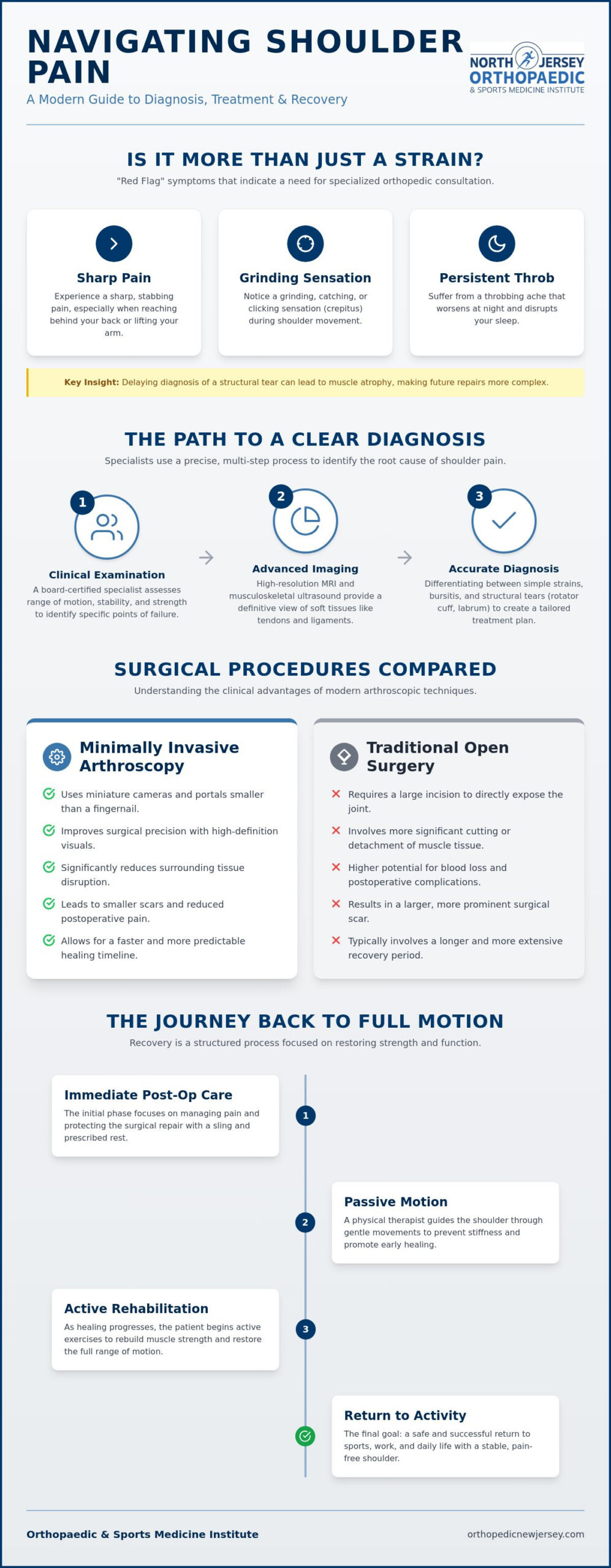
Many patients initially attempt to manage discomfort with rest or over-the-counter anti-inflammatories, but certain “red flag” symptoms indicate that the issue is structural rather than a simple muscle strain. If you experience sharp pain when reaching behind your back, a grinding sensation during movement, or throbbing that prevents sleep, it’s time to consult a specialist. It’s critical to review the signs you should not ignore to determine if your condition requires an immediate orthopedic consultation.
Comprehensive Treatment for Major Shoulder Conditions
The shoulder joint’s functionality depends on a delicate equilibrium between the rotator cuff and the labrum. When this balance is disrupted by injury or wear, a shoulder pain specialist Nutley NJ uses high-resolution diagnostic tools to visualize the extent of the damage. While physical exams provide clinical clues, advanced imaging like MRI and musculoskeletal ultrasound provides a definitive view of soft tissue integrity. This diagnostic precision ensures that every treatment plan is customized based on the patient’s age, activity level, and the specific severity of the structural damage.
Our clinical philosophy prioritizes exhausted conservative care. Surgery is rarely the first recommendation. Instead, we explore every non-surgical avenue to restore function and alleviate discomfort. This methodical approach allows many patients to find relief through targeted rehabilitation and localized injections before considering a procedural intervention. We believe in providing clear, evidence-based guidance so that patients feel secure in their chosen path to recovery.
Rotator Cuff Repair and Tendon Management
Rotator cuff injuries are categorized based on the depth of the tissue damage. Partial-thickness tears involve fraying of the tendon, while full-thickness tears represent a complete detachment of the tendon from the humerus. Determining when surgery is necessary for a torn rotator cuff depends on the patient’s pain levels, functional loss, and the failure of conservative treatments over a period of three to six months. Modern surgical interventions now utilize biological augmentation. This involves using specialized patches or growth factors to reinforce the repair and promote more robust tendon-to-bone healing. Working with a qualified rotator cuff repair surgeon in NJ ensures that the most appropriate technique is selected based on your specific tear pattern and tissue quality.
Shoulder Arthritis and Labral Tear Solutions
For the Nutley senior community, managing degenerative joint pain often involves addressing the loss of cartilage. We frequently utilize hyaluronic acid injections to provide lubrication within the joint, acting as a shock absorber to reduce the friction that causes arthritic pain. Conversely, local athletes and overhead workers often present with labral tears, which affect the rim of cartilage that deepens the shoulder socket. These common shoulder injuries and disorders are often managed through specialized physical therapy protocols designed to strengthen the surrounding musculature and stabilize the joint.
If non-invasive methods don’t yield the desired results, our team provides advanced surgical options to restore your quality of life. You can consult with our specialized team to determine which clinical pathway is most appropriate for your specific injury.
Minimally Invasive Surgery vs. Traditional Open Procedures
The evolution of orthopedic surgery has moved away from the large, invasive incisions of the past toward highly precise, minimally invasive techniques. For a shoulder pain specialist Nutley NJ, the primary objective is to repair structural damage while preserving as much healthy tissue as possible. Traditional open surgery often requires detaching or cutting through significant muscle groups to access the joint, which inherently increases post-operative pain and extends the recovery timeline. Modern arthroscopy replaces this disruptive approach with small, specialized portals that accommodate miniature cameras and precision instruments.
By visualizing the joint from the inside, surgeons gain a high-definition view of the pathology that isn’t possible through a standard incision. This technical shift allows for a more meticulous repair of the labrum or rotator cuff tendons. Because the surrounding deltoid and pectoral muscles remain largely intact, patients experience significantly less trauma to the soft tissues. This preservation of muscle integrity is why minimally invasive surgery has become the preferred standard for Nutley residents who prioritize outpatient care and a faster return to their professional or athletic lives.
Benefits of Arthroscopic Shoulder Repair
The clinical benefits of arthroscopy extend beyond the operating room. Smaller incisions naturally result in minimal scarring and a lower risk of post-operative infection compared to traditional open procedures. This reduced inflammatory response allows for a much faster transition to functional movement. Most patients find they can begin guided physical therapy sooner, which is essential for preventing the joint stiffness often associated with older surgical methods. You can learn more about arthroscopic rotator cuff repair in NJ to see how these advancements improve long-term joint stability.
Comparing Recovery Timelines and Outcomes
In 2026, the standard of care for most shoulder repairs has shifted almost entirely to the outpatient setting. While traditional open surgery often necessitated a hospital stay for pain management, arthroscopic patients typically return home the same day. Modern anesthetic techniques combined with less invasive portals have leveled the playing field for complex repairs, offering success rates that meet or exceed those of traditional methods. Traditional open surgery typically requires an incision of several inches, whereas arthroscopy utilizes portals only a few millimeters in length. We frequently reference common shoulder problems to help patients understand why this technical precision is necessary for restoring the complex mechanics of the glenohumeral joint.
The Path to Recovery: What to Expect in Nutley and North Jersey
Successful surgical repair is only half of the equation; the subsequent rehabilitation phase determines your ultimate functional outcome. After a procedure, your shoulder pain specialist Nutley NJ transitions from a surgical role to a diagnostic monitor, ensuring that the repaired tissues heal without excessive scarring or stiffness. The first 48 hours are focused on pain management and strict adherence to immobilization protocols. You’ll likely wear a specialized sling or immobilizer to protect the repair, and managing discomfort involves a combination of cryotherapy and prescribed clinical protocols.
Regaining range of motion requires a collaborative effort between the patient and a skilled physical therapist. Residents of Nutley have access to high-tier rehabilitation centers in neighboring Bloomfield, Clifton, and Belleville, which simplifies the logistics of attending multiple weekly sessions. It’s essential to set realistic expectations for your return to work or sports. While sedentary office tasks might be resumed within a couple of weeks, returning to heavy lifting or overhead athletics requires a more deliberate, phased approach to ensure the joint’s long-term integrity.
A Structured Recovery Timeline
The initial six weeks are known as the ‘Protection Phase’. This period is vital because the biological attachment of the tendon to the bone is still fragile. During this time, your movements are strictly limited to prevent tension on the repair site. For a detailed breakdown of what to anticipate during each stage of healing, you should refer to the 2026 patient guide for rotator cuff recovery. Once you clear this phase, your therapist will introduce gradual strengthening exercises, moving toward the milestone of ‘full duty’ and unrestricted activity.
Patient Support and Local Logistics
Preparing for recovery involves practical adjustments to your daily environment. Before surgery, we recommend arranging your home in Nutley for a one-handed recovery period. Simple tasks like dressing, cooking, and hygiene require forward-thinking solutions when one arm is immobilized. Coordinating follow-up visits and imaging within the North Jersey corridor is streamlined when you choose a local expert. Having a shoulder pain specialist Nutley NJ nearby ensures that any concerns during the postoperative period can be addressed promptly through in-person examinations. This local accessibility is especially important given the 2026 New Jersey requirements for in-person evaluations regarding certain postoperative care protocols.
Our team is dedicated to guiding you through every milestone of your rehabilitation journey. If you’re ready to take the first step toward a pain-free life, schedule an evaluation with our specialists today.
Why Choose the Orthopaedic & Sports Medicine Institute?
Dr. Michael C. Russonella leads the Orthopaedic & Sports Medicine Institute as a board-certified specialist dedicated to restoring joint function through advanced methodology. While many facilities offer general care, our practice is anchored in the belief that a shoulder pain specialist Nutley NJ should provide a bridge between traditional medical wisdom and the latest surgical innovations. We prioritize minimally invasive techniques because they offer our patients a more predictable recovery and significantly less postoperative discomfort than traditional open procedures.
Our clinical approach isn’t limited to high-performance athletes; we provide the same level of specialized care to every member of the Nutley community. Whether you’re a retiree managing shoulder arthritis or a local worker suffering from a labral tear, we treat the individual person rather than just the pathology. This patient-centered mindset ensures that your specific recovery goals are integrated into every stage of the diagnostic and treatment process, from the first imaging scan to the final physical therapy session.
Advanced Technology and Specialized Credentials
The institute utilizes cutting-edge implants and surgical navigation systems to enhance the precision of every repair. These modern tools allow for better anatomical alignment and more durable outcomes in rotator cuff and labral reconstructions. Our foundation in sports medicine is a significant advantage for patients of all ages, as these principles focus on maximizing movement and joint longevity. This commitment to excellence has established our reputation as a trusted resource for residents in Nutley, Bloomfield, and Clifton who seek specialized orthopedic expertise.
Schedule Your Consultation in Nutley
Preparing for your initial evaluation is a straightforward process that ensures we can begin your diagnostic journey immediately. We ask that you bring any previous imaging, such as MRI or X-ray discs, along with your relevant medical records to your appointment. Our facility is conveniently located for regional patients, offering easy access from Route 21 and the Garden State Parkway. Taking the first step toward recovery shouldn’t be complicated; our team is here to provide the clear guidance and specialized expertise you need to regain your mobility.
You can book your consultation with our Nutley shoulder specialist today to discuss your symptoms and explore your options for advanced orthopedic care and recovery.
Restore Your Shoulder Mobility with Precision Care
Regaining full use of your arm requires more than just managing symptoms; it necessitates a definitive diagnosis and a clinical strategy tailored to your specific anatomy. By prioritizing minimally invasive arthroscopy, we ensure that structural repairs to the rotator cuff or labrum are performed with maximum precision and minimal tissue disruption. This advanced methodology, when paired with a structured rehabilitation protocol, provides the most reliable pathway for returning to the daily activities and sports that define your quality of life.
Our practice has served the residents of Nutley, Bloomfield, and Clifton for over a decade, acting as a trusted resource for board-certified orthopedic expertise. Consulting with a dedicated shoulder pain specialist Nutley NJ ensures your care is managed by professionals who specialize in modern, less disruptive alternatives to traditional surgery. You don’t have to accept chronic discomfort as a permanent condition when specialized interventions are available locally.
Take the first step toward a full recovery by consulting with a recognized leader in orthopedic care. Schedule Your Shoulder Specialist Consultation in Nutley to receive a comprehensive evaluation and a personalized treatment plan. We’re here to help you move forward with confidence and strength.
Frequently Asked Questions
When should I see a shoulder pain specialist in Nutley instead of my regular doctor?
You should consult a shoulder pain specialist Nutley NJ when you experience “red flag” symptoms like sharp pain during overhead movement or nocturnal throbbing that prevents sleep. While a primary care physician handles general wellness, a specialist is required to diagnose structural damage through advanced imaging. Early intervention is necessary to prevent muscle atrophy and permanent joint degeneration that can occur with delayed treatment.
Is minimally invasive shoulder surgery always an option for rotator cuff tears?
Minimally invasive arthroscopy is the clinical standard for the majority of rotator cuff repairs, though the specific approach depends on the tear’s size and tissue quality. In rare cases of massive, retracted tears or significant bone loss, a specialist may recommend a mini-open approach to ensure a secure repair. Most patients in 2026 are excellent candidates for arthroscopic portals, which prioritize faster recovery and minimal scarring.
How long is the recovery period for a labral tear repair in 2026?
The recovery for a labral tear repair typically follows a structured six to nine-month timeline to ensure the cartilage rim heals securely to the bone. The first six weeks focus on protection and passive range of motion, followed by several months of progressive strengthening. Athletes usually return to full-contact sports or overhead activities once they’ve demonstrated symmetrical strength and stability in clinical testing.
Does the Orthopaedic & Sports Medicine Institute accept major insurance plans in NJ?
The Orthopaedic & Sports Medicine Institute accepts most major private insurance plans and PPO providers throughout New Jersey. While our practice accepts a wide range of coverage, specific plans like Medicaid are generally excluded. It’s always advisable to verify your specific benefits and any referral requirements with your insurance carrier directly before scheduling your first clinical evaluation.
What is the difference between a shoulder specialist and a general orthopedic surgeon?
A shoulder specialist is a board-certified surgeon who has completed additional fellowship training specifically focused on the complex mechanics of the glenohumeral joint. While a general surgeon treats the entire musculoskeletal system, a specialist maintains a higher volume of shoulder-specific procedures. This focused expertise results in higher precision during advanced arthroscopic repairs and more refined postoperative protocols for their patients. Understanding how to choose the right rotator cuff repair surgeon in NJ can help you evaluate these credentials and make a more informed decision for your care.
Can shoulder arthritis be treated without a full joint replacement?
Yes, shoulder arthritis can often be managed effectively through conservative treatments like hyaluronic acid injections and targeted physical therapy. We focus on preserving the natural joint through anti-inflammatory protocols and biological augmentation whenever possible. Surgery is only recommended when these non-invasive methods no longer provide sufficient pain relief or the functional mobility required for your daily activities.
How soon can I return to sports like golf or tennis after shoulder surgery?
Returning to golf or tennis usually begins with a phased protocol around four to six months after surgery, starting with gentle chipping or groundstrokes. A full, unrestricted swing typically requires at least six months of healing and dedicated strengthening to prevent re-injury. Your specialist will use specific functional milestones rather than just a calendar date to clear you for competitive play.
What should I bring to my first orthopedic consultation in Nutley?
For your first consultation, you must bring any existing imaging on a CD, such as MRI or X-ray scans, along with the corresponding radiologist reports. It’s also helpful to provide a concise history of your symptoms and a list of previous treatments like physical therapy or injections. This clinical data allows the specialist to provide an accurate diagnosis and treatment plan during your initial visit.