Could the most critical part of your shoulder repair happen after you leave the operating room? While modern arthroscopic techniques allow for high-level surgical precision, the ultimate success of your rotator cuff surgery recovery depends on a deliberate partnership between advanced medicine and your body’s natural healing timeline. It’s completely normal to feel frustrated by the limitations of a sling or the persistent difficulty of finding a comfortable sleeping position during the initial weeks. You’re likely worried about the risk of re-tearing the repair, especially since clinical data indicates that biological healing is a gradual process that cannot be rushed without consequence.
We’re here to provide the clinical clarity you need to move forward with confidence. This 2026 guide offers a comprehensive roadmap to help you regain peak shoulder function through evidence-based protocols and expert-led rehabilitation. We’ll walk you through a detailed week-by-week recovery timeline, explain how bioinductive implants are currently improving outcomes, and share professional strategies for managing pain while protecting your surgical investment. By understanding the milestones ahead, you’ll transition from a cautious patient to an active participant in your own healing journey.
Key Takeaways
- You’ll understand the precise milestones of your rotator cuff surgery recovery, from the initial protection phase to regaining independent arm movement by week twelve.
- Discover clinical strategies for managing post-operative discomfort, including the “Recliner Strategy” to ensure restorative sleep during the first month of healing.
- Learn why modern, minimally invasive surgical techniques allow for a more streamlined physical therapy process without the risks of aggressive “no pain, no gain” protocols.
- Master practical lifestyle adjustments for maintaining independence while strictly adhering to essential sling requirements and tendon protection.
- Identify how the expertise of a board-certified orthopedic surgeon and the specific surgical approach chosen impact your long-term functional outcomes.
The Initial Protection Phase: The First 48 Hours and Week 1
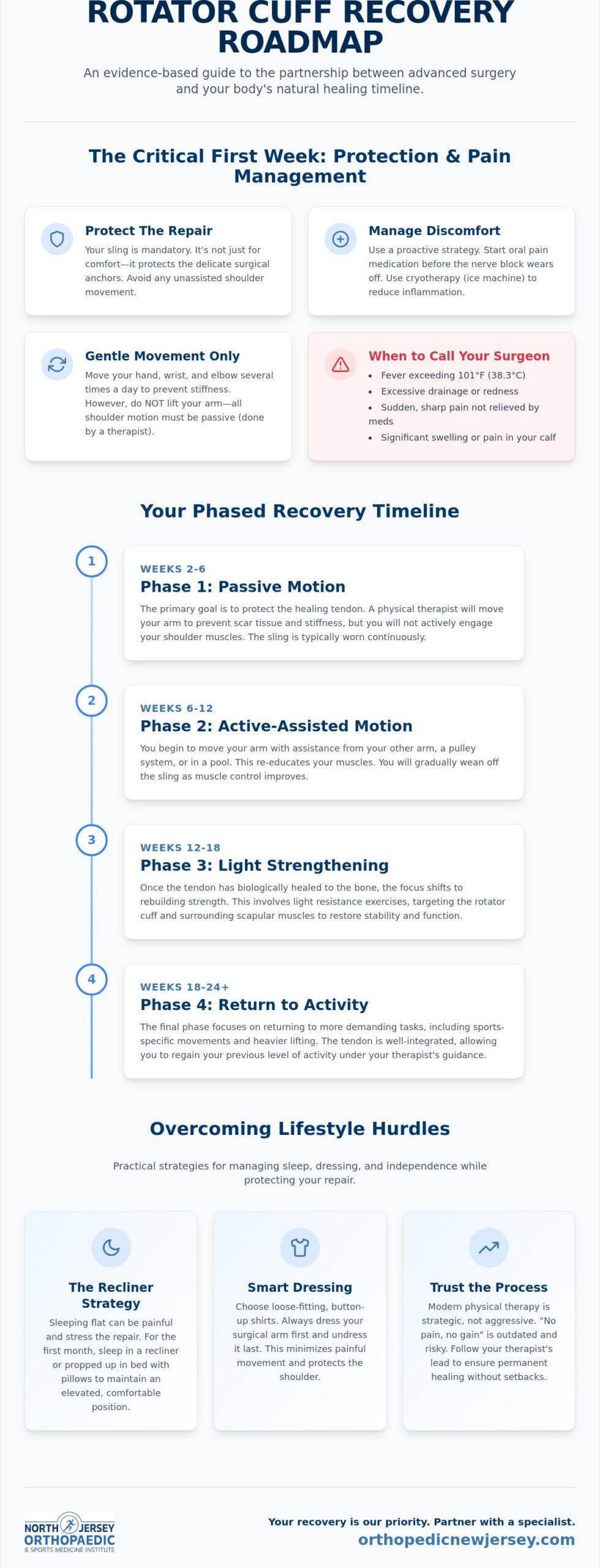
The first 48 hours of your rotator cuff surgery recovery represent a critical window where clinical management transitions into patient-led care. Most patients leave the surgical center with a regional nerve block, which provides significant numbness and pain relief for the immediate post-operative period. While this allows for a comfortable journey home, it’s essential to understand that this effect is temporary. As the block begins to dissipate, usually within 12 to 24 hours, you’ll need a proactive strategy to manage emerging discomfort and ensure the surgical site remains stable.
The sling is your shoulder’s most vital defense during this week. It isn’t merely for comfort; it protects the delicate tendon-to-bone interface where the repair was performed. Any sudden or unassisted movement of the shoulder can jeopardize the surgical anchors before biological healing has even begun. We recommend a strict adherence to the RICE method, specifically modified for the shoulder. This includes consistent rest, targeted cryotherapy, and maintaining an elevated torso position to minimize the swelling that naturally follows a rotator cuff tear rehabilitation program.
Managing Post-Surgical Pain at Home
The transition from clinical anesthesia to home-based medication management requires a methodical approach. We often suggest starting oral pain medications before the nerve block completely wears off to maintain a steady baseline of comfort. Utilizing a specialized cryotherapy machine is a highly effective way to reduce inflammation and may decrease your reliance on opioid-based medications. To ensure a smooth experience, set up a “recovery station” before your surgery day. This area should include your ice machine, medications, easy-to-grab snacks, and several pillows to support an upright sleeping position.
Early Movement: What is Allowed?
While the shoulder joint must remain immobilized, your hand, wrist, and elbow require movement to prevent secondary stiffness. You’ll be encouraged to perform gentle wrist rotations and elbow extensions several times a day to maintain circulation. However, the “passive motion” rule is absolute during the first week. You must not attempt to lift your arm using its own muscles. Passive motion is movement where an external force or person moves your joint without your muscle engagement.
You should contact your Nutley orthopedic surgeon immediately if you experience any of the following warning signs:
- A fever exceeding 101°F.
- Excessive drainage or redness around the incision sites.
- Sudden, sharp pain that isn’t relieved by medication.
- Significant swelling or pain in your calf, which could indicate a blood clot.
Rotator Cuff Surgery Recovery Timeline: Weeks 2 through 24
Your journey through rotator cuff surgery recovery is a structured progression that respects the biological pace of tendon-to-bone healing. While modern surgical techniques provide excellent mechanical fixation, the body requires a specific sequence of phases to integrate the repair into the bone. This process is not a race; instead, it’s a series of milestones designed to restore function without compromising the integrity of the surgical site. Adhering to these professional protocols ensures that you don’t inadvertently stress the repair before the biological “bridge” is strong enough to handle independent movement.
- Phase 1 (Weeks 2-6): This period focuses on passive motion. During these weeks, your physical therapist will move your arm for you to prevent scar tissue formation while you continue to wear your sling for protection.
- Phase 2 (Weeks 6-12): We transition into active-assisted motion. You’ll begin to move the arm independently using pulleys or your other arm for support, gradually weaning off the sling as your muscle control improves.
- Phase 3 (Weeks 12-18): The focus shifts toward light resistance training. You’ll begin to rebuild the atrophy that occurred during immobilization, using specific exercises to strengthen the rotator cuff and scapular stabilizers.
- Phase 4 (Weeks 18-24+): This final stage involves sport-specific activities and heavy lifting. By this point, the tendon is typically well-integrated, allowing for a return to more demanding physical tasks.
The 6-Week Milestone: Losing the Sling
Reaching the six-week mark is often the most significant psychological victory for patients. It’s the point where the initial tendon-to-bone healing is stable enough to allow for light daily activities. However, it’s also a high-risk period. Because you feel significantly better, you might be tempted to lift heavy objects or reach suddenly. If you feel “stiff” or believe you’re behind the average timeline, don’t panic. Every patient heals at a unique rate, and persistent stiffness is often a sign that the body is prioritizing stability over mobility. If you have concerns about your specific surgical plan, consulting with a specialist in minimally invasive orthopaedic surgery can provide the clarity you need to stay on track.
The 3-Month Shift: From Motion to Strength
By the third month, the focus of your rotator cuff surgery recovery pivots from simply getting the arm to move to making that movement powerful. We introduce TheraBands and light weights to challenge the muscles without overloading the repair. It’s critical to distinguish between “good” soreness, which feels like a dull ache in the muscle, and “bad” pain, which is sharp or located deep within the joint. Patients returning to desk-based roles can typically do so much earlier, often within 2 to 4 weeks, while those in manual labor roles involving overhead lifting may need to wait until the 4-to-6-month mark to ensure full structural safety.
Overcoming Lifestyle Hurdles: Sleep, Driving, and Dressing
While the clinical milestones of your rotator cuff surgery recovery are managed through professional protocols, the daily logistics of life often present the most immediate challenges. Regaining your independence requires a strategic approach to tasks that were once second nature. From maintaining personal hygiene to navigating the complexities of dressing with one functional arm, preparation is the key to reducing frustration. We recommend securing loose-fitting, front-opening clothing before your procedure; anything that requires pulling over the head should be avoided for the first six weeks to prevent accidental strain on the repair.
Hygiene also requires a modified approach. It’s imperative to keep the surgical incision site dry and protected until your first post-operative follow-up. Many patients find success using a waterproof plastic sleeve or a specialized shower bag to cover the operative arm. This allows you to maintain a regular bathing routine without risking moisture-induced complications at the wound site. Taking these small, proactive steps ensures that your focus remains on healing rather than the stress of basic self-care.
The Secret to Sleeping After Shoulder Surgery
Finding a comfortable sleeping position is frequently cited as the most difficult part of the early recovery phase. Sleeping flat in a bed is often impossible for the first month because gravity pulls the shoulder joint backward, creating painful tension on the fresh repair. The “Recliner Strategy” is the gold standard for this period. By sleeping at a 45-degree angle in a recliner or using a structured wedge pillow in bed, you keep the shoulder in a neutral, forward-leaning position. We also suggest placing a small pillow behind the elbow of the operative arm to prevent it from dropping toward the mattress. Timing your evening pain medication to take effect 30 minutes before you settle in can help you achieve the restorative sleep necessary for tissue repair.
When Can I Drive Again?
Returning to the driver’s seat is a major milestone, but it’s one that carries significant safety and legal weight. In New Jersey, driving while wearing a sling or while using narcotic pain medications can lead to liability issues and safety risks. You must meet two definitive requirements before we can clear you to drive:
- You must be completely weaned off all opioid-based pain medications for at least 24 to 48 hours.
- You must be out of the sling and have enough active-assisted motion to safely control the steering wheel with both hands during an emergency maneuver.
Attempting to drive one-handed is not a safe alternative. We will conduct a formal evaluation during your follow-up appointment to ensure you have the necessary strength and reaction time to return to the road safely.
The Role of Physical Therapy in Permanent Healing
The success of your rotator cuff surgery recovery is heavily influenced by the surgical method used to repair the joint. At our Nutley office, we prioritize minimally invasive techniques that minimize disruption to the surrounding deltoid and rotator cuff muscles. Because there is less trauma to the soft tissue, patients often experience a more manageable entry into physical therapy with reduced inflammation. This modern approach allows us to initiate gentle range-of-motion exercises sooner, which is vital for preventing the “frozen shoulder” complications that were once common with traditional open procedures.
We emphasize a philosophy of “motion without emotion” during the early stages of rehab. The old “no pain, no gain” mentality is actually dangerous during the first few months of healing. Pushing into sharp, stabbing pain can create micro-tears in the newly repaired tendon. Instead, we look for a “comfortable stretch.” Your board-certified surgeon works in close coordination with local NJ therapists to ensure your protocol is exactly tailored to the size and quality of your specific repair. This collaborative care model ensures that your therapist knows exactly what was found during surgery and how much stress the repair can safely handle.
While clinical sessions are important, your Home Exercise Program (HEP) is the primary driver of long-term success. Consistency in performing your prescribed movements at home ensures that the joint remains supple and the muscles begin to wake up after their period of immobilization. If you’re ready to start your journey toward a pain-free shoulder, you can learn more about our specialized approach to rotator cuff repair.
Customizing Rehab for Athletes and Active Adults
For our North Jersey patients who are eager to return to the golf course or the tennis court, rehab must go beyond basic lifting. We focus heavily on the kinetic chain, starting with the foundation of the shoulder. Scapular stabilization involves strengthening the muscles that support the shoulder blade to create a solid foundation for arm movement. By stabilizing the scapula, we reduce the stress placed on the rotator cuff during high-velocity movements like a golf swing or a tennis serve. This sport-specific focus ensures you don’t just return to play, but do so with better mechanics than before your injury.
Managing the “Plateau”: What to Do When Progress Slows
It’s common to hit a point around month three or four where progress seems to stall. Healing is non-linear; your body may take time to consolidate its gains before moving to the next level of strength. During these plateaus, manual therapy and professional massage can be effective in breaking down restrictive scar tissue that might be limiting your range of motion. However, if you experience persistent shoulder pain that doesn’t improve with rest or modified therapy, it’s essential to consult your orthopedic surgeon to rule out any underlying issues. We often find that a slight adjustment to the exercise intensity is all that’s needed to kickstart progress again.
Choosing the Right Surgeon for Your Rotator Cuff Repair
The success of your rotator cuff surgery recovery is fundamentally linked to the technical precision of the initial repair. While traditional open surgeries were once the standard, modern arthroscopic techniques allow for a significantly less disruptive experience. By utilizing small incisions and specialized cameras, a board-certified surgeon can repair the tendon without detaching the deltoid muscle. This preservation of healthy tissue is a primary driver of a more efficient rehabilitation process, as it reduces the biological trauma your body must overcome before beginning active physical therapy. If you are still weighing your options and wondering when is surgery necessary for a torn rotator cuff, understanding the clinical criteria that distinguish surgical from conservative care can help you make a more informed decision alongside your specialist.
Complexity in shoulder anatomy requires a specialist who understands the nuances of various tear patterns and tissue qualities. A board-certified orthopedic surgeon has undergone rigorous evaluation to demonstrate mastery in these advanced procedures. This expertise is especially critical for chronic or massive tears where biological augmentation or modern fixation methods may be necessary to ensure a durable result. Choosing a specialist who prioritizes minimally invasive methodology means you are opting for a surgical plan designed around faster healing and long-term joint stability. For a deeper look at how these procedures are performed and what outcomes you can expect, our comprehensive overview of arthroscopic rotator cuff repair NJ patients rely on covers the clinical foundations in detail.
Expert Shoulder Care in Nutley and North Jersey
We are proud to serve the North Jersey community from our centralized office in Nutley. This location provides convenient access for patients traveling from Bloomfield, Clifton, Belleville, and surrounding areas. Proximity to your surgical team is a practical advantage during your rotator cuff surgery recovery, as frequent follow-up visits are essential for monitoring your progress and adjusting your rehabilitation protocol in real time. Our commitment to utilizing the latest orthopedic technology ensures that every patient receives care that meets the highest modern standards. If you’re unsure if your current discomfort requires professional intervention, review our guide on when to see an orthopedic surgeon for shoulder pain: signs you should not ignore.
Schedule Your Consultation Today
Transitioning back to a pain-free, active lifestyle starts with a thorough diagnostic evaluation. During your initial consultation, we utilize advanced imaging and clinical testing to determine the exact nature of your injury and develop a customized recovery roadmap. We take the time to explain your options, whether you require a primary repair or treatment for a complex re-tear. Our goal is to bridge the gap between your current physical limitations and your peak functional potential. Book an appointment with our Nutley shoulder specialist today.
Restoring Your Active Lifestyle Through Clinical Excellence
The path to regaining your shoulder’s full range and strength is a deliberate process rooted in biological healing and clinical precision. By following a structured timeline and implementing practical lifestyle strategies for sleep and mobility, you can navigate the complexities of your rotator cuff surgery recovery with confidence. Your commitment to a professional physical therapy program acts as the final bridge to a permanent, pain-free outcome.
Our team specializes in minimally invasive shoulder techniques designed to preserve healthy tissue and streamline your progress. As board-certified orthopedic surgeons, we provide the expert oversight necessary for both primary repairs and complex cases. Our facility is conveniently located in Nutley, providing accessible, high-level care for residents in Bloomfield, Clifton, and Kearny.
Don’t let chronic shoulder limitations dictate your activity levels any longer. You can Schedule a Shoulder Consultation in Nutley, NJ today to begin your personalized roadmap to healing. We’re ready to help you return to the daily activities and sports you love with a shoulder that’s built to last.
Frequently Asked Questions
How long do I have to wear a sling after rotator cuff surgery?
Most patients must wear a sling for 4 to 6 weeks following their procedure. This period of immobilization is critical to protect the delicate tendon-to-bone interface while the biological bridge forms. Removing the sling prematurely places undue stress on the surgical anchors and can jeopardize the repair. You’ll only remove the device for bathing and performing your specific, therapist-led exercises. Strictly following this timeline is a cornerstone of a successful rotator cuff surgery recovery.
When can I return to work after shoulder surgery?
Your return to work depends on the specific physical demands of your professional role. Patients with desk-based jobs often return within 2 to 4 weeks, provided they can perform their duties without using the operative arm for typing or reaching. However, manual labor or roles involving overhead lifting typically require 4 to 6 months of healing to ensure structural safety. We’ll provide a specific clinical clearance based on your unique surgical findings and functional progress.
Is it normal to still have pain 3 months after rotator cuff repair?
Intermittent soreness or a dull ache at the three-month mark is a common part of the healing process. This period marks the transition from restoring motion to building strength, which places new demands on the shoulder muscles and the surgical site. While muscle soreness after physical therapy is expected, you should report any sharp, stabbing pain or a sudden loss of mobility to your board-certified surgeon. We’ll monitor these symptoms to ensure your recovery remains on the correct trajectory.
Can I re-tear my rotator cuff during recovery?
Re-tears can occur if the surgical repair is overloaded before the tissue has fully integrated into the bone. Research indicates that re-tear rates vary significantly by tear size; small tears have a 26% re-tear rate within two years, while massive tears carry a higher risk. Adhering to your sling requirements and avoiding unassisted lifting during the early phases is the most effective way to protect your rotator cuff surgery recovery and ensure long-term joint stability.
When can I lift heavy objects or return to the gym?
You can typically begin heavy lifting or return to the gym for overhead sports between 4 and 6 months post-surgery. While light resistance training with TheraBands starts around week 12, the tendon requires more time to achieve the structural integrity needed for high-impact loads. We’ll use specific strength testing during your follow-up appointments to determine when your shoulder is biologically ready for these increased demands. Rushing this milestone can lead to inflammation or injury.
How soon can I start physical therapy after surgery?
Physical therapy usually begins within the first week after your procedure to prevent joint stiffness. The initial sessions focus on passive motion, where the therapist moves your joint for you without engaging your shoulder muscles. Because we utilize minimally invasive techniques, we can often start these gentle movements earlier than traditional open surgery would allow. This early intervention is essential for restoring your joint’s natural fluid dynamics and achieving a full range of motion.
What is the success rate of arthroscopic rotator cuff repair?
The success rate for arthroscopic rotator cuff repair generally ranges from 75% to 90% for most patients. Outcomes are influenced by the size of the initial tear and the quality of the patient’s existing tendon tissue. Data from 2026 shows that minimally invasive approaches provide high patient satisfaction and functional restoration. Adherence to post-operative rehabilitation protocols remains the most significant factor in achieving these high success rates and avoiding secondary complications.
Do I need someone to stay with me at home after surgery?
You’ll need a dedicated caregiver to assist you for at least the first 24 to 72 hours after you return home. Managing daily tasks like meal preparation, dressing, and operating your cryotherapy machine is exceptionally difficult with only one functional arm. Additionally, the lingering effects of anesthesia and pain medication make having someone available for monitoring and support a vital safety precaution. Preparing your “recovery station” in advance will help your caregiver support you more effectively.