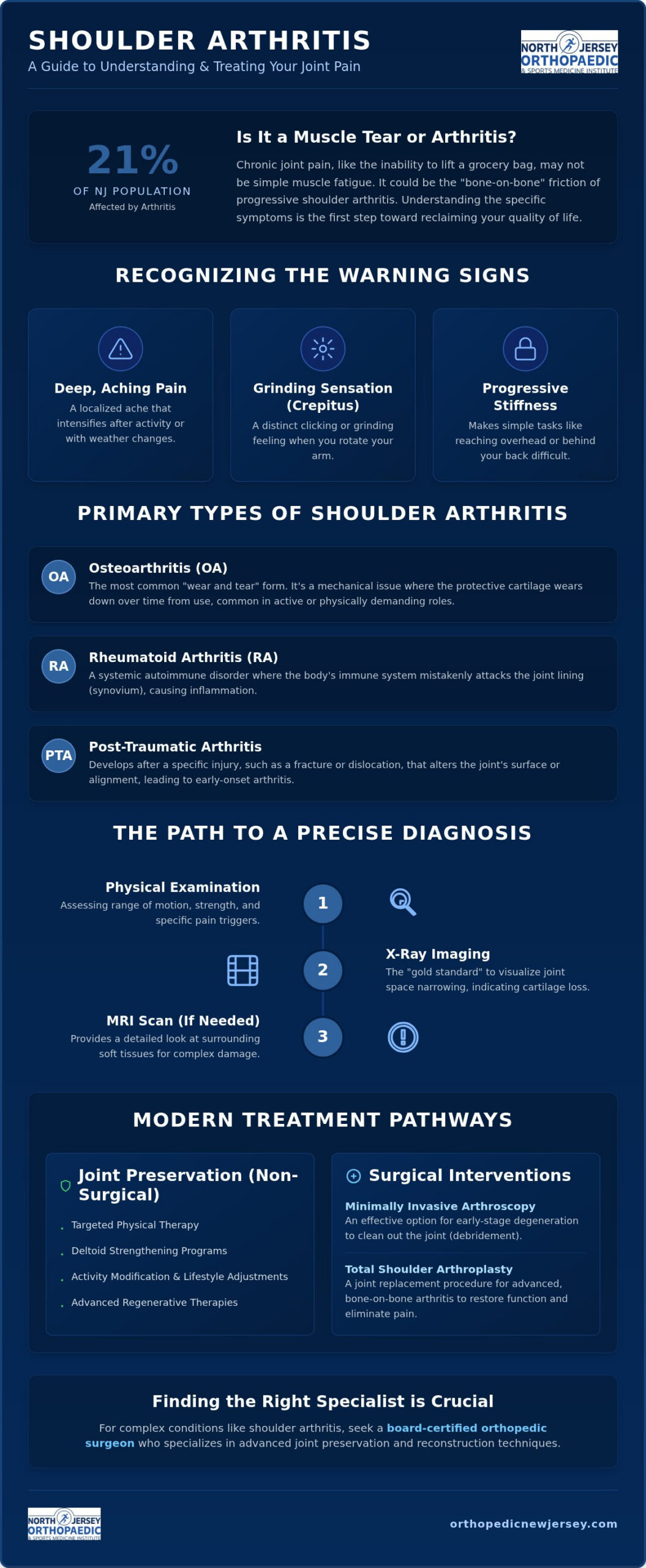
What if the “rotator cuff tear” you’ve been self-diagnosing is actually the early stages of joint degeneration? For many in our community, the reality of chronic joint pain isn’t just a clinical diagnosis; it’s the inability to lift a grocery bag or the constant, throbbing ache that makes a full night’s sleep feel impossible. With 21% of the New Jersey population currently affected by arthritis, seeking specialized shoulder arthritis treatment in Kearny NJ is a critical step toward distinguishing between simple muscle fatigue and the bone-on-bone friction that characterizes progressive joint wear.
It’s natural to feel hesitant about professional intervention when you’re worried that a diagnosis inevitably leads to months of grueling surgical recovery. However, modern orthopaedics has evolved significantly. You’ll discover how a board-certified specialist utilizes joint preservation and minimally invasive techniques to restore your range of motion. This article previews the latest non-surgical interventions and regenerative therapies designed to help you avoid major surgery while reclaiming your functional independence and quality of life.
Key Takeaways
- Learn how to distinguish between common muscle tears and the “bone-on-bone” friction of shoulder arthritis through precise diagnostic imaging.
- Discover the critical role of targeted physical therapy and deltoid strengthening in preserving joint function without immediate surgery.
- Explore advanced options for shoulder arthritis treatment in Kearny NJ, ranging from non-invasive activity modification to regenerative approaches.
- Understand the benefits of minimally invasive arthroscopic debridement for early-stage degeneration and the criteria for a successful total shoulder arthroplasty.
- Identify the essential qualifications to look for in a board-certified orthopedic surgeon specializing in complex joint reconstruction.
Understanding Shoulder Arthritis: Causes and Symptoms in Kearny Patients
Shoulder arthritis isn’t merely a consequence of aging; it’s a progressive clinical condition involving the deterioration of articular cartilage. Within the glenohumeral joint, this smooth tissue allows the ball of the upper arm to glide seamlessly against the socket. When this cartilage thins or disappears, the resulting bone-on-bone contact creates the chronic discomfort many seek to resolve through Understanding Shoulder Arthritis and professional intervention. Many Kearny residents dismiss these early signs as standard “wear and tear,” yet ignoring the specific symptoms can lead to irreversible joint damage and loss of function.
Identifying the condition early is essential for successful shoulder arthritis treatment Kearny NJ. Patients typically present with a cluster of symptoms that interfere with daily life. You might notice a deep, localized aching pain that intensifies after periods of activity or during changes in the weather. Another hallmark is crepitus, a distinct grinding or clicking sensation that occurs when you rotate your arm. Over time, this friction leads to significant stiffness, making simple tasks like reaching for a seatbelt or grooming your hair feel like monumental challenges.
Osteoarthritis vs. Rheumatoid Arthritis: What is the Difference?
Osteoarthritis (OA) is the most prevalent form we see in North Jersey. It’s primarily a mechanical issue where the joint’s natural “shock absorbers” wear out over decades of use. It often affects those who have led active lifestyles or worked in physically demanding roles. In contrast, Rheumatoid Arthritis (RA) is a systemic autoimmune disorder. In RA, the body’s immune system mistakenly attacks the synovium, which is the lining of the joint membranes. Because the treatments for mechanical wear and autoimmune inflammation differ vastly, a precise clinical evaluation is the cornerstone of effective shoulder arthritis treatment Kearny NJ.
Post-Traumatic Arthritis: The Legacy of Old Injuries
If you spent your younger years playing competitive sports or performing repetitive manual labor, you might be facing post-traumatic arthritis. This condition develops after a specific injury, such as a fracture or dislocation, alters the joint’s alignment or surface. Even a successful labral tear shoulder treatment in your past can eventually lead to early-onset arthritis if the joint surfaces were compromised during the initial trauma. Reviewing your full medical history during a consultation is vital. It allows us to map the progression of your joint health and identify the most appropriate preservation strategies before the condition advances further.
The Diagnostic Process: Evaluating Shoulder Pain in North Jersey
The diagnostic journey begins with a comprehensive physical examination. A board-certified specialist doesn’t just look at the shoulder; they evaluate the entire kinetic chain of the upper extremity. We assess your active and passive range of motion, testing for specific pain triggers that distinguish arthritis from other pathologies. Strength testing is equally vital. If you’re seeking shoulder arthritis treatment NJ, understanding whether your pain stems from joint friction or muscle weakness is the first step toward a personalized recovery plan.
While clinical exams provide clues, imaging remains the definitive tool for staging the disease. We typically start with high-resolution radiographs. These images allow us to visualize the internal architecture of the glenohumeral joint. If the baseline evaluation suggests complex damage, we may utilize an MRI to inspect the surrounding soft tissues. This integrated approach ensures that your shoulder arthritis treatment Kearny NJ addresses both the bone and the stabilizing structures. If you are experiencing persistent discomfort, a professional diagnostic consultation can clarify the state of your joint health.
X-Rays: Visualizing Joint Space Narrowing
Radiographs are the gold standard for diagnosing structural arthritis. On a healthy X-ray, a clear gap exists between the humerus and the glenoid, representing the space occupied by healthy cartilage. Joint space narrowing is the primary indicator of cartilage loss; it signifies that the protective cushion has eroded. As the condition progresses, you may see “bone-on-bone” contact. This friction often triggers the body to produce osteophytes, or bone spurs, which are small bony projections that further restrict movement and cause shoulder arthritis symptoms and treatments to worsen.
The Role of the Rotator Cuff in Arthritis Treatment
The success of any intervention depends heavily on the integrity of your rotator cuff. These tendons act as the primary stabilizers of the shoulder joint. If the tendons are healthy, we have a wider range of surgical and non-surgical options. However, chronic arthritis can sometimes coexist with significant tendon damage, a condition known as Rotator Cuff Tear Arthropathy. In these complex cases, a standard repair might not suffice. For patients who have previously undergone arthroscopic rotator cuff repair NJ, we must carefully evaluate how previous scar tissue or structural changes impact current arthritis management.
Non-Surgical Shoulder Arthritis Treatment Options
A diagnosis of joint degeneration doesn’t necessitate an immediate transition to the operating room. In fact, most successful protocols for shoulder arthritis treatment Kearny NJ prioritize conservative, non-operative strategies to manage inflammation and preserve joint mechanics. The initial goal is to modify the metabolic environment of the joint while maintaining as much functional movement as possible. This often begins with activity modification; simple adjustments such as avoiding repetitive overhead reaching or heavy carrying can significantly reduce the frequency of inflammatory “flares.”
Pharmacological management plays a supporting role in this process. We often recommend the judicious use of non-steroidal anti-inflammatory drugs (NSAIDs) or topical agents to manage daily discomfort. If oral medications are insufficient, injectable therapies offer more localized relief. Corticosteroid injections provide rapid, potent anti-inflammatory effects for acute pain, while viscosupplementation involves introducing hyaluronic acid to improve joint lubrication. These interventions are designed to create a “window of opportunity” where the patient can participate more effectively in physical rehabilitation.
Physical Therapy and Functional Rehabilitation
Physical therapy is the cornerstone of joint preservation. The primary objective is to “offload” the arthritic glenohumeral joint by strengthening the surrounding musculature. We focus heavily on the deltoid and scapular stabilizers; when these muscles are robust, they help center the humeral head in the socket, reducing the friction that causes pain. Consistency is vital, so we often coordinate care with local Kearny therapists to ensure patients follow a structured, evidence-based program. Crucially, these sessions also prioritize maintaining “passive” range of motion. Without regular, guided movement, an arthritic shoulder is at high risk for developing secondary stiffness or a “frozen shoulder,” which complicates future recovery efforts.
Biologics and Regenerative Medicine
For patients with mild to moderate degeneration who wish to delay or avoid traditional surgery, regenerative medicine offers a forward-thinking alternative. Platelet-Rich Plasma (PRP) therapy is a primary example, utilizing the growth factors found in the patient’s own blood to modulate the inflammatory environment within the joint. This isn’t a “cure” for arthritis, but it can significantly alter the pain signals and improve tissue health. While some proprietary, marketing-heavy models like the Regenexx approach are common in the industry, we focus on standardized, clinical biologics that are backed by peer-reviewed research. By using your body’s own cellular signaling, we can often manage shoulder arthritis treatment Kearny NJ with a focus on long-term joint health rather than just temporary symptom suppression.
Modern Surgical Interventions: Minimally Invasive Solutions
When conservative strategies no longer provide sufficient relief, modern surgical interventions offer a definitive path toward permanent recovery. For many seeking shoulder arthritis treatment Kearny NJ, the primary goal is to address the mechanical failure of the joint through techniques that prioritize tissue preservation. Arthroscopic debridement is often the first surgical consideration for early-stage patients. This “clean out” procedure involves using small incisions and a camera to remove loose cartilage fragments and inflammatory tissue, effectively smoothing the joint surfaces to reduce friction and pain.
Advancements in minimally invasive orthopedic surgery NJ have revolutionized the patient experience by significantly reducing post-operative scarring and muscle disruption. These refined techniques allow for greater precision during the procedure, which translates to less trauma to the surrounding soft tissues. By utilizing smaller portals and specialized instruments, a board-certified surgeon can address the underlying joint degeneration while facilitating a faster transition to active rehabilitation. If you have reached the limits of non-surgical care, it may be time to consult with a specialist about advanced surgical options.
The Decision Bridge: When is it Time for Surgery?
The “Decision Bridge” is the critical period where a patient and their surgeon evaluate whether the benefits of surgery outweigh the risks of continued conservative management. We typically look for specific clinical indicators: pain that persists even at rest, a significant loss of functional independence, or the failure of multiple non-operative modalities over a six-month period. A board-certified surgeon provides the necessary expertise to help you weigh these factors against your long-term health goals. Ultimately, surgery is a quality-of-life decision made between patient and specialist based on individual functional needs and pain thresholds.
Total vs. Reverse Shoulder Replacement
The choice between a Total Shoulder Arthroplasty (TSA) and a Reverse Total Shoulder Arthroplasty depends entirely on your unique anatomy. TSA is the gold standard for patients with an intact rotator cuff; it replaces the damaged ball and socket with prosthetic components that mimic natural joint mechanics. However, if the rotator cuff is severely deficient or torn beyond repair, a standard replacement will fail. The Reverse Total Shoulder Arthroplasty was a major breakthrough for these complex cases. By “reversing” the anatomy—placing the ball on the socket side and the socket on the arm side—the procedure allows the deltoid muscle to take over the work of the damaged rotator cuff.
Recovery expectations have shifted significantly as we move through 2026. While traditional joint replacements once required multi-day hospital stays, modern protocols and improved anesthetic techniques have made outpatient or same-day discharge increasingly common. This shift allows patients to begin their shoulder arthritis treatment Kearny NJ recovery in the comfort of their own homes, supported by a structured physical therapy plan that starts within days of the procedure.
Choosing a Shoulder Specialist Near Kearny, NJ
Selecting a surgeon for shoulder arthritis treatment Kearny NJ is a decision that impacts your long-term mobility and quality of life. The most critical benchmark in this process is “Board Certification.” This designation ensures your physician has undergone rigorous peer evaluation and met the highest national standards for orthopedic knowledge and surgical skill. While many generalists perform basic procedures, complex joint degeneration requires a specialist who understands the intricate nuances of shoulder anatomy and modern reconstruction techniques. Choosing a practitioner with a dedicated focus on the upper extremity provides an additional layer of security for patients facing advanced arthritis.
High-volume clinics often operate on a model of efficiency that can feel impersonal. However, effective arthritis management requires a patient-centered approach where your specific functional goals are the primary focus. Whether you are aiming to return to a professional trade or simply want to sleep without joint throbbing, your treatment plan must be bespoke. For Kearny residents, accessing this caliber of care doesn’t require a stressful commute into New York City. You can find sophisticated, board-certified expertise within your local community, ensuring that your follow-up care and rehabilitation are convenient and accessible.
The Orthopaedic & Sports Medicine Institute Advantage
Our practice bridges the gap between traditional surgical wisdom and the future of specialized care. We integrate sports medicine principles into every arthritic case, focusing on joint preservation and the restoration of natural mechanics. This philosophy is particularly beneficial for active adults who aren’t ready to settle for a sedentary lifestyle. As a trusted sports medicine clinic Montclair NJ area resource, we prioritize minimally invasive techniques that facilitate faster recovery times for our Kearny patients. By minimizing muscle disruption during surgery, we help you transition into the rehabilitation phase with less pain and greater confidence.
Preparing for Your Consultation
A successful diagnostic process is a collaborative effort. To ensure you receive the most accurate assessment for shoulder arthritis treatment Kearny NJ, come prepared with a comprehensive overview of your orthopedic history. Use the following checklist to maximize the value of your initial visit:
- Provide copies of previous imaging, including X-rays or MRIs, on a disc or via a digital portal.
- Bring an updated list of all medications, including supplements and anti-inflammatories.
- Document a clear timeline of your symptoms, noting specific activities that trigger pain.
- Prepare questions regarding your non-surgical goals and the expected long-term outcomes of different interventions.
Understanding the roadmap to recovery is the first step in reclaiming your independence. If chronic shoulder pain is disrupting your sleep or limiting your daily activities, it’s time to seek a definitive diagnosis. Schedule your shoulder arthritis consultation today to explore the advanced care options available in your neighborhood.
Restore Your Mobility and Sleep Quality
Effective management of joint degeneration relies on a precise diagnostic foundation followed by a structured, progressive treatment plan. Whether your recovery involves targeted physical therapy to offload the joint or advanced biologics to manage inflammation, the goal remains the same: restoring functional independence. For those requiring more definitive intervention, modern arthroscopic techniques and specialized shoulder replacements offer reliable solutions for even the most complex cases of bone-on-bone friction.
Accessing specialized shoulder arthritis treatment Kearny NJ means you don’t have to navigate chronic pain alone or travel far for elite medical care. As a board-certified orthopedic surgeon specializing in minimally invasive techniques, we are dedicated to serving the Kearny and Nutley communities with patient-centered expertise. Take the first step toward a pain-free future by choosing a team that prioritizes joint preservation and modern recovery protocols. Book a Consultation with our Board-Certified Shoulder Specialist to start your journey back to an active life today.
Frequently Asked Questions
Is shoulder arthritis a normal part of aging?
Shoulder arthritis is a pathological condition involving the progressive breakdown of cartilage, and it’s not an inevitable consequence of getting older. While the risk increases with age, many individuals maintain healthy joint function well into their senior years. Factors such as genetics, previous sports injuries, and repetitive labor play more significant roles in the development of arthritis than age alone. Early clinical intervention can often slow the progression of joint wear.
Can I treat shoulder arthritis without surgery?
You can effectively manage shoulder arthritis through non-surgical modalities, especially when the condition is identified in its early stages. Successful shoulder arthritis treatment Kearny NJ often begins with a combination of activity modification, targeted physical therapy, and anti-inflammatory medications. Biologics, such as Platelet-Rich Plasma (PRP), also provide a regenerative approach to managing joint inflammation and pain without the need for traditional surgical intervention or lengthy recovery periods.
How long does a shoulder replacement last in 2026?
Modern shoulder replacements are highly durable, with clinical data from 2026 suggesting that 90% of implants remain functional for 15 to 20 years. Advancements in polyethylene materials and 3D-printed titanium surfaces have significantly improved the longevity of these components. Your specific activity level and bone quality will influence the lifespan of the implant, but most patients enjoy decades of relief before ever needing to consider a revision procedure.
What is the recovery time for minimally invasive shoulder surgery?
Recovery from minimally invasive shoulder surgery is typically faster than traditional open procedures, with many patients returning to light daily activities within two to three weeks. While the initial healing phase is shorter due to reduced muscle disruption, a full return to high-impact sports or heavy lifting generally requires four to six months of structured rehabilitation. Adhering to a personalized physical therapy plan is essential for optimizing your long-term functional outcome.
Will physical therapy make my shoulder arthritis worse?
Structured physical therapy won’t worsen arthritis; instead, it protects the joint by strengthening the deltoid and scapular stabilizers. These exercises are designed to “offload” the glenohumeral joint, reducing the bone-on-bone friction that causes pain. While you might experience mild soreness after a session, the goal is to increase your pain-free range of motion and prevent the secondary stiffness often associated with chronic joint degeneration and inactivity.
Does a cortisone shot cure shoulder arthritis?
A cortisone injection isn’t a cure for arthritis, as it doesn’t regrow cartilage or reverse joint damage. It is a potent anti-inflammatory tool designed to provide temporary relief from acute pain and swelling. These injections are often used to facilitate physical therapy or manage symptoms during a significant flare-up. For patients seeking long-term shoulder arthritis treatment Kearny NJ, we typically combine injections with other joint preservation strategies for lasting relief.
What is the difference between a total and reverse shoulder replacement?
A total shoulder replacement mimics your natural anatomy by placing a metal ball on the humerus and a plastic socket on the glenoid. This is ideal for patients with healthy rotator cuffs. In contrast, a reverse shoulder replacement swaps these components, placing the ball on the socket side. This “reverse” design allows the deltoid muscle to power the arm, making it the standard solution for arthritis complicated by significant rotator cuff deficiency.
How do I know if my shoulder pain is arthritis or a rotator cuff tear?
Distinguishing between arthritis and a rotator cuff tear requires a professional clinical exam and imaging. Arthritis typically presents with a deep, aching pain accompanied by “grinding” sensations and global stiffness. Rotator cuff tears are more likely to cause sudden weakness and sharp pain when reaching overhead or behind your back. Because these conditions often coexist, a board-certified specialist uses high-resolution X-rays to visualize joint space narrowing and confirm the diagnosis.