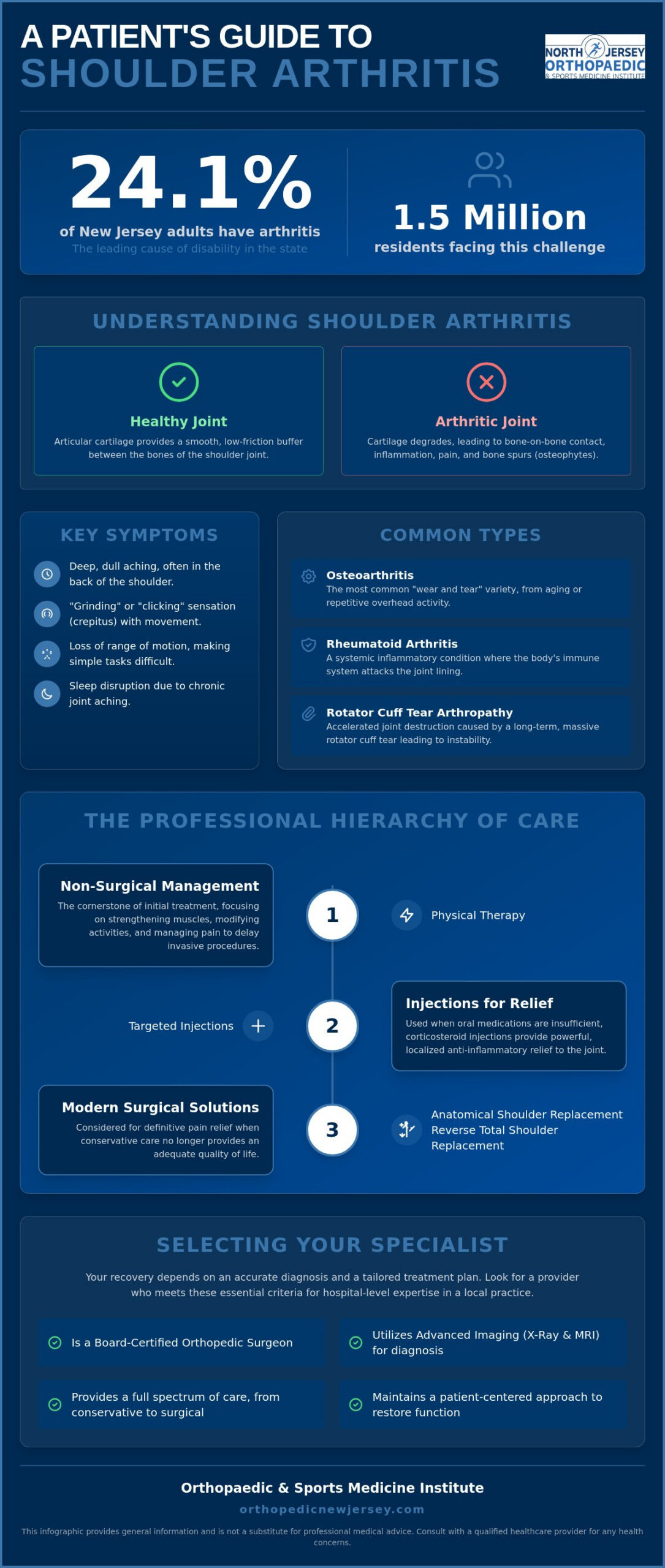
Did you know that 24.1% of adults in New Jersey have been diagnosed with some form of arthritis, making it the leading cause of disability across our state? If you’re one of the 1.5 million residents facing this challenge, you likely understand how a stiff, painful joint can turn simple tasks like reaching for a high shelf or getting dressed into a source of daily dread. It’s common to feel overwhelmed when searching for effective shoulder arthritis treatment NJ, especially when you’re unsure if your condition requires a total joint replacement or can be managed with specialized physical therapy.
You deserve a clear, evidence-based path to recovery that prioritizes your mobility and long-term comfort. We recognize the physical toll that sleep disruption and chronic joint aching take on your quality of life. This guide outlines the professional hierarchy of care, moving from conservative non-surgical interventions to advanced, minimally invasive surgical techniques. By understanding your options, you can work with a board-certified specialist to implement a plan that reduces daily pain and restores the functional independence you need to thrive right here in North Jersey.
Key Takeaways
- Understand the clinical progression of cartilage degradation in the glenohumeral joint and how identifying your specific type of arthritis informs your recovery plan.
- Discover how a “conservative first” approach to shoulder arthritis treatment NJ utilizes specialized physical therapy to restore function and delay the need for invasive procedures.
- Learn about modern surgical advancements, including the functional differences between anatomical and reverse total shoulder replacements for definitive pain relief.
- Identify the essential criteria for selecting a board-certified specialist in North Jersey who can provide hospital-level expertise within a patient-centered local practice.
- Gain a clear understanding of the professional treatment hierarchy to help you confidently transition from chronic discomfort toward a restored quality of life.
Understanding Shoulder Arthritis Pain and Progression
Shoulder arthritis is clinically defined as the progressive degradation of the articular cartilage within the glenohumeral joint. This cartilage serves as a vital, low-friction buffer between the humeral head and the glenoid socket. When this protective tissue thins or disappears, the resulting bone-on-bone contact causes significant inflammation and structural damage. For those researching Understanding Shoulder Arthritis, it is important to view this condition as an evolving process rather than a static injury. Without timely intervention, the joint often develops osteophytes, or bone spurs, which further restrict movement and increase discomfort.
In North Jersey, where many residents remain active in local sports and community activities, the loss of shoulder function can be devastating. Patients often report a deep, dull aching localized to the back of the shoulder, accompanied by a distinct “grinding” or “clicking” sensation known as crepitus. Early shoulder arthritis treatment NJ is critical for preserving existing joint function. By addressing the symptoms in their initial stages, patients can often avoid the rapid loss of range of motion that makes simple tasks, such as reaching into a cabinet or dressing, nearly impossible.
The Different Faces of Shoulder Degeneration
Shoulder arthritis manifests in several distinct forms, each requiring a specific clinical approach. Osteoarthritis is the most common “wear and tear” variety, often affecting patients as they age or following years of repetitive overhead activity. Rheumatoid arthritis differs in that it is a systemic inflammatory condition where the immune system attacks the joint’s synovium. Another complex form is rotator cuff tear arthropathy. In this scenario, a long-term, massive rotator cuff tear leads to joint instability, causing the humeral head to shift upward and grind against the acromion, which accelerates the destruction of the joint surface.
When to Seek a Professional Orthopedic Consultation
Recognizing when to transition from home care to a specialist is essential for a successful recovery. You should prioritize a consultation if you experience shoulder pain that won’t go away with rest or if your sleep is consistently interrupted by joint aching. These are often signs that the cartilage loss has reached a symptomatic threshold.
At our Nutley facility, the diagnostic process involves a thorough physical examination and advanced imaging. High-resolution X-rays allow us to visualize joint space narrowing, while MRIs can identify concurrent soft tissue damage. A board-certified orthopedic surgeon provides the specialized expertise necessary to differentiate between various pathologies, ensuring your treatment plan is built on an accurate long-term prognosis. This professional oversight is the cornerstone of effective joint preservation and recovery.
Evaluating Non-Surgical Shoulder Arthritis Treatment in NJ
Our practice adheres to a “conservative first” philosophy for managing joint degeneration. While surgical options are highly effective, we prioritize non-invasive shoulder arthritis treatment NJ to determine if your symptoms can be managed without the risks associated with surgery. This methodical approach ensures that every patient receives the least disruptive care necessary to achieve their mobility goals. Most patients find that a combination of professional guidance and lifestyle adjustments can significantly delay the need for more intensive procedures.
A key part of these lifestyle adjustments often includes weight management to reduce systemic inflammation and mechanical stress on the joints, a service provided by specialists like nusbaummedicalcenters.com for those in the New Jersey area.
Physical therapy serves as the cornerstone of conservative management. By focusing on strengthening the rotator cuff and scapular stabilizers, we can effectively offload the pressure on the glenohumeral joint. Additionally, activity modification is essential for patients in Nutley and Bloomfield. This might involve adjusting your golf swing at a local club or modifying how you lift heavy objects during weekend yard work. Pharmacological support, including nonsteroidal anti-inflammatory drugs (NSAIDs) and topical analgesics, often provides the necessary baseline comfort to engage fully in these rehabilitative exercises.
Injections: Corticosteroids vs. Biologics
When oral medications are insufficient, targeted injections can provide localized relief. Corticosteroid injections are a standard tool for reducing acute inflammation and breaking the cycle of pain. For some patients, hyaluronic acid injections, often called viscosupplementation, act as a lubricant to improve joint gliding. While biologics are an area of intense research, we maintain a transparent dialogue with our patients about the current evidence, ensuring they understand which Shoulder Arthritis Treatment Options are supported by robust clinical data. These interventions are often used to bridge the gap between early-stage discomfort and long-term joint preservation.
The Decision Bridge: When Conservative Care Fails
We track “failure of conservative management” as a significant clinical milestone. This occurs when, despite consistent therapy and medical management, your quality of life continues to decline. If you can no longer perform basic daily hygiene, reach overhead, or achieve a restful night’s sleep, it’s time to transition to a more definitive intervention. Consulting a joint pain specialist in North Jersey allows for a comprehensive re-evaluation of your joint’s structural integrity. We look for specific indicators on diagnostic imaging that suggest the cartilage loss has progressed beyond what therapy can compensate for. If your current routine is no longer providing the relief you need, consider speaking with our team about a personalized orthopedic evaluation to explore your advanced recovery options.
Modern Surgical Interventions: When to Consider Replacement
When conservative measures no longer provide adequate pain relief, surgical intervention becomes a necessary step toward restoring your quality of life. Shoulder arthroplasty, or joint replacement, is considered the definitive solution for advanced Arthritis of the shoulder. This procedure involves replacing the damaged articular surfaces with prosthetic components designed to mimic natural joint mechanics. Modern advancements in medical technology have made these procedures highly predictable, with high patient satisfaction rates for those suffering from chronic joint degradation.
Choosing the correct surgical approach depends heavily on the structural integrity of your surrounding soft tissues. We utilize shoulder arthritis treatment NJ protocols that prioritize long-term stability and functional restoration. For many patients, the choice of implant is determined by the condition of the rotator cuff. Integrating minimally invasive orthopedic surgery NJ techniques allows our specialists to access the joint with less disruption to the surrounding musculature, which often results in reduced postoperative pain and a more efficient rehabilitation process.
Total vs. Reverse Shoulder Replacement
Anatomical total shoulder replacement is the standard approach for patients whose rotator cuff tendons are healthy and intact. In this procedure, a metal ball replaces the humeral head, and a plastic socket is fitted into the glenoid. However, if the rotator cuff is severely damaged or non-functional, a reverse shoulder replacement is often required. Reverse shoulder replacement mechanically shifts the center of rotation for the joint, allowing the deltoid muscle to compensate for a non-functional rotator cuff. This innovation ensures that even patients with complex arthropathy can regain the ability to lift their arms and perform daily tasks.
Arthroscopic Debridement: A Less Invasive Option
In cases of early-stage arthritis, a full joint replacement might not be necessary. Arthroscopic debridement is a “cleaning out” procedure where a surgeon uses small incisions and a camera to remove loose fragments of cartilage and trim painful bone spurs. This intervention focuses on improving the joint’s internal environment to reduce friction and mechanical catching. While the recovery time for arthroscopy is significantly shorter than a full replacement, it’s typically reserved for patients with moderate degeneration who still have a viable amount of joint space. We carefully evaluate your diagnostic imaging to determine if this less invasive bridge is the right clinical choice for your specific stage of progression.
How to Choose a Shoulder Specialist in the Nutley Area
Selecting the right surgeon for your shoulder arthritis treatment NJ is a decision that directly impacts your long-term mobility and comfort. You shouldn’t settle for a generalist when your quality of life is on the line. Board certification in orthopedic surgery is the non-negotiable first step in your search. This credential ensures your surgeon has met rigorous national standards for clinical knowledge and technical skill. Beyond the certificate, you must evaluate their specific experience with modern shoulder arthritis surgery options. A specialist who performs these procedures frequently understands the nuances involved in both anatomical and reverse replacements, leading to more predictable outcomes.
Accessibility plays a vital role in your recovery journey. Choosing a specialist in the Nutley or Clifton area means your pre-operative visits and critical post-operative follow-ups don’t require exhausting travel into New York City. Recovery is a marathon, not a sprint. Having your board-certified surgeon nearby ensures that any concerns during your rehabilitation are addressed promptly by the expert who performed the procedure. This local connection simplifies the logistics of your care, allowing you to focus entirely on your physical therapy and healing.
Checklist for Your Orthopedic Consultation
Your initial meeting is an interview. You should feel empowered to ask direct questions about the surgeon’s practice patterns and surgical volume. Use this checklist to guide your conversation and ensure you are comfortable with the proposed path forward:
- Which local North Jersey hospitals are you affiliated with for surgical procedures?
- Do you prioritize minimally invasive techniques over traditional open surgery for my specific condition?
- What does your specific post-operative physical therapy protocol look like, and how closely do you monitor progress?
Patient-Centered Care vs. High-Volume Clinics
Many large hospital systems operate as high-volume clinics where you might only see your surgeon on the day of the operation. In contrast, local practices in Nutley prioritize a personalized approach. You should expect to see your surgeon at every visit, from the initial diagnostic phase through your final clearance. This continuity of care fosters a stronger therapeutic relationship and ensures your recovery plan is tailored to your specific lifestyle goals. Residents in Bloomfield and Belleville often highlight this individualized attention in their testimonials, noting that a community-based specialist provides a level of accountability that large institutions often lack. If you are ready to discuss a tailored plan for your recovery, schedule a consultation at our Nutley office today to meet with our board-certified team.
Personalized Shoulder Care at The Orthopaedic & Sports Medicine Institute
The Orthopaedic & Sports Medicine Institute serves as a dedicated resource for residents of Nutley, Clifton, and Kearny. We believe that effective care requires more than just clinical skill; it demands a deep commitment to the community. By combining established medical wisdom with modern technology, we provide a standard of care usually reserved for large metropolitan hospitals, delivered in a patient-centered local setting. Our specialized facility in Nutley is equipped to handle comprehensive diagnostics, ensuring every patient receives an accurate assessment of their joint health.
Our practice remains the preferred choice for shoulder arthritis treatment NJ because we treat the individual, not just the diagnostic image. We recognize that a retiree in Kearny has different functional goals than an active professional in Clifton. Our board-certified specialists use their expertise to bridge the gap between traditional surgical methods and modern, less disruptive alternatives, positioning us as a leader in specialized orthopedic care.
Our Minimally Invasive Philosophy
We prioritize surgical techniques that reduce tissue trauma, which is essential for facilitating a quicker return to work and sports. Our minimally invasive philosophy focuses on preserving as much natural anatomy as possible while achieving definitive pain relief. Every recovery plan we create is tailored to your specific activity goals, whether that involves returning to a local golf league or simply being able to sleep through the night without discomfort. Patients in Nutley benefit from direct access to expert orthopedic surgical consultations without the need for complex hospital navigation.
Start Your Recovery Journey Today
Taking the first step toward relief begins with a comprehensive shoulder evaluation. During your first visit to our Henger Street location, you can expect a thorough diagnostic process, including a physical examination and a review of your medical history. We encourage transparency and education, ensuring you leave your initial consultation with a clear understanding of your treatment hierarchy. If you are ready to regain your mobility and quality of life, schedule your consultation with our board-certified specialist today.
Take Control of Your Shoulder Health and Mobility
You now have a comprehensive understanding of how shoulder degeneration progresses and the various pathways available for recovery. Whether your condition requires targeted physical therapy or a modern joint replacement, the goal remains the same: restoring the fluid, pain-free movement you need for daily life. Choosing a local specialist ensures that your shoulder arthritis treatment NJ is both accessible and highly personalized to your specific activity goals. By following a structured hierarchy of care, you can move from chronic discomfort toward a functional, active future.
Our practice is led by a board-certified orthopedic surgeon who specializes in minimally invasive techniques designed to get you back to your routine with less downtime. We are dedicated to serving the Nutley, Bloomfield, and North Jersey community with a standard of care that prioritizes your long-term joint health. It’s time to stop simply managing your pain and start focusing on your recovery. Request a Consultation for Shoulder Arthritis Treatment in Nutley today to discuss your options. We look forward to helping you regain your independence and your quality of life.
Frequently Asked Questions
What is the most effective treatment for shoulder arthritis in NJ?
The most effective shoulder arthritis treatment NJ depends entirely on the stage of your cartilage degradation and your functional goals. For early to moderate stages, a combination of physical therapy and anti-inflammatory management often provides significant relief. If the condition has progressed to bone-on-bone contact and conservative care no longer works, total shoulder replacement is considered the gold standard for restoring mobility.
Can shoulder arthritis be treated without surgery?
Yes, many patients successfully manage their symptoms through non-invasive protocols. These treatments include specialized physical therapy to strengthen the surrounding musculature, activity modification to reduce joint stress, and various injection therapies. These methods focus on controlling inflammation and improving joint mechanics to help you maintain an active lifestyle without the need for an operation.
How do I know if I need a total shoulder replacement?
You may be a candidate for total shoulder replacement if your pain consistently interrupts your sleep or prevents you from performing basic daily tasks like dressing and grooming. Clinical indicators include advanced joint space narrowing visible on diagnostic imaging and a failure to find relief through six months of conservative management. A board-certified surgeon will evaluate your X-rays to confirm if the cartilage has completely worn away.
Is physical therapy effective for degenerative shoulder joints?
Physical therapy is a vital component of joint management because it optimizes the strength of the rotator cuff and scapular stabilizers. By improving the support system around the glenohumeral joint, therapy helps offload the pressure on the arthritic surfaces. While it cannot restore lost cartilage, it is highly effective at reducing pain and preventing the stiffness that often accompanies joint degeneration.
What is the recovery time for minimally invasive shoulder surgery?
Recovery from minimally invasive procedures is typically more efficient than traditional open surgery due to reduced tissue trauma. Most patients regain the ability to perform light daily activities within six weeks; however, a full return to sports or heavy lifting usually requires four to six months of structured rehabilitation. Your specific timeline will depend on the complexity of the procedure and your adherence to postoperative therapy.
Are corticosteroid injections safe for long-term shoulder pain relief?
Corticosteroid injections are safe and effective when used as a targeted tool to manage acute inflammatory flares. However, they are generally not recommended as a permanent long-term solution because frequent, repeated injections can potentially weaken the tendons and soft tissues over time. We use these injections strategically to provide a window of comfort that allows you to participate more fully in restorative physical therapy.
How do I find a board-certified orthopedic surgeon in Nutley, NJ?
You can identify qualified specialists by verifying their credentials through the American Board of Orthopaedic Surgery and checking for local hospital affiliations in North Jersey. It’s important to choose a surgeon who focuses specifically on shoulder pathologies and modern, less invasive techniques. Our Nutley office offers direct access to this level of specialized expertise, providing high-level surgical consultations right in your community.
What is the difference between anatomical and reverse shoulder replacement?
An anatomical replacement follows your natural anatomy by placing a metal ball on the humerus and a plastic socket on the glenoid; this is ideal for patients with a functional rotator cuff. A reverse shoulder replacement swaps these positions, placing the ball on the socket side. This mechanical shift allows the deltoid muscle to move the arm, making it the preferred choice for patients with significant rotator cuff damage.