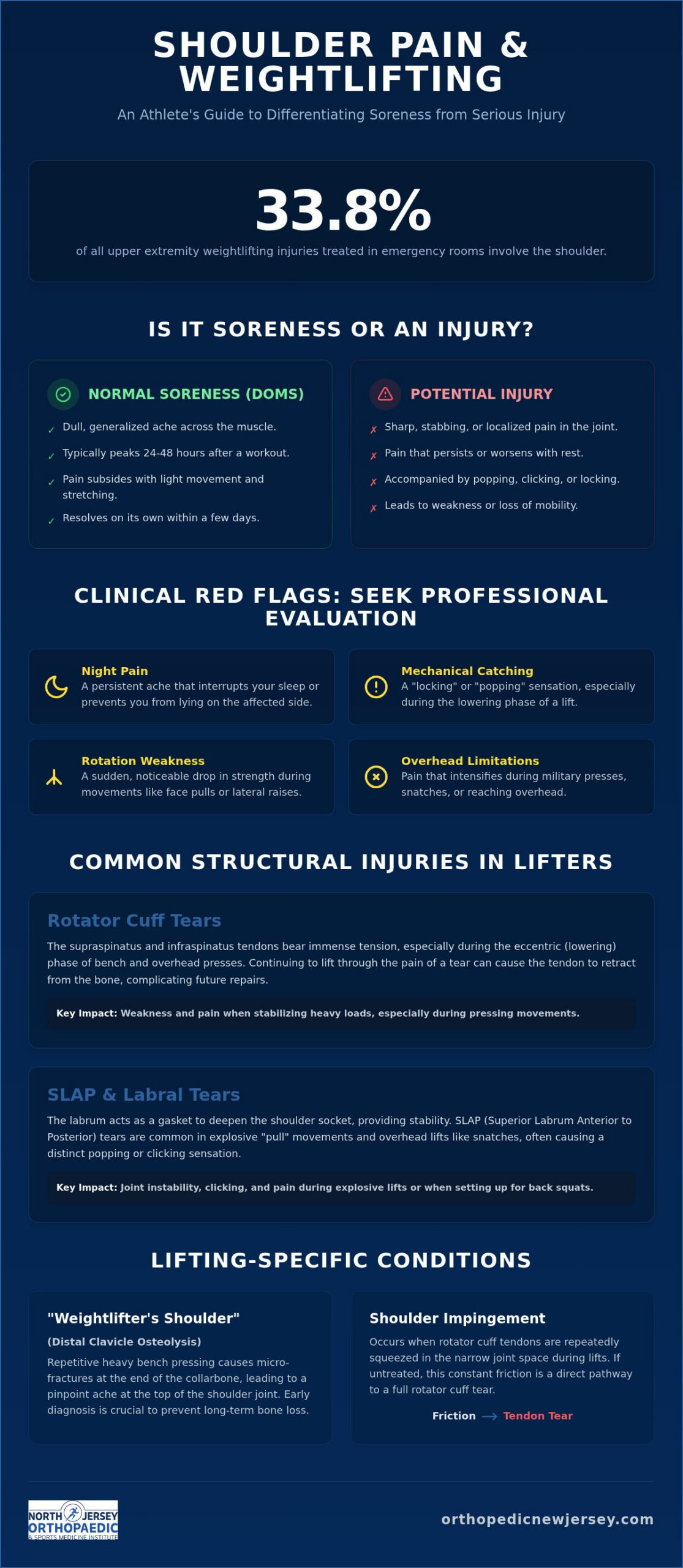
Did you know that 33.8 percent of all upper extremity weightlifting injuries treated in emergency rooms involve the shoulder? This statistic highlights a reality many athletes face: the complex joint is remarkably vulnerable during high intensity training. If you’re searching for a shoulder pain from lifting weights doctor Clifton NJ, you likely understand the frustration of a persistent ache that halts your progress. It’s difficult to distinguish between standard muscle soreness and a structural injury like a labral tear when your overhead press or bench press starts to suffer.
We recognize that for a dedicated lifter, being sidelined is not just a physical setback but a mental one. You deserve clarity on whether that nightly throbbing requires professional intervention. In this guide, you’ll learn how to identify when your pain necessitates a board-certified specialist and discover the advanced, minimally invasive treatment options available near Clifton. We’ll outline the diagnostic process and how a tailored recovery plan can prioritize your return to the gym. By focusing on modern procedural solutions, we aim to bridge the gap between injury and your next personal best.
Key Takeaways
- Learn to differentiate between standard delayed onset muscle soreness and structural injuries that require professional medical attention.
- Discover why a clinical evaluation by a shoulder pain from lifting weights doctor Clifton NJ is essential for identifying the root cause of mechanical failure.
- Understand the specific impact of rotator cuff and labral tears on your ability to perform compound lifts like the bench press or cleans.
- Explore advanced, minimally invasive surgical options designed to preserve muscle tissue and accelerate your return to high intensity training.
- Gain access to specialized sports medicine expertise from a board-certified surgeon located just minutes from Clifton in Nutley.
Identifying Shoulder Pain from Lifting: When to See a Doctor
Distinguishing between the productive burn of a high intensity workout and a debilitating injury is a skill every athlete must develop. While delayed onset muscle soreness (DOMS) is a common byproduct of hypertrophy training, it shouldn’t be confused with structural damage. If you find yourself searching for a shoulder pain from lifting weights doctor Clifton NJ, your symptoms have likely moved beyond simple fatigue. Mechanical failure in the shoulder joint often presents as a sharp, localized pain that doesn’t resolve with standard rest or anti-inflammatory protocols.
Certain symptoms act as definitive indicators that the joint’s integrity is compromised. Clinical red flags that demand a professional evaluation include:
- Night Pain: A persistent ache that interrupts your sleep cycle or makes it impossible to lie on the affected side.
- Mechanical Catching: A “locking” or “popping” sensation specifically during the eccentric phase of a lift.
- External Rotation Weakness: A sudden, noticeable drop-off in strength when performing movements like face pulls or lateral raises.
- Overhead Limitations: Pain that intensifies during the military press or snatches, suggesting a narrowing of the joint space.
Clifton athletes who experience these issues should seek a clinical evaluation promptly. Ignoring these signals often leads to compensatory patterns that can trigger secondary injuries in the neck or upper back. To manage these secondary muscular issues, athletes often look for remedial massage specialists—like the team at Body Therapist—who understand the specific needs of strength athletes.
The “Weightlifters Shoulder”: Distal Clavicle Osteolysis
This condition is frequently seen in powerlifters and bodybuilders who prioritize heavy bench pressing. The repetitive, heavy loading causes micro-fractures at the distal end of the collarbone. You’ll likely feel this as a pinpoint ache at the very top of the shoulder joint during horizontal pressing movements. Seeking care at our Nutley facility, which is conveniently adjacent to Clifton, allows for an early diagnosis through physical examination and imaging. Early intervention is vital to prevent long-term joint degeneration and bone loss in the clavicle.
Shoulder Impingement vs. Rotator Cuff Tears
Shoulder impingement occurs when the tendons are squeezed in the narrow subacromial space during repetitive lifting. If left untreated, this constant friction can progress into a Rotator cuff tear. These injuries range from minor fraying to full-thickness ruptures that significantly impact your ability to stabilize heavy loads. A board-certified surgeon uses specific diagnostic maneuvers to differentiate between simple inflammation and a structural tear. This professional precision ensures your recovery plan is built on an accurate assessment of the damage.
Common Lifting Injuries: Rotator Cuff and Labral Tears
The shoulder is a masterpiece of mobility, but it sacrifices inherent stability to achieve its impressive range of motion. For those performing heavy compound movements, the rotator cuff and labrum act as the primary stabilizers. When these structures fail, your lifting total doesn’t just plateau; it regresses. Understanding the specific pathology of these injuries is the first step toward a successful return to the platform. Finding a shoulder pain from lifting weights doctor Clifton NJ is critical when these mechanical symptoms persist during your sessions.
Rotator Cuff Tears in the Gym
The rotator cuff is a group of four muscles, but the supraspinatus and infraspinatus bear the brunt of the load during overhead and bench pressing. Eccentric loading, or the controlled lowering of a heavy barbell, puts immense tension on these tendons. If a tear occurs, continuing to lift through the pain can lead to tendon retraction, where the muscle pulls away from the bone. This makes a later repair significantly more complex. For athletes in our community, seeking an arthroscopic rotator cuff repair NJ specialist ensures that the repair is handled with minimally invasive precision to preserve as much healthy tissue as possible.
SLAP Tears and Labral Instability
The labrum is a ring of fibrocartilage that deepens the shoulder socket. It acts like a gasket, keeping the humerus centered during explosive movements. SLAP (Superior Labrum from Anterior to Posterior) tears are common in lifters who perform heavy “pull” movements or snatches. You might notice a distinct “popping” or “clicking” when you’re setting up for a back squat or during the catch phase of a clean. This instability isn’t just annoying; it’s a mechanical failure that compromises your joint’s safety. Professional labral tear shoulder treatment focuses on restoring that stability so you can pull heavy without fear of subluxation.
While some clinics suggest that injections are the only solution, high-grade tears in active lifters often require mechanical repair to withstand the forces of a heavy bench or squat. A board-certified surgeon can determine if your injury requires surgical intervention or if conservative management is viable. You can consult with our specialized team in Nutley to get an accurate diagnosis and a clear path back to the gym. We prioritize treatments that get you back to your routine without sacrificing long-term joint health.
The Diagnostic Process for Clifton Athletes
Many lifters believe an MRI report is the final word on their injury. However, a report from an imaging center lacks the essential context of how your shoulder functions under the specific stresses of a heavy load. When searching for a shoulder pain from lifting weights doctor Clifton NJ, you need a specialist who correlates your gym mechanics with diagnostic data. A comprehensive evaluation ensures that the treatment plan addresses the actual source of your mechanical failure rather than just an incidental finding on a scan.
Why Imaging Alone Isn’t Enough
Medical research indicates that many high level athletes possess asymptomatic tears that appear on advanced imaging. If a radiologist identifies a labral fraying but you maintain full strength and stability during provocative testing, that finding might be irrelevant to your current discomfort. A board-certified surgeon uses specific maneuvers, such as the Hawkins-Kennedy or Neer’s test, to physically recreate the impingement you feel during an overhead press. We don’t just look at the pictures; we look at how the joint responds to resistance. This clinical correlation prevents misdiagnosis and ensures we aren’t recommending unnecessary interventions for structural variations that aren’t causing your pain.
Consulting a Board-Certified Surgeon
Even if your primary goal is to avoid the operating room, a surgical perspective is invaluable. A board-certified surgeon understands the structural limits of human anatomy better than a general practitioner. We can determine if a rotator cuff tear is truly “fixable” through conservative protocols or if delaying a minimally invasive procedure will lead to irreversible tendon retraction. Our diagnostic process often incorporates several layers of data:
- Digital X-rays: These are essential for ruling out subacromial bone spurs that can shred tendons during repetitive lifting.
- Diagnostic Ultrasound: This allows for real-time visualization of the tendons while you move the joint, capturing issues that a static MRI might miss.
- Return to Lift Roadmap: We develop a personalized protocol that bridges the gap between clinical physical therapy and your return to heavy compound movements.
Our Nutley office is situated just minutes from major Clifton imaging centers, facilitating a seamless transition from your diagnostic scans to a professional clinical review. We coordinate directly with local radiologists to ensure your high resolution images are analyzed through the lens of sports performance. This integrated approach allows us to treat the root cause of your pain and get you back to the gym with a clear, data-driven strategy for recovery.
Minimally Invasive Treatment Options for Faster Recovery
Traditional orthopedic procedures often required large incisions that disrupted the surrounding musculature, particularly the deltoid. For a weightlifter, the deltoid is a primary driver for nearly every pressing movement. Modern surgical advancements have shifted toward minimally invasive orthopedic surgery NJ, which prioritizes the preservation of this critical muscle. By utilizing arthroscopic portals, a board-certified surgeon can access the joint space without detaching the large muscle groups that you’ve spent years developing in the gym. This approach doesn’t just improve the aesthetic outcome; it directly impacts your ability to regain peak strength during the rehabilitation phase.
Arthroscopic Rotator Cuff Repair
During an arthroscopic rotator cuff repair, we use high-definition cameras to visualize the precise nature of the tear. This level of clarity allows for a more accurate repair than traditional open methods. Because the surgical trauma is significantly reduced, post-operative pain levels are typically lower. While a full return to a heavy bench press takes time, most athletes can begin light, range-of-motion resistance training within weeks rather than months. This accelerated timeline is a primary reason to seek a shoulder pain from lifting weights doctor Clifton NJ who is trained in these advanced protocols. We focus on a methodical progression that respects the biological healing of the tendon while keeping you active.
Biologic Augmentation and Modern Healing
Modern repairs aren’t just about mechanical sutures. We now integrate biologic augmentation and specialized high-tension anchors designed to withstand the forces of heavy loading. These anchors are made from bio-composite materials that eventually integrate with your bone, providing a permanent solution for joint stability. We also utilize advanced suturing techniques that distribute tension more evenly across the tendon, reducing the risk of a re-tear during explosive movements like snatches or cleans. This focus on long-term structural integrity ensures that your repair isn’t just a temporary fix, but a foundation for future performance. These technological leaps mean that a diagnosis of a rotator cuff or labral tear is no longer a career-ending event for a serious lifter.
If your progress has stalled due to mechanical instability, it’s time to explore these modern interventions. You can schedule a consultation with our board-certified team to discuss which minimally invasive option best suits your athletic goals.
Why Choose The Orthopaedic & Sports Medicine Institute Near Clifton
Choosing the right specialist is a decision that dictates the trajectory of your athletic future. The Orthopaedic & Sports Medicine Institute, located in Nutley, offers a highly specialized clinical environment for residents in the surrounding North Jersey area. If you require a shoulder pain from lifting weights doctor Clifton NJ, our facility provides the specific expertise needed to address high-demand joints. We serve a diverse patient base from Clifton, Bloomfield, and Verona, ensuring that elite-level orthopedic care is accessible without a commute to major metropolitan centers. Our practice is led by a board-certified surgeon who understands that for an athlete, “rest” is often the least desirable prescription.
The Orthopaedic & Sports Medicine Institute provides a continuum of care that spans from the initial injury assessment to post-surgical rehabilitation. We don’t just perform a procedure and send you elsewhere for recovery; we coordinate the entire process to ensure that your specific athletic goals are met. This integrated model is particularly beneficial for lifters who need a nuanced approach to physical therapy that includes progressive loading protocols. By choosing a specialist who speaks the language of athletes, you ensure that your recovery isn’t just about healing, but about regaining the strength and stability required for high intensity training.
A Specialized Approach for Active Patients
We recognize that weightlifters have unique physiological requirements. A general practitioner might suggest ceasing all resistance training, but our goal is to help you lift safer and more effectively. By analyzing the biomechanics of your specific gym routine, we develop personalized recovery plans that prioritize your return to the platform. Whether you’re a powerlifter in Kearny or a cross-trainer in Clifton, our team integrates surgical precision with sports-specific rehabilitation. For those seeking a sports medicine clinic near Nutley NJ, we offer a bridge between acute injury management and long-term performance optimization.
Booking Your Consultation
The path to recovery begins with a thorough orthopedic evaluation. During your initial visit, you can expect a detailed physical examination that goes beyond a simple review of imaging reports. We focus on provocative testing and functional assessments to pinpoint the exact source of your mechanical failure. Our streamlined appointment process ensures that Clifton residents can access specialized care quickly. As a board-certified practice, we adhere to the highest professional standards in North Jersey, ensuring that every treatment plan is rooted in evidence-based medicine and modern surgical techniques. We’re committed to transparency and education, guiding you through every step of the diagnostic and treatment journey.
Restoring Performance Through Specialized Orthopedic Care
Persistent shoulder pain shouldn’t be the price you pay for a heavy gym session. We’ve explored how identifying the difference between simple soreness and structural damage, such as a rotator cuff or labral tear, is essential for long-term joint health. A board-certified surgeon provides the clinical precision needed to move beyond the limitations of a standard MRI report. By choosing a shoulder pain from lifting weights doctor Clifton NJ, you gain access to advanced, minimally invasive techniques that prioritize muscle preservation and accelerated recovery times.
The Orthopaedic & Sports Medicine Institute is dedicated to serving the Clifton and Nutley communities with a focus on sports injury recovery. We treat the root cause of your mechanical failure, whether through conservative management or modern surgical interventions. Don’t let a lingering injury dictate your lifting total or force you to abandon your fitness goals. Schedule Your Shoulder Consultation Today to begin your journey back to peak performance. You have the strength to recover, and we have the expertise to guide you there.
Frequently Asked Questions
Is it okay to lift through shoulder pain if I use lighter weights?
Lifting through pain is generally discouraged if the discomfort is sharp, localized, or mechanical. While reducing weight might alleviate immediate pressure, it doesn’t address underlying structural issues like a labral tear or distal clavicle osteolysis. Continuing to train can aggravate a minor strain into a more serious injury. If you’re searching for a shoulder pain from lifting weights doctor Clifton NJ, our specialists recommend a professional evaluation before resuming any overhead or heavy pressing movements to ensure long term joint safety.
How do I know if my shoulder pain is a rotator cuff tear or just a strain?
A strain typically involves stretched muscle fibers and resolves with rest within two to three weeks. In contrast, a rotator cuff tear often presents with profound weakness during external rotation or a persistent, deep ache at night. Clinical provocative testing by a board-certified surgeon is the most reliable way to differentiate between these conditions. If you cannot hold your arm out against resistance, it’s a strong indicator that a structural tear is present rather than simple inflammation.
Does a labral tear always require surgery for weightlifters?
Surgery isn’t the only path for every labral tear. Low grade fraying or stable tears can often be managed through specialized physical therapy that focuses on scapular stabilization and rotator cuff strengthening. However, if the tear causes the shoulder to feel unstable or “catch” during heavy compound lifts, minimally invasive surgical repair may be necessary. We prioritize the most conservative treatment that still allows you to meet your specific athletic goals safely without risking further joint damage.
What is the recovery time for arthroscopic shoulder surgery?
Recovery timelines vary based on the extent of the repair and the patient’s biological healing rate. Most athletes can begin light, range of motion exercises within two to four weeks post surgery. Returning to high intensity resistance training typically takes four to six months of structured rehabilitation. Our Nutley office provides a detailed “Return to Lift” protocol that bridges the gap between clinical therapy and your return to the gym floor, ensuring the repair remains stable under heavy load.
Do you accept insurance for orthopedic consultations near Clifton?
Yes, The Orthopaedic & Sports Medicine Institute works with a wide range of insurance providers to ensure our services remain accessible to the Clifton community. Because insurance plans and coverage details frequently change, we recommend contacting our Nutley office directly to verify your specific plan before your consultation. Our staff can provide the most current information regarding accepted providers and any necessary referrals needed for your first visit with our board-certified surgeon to discuss your recovery options.
Can physical therapy fix a shoulder impingement caused by bench pressing?
Physical therapy is often the first line of defense for shoulder impingement. A targeted program can correct postural imbalances and strengthen the posterior deltoid and rotator cuff muscles to create more subacromial space. This reduces the friction on the tendons during horizontal pressing movements. If conservative therapy fails to provide relief after several weeks of consistent work, we may explore minimally invasive options to remove bone spurs or repair damaged tissue that is contributing to the persistent impingement.
What should I bring to my first appointment with a shoulder doctor?
To ensure an efficient diagnostic process, please bring any previous imaging reports, such as X-rays or MRIs, on a disc or via a digital portal. It’s also helpful to have a list of your current gym routine and specific movements that trigger your pain. Providing a clear medical history and a list of current medications allows our board-certified surgeon to develop a more accurate treatment plan. This preparation helps us correlate your clinical symptoms with your specific athletic performance needs.