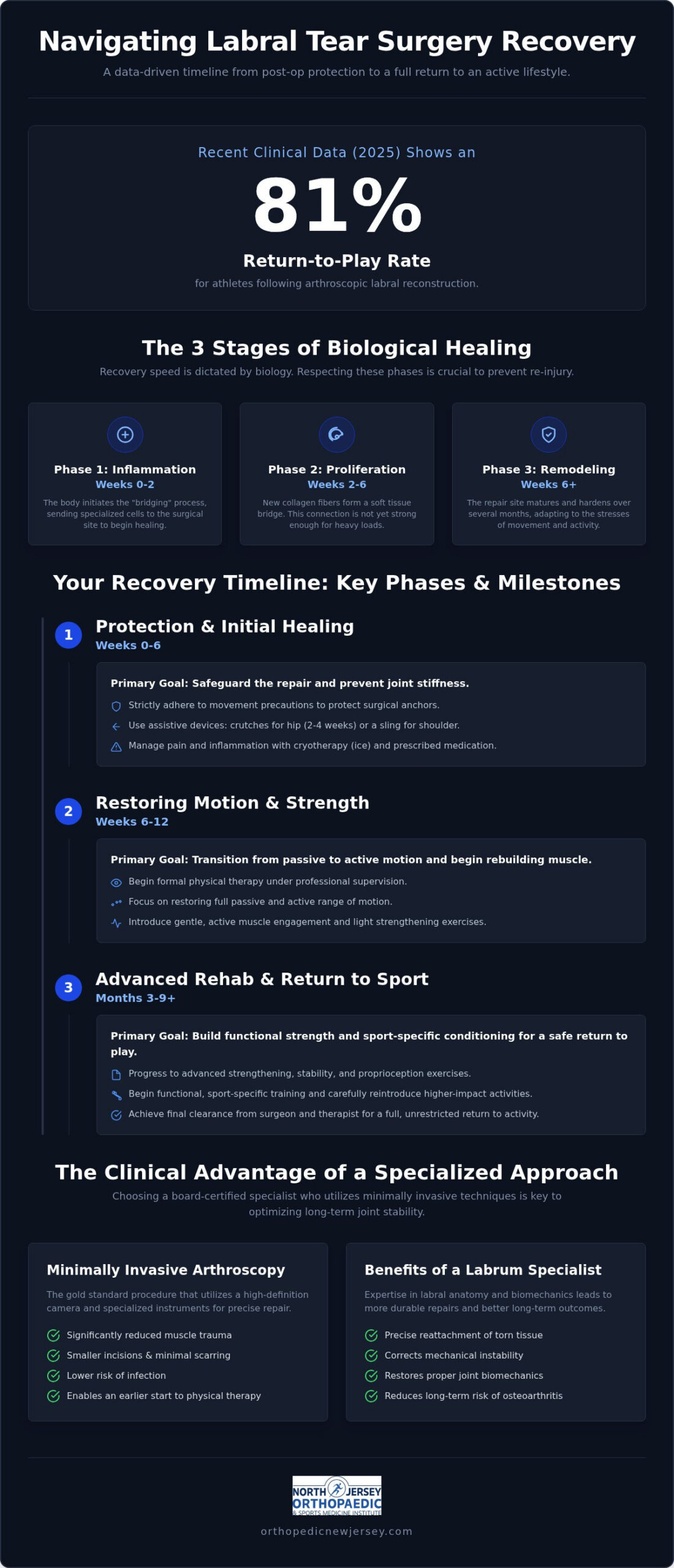
Did you know that recent clinical data from 2025 indicates a return-to-play rate of over 81 percent for athletes following arthroscopic labral reconstruction? While that statistic is encouraging, the path to reaching that milestone requires more than just a successful procedure; it demands a disciplined, biological marathon. If you’re currently struggling with post-operative pain or the frustration of restricted mobility, you’re likely wondering exactly how long your labral tear surgery recovery will take before you can safely return to the gym or the field.
We understand that the fear of re-injury can make every step of rehabilitation feel uncertain. This guide serves as your authoritative resource, offering a detailed week-by-week timeline and expert guidance to help you navigate your recovery with confidence. You’ll discover the specific milestones necessary for a safe return to activity, from early-stage pain management to the advanced functional training required for competitive sports. By following this structured approach, you can transition from surgical intervention back to the pain-free, active lifestyle you deserve.
Key Takeaways
- Understand the biological progression of tissue healing, moving from initial joint protection to advanced functional restoration over several months.
- Learn the critical milestones of the first six weeks, including how to manage weight-bearing restrictions while preventing post-operative stiffness.
- Identify the transition points for weaning off assistive devices and moving from passive range of motion to active muscle engagement.
- Navigate your labral tear surgery recovery with clear, data-driven expectations for returning to high-impact activities and competitive sports.
- Recognize the clinical advantages of choosing a board-certified specialist who utilizes minimally invasive techniques to optimize long-term joint stability.
Understanding Labral Tear Surgery and the Healing Process
The labrum is a specialized ring of fibrocartilage that lines the joint socket, providing essential stability and acting as a gasket to maintain fluid pressure. In the hip, it lines the acetabulum; in the shoulder, it surrounds the glenoid. When this tissue tears, it creates mechanical instability that leads to “catching,” “locking,” or deep-seated pain. Successfully navigating labral tear surgery recovery requires an understanding that biological healing follows a strict internal clock. While modern techniques have made the procedure more efficient, the underlying tissue still requires a specific timeframe to fuse securely back to the bone.
Arthroscopic repair is the gold standard for treating these injuries. During this procedure, a board-certified surgeon uses a high-definition camera and specialized instruments to reattach the torn labrum. This involves the placement of tiny, bio-absorbable anchors into the bone, which are then used to suture the cartilage back into its proper anatomical position. This precision ensures that the joint’s biomechanics are restored, reducing the long-term risk of osteoarthritis.
Minimally Invasive vs. Traditional Repair
At our practice in Nutley, NJ, we utilize minimally invasive arthroscopy to significantly reduce muscle trauma. This approach offers clear clinical advantages. Smaller incisions result in minimal post-operative scarring and a lower infection risk. By preserving the surrounding healthy tissue, we can initiate physical therapy much earlier than traditional methods allowed. The high-definition visualization provided by the arthroscope allows for a thorough inspection of the joint, ensuring that secondary issues, such as a SLAP tear in the shoulder, are addressed simultaneously.
The Biological Timeline of Cartilage Healing
It is vital to recognize that your labral tear surgery recovery speed is dictated by biology, not just your pain levels. Healing occurs in three distinct stages:
- Phase 1: Inflammation and Early Cellular Attachment (Weeks 0-2). The body sends specialized cells to the surgical site to begin the “bridging” process between the labrum and the bone.
- Phase 2: Proliferation and Soft Tissue Bridging (Weeks 2-6). New collagen fibers form a stable connection. However, this new tissue is not yet strong enough to withstand heavy loads.
- Phase 3: Remodeling and Strengthening (Weeks 6+). The repair site matures and hardens. This phase continues for several months as the tissue adapts to the stresses of movement.
By respecting these biological phases, patients can avoid the common pitfall of overexertion, which can lead to re-injury or the failure of surgical anchors. Our localized care in Nutley allows for the frequent follow-up appointments necessary to monitor this progression closely and adjust your rehabilitation plan as needed.
Phase 1: Protection and Initial Healing (Weeks 0-6)
The first six weeks represent the most vulnerable period for the surgical repair. During this phase, the primary clinical objective is to safeguard the reattached tissue while carefully preventing joint arthrofibrosis, or stiffness. Whether you’re recovering from a hip or shoulder procedure, the initial labral tear surgery recovery period requires strict adherence to movement precautions to ensure the anchors remain secure within the bone. Establishing a foundation of protection now prevents mechanical failure later.
For those Understanding Hip Labral Tears and their subsequent repair, weight-bearing restrictions are a standard protocol. Most hip patients utilize crutches for approximately 2 to 4 weeks to limit the axial load on the acetabular labrum. Conversely, shoulder patients must consistently wear a sling to prevent the arm’s weight from pulling on the reattached tissue. Pain management during this window typically involves a strategic combination of cryotherapy (ice) to reduce inflammation and prescribed medications to manage post-operative discomfort.
Immediate Post-Op Care and Home Setup
Optimizing your environment is essential for a smooth transition. Arrange your sleeping area so the joint remains in a neutral position; hip patients often benefit from a pillow between the knees, while shoulder patients may find comfort sleeping in a semi-upright recliner. Managing the surgical portal sites is equally critical. You must keep dressings clean and dry until your first follow-up appointment. The first 48 hours are the most critical window for aggressive swelling control through consistent cryotherapy and elevation.
Early Physical Therapy Milestones
Rehabilitation begins almost immediately. Within the first few days, you’ll start “passive” range of motion exercises, where a therapist or a machine moves the joint for you. This maintains joint lubrication without straining the repair. In hip cases, a continuous passive motion (CPM) machine may be used for several hours a day to prevent adhesions. We also introduce gentle isometric exercises to maintain muscle activation without actual joint movement. These small contractions keep the neuromuscular pathways active while the cartilage heals.
If you’re specifically managing a shoulder injury, following a labral tear shoulder treatment protocol ensures that the biceps tendon isn’t stressed prematurely. Our specialists in Nutley provide comprehensive post-operative evaluations to ensure your early labral tear surgery recovery milestones are met with precision. This local access is invaluable for the frequent check-ins required during these first six weeks.
Phase 2: Restoring Range of Motion and Strength (Weeks 6-12)
By the six-week mark, the surgical repair has transitioned into the proliferation phase. This biological shift allows for a gradual move from passive protection to active engagement. The focus of your labral tear surgery recovery now shifts toward regaining lost muscle volume and restoring normal movement patterns. You’ll begin using your own muscles to move the joint through its range of motion, a process known as active-assisted or active range of motion (AROM).
Weaning from assistive devices typically occurs during this window. Hip patients transition from two crutches to one, and eventually to full weight-bearing, provided they can walk without a limp. Shoulder patients begin removing the sling for light, waist-level activities, though they must still avoid heavy lifting or reaching behind the back. During this phase, we introduce low-impact cardiovascular exercise, such as stationary cycling with low resistance, to improve joint circulation and maintain aerobic fitness.
Rebuilding Functional Stability
Strength is about more than just muscle size; it’s about neurological control. We focus on proprioception, which is the brain’s ability to sense the joint’s position in space. For hip patients, this involves pelvic and core stabilization to prevent compensatory movements. Shoulder patients focus on scapular stability, ensuring the shoulder blade provides a firm foundation for the repaired joint. Strengthening the glutes for the hip and the rotator cuff for the shoulder is vital for long-term joint health. This targeted approach is a hallmark of minimally invasive orthopedic surgery NJ, where the goal is a rapid return to function through muscle preservation.
Returning to Daily Activities
Resuming a normal routine requires a methodical approach. You can typically return to driving once you’ve discontinued all narcotic pain medications and have regained enough strength to perform emergency maneuvers safely. For those in sedentary roles, ergonomic adjustments are necessary. We recommend frequent movement breaks every 30 minutes to prevent joint stiffness. Light household chores and walking for exercise are generally encouraged by week 8, provided they don’t cause a flare-up of symptoms. Your labral tear surgery recovery is a steady progression; if an activity causes sharp pain, it’s a signal to scale back and consult your clinical team.
Phase 3: Advanced Rehab and Return to Sport (3-9 Months)
Entering the third month of labral tear surgery recovery marks a transition from functional restoration to athletic performance. At this stage, the biological repair is sufficiently mature to handle increased load, allowing for the introduction of explosive power and agility training. While you may feel significantly improved, it’s critical to remember that the final remodeling of the cartilage continues well into the first year. Rushing this phase is the most common cause of secondary complications.
Clinical benchmarks dictate the pace of this progression. Most patients can begin light jogging on flat surfaces or swimming laps around the 3 to 4 month mark, provided they demonstrate adequate limb symmetry and core control. However, full clearance for high-impact contact sports, such as football or hockey, typically requires 6 to 9 months of dedicated rehabilitation. We utilize rigorous functional testing, including hop tests for hip patients and medicine ball toss variations for shoulder patients, to ensure the joint can withstand competitive forces before granting full clearance.
The Sport-Specific Progression
Athletes must follow a tiered loading protocol tailored to their specific discipline. For those recovering from SLAP or Bankart repairs in the shoulder, this involves a structured throwing program that gradually increases distance and velocity over several weeks. Soccer and basketball players post-hip repair focus on multi-planar movements, including cutting, pivoting, and deceleration drills. It’s essential to implement a gradual loading protocol during these exercises to prevent the development of compensatory tendonitis in the surrounding soft tissues. If you’re unsure if you’re ready for the next level of play, a consultation with a board-certified specialist can provide the objective data needed to make a safe decision.
Long-Term Joint Maintenance
Successful recovery extends beyond the initial nine-month window. A consistent maintenance program is necessary to preserve joint longevity and prevent the recurrence of labral pathology. Patients must learn to differentiate between “good pain,” such as delayed onset muscle soreness (DOMS) from a hard workout, and “bad pain,” which is characterized by sharp joint catching, locking, or localized swelling. Regular orthopedic follow-ups at our Nutley, NJ facility allow us to monitor your joint health long-term, ensuring that the repair remains stable as you return to the activities you love. Maintaining this clinical connection is the best way to safeguard your surgical investment.
Choosing a Labrum Specialist in North Jersey
Labral repair is among the most technically demanding procedures in orthopedics, requiring a high degree of precision to restore the joint’s natural suction-seal effect. Because the labrum has a limited blood supply, the success of the reattachment depends heavily on the surgeon’s ability to place anchors with millimeter accuracy. Selecting a specialist for this procedure is a decision that directly impacts the long-term success of your labral tear surgery recovery. At the Orthopaedic & Sports Medicine Institute, we prioritize a specialized approach that bridges the gap between advanced surgical intervention and personalized rehabilitation.
Our methodology focuses on the preservation of native tissue through minimally invasive techniques. By utilizing high-definition arthroscopic visualization, we can address complex pathology while minimizing disruption to the surrounding musculature. This clinical focus isn’t just about the time spent in the operating room; it’s about a comprehensive care model that oversees every milestone from the initial diagnostic imaging to the final clearance for athletic activity.
Why Board Certification Matters
Board certification is a critical indicator of a surgeon’s commitment to the highest national standards of orthopedic care. It ensures that your practitioner is well-versed in the latest evidence-based protocols and modern surgical alternatives. Our expertise extends to cutting-edge regenerative and restorative techniques that prioritize joint longevity. For instance, while we focus on cartilage stability, we also utilize advanced methodology for adjacent issues, such as BEAR implant ACL repair New Jersey, which represents the new standard for native ligament healing. This level of specialized knowledge ensures that your labral tear surgery recovery is managed by a practitioner who understands the intricate relationship between different joint structures.
Convenient Care for Nutley, Clifton, and Beyond
The logistical aspect of recovery is often overlooked but remains vital for a successful outcome. Recovering from a labral repair requires frequent post-operative follow-ups to monitor healing and adjust physical therapy protocols. Our primary facility in Nutley offers a central location for patients in Bloomfield, Clifton, and Belleville, reducing the stress of travel during the early phases of restricted mobility. We maintain close clinical coordination with top-tier physical therapy centers in Kearny, Belleville, and Lyndhurst to ensure your rehab remains on track.
We believe that streamlined scheduling and local access to board-certified expertise are essential components of a patient-centered experience. If you’re ready to move past the limitations of a joint injury, the next step is a thorough clinical evaluation. Scheduling a consultation allows us to discuss your specific goals and develop a surgical or recovery plan tailored to your lifestyle. Your journey back to pain-free movement begins with a commitment to specialized, local care.
Reclaiming Your Active Lifestyle After Labral Repair
Successful long-term results after a labral repair depend on respecting the biological timeline of cartilage healing. As discussed throughout this guide, this journey moves through distinct phases of protection, restoration, and functional loading. By adhering to a structured protocol and avoiding the temptation to rush your labral tear surgery recovery, you protect the surgical anchors and ensure the joint remains stable for years to come. Consistency in your rehabilitation is the most critical factor in achieving a pain-free return to the gym or the field.
Our team at the Orthopaedic & Sports Medicine Institute brings over a decade of experience to the Nutley, Bloomfield, and Clifton communities. Led by a board-certified orthopedic surgeon, we specialize in minimally invasive arthroscopy that targets the injury while preserving healthy tissue. We provide the authoritative guidance and local convenience necessary for a smooth transition from post-op care to peak performance. Schedule Your Consultation with a Labrum Specialist in Nutley today to begin your personalized recovery plan. You’ve already taken the first step toward healing; we’re here to help you finish the race.
Frequently Asked Questions
How long is the total recovery time for labral tear surgery?
Total recovery typically spans 4 to 9 months depending on the joint and your activity goals. While the initial protection phase ends at 6 weeks, full biological remodeling of the cartilage takes significantly longer. Athletes returning to high-impact contact sports should expect a more extensive 9-month rehabilitation period to ensure the joint can withstand competitive forces safely.
When can I start driving after a hip or shoulder labrum repair?
Most patients resume driving between 2 and 6 weeks post-operation. The specific timing depends on whether the surgical site is your driving leg and your ability to stop narcotic pain medications. You must demonstrate sufficient reaction time and muscle strength to perform emergency maneuvers. Your surgeon will provide a clinical clearance based on your specific functional progress.
Is physical therapy mandatory after labral tear surgery?
Professional physical therapy is a mandatory component of the surgical plan. It provides the structured, tiered loading necessary to restore range of motion while protecting the reattached tissue. Without guided rehabilitation, patients face a high risk of joint stiffness, muscle atrophy, and the formation of painful adhesions. A therapist ensures your labral tear surgery recovery follows a safe, biological progression.
What are the signs that my labrum repair is failing during recovery?
Clinical red flags include sharp, stabbing joint pain, mechanical “locking,” or a return of pre-surgical instability. While muscle soreness is a normal part of rehab, sharp catching sensations during movement suggest the labrum may not be healing correctly. Persistent, localized swelling after light activity should also be evaluated by your board-certified specialist to ensure the surgical anchors remain secure.
Can I sleep on my side after labral tear surgery?
Side sleeping is generally restricted for the first 4 to 6 weeks to avoid direct pressure on the repair site. Hip patients should sleep on their non-operative side with a pillow between their knees to maintain neutral alignment. Shoulder patients often find the most comfort sleeping in a semi-upright recliner or on their back with the operative arm supported by a pillow.
When can I return to the gym and lift weights after surgery?
Light resistance training typically begins around the 3-month mark. However, heavy compound lifts like squats, deadlifts, or overhead presses are usually restricted until 4 to 6 months post-op. This delay ensures the tissue-to-bone interface is strong enough to handle significant axial loading. Your clinical team will use functional testing to determine when it’s safe to increase your weight-lifting intensity.
How painful is the recovery from a minimally invasive labrum repair?
Post-operative discomfort is usually most intense during the first 72 hours. Because we utilize minimally invasive arthroscopy, muscle trauma is significantly reduced compared to traditional open procedures. We manage this early labral tear surgery recovery phase through a combination of consistent cryotherapy and scheduled medications. Most patients find their pain levels become very manageable once the initial inflammatory window passes.
Will I need crutches after hip labrum surgery?
Crutches are standard for the first 2 to 4 weeks following a hip labrum repair. They are essential for protecting the surgical site by limiting weight-bearing while the tissue begins to fuse with the bone. Transitioning to a single crutch or walking independently only occurs once you can demonstrate a normal gait pattern without compensatory movements or increased joint pain.