You reach for a high shelf and a sharp, radiating pain stops your arm mid-motion, or perhaps you’ve spent another night unable to find a comfortable position because of a persistent shoulder ache. When simple daily movements become a struggle, finding an expert rotator cuff specialist Lyndhurst NJ residents can rely on becomes a priority for restoring your quality of life. It’s common to feel frustrated when you can’t distinguish between minor bursitis and a physical tear that requires professional intervention. We understand that chronic pain and sleep disruption aren’t just physical burdens; they’re obstacles to your career and your passions.
In the following sections, you’ll learn how board-certified specialists use advanced diagnostic imaging and minimally invasive techniques to repair tears and restore mobility. We’ll explore the transition from accurate diagnosis to modern procedural solutions that prioritize rapid recovery and long-term joint health. This overview provides the clarity you need to move beyond shoulder dysfunction and return to the sports and activities you love, all through specialized care located just minutes away in Nutley.
Key Takeaways
- Learn to recognize “red flag” symptoms like night pain and grinding sensations that indicate a potential tear rather than simple inflammation.
- Understand the full spectrum of care, from conservative physical therapy and corticosteroid injections to advanced surgical interventions.
- Discover how a board-certified rotator cuff specialist Lyndhurst NJ residents trust utilizes minimally invasive arthroscopic techniques to minimize tissue trauma and accelerate recovery.
- Follow the diagnostic journey from clinical strength testing to advanced MRI imaging used to confirm tear size and guide treatment plans.
- Explore why specialized, board-certified expertise is essential for restoring full range of motion and returning to your professional or athletic activities.
Identifying Shoulder Dysfunction: When to See a Rotator Cuff Specialist in Lyndhurst, NJ
The shoulder joint is a marvel of biomechanical engineering, offering the greatest range of motion of any joint in the human body. This mobility is maintained by the rotator cuff, a specialized group of four muscles and tendons: the supraspinatus, infraspinatus, teres minor, and subscapularis. These structures work in unison to pull the head of the humerus, or upper arm bone, firmly into the shallow socket of the shoulder. When these tendons are compromised, the entire stability of the arm is at risk. A Rotator cuff tear occurs when one or more of these tendons are no longer fully attached to the bone, leading to significant dysfunction.
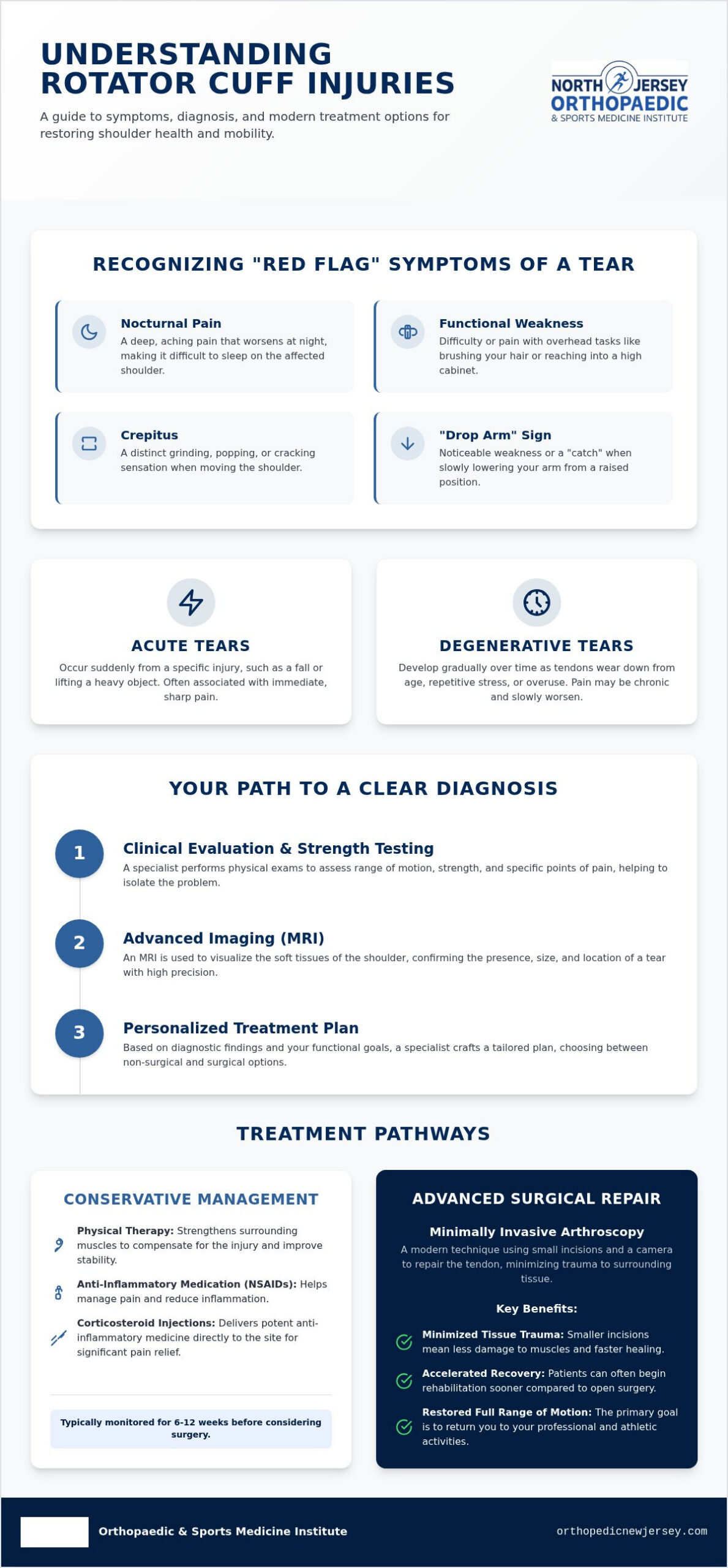
Injuries generally fall into two categories: acute and degenerative. An acute tear might happen suddenly, perhaps during a fall while walking through Riverside County Park or while attempting to lift a heavy object. Degenerative tears are more gradual, occurring as the tendon wears down over time due to age or repetitive stress. While a primary care physician can identify general shoulder discomfort, a rotator cuff specialist Lyndhurst NJ residents can visit in nearby Nutley provides the surgical and diagnostic precision needed to differentiate between simple inflammation and a structural tear that requires intervention.
Common Signs of a Rotator Cuff Tear
Recognizing the “red flags” of a tear is the first step toward recovery. Patients often report specific functional limitations that interfere with daily life. You should monitor for these symptoms:
- Nocturnal Pain: Deep, aching pain that worsens at night, especially if you attempt to sleep on the affected side.
- Functional Weakness: Difficulty or pain when performing overhead tasks, such as brushing your hair or reaching into a high cabinet.
- Crepitus: A distinct grinding, popping, or cracking sensation when moving the shoulder in certain directions.
- The “Drop Arm” Sign: A noticeable weakness or a “catch” when slowly lowering your arm from a raised position.
Why Lyndhurst Residents Should Seek Local Specialized Care
Choosing a rotator cuff specialist Lyndhurst NJ patients can access within minutes ensures that the logistical burden of treatment doesn’t interfere with clinical outcomes. Our Nutley location is situated for easy access, allowing commuters and local athletes to attend follow-up appointments without the stress of a long-distance drive. We understand the physical demands placed on North Jersey residents, whether you are navigating a daily commute into the city or participating in local recreational sports. Furthermore, our proximity allows for tight coordination with physical therapists in the Lyndhurst area, creating a seamless loop of communication that is vital for a successful, non-disruptive recovery process.
Rotator Cuff Treatment Options: Non-Surgical vs. Surgical Paths
Determining the most effective treatment path requires the expertise of a rotator cuff specialist Lyndhurst NJ patients can trust to provide a personalized assessment. The path to recovery depends heavily on the severity of the tendon injury and your specific functional goals. For many patients, the first line of defense doesn’t involve the operating room. Conservative management is the standard first step for partial tears and degenerative conditions. This approach focuses on reducing inflammation and restoring biomechanical balance through non-invasive means. A rotator cuff specialist Lyndhurst NJ residents consult will typically monitor progress over a period of six to twelve weeks before recommending more advanced measures.
Conservative Management Near Lyndhurst
Physical therapy is the cornerstone of non-surgical care. The primary objective isn’t just to heal the tendon but to strengthen the surrounding musculature, particularly the deltoid, to compensate for the compromised cuff. We often combine targeted exercises with activity modification and non-steroidal anti-inflammatory drugs (NSAIDs) to manage discomfort. Corticosteroid injections may also be utilized to deliver potent anti-inflammatory medication directly to the subacromial space. This can provide a “window of opportunity” for you to engage more effectively in physical therapy. If you’re experiencing persistent discomfort, reaching out to The Orthopaedic & Sports Medicine Institute can help determine if these initial steps are sufficient for your injury.
Surgical Intervention: When Repair is Necessary
Surgery becomes a clinical necessity when conservative measures fail to provide relief or when the injury is structurally significant. Full-thickness tears, where the tendon has completely detached from the bone, generally cannot heal on their own. In these cases, a rotator cuff repair is often recommended to prevent permanent muscle atrophy. Common criteria for surgical discussion include:
- Failure of symptoms to improve after several months of physical therapy.
- Large or full-thickness tears confirmed via imaging.
- Acute trauma resulting in immediate loss of strength and function.
- A desire to return to high-impact sports or demanding physical labor.
Younger, more active patients in the Lyndhurst area often opt for arthroscopic rotator cuff repair NJ sooner than sedentary individuals. This proactive approach aims to restore high-level function and prevent the tear from enlarging over time. Modern repair philosophies now emphasize “native ligament healing,” utilizing advanced anchoring systems to encourage the body’s own tissue to integrate with the bone. This bridge between traditional surgical methods and modern innovation ensures that patients receive the most durable repair possible.
The Benefits of Minimally Invasive Rotator Cuff Repair
Advancements in surgical technology have transformed the way a rotator cuff specialist Lyndhurst NJ patients consult approaches shoulder reconstruction. Traditionally, “open” surgery required a large incision, often several inches long, which involved detached or split muscle tissue to reach the damaged tendon. Modern arthroscopic techniques have largely replaced these invasive methods. By using small portals about the size of a buttonhole, a surgeon can repair the shoulder with minimal disruption to the overlying deltoid muscle. This approach significantly reduces the physical trauma associated with the procedure, leading to a more streamlined recovery process for patients in North Jersey.
Arthroscopic vs. Open Surgery
The primary advantage of arthroscopy is the level of precision it offers. A specialized camera, known as an arthroscope, is inserted into the joint to provide high-definition visualization of the internal structures. This allows the surgeon to identify subtle issues that might be missed in traditional surgery. Accurate clinical evaluation and Diagnosing a rotator cuff injury through imaging are the first steps that allow for this targeted surgical mapping. Once inside, the specialist uses micro-instruments to place high-strength anchors and sutures into the bone with extreme accuracy. This refined methodology results in:
- Minimal Blood Loss: Small incisions and localized focus drastically reduce operative bleeding.
- Shorter Anesthesia Times: Efficient arthroscopic techniques often mean patients spend less time under general anesthesia.
- Lower Infection Risk: Smaller wounds are less susceptible to post-operative complications and environmental contaminants.
- Cosmetic Benefits: Minimal scarring is a significant advantage for active patients who prefer a less noticeable surgical mark.
Faster Recovery Timelines
Because the surrounding muscles aren’t cut or detached during a minimally invasive procedure, the early stages of rehabilitation are typically more comfortable. Patients often report less immediate post-operative pain compared to those who undergo open repairs. This reduced discomfort allows for the earlier initiation of passive range-of-motion exercises, which is critical for preventing “frozen shoulder” or excessive scar tissue buildup. Choosing minimally invasive orthopedic surgery NJ means prioritizing a return to function without the prolonged downtime of traditional methods. By preserving the integrity of the healthy tissue surrounding the tear, a rotator cuff specialist Lyndhurst NJ residents trust can facilitate a faster transition from the operating room back to daily activities and sports.
Your Diagnostic Journey: Consulting a Specialist Near Lyndhurst
The path from shoulder pain to recovery follows a structured diagnostic protocol. When you visit a rotator cuff specialist Lyndhurst NJ patients rely on, the first step is a comprehensive clinical evaluation. This involves specific provocative tests designed to isolate each of the four tendons. We assess your passive and active range of motion, looking for gaps in strength that indicate which portion of the cuff is compromised. This physical exam provides the essential context that imaging alone cannot offer.
Diagnostic imaging serves as the second phase of your journey. We begin with digital X-rays to rule out bony abnormalities, such as subacromial bone spurs or advanced arthritis, which can mimic or exacerbate tendon pain. However, soft tissues like tendons aren’t visible on X-rays. This is why we utilize Magnetic Resonance Imaging (MRI) to gain a definitive view of the rotator cuff’s internal structure and assess the health of the surrounding muscle tissue.
Advanced Imaging and Precise Diagnosis
An MRI is considered the ‘gold standard’ because it allows us to visualize the degree of tendon retraction. In a partial tear, the tendon may appear ‘frayed’ or thinned but remains attached to the humerus. In contrast, a full-thickness tear may show the tendon has ‘retracted,’ pulling away from its natural footprint on the bone. The precise measurement of this gap and the quality of the remaining muscle tissue are the primary factors that dictate whether a surgical or non-surgical approach is most appropriate.
Preparing for Your Visit from Lyndhurst
For residents of Lyndhurst, North Arlington, and Kearny, the transition to specialized care is designed to be seamless. Our Nutley office is located just minutes away, providing an accessible hub for high-level orthopaedic consultation. To make your first visit as productive as possible, we recommend gathering any previous imaging discs or radiology reports from local North Jersey facilities. You should also consider your specific functional goals. Whether you’re focused on returning to the golf course, resuming a weightlifting routine, or simply being able to lift your grandchildren without pain, these objectives help us tailor your treatment plan.
Once a diagnosis is confirmed, we move into personalized treatment planning. We consider your age, activity level, and the chronicity of the injury to ensure the intervention matches your lifestyle. If surgery is the chosen path, our team coordinates your pre-operative clearance with local primary care providers to ensure you’re medically optimized for the procedure. To begin your recovery process with a board-certified expert, schedule a consultation at The Orthopaedic & Sports Medicine Institute today.
Expert Shoulder Care at The Orthopaedic & Sports Medicine Institute
At The Orthopaedic & Sports Medicine Institute, we bridge the gap between advanced surgical innovation and compassionate, community-based care. Finding a rotator cuff specialist Lyndhurst NJ residents can trust means looking for a practitioner who balances technical precision with a deep understanding of each patient’s unique lifestyle. We don’t just treat an MRI scan; we treat the individual. Whether your goal is to return to a professional athletic career or simply to sleep through the night without pain, our diagnostic and treatment processes are tailored to those specific functional outcomes.
Board-Certified Expertise in North Jersey
Choosing a board-certified orthopedic surgeon ensures you’re receiving care from a specialist who has met the highest national standards of education, evaluation, and excellence. This certification isn’t a one-time achievement; it requires a lifelong commitment to continuous learning and staying current with the latest trends in shoulder arthroscopy and regenerative medicine. For patients dealing with more complex joint issues, such as bone-on-bone wear alongside tendon damage, our expertise extends to comprehensive shoulder arthritis treatment NJ. This specialized knowledge allows us to offer a broader range of solutions, ensuring that every patient receives the most appropriate intervention for their specific stage of joint health.
A Trusted Resource for Lyndhurst Athletes and Families
Our practice is deeply rooted in the local community, serving as a primary resource for both high school athletes in Lyndhurst and seniors managing age-related degenerative tears. We understand the high-stakes environment of North Jersey sports and the urgency of a rapid, safe return to the field. By utilizing minimally invasive techniques, we minimize the downtime typically associated with traditional surgery, helping athletes maintain their competitive edge. Simultaneously, we provide the same level of sophisticated care to our senior neighbors, focusing on restoring the independence and comfort necessary for daily life.
We’re proud to serve as a rotator cuff specialist Lyndhurst NJ patients can access within minutes at our Nutley facility. Our commitment to transparency, professional standards, and modern methodology ensures that you aren’t just getting a procedure, but a partnership in your recovery journey. Don’t let shoulder dysfunction dictate your activity levels any longer. Take the first step toward a pain-free life and Schedule your shoulder consultation today at The Orthopaedic & Sports Medicine Institute.
Restoring Your Quality of Life and Shoulder Function
Regaining full use of your shoulder doesn’t have to be a journey of uncertainty. By prioritizing an accurate diagnosis through clinical evaluation and advanced imaging, you can determine whether conservative management or surgical repair is the most effective path for your recovery. Modern orthopedic care focuses on preserving as much healthy tissue as possible, utilizing minimally invasive techniques to reduce post-operative discomfort and accelerate your return to daily activities.
When you choose a board-certified rotator cuff specialist Lyndhurst NJ residents can access within minutes, you’re investing in elite training and surgical precision. Our practice remains a dedicated resource for the Lyndhurst and Nutley community, offering specialized care that treats the person rather than just the injury. Whether you’re an athlete aiming for the field or a grandparent wanting to reach for a hug, the right intervention makes all the difference.
Take the next step toward a pain-free future and Schedule Your Specialist Consultation Near Lyndhurst. Your path to restored mobility begins with a diagnostic plan built specifically for your lifestyle and long-term joint health.
Frequently Asked Questions
How do I know if my shoulder pain is a rotator cuff tear or just tendonitis?
Distinguishing between tendonitis and a tear involves assessing the severity of weakness and the presence of night pain. Tendonitis typically involves inflammation of the tendon without a structural break, while a tear is a physical detachment. If you experience a “drop arm” sensation or grinding, it’s time to consult a rotator cuff specialist Lyndhurst NJ residents trust. We use clinical testing and MRI imaging to provide a precise anatomical diagnosis that guides your recovery plan.
Is surgery always required for a torn rotator cuff?
Surgery is not the universal solution for every injury. Many partial tears and degenerative conditions respond well to conservative protocols, including targeted physical therapy, activity modification, and corticosteroid injections. We typically recommend surgery for full-thickness tears, acute traumatic injuries, or cases where six to twelve weeks of non-surgical treatment fails to restore function. Our board-certified surgeon evaluates your activity level and goals to determine if an operative approach is truly necessary for your lifestyle.
What is the typical recovery time after a minimally invasive rotator cuff repair?
Recovery following minimally invasive surgery is a phased process designed to protect the repair while restoring motion. While small incisions reduce immediate tissue trauma, the tendon still requires time to biologically integrate with the bone. Most patients begin passive range-of-motion exercises within the first few weeks. Returning to demanding sports or heavy overhead lifting generally takes four to six months. This methodical timeline ensures the structural integrity of the repair remains intact during your return to activity.
Can I drive myself home after a shoulder consultation in Nutley?
You can certainly drive yourself to and from a standard diagnostic consultation at our Nutley office. These visits involve physical examinations and discussions regarding your imaging results. However, if you are scheduled for a surgical procedure or an intervention involving sedation, you will need a designated driver to take you home. Our office is conveniently located just minutes from Lyndhurst, making it easy for a family member or friend to assist with your local transportation needs.
Does the Orthopaedic & Sports Medicine Institute accept patients from Lyndhurst and Kearny?
Our practice is a dedicated resource for the entire North Jersey area, including Lyndhurst, Kearny, and North Arlington. We focus on providing high-level, specialized orthopedic care to our local neighbors so they don’t have to travel into the city for expert treatment. As a rotator cuff specialist Lyndhurst NJ patients can reach quickly, we coordinate closely with local physical therapists to ensure your rehabilitation is convenient and integrated with your daily routine and community lifestyle.
What happens if a rotator cuff tear is left untreated?
Ignoring a significant tear can lead to permanent changes in the shoulder joint. Over time, a small tear may enlarge, making a future repair more difficult or even impossible. The affected muscle can also undergo “fatty infiltration,” where muscle tissue is replaced by fat due to disuse. Eventually, an untreated full-thickness tear can lead to rotator cuff arthropathy, a complex form of shoulder arthritis that may eventually require more invasive joint replacement surgery to resolve.
Are minimally invasive techniques available for all types of shoulder tears?
Most rotator cuff tears can be successfully addressed using advanced arthroscopic techniques. These minimally invasive methods allow for high-definition visualization and precise repair through small portals. While some rare, massive, or chronic retracted tears might have historically required open surgery, modern instrumentation allows us to manage nearly all varieties of tears arthroscopically. Our specialist will review your MRI to confirm if your specific tear pattern is a candidate for these tissue-preserving, less disruptive surgical options.
Do I need a referral to see a rotator cuff specialist in New Jersey?
The requirement for a referral depends entirely on your specific health insurance plan. Patients with PPO plans generally don’t need a formal referral to schedule an appointment with a specialist. However, those with HMO plans typically require a referral from their primary care physician to ensure coverage. We recommend checking with your insurance provider before your visit. Our Nutley team is available during standard business hours to help clarify any logistical questions regarding your initial orthopedic consultation.