You reach for a bag of groceries or try to adjust your pillow at night, but a sharp, persistent ache in your shoulder stops you mid-motion. For many local residents, this isn’t just a minor inconvenience; it’s a source of growing anxiety that interferes with sleep and daily independence. You likely suspect something is wrong, yet the fear of invasive surgery or a complex diagnosis keeps you from seeking the professional answers you deserve. It’s frustrating to feel your strength slip away while wondering if your shoulder will ever feel normal again.
Identifying the specific rotator cuff tear symptoms Belleville NJ patients encounter is the essential first step toward a successful recovery. This guide provides a clear roadmap to help you identify clinical warning signs and navigate the diagnostic process with confidence. We’ll examine the difference between simple strain and a true tendon tear, while highlighting how advanced, minimally invasive interventions allow for precise repair. By the end of this article, you’ll have a professional perspective on your symptoms and a clear path toward choosing a board-certified specialist who prioritizes your long-term mobility and comfort.
Key Takeaways
- Distinguish between acute injuries and degenerative wear to understand the specific origin and severity of your shoulder pathology.
- Identify the clinical rotator cuff tear symptoms Belleville NJ residents frequently encounter, such as deep nocturnal aching and significant weakness when lifting.
- Learn to differentiate structural tendon damage from inflammatory conditions like shoulder bursitis based on pain localization and functional limitations.
- Utilize the “Rule of Threes” to determine the precise moment persistent discomfort necessitates a diagnostic evaluation by a board-certified specialist.
- Discover how minimally invasive arthroscopic techniques offer a modern, precise alternative to traditional open surgery for restoring joint stability.
Recognizing Rotator Cuff Tear Symptoms in Belleville, NJ
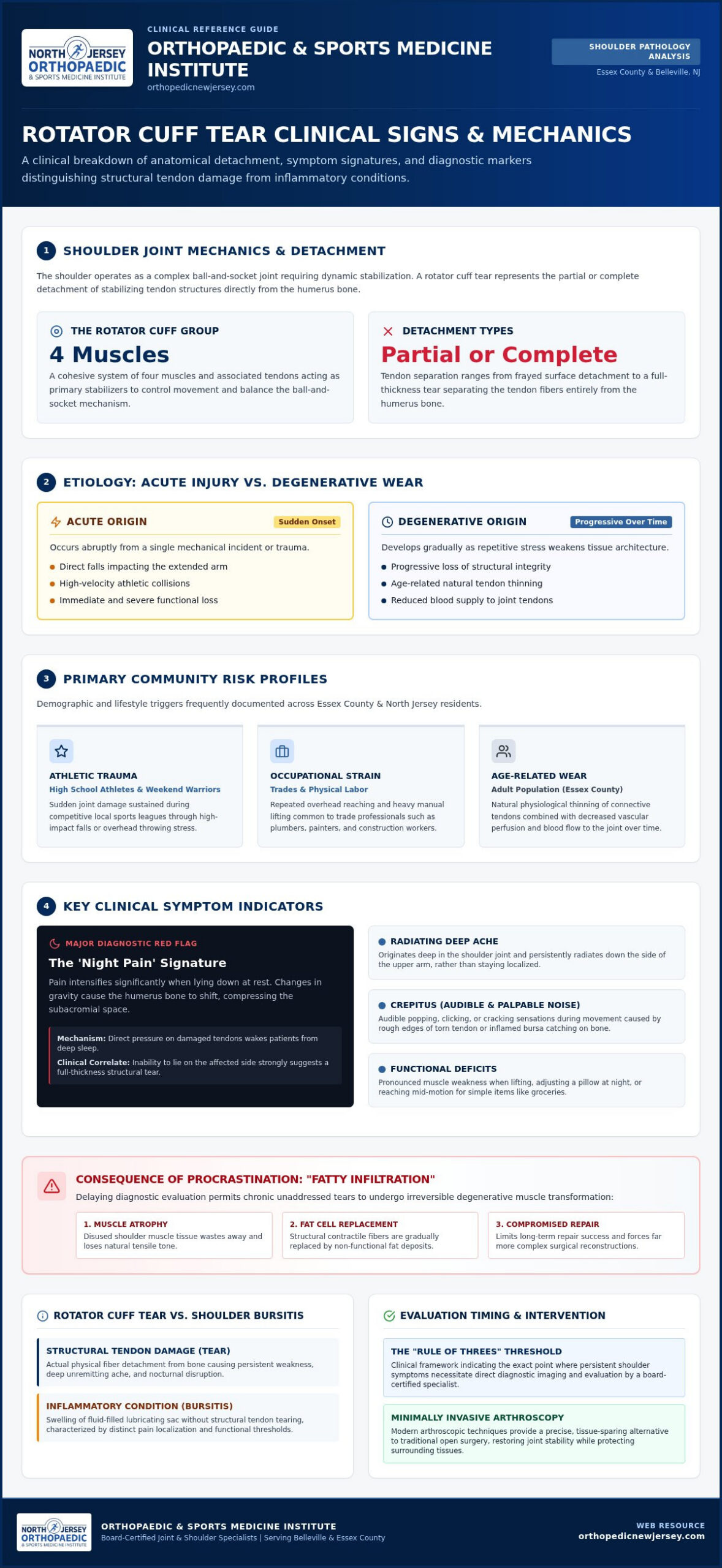
The shoulder joint is a sophisticated ball-and-socket mechanism that relies on the rotator cuff, a cohesive group of four muscles and their associated tendons, to provide essential stability and facilitate fluid motion. A rotator cuff tear is defined as the partial or complete detachment of these tendons from the humerus bone. For those monitoring rotator cuff tear symptoms Belleville NJ clinicians typically distinguish between acute and degenerative origins. Acute tears occur suddenly, often following a specific traumatic event like a fall; conversely, degenerative tears develop over time as the tendon tissue gradually loses its structural integrity through repetitive use. Identifying these issues early is vital for maintaining the long-term health of the joint.
Why Early Detection Matters for North Jersey Residents
Procrastinating on a professional diagnosis can lead to irreversible changes within the shoulder’s anatomy. One of the most significant concerns is “fatty infiltration,” where the muscle tissue begins to atrophy and is replaced by fat cells after a chronic tear remains unaddressed. This transformation can significantly complicate future surgical outcomes and limit the success of a repair. For residents in the Belleville area, where daily life often involves long commutes and active family schedules, maintaining full shoulder function is a necessity. Recognizing rotator cuff tear symptoms Belleville NJ early typically allows for more conservative or minimally invasive treatment options, preventing the need for more complex reconstructions later on.
Common Causes of Shoulder Injuries in Our Community
Various lifestyle factors contribute to the prevalence of shoulder pathology in our local population. We frequently see a range of causes that impact residents across different stages of life, including:
- Athletic Trauma: Sudden injuries among local high school athletes or weekend warriors participating in competitive sports leagues.
- Occupational Strain: Repetitive overhead reaching and heavy lifting common among trade professionals, such as plumbers, painters, and construction workers.
- Age-Related Wear: The natural thinning of tendons that occurs in the active adult population of Essex County, often exacerbated by reduced blood flow to the joint as we age.
Understanding these triggers helps patients recognize when their discomfort is more than just a temporary muscle strain. Whether the injury is a result of a sudden accident or years of dedicated labor, a rotator cuff tear requires a precise diagnostic approach to ensure the best possible recovery path. When you understand the mechanics of the injury, you can move forward with a clear sense of purpose toward professional care.
The Clinical Signs of a Torn Rotator Cuff
Identifying a true tendon injury requires looking beyond general soreness. While a minor strain might resolve with a few days of ice and rest, the clinical indicators of a tear are persistent and often progressive. Patients frequently describe a dull, deep ache that originates in the shoulder but can radiate down the side of the upper arm. This discomfort is often accompanied by crepitus, which is a medical term for the audible popping, clicking, or cracking sensations experienced during specific movements. These sounds occur when the roughened surface of a torn tendon or inflamed bursa catches on the surrounding bone. Recognizing these rotator cuff tear symptoms Belleville NJ residents experience is the first step toward reclaiming joint stability.
The ‘Night Pain’ Signature
A defining characteristic of this pathology is pain that intensifies during periods of rest. When you lie down, the effects of gravity change, often causing the humerus to shift and compress the subacromial space. This compression puts direct pressure on the injured tendons, leading to sharp pain that can wake you from a deep sleep. For many, lying on the affected side becomes impossible. Clinical data suggests that persistent nocturnal pain is a significant red flag for a full-thickness tear, as the lack of tendon integrity prevents the joint from maintaining its proper alignment even in a neutral position. Understanding the relationship between position and discomfort is a key part of rotator cuff tear symptoms and treatment protocols.
Functional Limitations in Daily Activities
Beyond the pain, a tear manifests as a distinct loss of power. You might find it increasingly difficult to perform routine tasks that you once did without thought. Common limitations include:
- Difficulty reaching behind your back to tuck in a shirt or reach for a seatbelt.
- Noticeable weakness when lifting objects out to the side or overhead, such as reaching for a high shelf or lifting groceries.
- A “hitch” in motion where the arm feels stuck or unstable at a certain angle.
One specific clinical indicator used by specialists is the “Drop Arm Test.” During this assessment, the arm is passively raised, and the patient is asked to lower it slowly. If the arm drops suddenly or the movement causes severe pain, it suggests a significant breach in tendon integrity. If you’ve noticed these functional deficits, consulting a board-certified orthopedic surgeon can provide the diagnostic clarity needed to prevent further joint degradation. Addressing these limitations early ensures that your recovery remains as straightforward as possible.
Rotator Cuff Tear vs. Shoulder Bursitis: How to Tell the Difference
Distinguishing between inflammatory conditions and structural mechanical failure is a critical step in a professional diagnostic process. While both conditions cause significant discomfort, their underlying pathologies are fundamentally different. Shoulder bursitis involves the inflammation of the bursa, a small fluid-filled sac that reduces friction between tissues. In contrast, a tear represents a physical disruption or detachment of the tendon itself. Identifying rotator cuff tear symptoms Belleville NJ residents often find confusing requires a clinical evaluation to determine if the issue is a temporary irritation or a permanent structural deficit.
Pain localization and functional capacity serve as primary differentiators. Bursitis pain is typically diffuse, radiating across the shoulder and sometimes down the arm. Patients with bursitis often find that it hurts to move the joint in any direction. However, a tear often presents with specific “weak spots” where the arm simply lacks the power to perform a movement, regardless of the pain level. While bursitis may resolve with anti-inflammatory protocols, a tear requires a different management strategy. Specialized imaging, specifically a high-resolution MRI, remains the definitive tool for visualizing these soft tissue structures and confirming the extent of the damage.
Is it Just a Shoulder Strain?
A standard shoulder strain involves the overstretching of muscles or tendons and typically follows a predictable recovery timeline. Most minor strains begin to show significant improvement within one to two weeks when managed with rest and ice. If your discomfort persists beyond this window, or if you experience sharp, localized pain, these are indicators that conservative home care is insufficient. We recommend that local patients seek a professional orthopedic examination if they experience sharp pain that doesn’t subside after 48 hours. Early intervention prevents a minor irritation from evolving into a chronic functional limitation.
Understanding Shoulder Impingement Syndrome
Shoulder impingement occurs when the tendons of the rotator cuff are intermittently compressed during arm elevation. This condition often presents as a “painful arc,” where discomfort is most intense when the arm is positioned between 60 and 120 degrees. If left untreated, the constant friction of impingement can gradually fray the tendon, eventually leading to a full-thickness tear. Differentiating between simple impingement and a developing tear is complex. A board-certified specialist utilizes specific provocative testing and clinical expertise to determine the exact state of your shoulder health. This precision ensures you receive a treatment plan that addresses the root cause rather than just the superficial symptoms.
When to Consult a Shoulder Specialist in North Jersey
Determining the precise moment to transition from home care to professional evaluation is vital for long-term joint preservation. We often recommend utilizing the “Rule of Threes” as a clinical benchmark. If your discomfort persists for three weeks despite conservative measures, such as rest and over-the-counter anti-inflammatories, a professional assessment is necessary. Ignoring rotator cuff tear symptoms Belleville NJ patients frequently experience can lead to progressive tendon retraction, making future repairs more complex. While some minor strains resolve independently, a structural tear requires a targeted medical strategy.
Certain “red flag” symptoms necessitate an immediate consultation. If you experience a sudden loss of arm function, severe trauma from a fall, or acute weakness that prevents you from lifting your arm at all, you shouldn’t wait. Choosing to see a board-certified orthopedic surgeon first often saves significant time and resources. Rather than cycling through various ineffective treatments, a specialist provides a definitive diagnosis and a streamlined path to recovery. Residents can access a shoulder pain specialist in Nutley, NJ, ensuring top-tier surgical expertise is available just minutes from Belleville without the burden of a Manhattan commute.
What to Expect During Your Orthopedic Consultation
Your initial visit focuses on clinical precision and diagnostic clarity. The surgeon will perform specific physical examination techniques to test muscle strength and identify impingement signs. This process includes a thorough review of your medical history and a discussion of your typical activity levels. While an X-ray is often the first step to rule out bone-related issues, a high-resolution MRI is the gold standard for visualizing soft tissue damage. This comprehensive approach ensures that every aspect of your shoulder pathology is understood before a treatment plan is developed.
Preparing for Your Visit Near Belleville
To maximize the efficiency of your consultation, we suggest tracking your symptoms for several days prior to the appointment. Note which movements trigger sharp pain and whether your discomfort interferes with your sleep. This data helps your surgeon differentiate between various types of shoulder pathology. You should also prepare specific questions regarding minimally invasive orthopedic surgery in NJ to understand how modern techniques can shorten your recovery timeline. Knowing when to see an orthopedic surgeon for shoulder pain empowers you to take control of your health before minor issues become chronic disabilities. If you’re ready to find a permanent solution for your discomfort, contact our Nutley office today to schedule your comprehensive diagnostic evaluation.
Modern Treatment Options at the Orthopaedic & Sports Medicine Institute
Once a clinical diagnosis is established, the focus shifts to a structured recovery plan tailored to your specific pathology. For many patients, the journey begins with conservative management designed to restore function without immediate surgery. These non-surgical pathways often include specialized physical therapy protocols and ultrasound-guided injections to manage inflammation. However, when the rotator cuff tear symptoms Belleville NJ residents experience involve significant mechanical weakness or a full-thickness detachment, surgical intervention is typically the most effective route to permanent joint stability. Dr. Michael C. Russonella, D.O., utilizes his board-certified expertise to determine which pathway offers the highest probability of a successful long-term outcome.
Choosing a local specialist for these advanced treatments provides a distinct advantage. Accessing expert care at our Nutley office ensures that your post-operative follow-ups and diagnostic reviews are conducted just minutes from home. This proximity reduces the stress of travel during the early stages of recovery, allowing you to focus entirely on your rehabilitation. By staying within the community, you benefit from a continuum of care that bridges the gap between sophisticated surgical techniques and personalized, local recovery support.
Minimally Invasive Arthroscopic Repair
The modern gold standard for treating tendon detachments is arthroscopic rotator cuff repair. Unlike traditional open surgery, this technique utilizes a “tiny incision” approach that significantly reduces trauma to the surrounding healthy tissue. During the procedure, a high-definition camera provides the surgeon with unparalleled video-assisted precision, allowing for the meticulous reattachment of tendon fibers to the bone. This advanced methodology is particularly preferred for athletes and active professionals in Essex County, as it typically results in less post-operative discomfort and a more rapid return to daily activities. Minimizing disruption to the deltoid muscle is essential for preserving the natural strength of the shoulder during the healing process.
Your Path to Recovery in Belleville
Surgery is only one component of a successful outcome; the subsequent rehabilitation phase is equally vital. A structured physical therapy protocol is essential for gradually restoring the joint’s range of motion and muscular endurance. While every patient’s timeline is unique, many individuals can expect to return to light desk work within a few weeks, while more strenuous activities or sports may require several months of dedicated strengthening. Our team coordinates closely with local rehabilitation specialists to ensure your progress remains on track. If you’re ready to address your discomfort and reclaim your mobility, Schedule your consultation with Dr. Russonella today to find relief from shoulder pain and begin your professional diagnostic journey.
Take the First Step Toward Shoulder Recovery
Persistent shoulder pain shouldn’t be a permanent fixture in your daily life. By recognizing the specific rotator cuff tear symptoms Belleville NJ patients encounter, you’ve already taken a vital step toward making an informed decision about your long-term health. We’ve discussed how identifying clinical indicators like nocturnal discomfort and functional weakness can lead to earlier, more effective interventions that preserve joint integrity and prevent muscle atrophy.
Michael C. Russonella, D.O., brings the specialized expertise of a board-certified orthopedic surgeon to our convenient Nutley location, serving the entire Belleville community. Our practice focuses on modern, minimally invasive techniques designed to provide precise repairs while reducing the physical toll of traditional surgery. You don’t have to navigate the uncertainty of shoulder pathology without professional guidance and a clear diagnostic roadmap.
Schedule a Consultation with our Board-Certified Shoulder Specialist today to receive a definitive diagnosis and a structured plan for your recovery. Reclaiming your strength and the ability to sleep without pain is possible with the right clinical partner. We look forward to helping you return to the activities you love with confidence and renewed mobility.
Frequently Asked Questions
Can a rotator cuff tear heal on its own without surgery?
While the symptoms of a partial tear might improve with rest and physical therapy, a full-thickness rotator cuff tear cannot heal on its own. Because these tendons have a limited blood supply and are under constant tension from the muscle, they don’t spontaneously reattach to the bone. Professional management is essential to prevent the tear from enlarging or leading to muscle atrophy, which could complicate future repairs.
How do I know if my shoulder pain is serious enough for a specialist?
You should seek a specialist if your pain persists for more than three weeks despite conservative care. Other indicators include the inability to lift your arm, sharp pain that wakes you from sleep, or a sudden loss of strength after a fall. Identifying rotator cuff tear symptoms Belleville NJ patients often ignore early allows our board-certified surgeon to offer less invasive treatment pathways before the condition worsens.
What does a rotator cuff tear feel like compared to a frozen shoulder?
A rotator cuff tear primarily causes pain and significant weakness during specific movements, such as reaching overhead or behind your back. In contrast, a frozen shoulder, or adhesive capsulitis, involves a global loss of motion where the joint feels physically stuck in all directions. While a tear might let you move your arm with help, a frozen shoulder remains rigid even when someone else tries to lift it for you.
Is an MRI always necessary to diagnose a rotator cuff tear in Belleville?
While a physical examination and X-rays are the initial steps to rule out arthritis or bone spurs, an MRI is usually necessary for a definitive diagnosis. This high-resolution imaging allows the surgeon to see the soft tissue structures clearly and determine if a tear is partial or full-thickness. For residents monitoring rotator cuff tear symptoms Belleville NJ, an MRI provides the anatomical detail required to create a precise, effective surgical or non-surgical plan.
How long is the recovery time for minimally invasive shoulder surgery?
Recovery times vary based on the severity of the injury, but most patients return to light daily activities within a few weeks. Minimally invasive arthroscopic repair typically involves a structured rehabilitation program that lasts several months. You can often expect to return to desk work quickly, while returning to competitive sports or heavy labor usually takes between four and six months. This timeline ensures the reattached tendon has sufficient time to bond securely to the bone.
What activities should I avoid if I suspect a rotator cuff injury?
If you suspect a tendon injury, you should immediately stop any activities that involve repetitive overhead reaching or heavy lifting. Avoid pushing or pulling heavy objects and try not to sleep directly on the affected shoulder. Continuing to use a damaged rotator cuff can cause a small tear to expand into a full-thickness detachment. Restricting these motions prevents further mechanical stress on the joint until a specialist can perform a diagnostic evaluation.
Does Dr. Russonella treat sports injuries for local Belleville athletes?
Yes, Dr. Russonella is a board-certified orthopedic surgeon who specifically focuses on sports medicine and tendon injuries for athletes in the Belleville area. Our practice has extensive experience treating high school, amateur, and professional athletes who require advanced, minimally invasive techniques. We prioritize restoring full functional stability so you can return to your sport safely. Our Nutley office is conveniently located for local players seeking specialized orthopedic care.
Are there non-surgical treatments available for partial rotator cuff tears?
Partial tears often respond well to non-surgical interventions if they are identified before they progress. These treatments include a combination of specialized physical therapy to strengthen the surrounding musculature and targeted injections to reduce inflammation. We monitor these cases closely to ensure the tear doesn’t enlarge over time. If conservative methods don’t restore your quality of life, we then discuss minimally invasive surgical options to physically repair the structural damage.