What if the sharp, grinding sensation preventing you from reaching the top shelf or sleeping through the night isn’t an inevitable sign that you need a total joint replacement? For many patients seeking shoulder arthritis treatment Clifton NJ, the persistent night pain and loss of overhead mobility create a sense of dread that major surgery is the only path forward. It’s exhausting to live with a shoulder that feels locked or unstable, especially when you value an active lifestyle in our North Jersey community.
You don’t have to accept chronic discomfort as your new normal. This article provides a comprehensive look at the modern, tiered recovery options available under the guidance of a board-certified specialist. We’ll explore how early intervention and joint preservation techniques can help you avoid total replacement. From specialized physical therapy to advanced, minimally invasive procedures, you’ll discover how cutting-edge methodology can restore your range of motion. We’ll guide you through the diagnostic process and the innovative treatments that bridge the gap between traditional medicine and the future of specialized orthopaedic care.
Key Takeaways
- Learn why a diagnostic evaluation by a board-certified orthopaedic surgeon is essential for distinguishing chronic glenohumeral arthritis from common soft-tissue injuries.
- Explore a tiered approach to shoulder arthritis treatment Clifton NJ that prioritizes conservative management and activity modification to reduce inflammation.
- Discover how early clinical intervention and joint preservation strategies can help you maintain mobility while potentially avoiding the need for a total shoulder replacement.
- Understand the advantages of modern, minimally invasive surgical techniques that target joint pain with less disruption to surrounding healthy tissue.
- Gain insights into specialized post-operative recovery milestones and protocols designed to restore pain-free range of motion and long-term joint health.
Understanding Shoulder Arthritis: Why Your Joint Pain Persists
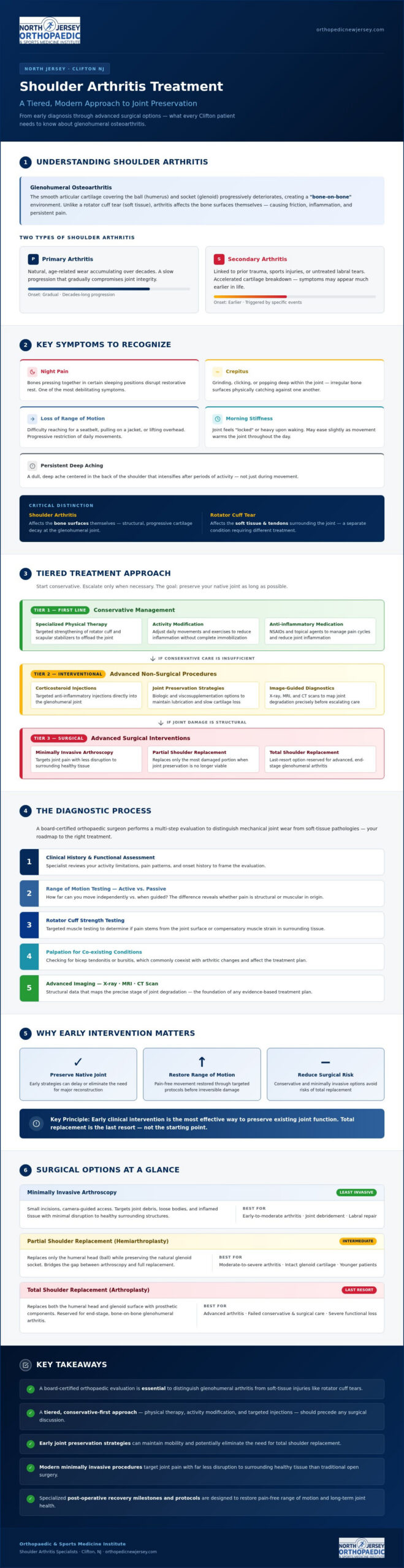
Shoulder arthritis, specifically glenohumeral osteoarthritis, occurs when the smooth articular cartilage covering the surfaces of the shoulder joint begins to deteriorate. While many people associate joint pain with sudden injuries, arthritis is a progressive structural decay. A foundational step in Understanding Shoulder Arthritis is recognizing that the shoulder is a complex ball-and-socket joint where the humerus meets the glenoid. When this protective cartilage thins, the joint loses its natural lubrication, leading to a “bone-on-bone” environment.
It’s vital to distinguish this condition from a rotator cuff tear. While a rotator cuff injury involves the soft tissue and tendons surrounding the joint, arthritis affects the bone surfaces themselves. For residents seeking shoulder arthritis treatment Clifton NJ, the pain often manifests during local activities like hiking the steeper trails of Garret Mountain or during a tennis serve. This friction triggers a cycle of inflammation that is particularly aggressive at night. This “night pain” occurs because the lack of joint cushioning allows the bones to press together in certain sleeping positions, disrupting restorative rest.
Primary vs. Secondary Shoulder Arthritis
Primary shoulder arthritis is typically the result of natural, age-related wear that accumulates over decades. It’s a slow progression that eventually compromises the joint’s integrity. Secondary arthritis, however, is often linked to a specific event or underlying condition. Old sports injuries or high-impact trauma can accelerate the breakdown of cartilage, leading to symptoms much earlier in life than expected. Post-traumatic arthritis is a common result of untreated labral tears. Whether the cause is biological or traumatic, a board-certified specialist can identify the specific stage of joint degradation through advanced imaging.
Common Symptoms for Clifton Patients
The symptoms of shoulder arthritis are distinct and often predictable. Many patients report crepitus, which is a grinding, clicking, or popping sensation felt deep within the joint during movement. This isn’t just a sound; it’s the physical sensation of irregular bone surfaces catching against one another. Other hallmark symptoms include:
- Loss of Range of Motion: You might find it increasingly difficult to reach for a seatbelt, pull on a jacket, or reach overhead.
- Morning Stiffness: The joint often feels “locked” or heavy upon waking, though it may improve slightly as you move and the joint warms up.
- Deep Aching: A persistent, dull ache that feels centered in the back of the shoulder and intensifies after periods of activity.
If these symptoms are preventing you from enjoying the 39 parks in Clifton or performing daily tasks, it’s time to evaluate your clinical options. Early intervention is the most effective way to preserve your existing joint function.
The Diagnostic Process: When to Seek a Shoulder Specialist in Clifton
While many patients visit general practitioners or local urgent care centers for initial joint pain, a specialized evaluation is critical for effective shoulder arthritis treatment Clifton NJ. A board-certified orthopaedic surgeon possesses the specific training to differentiate between mechanical joint wear and soft tissue pathologies. An accurate diagnosis is your roadmap. It ensures that patients don’t pursue ineffective treatments or rush into surgery that isn’t medically indicated. By identifying the root cause of discomfort early, we can often implement joint preservation strategies that delay or even eliminate the need for major reconstruction.
During your clinical evaluation, the specialist focuses on your functional limitations. They’ll measure your active and passive range of motion, testing how far you can lift your arm independently versus how far it moves when guided. Strength testing follows, specifically targeting the rotator cuff muscles. This hands-on assessment helps determine if your pain stems from the joint surface itself or from compensatory muscle strain. The surgeon also checks for specific areas of tenderness that might indicate bicep tendonitis or bursitis, which often coexist with arthritic changes.
Advanced Imaging: X-rays, MRI, and CT Scans
Specialized imaging at our local Clifton/Nutley area facilities provides the structural data needed for a definitive plan for shoulder arthritis treatment Clifton NJ. Weight-bearing X-rays are the gold standard for initial screening because they reveal joint space narrowing and bone spurs, also known as osteophytes. If the specialist suspects soft tissue involvement or needs to verify the integrity of the tendons, an MRI evaluates the health of the surrounding rotator cuff. For more complex cases, CT scans allow surgeons to map bone loss with precision. This data is vital if a replacement is eventually required, as it ensures the implant is sized and positioned with anatomical accuracy.
Determining the Severity of Joint Degeneration
Surgeons categorize arthritis into mild, moderate, and severe stages. In the mild stage, conservative Non-Surgical Shoulder Arthritis Treatment Options like physical therapy or activity modification are often highly effective. However, certain “red flags” suggest that more advanced intervention may be necessary. These include persistent pain at rest, a total inability to perform basic hygiene, or a failure to improve after six months of non-operative care. Identifying these indicators early can prevent permanent bone loss and muscle atrophy.
Establishing a baseline through an orthopedic consultation in Nutley allows for a personalized trajectory of care. This proactive approach prioritizes joint preservation whenever possible. If you are experiencing grinding sensations or significant loss of movement, scheduling a specialized review is the most logical next step toward recovery.
Non-Surgical Shoulder Arthritis Treatment Options
Before moving toward Advanced Surgical Interventions, we employ a tiered approach to clinical management. This strategy focuses on dampening systemic inflammation and preserving the joint’s mechanical function through the least invasive means available. For many patients pursuing shoulder arthritis treatment Clifton NJ, the primary objective is returning to local activities like walking the trails at Main Memorial Park or maintaining professional performance. It’s vital to manage expectations: conservative care successfully treats the symptoms of arthritis, such as pain and stiffness, but it cannot regenerate lost cartilage. Instead, these treatments provide a stable environment for the joint to function without constant irritation.
Effective management requires a synergy between medical intervention and specialized physical therapy. A structured PT program focuses on strengthening the rotator cuff and scapular stabilizers to offload the pressure on the glenohumeral joint. By improving the mechanics of how the shoulder moves, we can often reduce the “bone-on-bone” friction that causes daily discomfort. This combined approach allows many residents to delay surgical intervention for years while maintaining a high quality of life.
Medication and Lifestyle Modifications
Initial medical management typically involves the strategic use of nonsteroidal anti-inflammatory drugs (NSAIDs) or topical anti-inflammatories to manage baseline discomfort. While many patients ask about supplements like Glucosamine and Chondroitin, clinical evidence remains mixed; they are best viewed as supportive measures rather than cures. Lifestyle and ergonomic adjustments are equally critical for our local workforce. For Clifton warehouse employees or healthcare professionals, simple modifications in reaching patterns or lifting techniques can significantly reduce repetitive joint stress. Small changes in how you handle overhead tasks can prevent the acute “flares” that often lead to missed work days.
Injection Therapies: Corticosteroids and Beyond
When oral medications and activity modifications aren’t enough, injection therapies provide a more direct method of managing joint pain. Corticosteroid injections act as a powerful anti-inflammatory, offering rapid relief for acute flare-ups and helping patients participate more effectively in physical therapy. We also monitor the potential for viscosupplementation, which involves injecting a lubricating fluid into the joint to improve glide. However, it’s important to recognize the transition point. If the duration of relief from these injections begins to shorten, it often indicates that the arthritis has progressed. When injections lose their efficacy, it’s a clinical signal to re-evaluate the joint for more advanced procedural options.
Advanced Surgical Interventions: From Arthroscopy to Replacement
When conservative measures like physical therapy and injections no longer provide adequate relief, transitioning to surgical specialized care becomes the most effective path toward restoring function. For many North Jersey patients, the goal of shoulder arthritis treatment Clifton NJ is to eliminate the grinding “bone-on-bone” pain that prevents sleep and daily activity. Modern surgical interventions prioritize joint preservation and use techniques designed to minimize disruption to the surrounding healthy tissue.
A primary focus of our practice is minimally invasive orthopedic surgery. These advanced methodologies allow for smaller incisions, reduced blood loss, and a significantly faster trajectory for recovery compared to traditional open procedures. By utilizing specialized instruments and high-definition cameras, a board-certified surgeon can address joint pathology with extreme precision, tailoring the intervention to the specific stage of your arthritis.
Arthroscopic Debridement and Joint Preservation
In the earlier stages of joint degeneration, arthroscopic debridement offers a way to “clean out” the joint without the need for a full replacement. During this procedure, the surgeon uses small incisions to remove inflammatory tissue and “loose bodies,” which are fragments of bone or cartilage that have broken free. Candidates for this approach often exhibit mechanical symptoms, such as catching or locking, but still retain a relatively healthy amount of joint space. Arthroscopy can effectively delay the need for a total joint replacement in younger, more active patients by smoothing out irregular joint surfaces and reducing local friction.
Total Shoulder Arthroplasty (TSA) and Reverse TSA
For advanced arthritis where cartilage loss is extensive, joint replacement offers the most predictable long-term relief. Traditional Total Shoulder Arthroplasty (TSA) involves replacing the arthritic ball and socket with highly durable prosthetic components. This procedure is the gold standard for patients who have an intact rotator cuff to power the new joint. However, for those suffering from “cuff tear arthropathy,” where arthritis is combined with complex, non-repairable rotator cuff tears, a Reverse Total Shoulder Arthroplasty is often the superior choice. This innovative procedure modifies the mechanics of the shoulder, allowing the deltoid muscle to take over the work of the damaged rotator cuff.
Understanding the shoulder arthritis treatment NJ patient journey is essential for setting realistic expectations. Whether you require a joint-preserving cleanup or a modern reconstruction, the emphasis remains on a personalized clinical approach. If your joint pain has become unmanageable through non-surgical means, schedule a consultation with our board-certified team to explore the most appropriate surgical path for your lifestyle.
Recovery and Long-Term Outcomes in North Jersey
The success of your recovery depends on a structured, phased approach that respects the biological healing timeline of the joint. The first 90 days following shoulder arthritis treatment Clifton NJ are the most critical for establishing a foundation of mobility. During the initial 30 days, the focus is on protecting the joint while initiating passive range of motion exercises to prevent stiffness. By the 60-day mark, patients typically transition to active-assisted movements, where they begin to use their own muscle power to guide the arm. Between 60 and 90 days, the clinical focus shifts toward functional strengthening, allowing residents of Clifton, Nutley, and Bloomfield to return to light daily activities and low-impact recreation.
Rehabilitation is not a one-size-fits-all process. It requires adherence to specialized rotator cuff surgery recovery protocols, even in cases where the primary issue was joint wear. Because the muscles surrounding the shoulder must be recalibrated to support the joint’s new mechanics, these protocols ensure that strength is rebuilt without overloading the repair. Modern shoulder replacements currently demonstrate an 85% to 95% success rate in providing significant pain relief, but these outcomes are heavily influenced by the quality of the post-operative rehabilitation phase.
The Multidisciplinary Recovery Team
A successful outcome is the result of close collaboration between the board-certified orthopaedic surgeon and local Clifton physical therapists. This multidisciplinary approach ensures that your progress is monitored with clinical precision. We utilize advanced pain management strategies during the initial healing phase to facilitate early movement, which is essential for preventing scar tissue formation. However, the most vital member of this team is the patient. Compliance with a prescribed home exercise program is the primary factor in determining how quickly you regain your independence and return to the active lifestyle you enjoy.
Why Choose The Orthopaedic & Sports Medicine Institute?
Choosing our institute means accessing high-level, board-certified expertise right in the Nutley and Clifton community. We provide a bridge between traditional surgical wisdom and the future of specialized care, prioritizing minimally invasive techniques that reduce downtime. Our practice is built on a foundation of patient-centered empathy; we recognize the physical and emotional toll of chronic joint pain. We offer the sophisticated diagnostic and surgical capabilities of a major metropolitan hospital with the personalized attention of a local consultant.
By keeping your care local, you eliminate the stress of long commutes to major cities, allowing you to focus entirely on your recovery. Long-term maintenance involves protecting your joint through proper body mechanics and regular follow-up evaluations to ensure the longevity of your treatment. Most modern shoulder implants are now expected to last between 15 and 20 years, providing decades of pain-free movement for our North Jersey patients.
Reclaiming Your Mobility and Quality of Life
Persistent joint pain doesn’t have to be your permanent reality. As we’ve explored, the path to recovery involves a precise diagnosis followed by a tiered clinical strategy. Whether your condition requires specialized physical therapy or advanced, minimally invasive surgical intervention, the ultimate goal is to preserve joint function and eliminate the discomfort that disrupts your daily life and sleep.
As a board-certified orthopedic surgeon and expert in minimally invasive shoulder repair, I’ve dedicated years to serving the Clifton and Nutley communities. Our practice provides the sophisticated diagnostic tools and surgical expertise necessary for effective shoulder arthritis treatment Clifton NJ, allowing you to access high-level care close to home. We prioritize treatments that minimize recovery time and maximize long-term joint health.
Schedule a Consultation with our Board-Certified Shoulder Specialist today to begin your personalized recovery journey. You’ve navigated the limitations of chronic pain long enough; it’s time to move toward a future of pain-free motion and renewed strength.
Frequently Asked Questions
How do I know if my shoulder pain is arthritis or a rotator cuff tear?
Arthritis typically presents as a deep, dull ache accompanied by a grinding sensation, known as crepitus, during joint rotation. In contrast, a rotator cuff tear often results in sudden weakness or sharp pain when attempting to lift your arm overhead. While both conditions can cause night pain, a board-certified specialist uses physical exams and imaging to distinguish structural joint wear from soft tissue damage. Accurate diagnosis ensures you receive the most effective shoulder arthritis treatment Clifton NJ.
Is there a way to treat shoulder arthritis without surgery in Clifton?
Conservative management is the first line of defense. Many patients successfully manage symptoms through a combination of specialized physical therapy, activity modification, and anti-inflammatory medications. Utilizing low-impact recreation at local sites like Main Memorial Park can help maintain mobility without overstressing the joint. Corticosteroid or viscosupplementation injections also provide significant temporary relief from inflammation. These non-operative methods focus on symptom control and joint preservation to delay or prevent the need for surgical intervention.
What is the recovery time for a minimally invasive shoulder procedure?
Recovery timelines vary based on the specific procedure performed. For a minimally invasive arthroscopic debridement, patients often return to light activities within a few weeks. However, a total or reverse shoulder replacement involves a more structured 90-day recovery protocol. The first month focuses on protection and passive motion, while the subsequent months involve active strengthening. Most patients achieve significant functional restoration and return to their normal daily routines in North Jersey within three to four months.
Can I still play sports or hike Garret Mountain after a shoulder replacement?
Most patients successfully return to low-impact activities like hiking the trails at Garret Mountain or playing doubles tennis after a full recovery. The primary goal of modern shoulder replacement is to restore a pain-free range of motion that supports an active lifestyle. While high-impact contact sports or heavy weightlifting may be restricted to protect the longevity of the implant, typical recreational activities in Nutley and Clifton are generally encouraged once the bone has fully integrated with the prosthetic.
Do I need a referral to see an orthopedic surgeon in New Jersey?
Whether you need a referral depends entirely on your specific health insurance plan, such as an HMO versus a PPO. While New Jersey law allows “Direct Access” to physical therapy for up to 30 days without a physician’s note, many specialists recommend an initial consultation to establish a clinical baseline. It’s best to verify your coverage requirements with your provider before scheduling. Our office provides specialized orthopaedic consultations to residents in Clifton, Nutley, and the surrounding North Jersey areas.
What happens if I ignore my shoulder arthritis symptoms?
Ignoring symptoms often leads to progressive cartilage deterioration and permanent structural changes within the joint. Over time, the “bone-on-bone” friction causes significant bone loss and the formation of large osteophytes, or bone spurs. This can result in muscle atrophy in the rotator cuff and a permanent loss of range of motion. Early clinical intervention is essential because it allows for joint-preserving treatments that are no longer viable once the arthritis reaches an advanced stage.
Are there specific exercises for shoulder arthritis that actually work?
Specific exercises designed to stabilize the scapula and strengthen the rotator cuff are highly effective. These movements help offload the pressure on the glenohumeral joint by improving the mechanics of the shoulder blade. Focus on low-resistance, high-repetition exercises like external rotations and wall slides. It’s important to perform these under the guidance of a specialist to ensure you don’t inadvertently aggravate the inflammation. Consistent strengthening is a cornerstone of successful shoulder arthritis treatment Clifton NJ.
What makes a board-certified orthopedic surgeon different from a general doctor?
A board-certified orthopedic surgeon has completed extensive, specialized training beyond medical school, including a five-year residency and rigorous peer-reviewed examinations. This certification signifies a high level of expertise in both surgical and non-surgical management of musculoskeletal conditions. While a general doctor can diagnose basic joint pain, a specialist provides the advanced diagnostic precision and technical skill required for complex procedures like minimally invasive joint repairs and total shoulder reconstructions in our local community.