Did you know that approximately 33% of patients who receive a traditional hamstring graft for ACL reconstruction show signs of osteoarthritis only six years after surgery? For an athlete or active adult in North Jersey, a musculoskeletal injury shouldn’t mean trading today’s performance for a future of chronic joint discomfort. You likely feel that every day spent in a brace is a day lost, and the pressure to choose the correct path between surgical and non-surgical options is immense. Securing a specialized sports medicine doctor in Essex County is the first step toward reclaiming your mobility through precise, evidence-based interventions.
This guide explores how specialized, minimally invasive orthopedic care can accelerate your recovery and return you to peak performance. You’ll discover the clinical advantages of the BEAR® Implant for native ligament healing and learn why board-certified surgical expertise is vital for long-term joint health. From treating rotator cuff tears to advanced shoulder arthritis, we’ll preview the modern procedural solutions available in Nutley that serve the active communities of Bloomfield and Clifton. Our focus is on providing a clear, professional roadmap that moves you from acute pain to a functional, high-level return to sport.
Key Takeaways
- Distinguish between general orthopedics and specialized sports medicine to ensure complex injuries like labral or rotator cuff tears receive the most advanced care available.
- Consult a sports medicine doctor in Essex County to determine if you qualify for the BEAR® Implant, a breakthrough in native ligament healing that should be performed within 50 days of injury.
- Understand how minimally invasive surgical techniques prioritize tissue preservation, significantly reducing recovery times for high school, collegiate, and adult athletes.
- Identify the advantages of board-certified surgical expertise and localized, personalized diagnostic roadmaps over the standardized approach of large medical conglomerates.
Navigating Sports Injuries in Essex County: When to See a Specialist
For an athlete or active adult in North Jersey, a musculoskeletal injury is more than a physical setback; it’s an interruption of a lifestyle. While general orthopedists treat a wide array of bone and joint issues, sports medicine focuses specifically on the intricate mechanics of movement and the preservation of soft tissue. A sports medicine doctor Essex County residents trust understands that for a collegiate athlete or a dedicated weekend warrior, recovery isn’t just about the absence of pain. It’s about the restoration of explosive power, agility, and long-term joint health.
The Difference Between General Orthopedics and Sports Medicine
Traditional orthopedics often addresses broad musculoskeletal issues, such as fractures or age-related degenerative changes in non-active populations. In contrast, sports medicine prioritizes joint preservation and restorative techniques designed for high-intensity lifestyles. This specialized approach incorporates return-to-play protocols that evaluate biomechanical efficiency and functional strength. Whether you’re dealing with a complex ligament tear or chronic tendonitis, the treatment plan’s tailored to your specific athletic intensity and performance goals. The focus remains on getting you back to your sport using the least invasive methods possible.
When “Walking it Off” Isn’t an Option
Many active adults ignore minor aches, but structural damage often presents with specific red flags that rest alone won’t resolve. If you experience joint instability, a sensation of “locking,” or persistent swelling that recurs after activity, it’s time for a professional evaluation. In Nutley, we utilize advanced diagnostic imaging to identify micro-tears and structural imbalances that general physical exams might miss. Identifying these issues early is vital for successful outcomes.
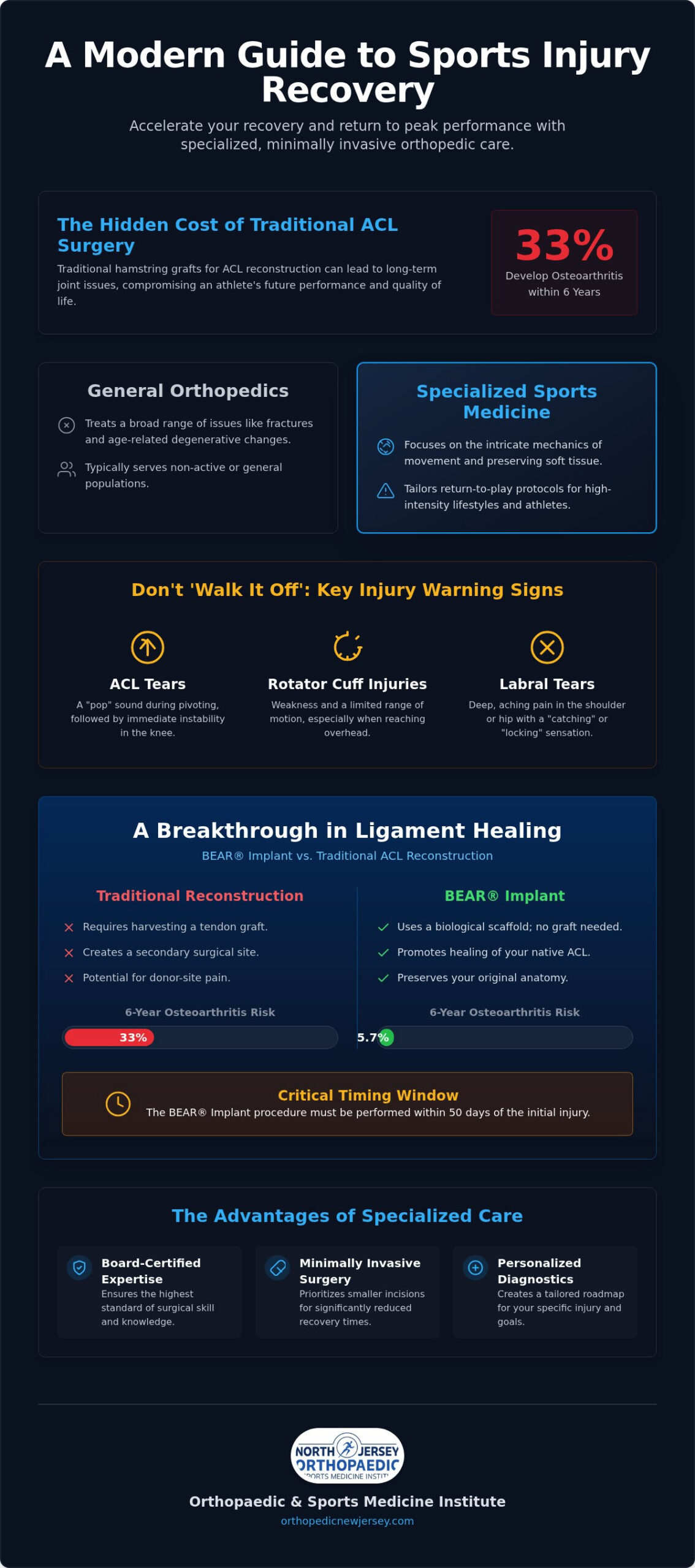
- ACL Tears: Often characterized by a “pop” and immediate instability during pivoting movements.
- Rotator Cuff Injuries: Resulting in weakness and limited overhead range of motion that interferes with daily tasks.
- Labral Tears: Causing deep, aching pain and mechanical catching in the shoulder or hip joint.
Timing is a critical factor in orthopedic outcomes. For instance, advanced procedures like the BEAR® Implant require intervention within a 50-day window following the initial injury. Delaying a consultation with a sports medicine doctor Essex County specialist can lead to permanent joint degeneration or the development of compensatory injuries. Early diagnosis ensures you have access to the widest range of minimally invasive options before your condition necessitates more invasive traditional surgery. Don’t let a “minor” injury become a chronic limitation.
Advanced Treatment Options: From BEAR® Implants to Minimally Invasive Surgery
The field of sports recovery has evolved beyond simple mechanical fixes toward sophisticated biological restoration. When you consult a sports medicine doctor Essex County specialist, you gain access to techniques that prioritize the preservation of your natural anatomy. These modern interventions are particularly effective for managing common sports injuries while minimizing the surgical footprint on your body. By using smaller incisions and advanced technology, we focus on reducing postoperative pain and accelerating your timeline back to peak performance.
BEAR® Implant: ACL Repair Without a Graft
The Bridge-Enhanced ACL Restoration (BEAR®) Implant represents a paradigm shift in how we treat ligament ruptures. Traditional ACL reconstruction typically involves an autograft, where a healthy tendon is harvested from your own hamstring or patellar. This process creates a secondary surgical site and the potential for donor-site morbidity. The BEAR® Implant eliminates this need by acting as a biological scaffold that bridges the gap between torn ligament ends. It facilitates native ligament healing, allowing your original ACL to restore itself over time.
Clinical data reveals that six years after the procedure, the risk of post-traumatic osteoarthritis is significantly lower with this technology. Specifically, only 5.7% of BEAR® patients showed signs of osteoarthritis compared to 33% of those receiving traditional hamstring grafts. This 27.7% absolute reduction in risk highlights the long-term benefits of native healing. However, timing is critical for this restorative path. You must receive the BEAR® Implant ACL Repair in New Jersey within 50 days of your initial injury to ensure the biological environment is optimal for restoration.
Arthroscopic Excellence in Shoulder and Knee Care
Minimally invasive arthroscopy has revolutionized the treatment of shoulder and knee conditions. By using high-definition cameras and specialized precision instruments, we can perform complex repairs through incisions no larger than a buttonhole. This approach is essential for Arthroscopic Rotator Cuff Repair in NJ and labral tear treatments. Because we avoid large dissections of muscle and skin, trauma to surrounding tissues is minimized.
Patients often experience a smoother transition into physical therapy, which is the cornerstone of a successful return to sport. Every athlete’s journey is unique, and modern technology offers paths that didn’t exist a decade ago. Our Nutley practice focuses on these forward-thinking solutions to keep you moving without the heavy burden of traditional open surgery. If you’re ready to explore a personalized recovery plan, consider a consultation for minimally invasive orthopedic surgery.
Evaluating Sports Medicine Providers: Board Certification and Expertise
Selecting the right clinician is the most consequential decision in your recovery journey. For residents seeking a sports medicine doctor Essex County offers various models of care, ranging from massive multi-state hospital systems to specialized, surgeon-led practices. Understanding the credentials and professional philosophy of your provider ensures that your treatment aligns with the highest clinical standards. You shouldn’t settle for a generic orthopedic approach when your athletic future depends on specialized precision and a deep understanding of biomechanics.
The Importance of Board Certification in Orthopedic Surgery
Board certification serves as the non-negotiable benchmark for surgical safety and technical proficiency. Unlike a standard medical license, this credential signifies that a surgeon has successfully navigated years of specialized residency and fellowship training, followed by rigorous peer-reviewed examinations. A sports medicine specialist with this status remains accountable to national boards, requiring continuous education to master the latest innovations in joint preservation. When evaluating a surgeon, verifying their board-certified status confirms they possess the diagnostic precision necessary to manage complex pathologies like multi-ligament knee injuries or chronic shoulder instability. This expertise is what allows a practitioner to safely implement advanced protocols such as native ligament healing and minimally invasive repairs.
Personalized Care vs. The “Large Group” Experience
Many patients find themselves lost in the bureaucracy of large medical conglomerates where care is often delegated to administrative staff or mid-level providers. A localized, specialized practice offers a distinct advantage: direct and consistent access to your board-certified surgeon throughout the entire recovery process. This continuity is vital from the initial diagnostic imaging through the final stages of physical therapy. It allows for a more nuanced understanding of your athletic goals, whether you’re a competitive student-athlete or a high-functioning professional. Choosing the Best Sports Medicine Clinic Near Montclair, NJ involves finding a partner who prioritizes your individual outcomes over high patient volume. In a smaller, focused environment, your rehabilitation plan is tailored specifically to the demands of your sport and the unique anatomy of your injury.
During your initial consultation, transparency is paramount. You should feel empowered to ask your sports medicine doctor Essex County specialist specific questions about their clinical volume and surgical success rates. Consider asking the following to gauge their experience with your particular condition:
- How many minimally invasive rotator cuff or labral repairs have you performed in the last year?
- What’s the typical return-to-sport timeline for patients with my specific injury profile?
- Do you personally supervise the postoperative rehabilitation milestones, or is that handled by a separate department?
- Which advanced technologies, such as biological scaffolds or precision arthroscopy, do you utilize for joint preservation?
An expert surgeon will provide direct, data-driven answers that instill confidence and clarity. This level of communication is the foundation of a successful patient-doctor relationship and a faster return to the activities you love.
The Road to Recovery: Diagnostic Precision and Rehabilitation
The journey from an acute injury to peak performance requires a methodical, step-by-step approach. When you visit a sports medicine doctor Essex County specialist, the process begins with identifying the exact nature of the structural damage. A precise diagnosis is the foundation of every successful outcome. It dictates whether your path involves biological restoration, conservative management, or advanced surgical intervention. We don’t guess; we diagnose with clinical certainty to ensure your recovery is both safe and efficient.
Diagnostic Excellence in North Jersey
Modern diagnostics have moved beyond simple X-rays. We utilize high-resolution MRI and musculoskeletal ultrasound in Nutley to visualize soft tissue morphology with incredible detail. This precision allows us to differentiate between chronic degeneration, such as long-term wear on a tendon, and an acute tear that requires immediate attention. For instance, identifying a mid-substance ACL tear early is critical because the window for native restorative procedures like the BEAR® Implant is limited to 50 days post-injury. If we miss this window due to vague diagnostics, your options for native ligament healing diminish significantly.
Once we’ve established the diagnosis, we develop a personalized roadmap. This isn’t a one-size-fits-all protocol. We consider your age, your specific sport, and your long-term joint health goals. A high school pitcher with a labral tear requires a different rehabilitation trajectory than a marathon runner with shoulder arthritis. This stage involves a transparent discussion regarding surgical versus non-surgical options, ensuring you understand the biomechanical implications of each choice.
Accelerated Recovery Protocols
The transition from surgery to rehabilitation is where minimally invasive techniques provide the greatest advantage. By minimizing trauma to the skin and underlying muscle, we reduce the inflammatory response that often stalls early recovery. Smaller incisions lead to less postoperative pain, which allows you to begin physical therapy sooner. Starting gentle range-of-motion exercises early prevents joint stiffness and muscle atrophy, keeping your recovery on a steady, upward trajectory.
You can learn more about these techniques in our guide to Minimally Invasive Orthopedic Surgery in NJ. Structured, sport-specific physical therapy follows, with clear milestones for your return to play:
- Weeks 1-4: Focus on edema control and protecting the surgical repair.
- Months 2-3: Restoration of full range of motion and initiation of progressive strength training.
- Months 4-6: Introduction of sport-specific drills, including running, jumping, and agility work.
- Month 6+: Final clearance for contact sports based on objective functional testing and strength symmetry.
If you’re struggling with persistent pain or instability that limits your activity, schedule an evaluation at The Orthopaedic & Sports Medicine Institute to begin your personalized recovery journey.
Expert Orthopedic Care in Nutley: Serving the Essex County Community
Residents of Bloomfield, Clifton, and Belleville don’t need to travel to major metropolitan hospitals to find elite clinical expertise. Our facility in Nutley serves as a vital resource for athletes across Essex County who require specialized intervention for soft tissue injuries. Finding a qualified sports medicine doctor Essex County specialist means choosing a practitioner who understands the local athletic landscape, from high school sports programs to adult recreational leagues. We’re dedicated to native ligament healing and joint preservation, ensuring every patient receives a plan focused on long-term functional stability.
A Specialized Resource for North Jersey Athletes
The athletic spirit of North Jersey is vibrant, stretching from the fields of Kearny to the training facilities in Lyndhurst and North Arlington. We provide the same level of sophisticated surgical precision found in major academic centers but within a focused, patient-centered environment. Our board-certified surgeon specializes in the most complex knee and shoulder conditions, including labral tears and rotator cuff repairs. We understand that for a local athlete, a fast return to play is the only acceptable outcome. This commitment to the community means providing transparent, evidence-based guidance that avoids the bureaucratic delays often associated with large medical conglomerates.
Our clinical focus remains on the “Native Ligament Healing” aspect of modern orthopedics. By utilizing the BEAR® Implant and other minimally invasive techniques, we help patients maintain their original anatomy whenever possible. This approach is particularly beneficial for the younger athletic population in Essex County, where preserving the natural joint environment is essential for preventing early-onset osteoarthritis. We don’t just treat the injury; we protect your future mobility.
Next Steps for Your Recovery
Initiating your recovery starts with a thorough clinical evaluation. When you arrive for your first visit at our Nutley office, please provide any previous diagnostic imaging, such as MRI or X-ray reports, and a detailed history of your symptoms. Our team will guide you through the insurance verification and consultation process to ensure your focus remains entirely on healing. Because restorative options like the BEAR® Implant are time-sensitive and require action within 50 days of injury, we prioritize efficient intake for acute cases.
Our practice operates during standard business hours to maintain the highest quality of focused surgical care. While we don’t offer weekend appointments or 24/7 emergency services, our methodical approach to scheduled orthopedic consultations ensures every patient receives the dedicated time they deserve. We’re here to help you navigate the complexities of your injury with clinical authority and empathetic care.
Schedule your consultation with our board-certified specialist today.
Reclaiming Your Active Lifestyle in North Jersey
Recovering from a complex sports injury requires a specialized clinical approach that prioritizes your long-term joint health over temporary fixes. We’ve explored how native ligament healing through the BEAR® Implant and the precision of minimally invasive surgical techniques can significantly reduce your risk of future osteoarthritis. By choosing an experienced sports medicine doctor Essex County residents ensure their recovery roadmap is developed by a board-certified expert who understands the unique demands of high-level athletics. From diagnostic certainty to sport-specific rehabilitation, every step is designed to restore your functional stability and explosive power.
Our Nutley facility serves as a dedicated resource for the active communities of Bloomfield, Clifton, and Belleville. We combine sophisticated surgical expertise with a patient-centered mindset to help you overcome structural limitations and chronic pain. You don’t have to settle for a generic orthopedic solution when advanced, restorative care is available locally. Request a Consultation with our Board-Certified Sports Medicine Specialist today to take the first step toward your peak performance. We’re committed to helping you return to the field, court, or track with confidence and strength.
Frequently Asked Questions
What is the difference between a sports medicine doctor and a general orthopedist?
Sports medicine focuses on biomechanics and return-to-play for active individuals. While general orthopedists treat broad musculoskeletal issues, a sports medicine doctor Essex County specialist prioritizes joint preservation and restoration. This includes specialized protocols for athletes like the BEAR® Implant or advanced labral repairs. The goal is to return you to your specific sport rather than just restoring basic daily function. We focus on the unique biomechanical demands of athletes to ensure long-term performance.
Do all sports injuries require surgery?
Recovery timelines vary based on the specific procedure and individual healing rates. For a minimally invasive ACL repair, patients typically begin gentle range-of-motion exercises within the first week. Most athletes return to running and agility drills by the four to six-month mark. Full clearance for contact sports generally occurs between six and nine months post-surgery, following objective functional testing to ensure strength symmetry and joint stability are fully restored to pre-injury levels.
Does the BEAR® Implant work for all types of ACL tears?
The BEAR® Implant is specifically designed for mid-substance ACL tears where the ligament remains attached to the bone. It’s a biological restoration that requires the procedure to be performed within 50 days of the initial injury. If the ligament is shredded or the injury occurred several months ago, traditional reconstruction may be necessary. A board-certified surgeon must evaluate the tissue quality and timing to determine if this native healing approach is viable for you.
Which areas of Essex County do you serve for orthopedic consultations?
Our practice is centrally located in Nutley to provide convenient access for residents throughout North Jersey. We frequently treat patients from Bloomfield, Clifton, and Belleville who are seeking specialized sports medicine expertise. Additionally, we serve the active populations of Lyndhurst, North Arlington, Kearny, and Verona. Our facility focuses on providing elite-level care to local athletes and active adults, ensuring they receive specialized treatment without the need to travel to a major metropolitan hospital.
Can I return to contact sports after a rotator cuff repair?
Yes, the primary objective of a rotator cuff repair is to restore the strength and stability required for high-intensity activity. Following a structured rehabilitation program, many athletes return to contact sports once they demonstrate full range of motion and baseline strength. This process typically takes six to twelve months. We monitor your progress through specific milestones to ensure the tendon has biologically integrated before you’re cleared for the physical demands of contact play.
What should I bring to my first sports medicine appointment in Nutley?
To ensure a thorough diagnostic process, please bring any recent imaging reports, such as MRI or X-ray discs, and a list of current medications. If you’ve previously received treatment or physical therapy for the injury, those records are also beneficial. Wear comfortable clothing that allows for a physical examination of the affected joint. This preparation helps your sports medicine doctor Essex County specialist develop an accurate and efficient treatment plan during your initial consultation.
Is minimally invasive surgery safer than traditional open surgery?
Minimally invasive techniques are generally associated with a lower risk of infection and less trauma to surrounding soft tissues. By using smaller incisions and arthroscopic cameras, we preserve more of the natural anatomy, which leads to a reduced inflammatory response. This often results in less postoperative pain and a faster transition into physical therapy. While every surgical procedure carries some level of risk, these advanced methods are considered the modern standard for sports injury repair.