What if the most effective way to restore your shoulder isn’t an immediate trip to the operating room, but a strategic period of clinical observation? Many patients facing a rotator cuff injury feel a sense of urgency to fix the problem surgically, yet modern orthopaedic data suggests that patience is often a powerful clinical tool. You’re likely exhausted from nights spent propped up on pillows, unable to find a comfortable position because of a persistent ache that disrupts your sleep. It’s natural to feel overwhelmed by the technical distinctions between partial and full-thickness tears while fearing a long, arduous recovery process.
This guide explains exactly when is surgery necessary for torn rotator cuff injuries and when conservative protocols are the more effective path to lasting relief. We’ll explore how board-certified specialists use the latest 2025 AAOS clinical guidelines to distinguish between cases that require minimally invasive repair and those that respond to advanced rehabilitation. You’ll gain a clear understanding of the biological timing required for a successful recovery, the role of bioinductive implants in reducing retear rates, and the specialized non-surgical resources available to patients in North Jersey today.
Key Takeaways
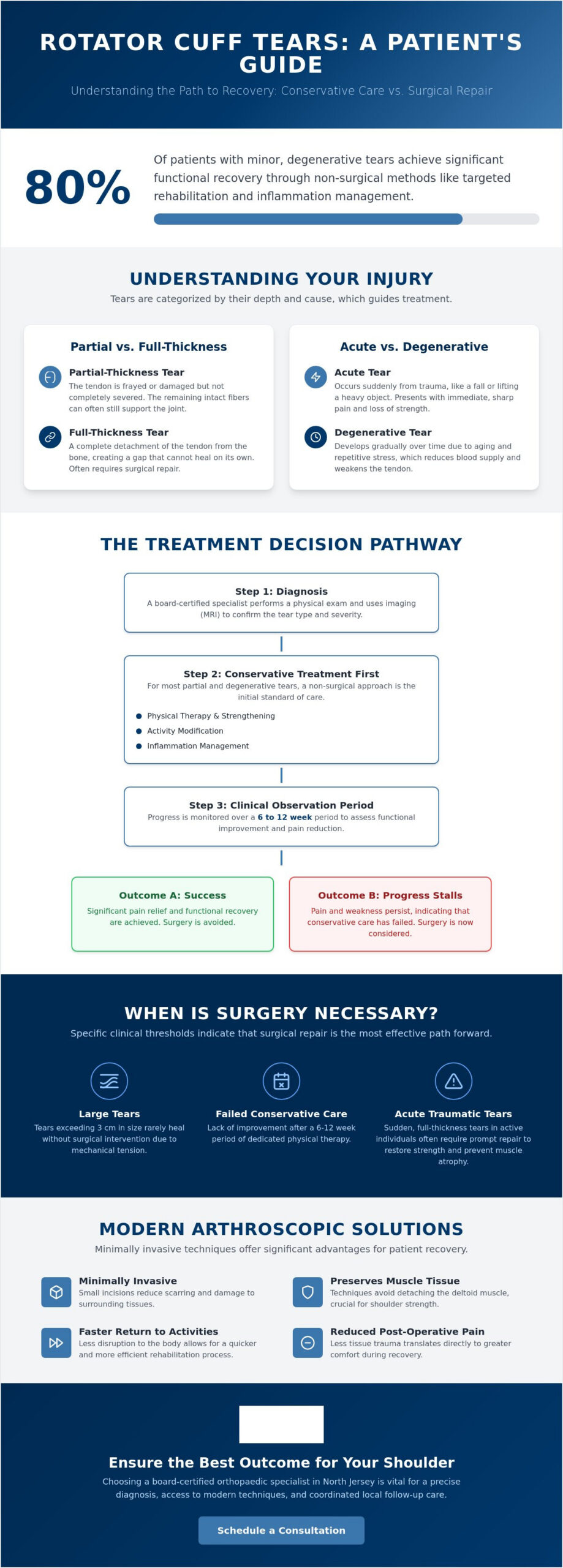
- Approximately 80% of patients with minor degenerative tears achieve significant functional recovery through targeted rehabilitation and inflammation management without the need for surgical intervention.
- Identify the specific clinical thresholds for when is surgery necessary for torn rotator cuff repairs, including tears exceeding 3 cm and the failure of conservative treatment after a 6-12 week period.
- Learn how modern arthroscopic techniques utilize minimally invasive methods to preserve muscle tissue, leading to a faster return to daily activities and reduced post-operative pain.
- Understand the vital importance of choosing a board-certified orthopaedic specialist in North Jersey to ensure precise diagnostic imaging and coordinated, local follow-up care.
Understanding Rotator Cuff Tears: Anatomy and Tear Types
The rotator cuff is a functional unit comprised of four distinct muscles and their corresponding tendons: the supraspinatus, infraspinatus, teres minor, and subscapularis. Together, these structures provide the dynamic stability required to keep the head of the humerus centered within the shallow shoulder socket. Among these, the supraspinatus is the most frequently compromised tendon. Its anatomical position makes it susceptible to impingement against the bony acromion, especially during overhead movements. A Rotator cuff tear involves a disruption in this delicate balance, often leading to significant functional deficits and persistent discomfort.
Determining when is surgery necessary for torn rotator cuff injuries begins with a precise anatomical diagnosis. Specialists evaluate whether the tendon remains partially anchored or if the mechanical integrity of the joint’s been fundamentally altered. This assessment isn’t just about the presence of pain; it’s about the patient’s ability to maintain a normal range of motion and the long-term viability of the muscle tissue.
Partial vs. Full-Thickness Tears
Partial-thickness tears represent a fraying of the tendon that doesn’t extend through its entire depth. These injuries often respond favorably to non-surgical resources because the remaining intact fibers continue to support the joint’s biomechanics. In contrast, full-thickness tears create a distinct gap between the tendon and the bone. Because the retracted muscle pulls the tendon away from its attachment site, these gaps can’t bridge themselves through natural healing processes. A full-thickness tear is a complete detachment from the humerus. If left unaddressed, these complete separations can lead to muscle atrophy and permanent loss of function.
Acute Trauma vs. Degenerative Wear
Injuries typically fall into two categories: acute trauma or chronic degeneration. Acute tears occur suddenly, often resulting from a fall on an outstretched arm or an attempt to lift a heavy object with a jerking motion. These cases often present with immediate, sharp pain and a clear loss of strength. The clinical threshold for when is surgery necessary for torn rotator cuff repairs is often lower for acute injuries, particularly in active patients who need to restore strength quickly.
Degenerative tears are far more common and develop gradually over time. As we age, the natural blood supply to the rotator cuff tendons diminishes, particularly in a region known as the “critical zone.” This reduced vascularity impairs the body’s ability to repair microscopic damage caused by daily use. Over time, the tendons thin and weaken, making them prone to tearing even during routine activities. Understanding this distinction’s vital, as degenerative tears may allow for a more conservative, therapy-first approach before considering surgical intervention.
Torn Rotator Cuff Treatment Without Surgery: The Conservative Path
Surgery isn’t the immediate answer for every shoulder injury. Clinical data indicates that approximately 80% of patients presenting with small or partial-thickness tears experience significant relief through non-operative protocols. The primary objective of this conservative path is to mitigate localized inflammation while systematically strengthening the auxiliary muscle groups that support the glenohumeral joint. For active professionals and athletes in North Jersey, this often begins with activity modification. Adjusting ergonomic setups or altering training volumes allows the biological healing process to occur without the constant mechanical stress of repetitive overhead motion.
While non-surgical rotator cuff injury treatments are highly effective for many, the process requires diligent oversight. A board-certified orthopaedic surgeon plays a critical role in this phase, not by operating, but by monitoring functional milestones to determine exactly when is surgery necessary for torn rotator cuff repairs if progress stalls. Understanding the limitations of these non-operative methods helps define when is surgery necessary for torn rotator cuff injuries that fail to respond to traditional care.
In addition to physical therapy, some patients find that a multi-disciplinary approach—including the type of specialized care offered by Fit & Healthy Chiropractic—can help address secondary nerve or postural issues that may be exacerbating shoulder pain.
Physical Therapy and Strengthening
Rehabilitation protocols focus heavily on the deltoid and scapular stabilizers. By enhancing the strength of these surrounding structures, physical therapy effectively “re-trains” the shoulder to maintain stability even when a specific tendon is compromised. This compensatory mechanism allows for a return to pain-free daily activities and restores a functional range of motion. Patients can access these specialized protocols through a shoulder pain specialist in Nutley, NJ, where guided rehabilitation is tailored to individual biomechanical needs. For those interested in a global standard of premium, evidence-based care, Benchmark Physio offers a specialized approach to physiotherapy that can serve as a helpful reference for high-quality clinical outcomes.
For patients interested in how integrative medicine can enhance physical rehabilitation, the approach used by Dr. Philip Boamah | Natural Medicine & Physical Therapy offers a valuable model for combining naturopathic care with traditional physical therapy to support the body’s natural healing mechanisms.
Anti-Inflammatory Modalities and Injections
Managing the chemical environment of the joint is equally vital. Non-steroidal anti-inflammatory drugs (NSAIDs) are frequently used to manage baseline discomfort, but corticosteroid injections may be utilized for more acute episodes. These injections provide rapid relief by suppressing intense inflammation, though their timing must be carefully managed. Over-utilization or poor timing can potentially weaken the tendon tissue, complicating future outcomes. Daily management also includes structured ice and heat therapy to regulate blood flow and soothe reactive muscle guarding. To explore root-cause healing strategies through naturopathic care, learn more about Westridge Holistic medicine. If you’re currently struggling with persistent discomfort, consulting a shoulder specialist can help clarify your best path forward.
When is Surgery Necessary for a Torn Rotator Cuff? 5 Critical Signs
While many patients succeed with physical therapy, there is a definitive clinical threshold where conservative measures are no longer sufficient. Determining when is surgery necessary for torn rotator cuff injuries involves monitoring specific functional and biological red flags. If a patient hasn’t seen measurable improvement in strength or pain levels within 6 to 12 weeks of structured rehabilitation, the likelihood of non-surgical success diminishes. Waiting months for a breakthrough that doesn’t arrive can lead to irreversible changes in the muscle-tendon unit, making future repairs more complex.
Beyond the failure of therapy, surgeons evaluate these five critical indicators:
- Tear Size: Any defect exceeding 3 cm is structurally unstable and prone to rapid expansion.
- Acute Functional Loss: A sudden inability to raise the arm laterally, often called the “drop arm” sign.
- Retraction: The tendon pulling back toward the shoulder blade, which indicates a high-tension environment.
- Fatty Infiltration: The replacement of healthy muscle tissue with fat, signaling chronic disuse.
- Nocturnal Pain: Persistent pain that prevents restorative sleep despite consistent anti-inflammatory use.
The 3cm Rule and Tear Progression
Larger tears are fundamentally less likely to respond to physical therapy because the mechanical load is distributed across too few remaining fibers. This often leads to a “zippering” effect, where a manageable tear expands into a massive, irreparable one. Once the tear reaches the 3 cm threshold, the risk of the tendon retracting away from the bone increases. This retraction makes it difficult for a surgeon to pull the tissue back to its original attachment point without excessive tension.
| Tear Size | Patient Profile | Recommended Path |
|---|---|---|
| Small (< 1 cm) | Low demand / Sedentary | Physical Therapy First |
| Medium (1-3 cm) | Active / Under 65 | Surgical Repair |
| Large (> 3 cm) | Any age; active lifestyle | Surgical Repair |
| Massive (> 5 cm) | Chronic / Low demand | Symptom Management |
Acute Injury Timing: The 6-Week Window
The timing of intervention is paramount for acute trauma. If you’ve suffered a sudden injury from a fall or heavy lift, you should see an orthopedic surgeon for shoulder pain within a 6-week window. This timeframe is critical because the muscle begins to undergo fatty infiltration and atrophy once it’s no longer under tension. Once healthy muscle fibers turn to fat, even a technically perfect surgical repair may not restore your strength. The “motor” of the shoulder has been permanently compromised, regardless of the quality of the tendon repair. Early surgical consultation ensures you don’t miss the window for optimal functional recovery.
Modern Surgical Solutions: Minimally Invasive Techniques
Determining when is surgery necessary for torn rotator cuff injuries is a collaborative process, but once the clinical threshold is crossed, the focus shifts to the methodology of the intervention. Modern orthopaedics has largely moved away from large, invasive incisions in favor of arthroscopic repair, which is now considered the global gold standard. This technique utilizes high-definition cameras and specialized suture anchors to reattach the tendon with microscopic precision. For patients in North Jersey, these minimally invasive techniques mean significantly less disruption to the surrounding deltoid muscle, which translates to reduced post-operative pain and a more streamlined transition into rehabilitation.
The specialized anchors used in these procedures are often composed of bio-absorbable materials or high-strength polymers. These tools provide the necessary tension for biologic healing without leaving permanent metal hardware in the joint. By using portals no larger than a pencil tip, surgeons can address the tear while preserving the integrity of the overlying soft tissues, a factor that’s vital for a successful long-term outcome. Understanding when is surgery necessary for torn rotator cuff repairs also means understanding the technology that makes modern recovery more predictable than ever before.
Arthroscopic vs. Open Repair
Choosing between arthroscopic and traditional open repair depends on the tear’s complexity and the surgeon’s specialized training. Most modern procedures are performed as arthroscopic rotator cuff repairs in NJ, offering a much faster initial recovery window compared to the open surgeries of the past. While traditional open repairs were once the only option for massive defects, they’re now largely reserved for complex reconstructions or revision cases. A “mini-open” approach might still be utilized if the surgeon needs better visualization of a retracted tendon while still minimizing muscle detachment.
Post-Surgical Recovery and Biologic Healing
The 2026 standard for post-surgical care emphasizes early passive range of motion to prevent adhesive capsulitis, commonly known as frozen shoulder. Biologic healing occurs in distinct stages: the protection phase (weeks 0-6), the mobilization phase (weeks 6-12), and the final strengthening phase. Following a structured rotator cuff surgery recovery guide is essential for ensuring the tendon successfully integrates with the bone. During the protection phase, the focus is entirely on allowing the biological interface between tendon and bone to mature. By the time a patient enters the strengthening phase, the goal is to restore the power of the rotator cuff muscles so they can once again stabilize the joint during complex movements.
If conservative methods haven’t restored your quality of life, it’s time to discuss modern surgical options with a board-certified specialist. You can schedule a consultation for rotator cuff repair to explore a personalized surgical plan tailored to your activity goals.
Choosing a Rotator Cuff Specialist in North Jersey
Selecting the right surgeon is as critical as the diagnosis itself. While understanding when is surgery necessary for torn rotator cuff injuries is the first step, the technical execution of that repair determines your long-term mobility. You should prioritize board-certified orthopaedic surgeons who specialize in shoulder reconstruction. This certification acts as a clinical anchor, ensuring your practitioner has met the highest national standards for surgical expertise and patient safety. For residents in Nutley, Bloomfield, and Clifton, choosing a shoulder pain specialist in Nutley, NJ facilitates the frequent follow-up appointments necessary for monitoring the biological healing of the tendon.
A sports medicine approach offers distinct advantages even for non-athletes. This philosophy focuses on restoring the highest possible level of function rather than just achieving a baseline of pain-free movement. It utilizes the same advanced techniques used to return professional athletes to the field to help local professionals return to their careers and hobbies without restriction. When you’re deciding when is surgery necessary for torn rotator cuff repairs, you want a consultant who views your recovery through the lens of performance and longevity. Working with a qualified rotator cuff repair surgeon in NJ ensures that your care plan is built on both clinical excellence and the latest minimally invasive innovations available in the region.
What to Ask Your Orthopedic Surgeon
Your initial consultation is the time to bridge the gap between clinical data and your personal lifestyle goals. Clear communication ensures that your expectations align with the biological reality of your injury. Always bring your latest imaging, such as an MRI on a disc, to this appointment so the surgeon can review the raw data rather than just the radiologist’s report. Consider asking these specific questions:
- What is the exact size of the tear, and is there evidence of tendon retraction?
- Given my activity level, what are the specific risks of continuing with non-surgical management?
- Which minimally invasive technique do you recommend for this specific tear pattern?
- What does the rehabilitation timeline look like for my specific profession or hobby?
- How many of these specific arthroscopic repairs do you perform annually?
The Orthopaedic & Sports Medicine Institute Advantage
The Orthopaedic & Sports Medicine Institute is dedicated to providing world-class shoulder care to the Nutley and Clifton communities. Our team prioritizes transparency and patient education, ensuring you understand every facet of your diagnostic process. We specialize in minimally invasive orthopaedic surgery, utilizing the latest arthroscopic technology to reduce tissue trauma and accelerate your return to daily life. By combining clinical precision with a patient-centered approach, we help you navigate the complexities of shoulder health with confidence. If you’re ready to address your shoulder pain and regain your range of motion, book a consultation today to determine the most effective treatment path for your unique needs.
Restore Your Shoulder Function with Precision Care
Deciding between structured physical therapy and surgical intervention is a pivotal moment in your recovery journey. While clinical data indicates that approximately 80% of minor tears respond to non-operative protocols, recognizing the clinical indicators for when is surgery necessary for torn rotator cuff repairs ensures you don’t miss the critical window for healing. Timely action is especially vital for acute injuries or tears exceeding 3 cm, where waiting too long can lead to irreversible muscle changes and permanent weakness. Modern minimally invasive techniques now offer a streamlined path back to the activities you love, focusing on tissue preservation and faster rehabilitation.
The Orthopaedic & Sports Medicine Institute provides board-certified expertise in these advanced shoulder procedures. We specialize in minimally invasive techniques designed to get you back to work and sports with confidence. Our team proudly serves the Nutley, Bloomfield, and Clifton communities with specialized care tailored to your unique biomechanical needs. You don’t have to navigate shoulder pain alone. Schedule a Consultation with a Board-Certified Rotator Cuff Specialist in Nutley today to explore your treatment options and start your path toward pain-free movement. Your recovery is our priority, and we’re here to guide you every step of the way.
Frequently Asked Questions
Can a torn rotator cuff heal on its own without surgery?
A full-thickness rotator cuff tear cannot heal on its own because the retracted tendon is no longer in physical contact with the humerus. While the body can’t bridge this gap naturally, many patients with partial tears or small degenerative injuries find relief through non-operative care. These protocols focus on reducing inflammation and strengthening the surrounding musculature to compensate for the compromised tendon, effectively restoring function without a surgical repair.
How long can you wait to have rotator cuff surgery before it becomes permanent?
Clinical outcomes are generally superior when acute traumatic tears are addressed within a six-week window. For chronic or degenerative tears, specialists typically monitor conservative progress for three to six months. Waiting longer than a year after a significant injury increases the risk of fatty infiltration, where healthy muscle tissue is replaced by fat. Once this transformation occurs, the damage to the muscle’s “motor” may become permanent regardless of the surgical repair.
Is rotator cuff surgery worth it for patients over 70?
Age is not a primary contraindication for surgery if the patient maintains an active lifestyle and experiences persistent pain that disrupts sleep. Many patients over 70 achieve excellent results with minimally invasive techniques, provided the biological quality of the remaining tendon is sufficient for repair. The goal for older patients is often focused on pain relief and restoring the ability to perform daily overhead tasks rather than high-impact athletic performance.
What happens if you leave a rotator cuff tear untreated?
Leaving a significant tear untreated often leads to a “zippering” effect, where a manageable defect expands into a massive, irreparable tear. Over time, the lack of mechanical tension causes the muscle to shorten and undergo irreversible atrophy. This progression can eventually lead to rotator cuff tear arthropathy, a complex form of shoulder arthritis that may eventually require a more invasive joint replacement rather than a simple tendon repair.
How painful is the recovery from minimally invasive rotator cuff surgery?
Post-operative discomfort is typically most intense during the first 48 to 72 hours but is managed through modern regional nerve blocks and multimodal pain protocols. Because arthroscopic techniques involve smaller incisions and less disruption to the deltoid muscle, patients generally experience less inflammatory pain than those undergoing traditional open surgery. Most individuals find that the temporary surgical ache is far more manageable than the chronic, sharp pain of the original injury.
Can I drive after rotator cuff surgery?
Most patients cannot safely operate a vehicle for at least six to twelve weeks following the procedure. You must be completely transitioned out of your immobilization sling and no longer taking narcotic pain medications before it is safe to drive. Safe operation requires the ability to perform sudden, bilateral steering maneuvers, a milestone that is typically reached during the mobilization phase of your physical therapy regimen.
What is the success rate of rotator cuff repairs in 2026?
Modern rotator cuff repairs demonstrate an overall success rate between 75% and 90% as of 2026. These high success rates are supported by advanced bioinductive implants and high-definition arthroscopic visualization, which allow for more secure tendon-to-bone fixation. Outcomes are most favorable when the repair is performed before significant muscle atrophy occurs and when the patient strictly adheres to the post-operative rehabilitation timeline.
Does a partial tear always eventually turn into a full tear?
A partial tear does not always progress to a full-thickness detachment, though the risk is significantly higher for active individuals who don’t modify their activities. Determining when is surgery necessary for torn rotator cuff injuries involves monitoring these partial defects for signs of expansion or increasing functional loss. If a partial tear involves more than 50% of the tendon’s thickness, proactive surgical repair is often recommended to prevent the injury from becoming a complete, retracted tear. Consulting with an experienced rotator cuff repair surgeon in NJ at this stage can help you make an informed decision about whether early intervention is the right choice for your specific tear pattern and activity demands.