You have likely spent another night staring at the ceiling, unable to find a comfortable position because your shoulder throbs every time you shift. It’s exhausting to live with a rotator cuff tear that dictates your sleep schedule and restricts your ability to reach for the simplest items. You know you need a solution, but the fear of a long, painful recovery often makes the surgical option feel as daunting as the injury itself. You might even wonder if modern arthroscopic methods are truly as effective as traditional, open procedures that require larger incisions.
We understand these concerns. At our Nutley practice, we believe that surgical intervention should be a bridge to your active lifestyle, not a permanent detour. Choosing minimally invasive rotator cuff surgery NJ means opting for a precision-guided approach that preserves healthy tissue and promotes biological healing. This guide will detail how our board-certified surgical expertise translates into a streamlined outpatient experience; one that minimizes scarring and maximizes your return to full range of motion. You’ll discover how advanced arthroscopic techniques allow you to bypass a traditional hospital stay and begin your recovery in the familiar comfort of your North Jersey home.
Key Takeaways
- Understand how arthroscopic techniques utilize small portals and high-definition cameras to repair tendons with minimal disruption to surrounding muscle tissue.
- Learn why modern interventions result in significantly less post-operative pain and a reduced risk of surgical complications compared to traditional open procedures.
- Compare the benefits of outpatient care, which allows patients to return home the same day to begin a more comfortable and private recovery process.
- Explore the structured, phased recovery timeline designed to move you safely from initial joint protection to the restoration of full functional strength.
- Identify the essential credentials, including board certification and sports medicine fellowship training, necessary for a specialist performing minimally invasive rotator cuff surgery NJ.
What is Minimally Invasive Rotator Cuff Surgery?
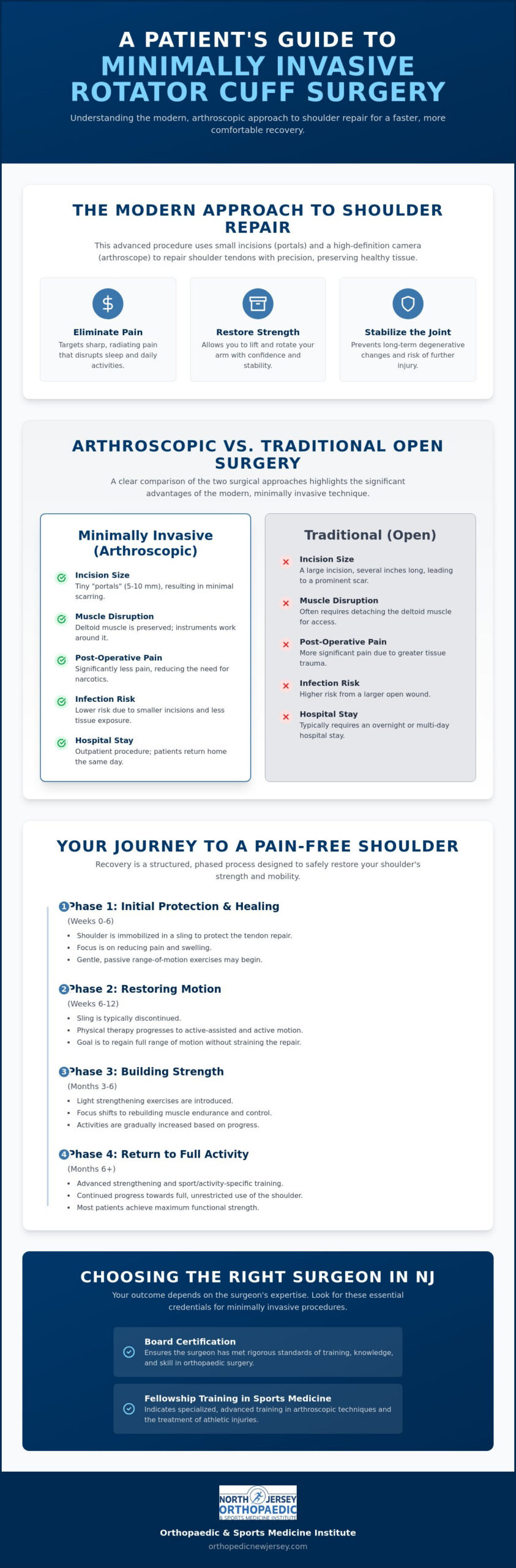
Modern orthopaedic care has moved away from the invasive “open” procedures of the past. Today, minimally invasive rotator cuff surgery NJ utilizes advanced visualization technology to repair damaged tendons through tiny incisions. These incisions, often called portals, are typically only 5 to 10 millimeters in size. This is a stark contrast to the several-inch incisions required in traditional surgery. By utilizing these small entry points, we can access the shoulder joint with surgical precision while leaving the surrounding healthy tissue largely undisturbed.
In 2026, this approach is the gold standard for North Jersey patients who lead active lifestyles. It isn’t just about smaller scars; it’s about the preservation of the surrounding biological environment. By keeping the surgical site mostly intact, we facilitate a faster biological healing response. This is essential for preventing further tendon retraction, a condition where the muscle pulls the detached tendon away from the bone, making future repairs significantly more complex.
The primary goals of this procedure include:
- Eliminating the sharp, radiating pain that frequently interrupts sleep and daily activities.
- Restoring functional strength, allowing you to lift and rotate your arm without the sensation of “giving out.”
- Stabilizing the joint to prevent long-term degenerative changes and further tearing.
The Role of the Arthroscope in Modern Repair
This technology, often referred to as arthroscopic or keyhole surgery, provides a high-definition view of the internal shoulder joint. A board-certified surgeon uses a tiny camera to project a magnified image onto a high-resolution monitor. This view is often clearer and more detailed than what the naked eye can see through a traditional open incision. It allows for precision-guided anchor placement, ensuring the tendon is reattached to the bone with extreme accuracy. Because the instruments pass through small portals, we don’t have to detach the deltoid muscle. Preserving this muscle is a major factor in reducing post-operative discomfort and accelerating your return to motion.
Common Conditions Treated Arthroscopically
Most rotator cuff injuries fall into two categories: partial-thickness and full-thickness tears. We treat both using these refined methods. During a minimally invasive rotator cuff surgery NJ, we can also perform subacromial decompression. This involves removing bone spurs that may be “pinching” the tendon and causing inflammation. If a patient is also suffering from cartilage damage, we can perform labral tear shoulder treatment concurrently. This comprehensive approach addresses all anatomical issues in a single outpatient session, ensuring a more stable and pain-free joint without the need for multiple surgeries.
The Arthroscopic Advantage: Why NJ Patients Prefer It
Patients seeking modern medical solutions in North Jersey are no longer satisfied with the lengthy hospital stays and extensive downtime associated with traditional surgery. The clinical shift toward arthroscopic methods represents a significant leap in patient safety and comfort. By choosing minimally invasive rotator cuff surgery NJ, patients benefit from a procedure that prioritizes the preservation of the shoulder’s complex anatomy. This precision-focused approach leads to significantly reduced post-operative pain, which often allows for a marked reduction in the reliance on narcotic pain medications during the initial healing phase.
Beyond pain management, the safety profile of arthroscopic repair is a primary reason for its preference. Smaller incisions naturally result in a lower risk of surgical site infections and other wound-related complications. This is particularly important for patients with underlying health concerns or those who are eager to begin their rehabilitation without the setbacks of traditional “open” surgery. Clinical data often suggests that rotator cuff repair surgery performed arthroscopically allows for a more controlled surgical environment, where every move is monitored via high-definition imaging.
Outpatient Surgery: Recovering at Home
One of the most significant advantages for our patients in Nutley and Clifton is the ability to undergo surgery on an outpatient basis. Most individuals return home the same day the procedure is performed. Recovering in a familiar environment provides a psychological boost that shouldn’t be underestimated; it reduces the stress of a hospital stay and allows for a more personalized recovery rhythm. For families residing in Bloomfield and Belleville, the logistical ease of a local surgical center means less travel time and a more efficient transition from the operating room to the comfort of their own living room.
Cosmetic and Functional Benefits
While the primary goal is internal healing, the cosmetic results of modern arthroscopy are a welcome secondary benefit. Instead of a prominent “S-shaped” open incision, patients are left with minimal scarring that fades significantly over time. Functionally, the preservation of the deltoid muscle attachment is the most critical factor. In traditional surgery, this muscle often must be detached and then re-anchored, which can lead to permanent weakness. Because we avoid this disruption, the shoulder retains its structural integrity from day one. This high level of tissue preservation directly correlates to reaching physical therapy milestones faster, as the body expends less energy on healing surgical trauma and more on restoring functional movement. If you’re ready to address your shoulder discomfort, you can request a consultation at our Nutley office to explore your options.
Minimally Invasive vs. Open Surgery: A Comparison
Choosing between surgical approaches is a clinical decision that depends on the specific pathology of your shoulder. Traditional “open” surgery requires a four to six centimeter incision and the detachment of the deltoid muscle to reach the underlying tear. This often necessitates a multi-day hospital stay and results in significant soft-tissue trauma. In contrast, minimally invasive rotator cuff surgery NJ leverages the latest advances in arthroscopic rotator cuff repair to achieve the same structural goals through portals smaller than a fingernail. Because the deltoid remains attached, patients typically experience a faster transition to functional movement and can recover in an outpatient setting.
A common misconception is that a surgeon’s visibility is limited when working through a camera. In reality, modern high-definition arthroscopes provide a level of magnification and lighting that the naked eye cannot achieve during open surgery. This allows for superior visualization of the “footprint,” which is the exact area where the tendon meets the bone, ensuring the repair is as anatomically precise as possible. While success rates for both methods are high, the long-term durability of arthroscopic repairs is now considered equal to open surgery, thanks to the evolution of high-strength suture materials and secure anchoring systems.
Which Approach is Right for Your Tear?
While arthroscopy is our preferred method, we occasionally recommend a “mini-open” or traditional approach for specific clinical scenarios. These may include massive, chronic tears with significant tendon retraction or cases where the bone quality is too poor to support arthroscopic anchors. Our board-certified specialists evaluate your tear size, tendon quality, and activity level to build an individualized surgical plan. This philosophy of precision applies to all our treatments, including our broader minimally invasive orthopedic surgery NJ offerings, ensuring every patient receives the least disruptive care possible.
Advanced Implants and Biologics
The year 2026 has brought sophisticated tools to the operating suite, including bio-absorbable anchors that eventually disappear as the bone heals. We also utilize biologic augmentation, such as collagen patches or growth factor injections, to stimulate a more robust healing response in complex tears. This focus on native tissue preservation mirrors the innovation seen in other areas of our practice, such as the BEAR implant ACL repair New Jersey. By prioritizing the body’s natural ability to heal its own tissue, we aim for a repair that isn’t just mechanically strong, but biologically integrated.
Recovery Timeline: Your Journey to a Pain-Free Shoulder
Recovery from minimally invasive rotator cuff surgery NJ is a methodical process that prioritizes the biological timeline of tendon-to-bone healing. While the advanced arthroscopic techniques used during the procedure minimize external trauma, the internal repair requires a disciplined approach to rehabilitation. Success isn’t measured by how quickly you can lift heavy objects, but by how well you adhere to a phased protocol designed to protect the integrity of the surgical anchors. Partnering with a specialized North Jersey physical therapy provider is essential to ensure each phase of movement is executed safely.
The rehabilitation journey is generally categorized into three distinct clinical phases:
- Phase 1 (Weeks 0-6): This is the protection phase. The primary goal is to allow the tendon to begin its initial attachment to the bone. You’ll remain in a sling and perform only passive range-of-motion exercises, where a therapist or your other arm moves the surgical shoulder.
- Phase 2 (Weeks 6-12): Once initial healing is confirmed, you’ll transition to active motion. You’ll begin to move the arm using its own muscle power and start light functional tasks, such as reaching for a cupboard or typing.
- Phase 3 (Months 3-6): This final phase focuses on progressive strengthening. This is when patients typically return to more demanding activities, including sports, heavy labor, or overhead lifting.
The First 48 Hours Post-Surgery
The immediate period after minimally invasive rotator cuff surgery NJ is focused on pain management and joint stabilization. Most patients receive a regional nerve block that provides significant numbness for the first 12 to 24 hours. It’s vital to begin your prescribed oral pain medication before this block completely wears off to stay ahead of any discomfort. At home in Nutley or Clifton, you’ll find that sleeping in a semi-upright position, such as in a recliner or propped up by pillows, is often the most comfortable way to rest. If you have questions about your bandage or sling fit, our Nutley orthopedic team is available to provide direct guidance during these critical first two days.
Long-Term Success and Prevention
Achieving a full return to motion requires a “slow and steady” mindset. Tendon biology cannot be rushed; it takes several months for the repair to reach maximum strength. Adhering to your home exercise program is the best way to prevent the development of “frozen shoulder” or secondary stiffness. To maintain your results and protect the opposite shoulder, we often recommend long-term athletic maintenance through a sports medicine clinic Montclair NJ. These specialists can help you refine your mechanics to ensure you don’t place undue stress on your rotator cuff in the future. If you’re ready to start your journey toward a stable, pain-free shoulder, schedule your evaluation today at our specialized facility.
Choosing the Right Rotator Cuff Surgeon in NJ
Selecting a surgeon for your shoulder repair is a decision that profoundly impacts your long-term mobility and quality of life. It’s essential to seek out a practitioner who maintains board certification and has completed specific fellowship training in sports medicine. These credentials indicate that the surgeon has undergone rigorous, specialized training beyond standard residency, focusing specifically on the complex biomechanics and advanced repair techniques of the shoulder joint. This level of expertise is a prerequisite for ensuring that your repair is both anatomically precise and biologically sound.
A surgeon who specializes in arthroscopic rotator cuff repair NJ possesses the technical dexterity required to operate through small portals while maintaining the structural integrity of the joint. This specialized focus is critical when performing minimally invasive rotator cuff surgery NJ, as the precision of anchor placement and the tensioning of sutures determine the ultimate durability of the repair. Choosing a specialist who performs these procedures regularly ensures they’re fluent in the latest technological advancements and surgical nuances.
While many patients consider traveling into New York City, our Nutley practice offers a high-tier alternative without the logistical stress of a major metropolitan hospital. We prioritize personalized care over the “factory” model often found in larger institutions. In our setting, you aren’t just a case number; you have direct access to your surgeon and a dedicated clinical team that follows you from the initial diagnostic phase through your final physical therapy milestone. This continuity of care is a significant factor in patient satisfaction and successful clinical outcomes.
Expert Care in Nutley, NJ
Our commitment to excellence serves the local communities of Clifton, Bloomfield, and the surrounding North Jersey area. We provide an environment where state-of-the-art diagnostic imaging meets individualized surgical planning. By utilizing high-resolution technology, we can visualize the specific geometry of your tear and prepare a bespoke approach before you ever enter the operating suite. This level of preparation minimizes time under anesthesia and maximizes the efficiency of the repair, allowing for a smoother transition to the outpatient recovery process we discussed earlier.
Schedule Your Shoulder Evaluation
It’s important not to wait for a partial tear to become a full-thickness retraction. When a tendon remains detached for too long, the muscle can begin to atrophy or pull away from the bone, making a successful minimally invasive rotator cuff surgery NJ more complex. During your initial evaluation, we’ll review your imaging, discuss your functional goals, and help you understand your insurance coverage and local surgical facility options. Our goal is to provide a transparent, professional experience that restores your confidence and your range of motion. Request an appointment with our Nutley shoulder specialist today.
Restore Your Shoulder’s Strength and Function
Living with a persistent rotator cuff tear shouldn’t be a permanent state that restricts your daily life. Modern arthroscopic techniques have fundamentally transformed the surgical experience; they replace large incisions and significant muscle trauma with precision-guided repairs and accelerated healing timelines. By prioritizing native tissue preservation and utilizing high-definition visualization, we can address your chronic pain while ensuring a more comfortable recovery in your own home. Choosing minimally invasive rotator cuff surgery NJ means you’re selecting a path that values both high-level clinical excellence and your personal convenience.
Our board-certified orthopedic surgeon specializes in these advanced techniques, providing a specialized alternative to major metropolitan hospital “factories” for residents in Nutley, Clifton, and Bloomfield. We focus on getting you back to your active lifestyle with minimal disruption and expert support throughout your entire rehabilitation process. Don’t let shoulder instability or night pain dictate your schedule any longer. You deserve a treatment plan that’s as unique as your injury.
Schedule Your Consultation in Nutley Today
Your journey to a pain-free shoulder begins with a precise diagnosis and a specialized surgical plan. We’re here to guide you toward a full recovery and a return to the activities you love most.
Frequently Asked Questions
Is minimally invasive rotator cuff surgery as effective as open surgery?
Yes, arthroscopic repair is clinically proven to be as effective as traditional open surgery for the majority of patients. While the methods of access differ, the internal structural repair and the quality of the tendon-to-bone healing remain identical. Choosing minimally invasive rotator cuff surgery NJ allows you to achieve these high success rates while significantly reducing the trauma to your surrounding shoulder muscles.
How long is the recovery from arthroscopic rotator cuff repair?
A complete recovery generally spans four to six months, depending on the tear’s size and your individual healing rate. The first six weeks focus on protecting the repair in a sling while performing passive motion. Strength training typically begins at the three-month mark, with a full return to demanding sports or manual labor occurring by the six-month milestone.
Will I need physical therapy after my shoulder surgery in NJ?
Comprehensive physical therapy is mandatory to ensure a successful outcome after your procedure. Our Nutley clinical team works closely with local therapists to guide you through a phased protocol that restores motion while protecting the surgical anchors. Skipping or rushing this rehabilitation can lead to joint stiffness or a potential failure of the repair.
Can a massive rotator cuff tear be fixed minimally invasively?
Yes, many massive tears are successfully repaired using minimally invasive rotator cuff surgery NJ. Advanced arthroscopic techniques allow surgeons to mobilize retracted tendons and secure them with high-strength anchors. If the tendon quality is severely compromised, we may incorporate biologic patches to reinforce the repair. A thorough evaluation at our Nutley office is necessary to determine if your specific tear is a candidate for this approach.
How soon can I drive after rotator cuff surgery?
You can typically resume driving once you’re no longer wearing a sling and have discontinued all narcotic pain medications, which usually occurs between six and eight weeks. You must have sufficient strength and range of motion to handle a steering wheel safely during an emergency maneuver. Your surgeon will provide a specific clearance based on your physical therapy progress.
What are the risks of minimally invasive shoulder surgery?
The risks associated with arthroscopy are minimal but include infection, nerve irritation, or the development of a “frozen shoulder.” While these complications occur in a small percentage of cases, choosing a board-certified specialist in NJ helps mitigate these risks. We prioritize sterile outpatient environments and early, controlled movement to ensure the highest safety standards are met for every patient.
Does insurance cover arthroscopic rotator cuff repair in New Jersey?
Most insurance plans in New Jersey cover arthroscopic rotator cuff repair when it’s medically necessary. Coverage typically applies after you’ve attempted conservative options like physical therapy or injections without success. We recommend reviewing your plan’s specific requirements for outpatient surgical centers. Our administrative team is familiar with local NJ providers and can help you understand your benefits and any necessary prior authorizations.
Why is my shoulder pain worse at night with a rotator cuff tear?
Shoulder pain often intensifies at night because the horizontal position allows the arm bone to slide upward, compressing the sensitive rotator cuff against the acromion. This mechanical impingement, combined with the natural increase in inflammatory markers during rest, often results in the throbbing discomfort that keeps patients awake. Sleeping in a semi-upright position can often alleviate this pressure while you await surgical repair.