Did you know that orthopedic surgery carries a 14.8% annual claim rate, marking it as one of the highest-risk specialties in modern medicine? When you’re facing a complex procedure like a rotator cuff repair or a bridge-enhanced ACL restoration, this statistic highlights why selecting the right practitioner is a decision of profound clinical significance. It’s natural to feel a sense of anxiety regarding your surgical outcome or to find yourself confused by the nuanced differences between a “board eligible” provider and a fully certified specialist.
You deserve a clear understanding of the safety standards that govern your care. This guide will explain what it truly means to work with a board certified orthopedic surgeon NJ, specifically focusing on how voluntary certification serves as a benchmark for surgical excellence and patient safety. We’ll demystify the 2026 ABOS Continuing Certification (CC) process and the importance of fellowship training in specialized areas like minimally invasive techniques. By the end of this article, you’ll have the confidence to identify a high-tier specialist in the Nutley and Clifton area who is dedicated to your long-term recovery and functional health.
Key Takeaways
- Distinguish between a mandatory state medical license and the voluntary, rigorous board certification process that signifies a higher tier of clinical excellence.
- Learn about the comprehensive American Board of Orthopaedic Surgery (ABOS) standards, including the two-part examination process and intensive five-year residency requirements.
- Understand why identifying a board certified orthopedic surgeon NJ with fellowship training is critical for achieving optimal outcomes in complex subspecialties like sports medicine.
- Identify key safety indicators, such as active hospital privileges and state board verification, to ensure your practitioner meets the highest professional benchmarks.
- Discover how a specialized, patient-centered practice in Nutley provides a more personalized recovery experience than large corporate medical groups.
Defining the Standard: What Does “Board Certified” Mean in New Jersey?
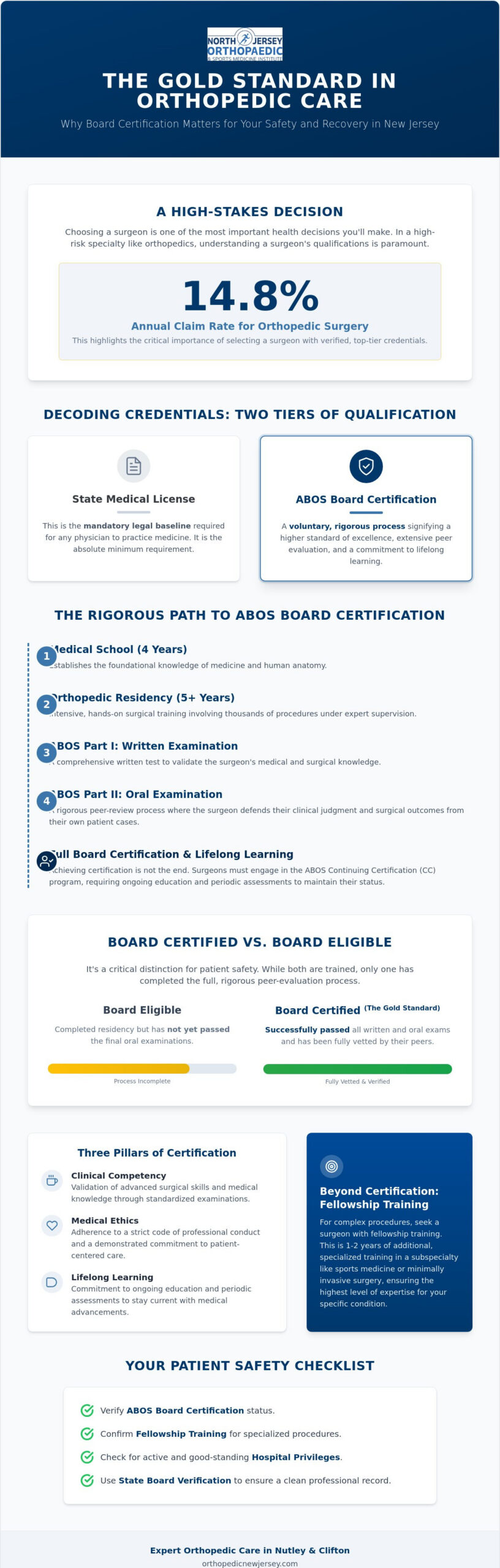
Choosing a surgeon is a decision that directly impacts your long-term mobility and quality of life. In New Jersey, every practicing physician must hold a state medical license, which serves as the legal baseline for clinical practice. However, a board certified orthopedic surgeon NJ has gone significantly beyond this minimum requirement. Board certification is a voluntary, rigorous process that acts as a professional seal of approval. It demonstrates that a surgeon has undergone extensive peer evaluation and met the stringent standards set by the American Board of Orthopaedic Surgery (ABOS). While Orthopedic surgery is a demanding and complex field, board certification provides patients with the baseline assurance that their doctor remains current with evolving medical knowledge and advanced surgical techniques.
Organizations like the American Academy of Orthopaedic Surgeons (AAOS) work in tandem with the ABOS to support these practitioners through advocacy and continuing education. Given that orthopedics is considered a high-risk specialty with a 14.8% annual claim rate according to verified medical data, these standards aren’t just bureaucratic hurdles. They are essential safeguards for patient safety. By choosing a surgeon who prioritizes these credentials, you’re selecting a professional who is committed to transparency and the highest levels of clinical accountability in the New Jersey medical community.
The Core Pillars of Orthopedic Certification
The certification process is built upon three primary foundations that ensure a surgeon is prepared for the complexities of modern musculoskeletal care. These pillars include:
- Clinical Competency: Validation of surgical skills through standardized written and oral examinations.
- Medical Ethics: Adherence to a strict code of professional conduct and patient-centered care.
- Lifelong Learning: A commitment to the ABOS Continuing Certification (CC) program, which requires ongoing education and periodic knowledge assessments to maintain active status.
Board Certified vs. Board Eligible: Knowing the Difference
You might encounter the term “Board Eligible” during your search for a specialist. This designation means the surgeon has successfully completed an accredited five-year orthopedic residency but hasn’t yet finished the final stages of the certification exams. The timeline to move from eligibility to full certification typically involves a period of clinical practice followed by a rigorous oral examination based on the surgeon’s actual patient cases. While board eligible surgeons are trained professionals, “Board Certified” remains the gold standard for patient safety. It confirms the surgeon has successfully navigated the entire evaluative process and has been fully vetted by their peers as an expert in the field.
The Path to Excellence: Understanding the Rigorous Standards of the ABOS
Achieving the status of a board certified orthopedic surgeon NJ requires a decade of specialized training before the formal certification process even begins. This journey starts with four years of medical school followed by a minimum of five years in an intensive orthopedic residency program. During residency, surgeons perform thousands of procedures under expert supervision, mastering the complexities of musculoskeletal care. This foundational period ensures that every candidate has the technical proficiency required to manage everything from routine fractures to complex joint reconstructions.
The American Board of Orthopaedic Surgery (ABOS) oversees this process to ensure that only those who demonstrate exceptional skill and ethical conduct are certified. Beyond technical exams, the board incorporates a comprehensive peer-review system. This involves evaluating a surgeon’s local reputation and their actual surgical outcomes within the medical community. This peer assessment ensures that a surgeon’s clinical judgment and professional behavior are respected by those who work alongside them every day. It’s a layer of scrutiny that goes far beyond what a standard medical license requires.
Certification isn’t a one-time achievement. As of 2026, the ABOS has transitioned its “Maintenance of Certification” program to “Continuing Certification” (CC). This shift emphasizes that a board certified orthopedic surgeon NJ must engage in lifelong learning to keep their credentials active. To maintain their status, surgeons must complete 240 credits of Category 1 Continuing Medical Education (CME) every ten years, including specific self-assessment examinations. If you’re seeking a specialist who remains at the forefront of medical innovation, you might consider scheduling a consultation with a board-certified practitioner in Nutley.
Step 1: The Part I Written Examination
This computerized assessment covers every sub-specialty within the field, from pediatric orthopedics to trauma and oncology. Surgeons must pass this exam immediately following their residency before they can enter the clinical practice period required for full certification. Only approximately 80% of applicants pass this stage on the first attempt, reflecting the high standard of academic knowledge required. This exam ensures that the surgeon possesses a deep, evidence-based understanding of the physiological and pathological aspects of orthopedic care.
Step 2: The Part II Oral Examination
After several years in practice, the surgeon undergoes a Part II oral examination. This is not a theoretical test; it’s a rigorous defense of their actual surgical cases before a panel of senior board-certified surgeons. The panel scrutinizes the candidate’s surgical decisions, ethical standards, and clinical outcomes. This step is designed to verify that the surgeon consistently prioritizes patient safety and achieves successful results in a real-world setting. It’s the final, most demanding hurdle in proving a surgeon’s readiness to provide high-level care independently.
Beyond General Orthopedics: The Role of Fellowship Training in Specialized Care
While the ABOS certification process confirms a high standard of clinical competency, the rapid evolution of surgical technology often requires a level of focus that goes beyond general residency. This is where fellowship training becomes a critical differentiator. An orthopedic fellowship represents an additional one to two years of hyper-specialized education dedicated to a specific sub-discipline, such as sports medicine, spine surgery, or hand and upper extremity care. When you’re searching for a board certified orthopedic surgeon NJ, understanding this secondary layer of expertise is essential for matching your specific injury with the most advanced treatment options available.
The synergy between board certification and fellowship training creates a practitioner who is both broad in their medical foundation and deep in their technical execution. Finding a board certified orthopedic surgeon NJ who is also fellowship-trained ensures that your provider has moved beyond generalist knowledge into the mastery of specific anatomical regions. When Evaluating Your Surgeon, you’ll find that fellowship-trained specialists are often the ones pioneering minimally invasive techniques. These modern approaches offer several distinct advantages for the patient:
- Reduced Tissue Trauma: Smaller incisions preserve surrounding muscle and connective tissue, which is vital for joint stability.
- Accelerated Recovery: Patients often experience less post-operative pain and a faster return to daily activities.
- Improved Visualization: Advanced arthroscopic tools provide a more detailed view of the joint pathology than traditional open surgery allows.
For a patient in the Nutley, Clifton, or Belleville area, this means access to state-of-the-art care that bridges the gap between traditional surgical wisdom and the future of specialized orthopedic medicine.
Sports Medicine Fellowships and Advanced ACL Repair
In the field of sports medicine, fellowship training focuses heavily on ligamentous injuries and the use of arthroscopic technology. This specialized background is what allows a surgeon to move beyond traditional ACL reconstruction toward innovative biological solutions. For instance, the BEAR implant ACL repair New Jersey utilizes a protein-based scaffold to encourage the body to heal its own native ligament. This technique is a significant departure from older methods that required harvesting healthy tissue from other parts of the body. For high-performance athletes, a fellowship-trained sports medicine specialist provides the technical precision needed to preserve as much natural anatomy as possible. Understanding the full scope of recovery is equally important, and athletes benefit from following a structured return to sport after ACL surgery protocol that replaces arbitrary timelines with objective, measurable performance milestones.
Shoulder and Upper Extremity Specialization
The shoulder is one of the most complex joints in the human body, requiring a surgeon who understands the delicate balance of the rotator cuff, labrum, and glenohumeral joint. A surgeon with a specific fellowship in the upper extremity is uniquely equipped to perform arthroscopic rotator cuff repair NJ with a high degree of accuracy. Whether treating a sudden labral tear or managing chronic shoulder arthritis, these specialists benefit from the sheer volume of specific joint procedures they perform annually. This repetition leads to refined surgical intuition and a more nuanced approach to patient recovery, ensuring that each intervention is tailored to the patient’s unique pathology and lifestyle goals.
Evaluating Your Surgeon: Key Indicators of Quality and Patient Safety in NJ
Identifying a board certified orthopedic surgeon NJ is a significant milestone in your healthcare journey, but professional credentials represent only one facet of a comprehensive vetting process. True patient safety is built upon multiple layers of accountability, ranging from national certification to local hospital oversight. While the ABOS confirms a surgeon’s clinical knowledge, you must also evaluate how that expertise translates into daily practice within the New Jersey medical ecosystem. This involves looking beyond the initial title to examine a surgeon’s local reputation, their surgical volume, and the specific facilities where they hold operating privileges.
A surgeon’s commitment to the local community in Nutley, Clifton, or Bloomfield is particularly vital for post-operative success. Recovery is a methodical process that requires consistent follow-up care and clear communication. Choosing a practitioner with a dedicated local presence ensures that you aren’t just another case number in a large corporate system. During your initial consultation, don’t hesitate to ask about specific outcomes or the number of procedures the surgeon performs annually. A high-volume specialist typically possesses the refined technical intuition necessary for complex interventions. If you’re ready to discuss your recovery options with an expert, you can schedule a consultation with our specialized team today.
Verifying Credentials in New Jersey
The NJ Division of Consumer Affairs provides a robust “Verify a License” tool that allows patients to confirm the status of any medical professional. This database is an essential resource for ensuring that your surgeon’s board certification is active and that they haven’t allowed their credentials to lapse. It also provides transparency regarding any past disciplinary actions or malpractice history. Given that malpractice insurance premiums for orthopedic surgeons in the NY/NJ metropolitan area are among the highest in the nation, often ranging from $25,000 to $70,000 for non-spine specialists, the state maintains rigorous oversight to protect patient interests. Checking these records ensures your provider meets the state’s strict ethical and legal requirements.
The Importance of Hospital Affiliations
Hospital privileges serve as an additional, rigorous layer of peer vetting known as “credentialing.” Before a hospital allows a surgeon to operate within its walls, its internal boards must review the surgeon’s education, residency performance, and surgical outcomes. Being treated at top-tier North Jersey medical centers provides peace of mind because these institutions have already performed their own deep-dive into the surgeon’s background. Furthermore, performing minimally invasive orthopedic surgery NJ requires access to sophisticated hospital-grade technology, including high-definition arthroscopic towers and specialized imaging equipment. A surgeon with strong affiliations at reputable hospitals demonstrates that they have the trust of the broader medical community and access to the tools necessary for modern, less disruptive care.
Expert Orthopedic Care in Nutley: Choosing a Surgeon Who Prioritizes Recovery
While the technical benchmarks of board certification ensure surgical safety, the environment where you receive care determines your day-to-day experience. Large, multi-specialty corporate groups often operate on a high-volume model that can feel impersonal, potentially leading to a fragmented recovery process. At The Orthopaedic & Sports Medicine Institute, we take a different approach. By maintaining a specialized, independent practice, we ensure that every patient receives the direct attention of their surgeon throughout the entire diagnostic and treatment cycle. Choosing a board certified orthopedic surgeon NJ who is personally invested in the Nutley, Belleville, and Bloomfield communities means your care is managed by a practitioner who understands your lifestyle and recovery goals.
Personalized care plans are the hallmark of a high-tier orthopedic practice. Instead of applying a one-size-fits-all protocol, we analyze your specific pathology—whether it’s a complex labral tear or chronic shoulder arthritis—to develop a customized intervention strategy. This focused approach allows for more nuanced communication between the patient and the surgical team. It also ensures that advanced options, such as minimally invasive techniques, are integrated into your plan only when they offer a clear biological advantage for your specific injury. This level of detail is often lost in larger systems but is essential for achieving the best possible functional outcomes.
A Local Resource for North Jersey Athletes
Our practice is a dedicated resource for active individuals across Nutley, Clifton, Lyndhurst, and North Arlington. We recognize that for an athlete or a busy professional, time away from activity is a significant burden. Having a sports injury specialist located conveniently near Kearny and Verona facilitates the frequent follow-ups and coordinated care necessary for a successful return to sport. Athletes throughout the region also benefit from working with a dedicated sports injury doctor Kearny NJ who understands the unique demands of competitive and recreational activity on the musculoskeletal system. We work closely with local physical therapists to monitor your progress, ensuring that every milestone in your rehabilitation is met with clinical precision and safety.
Scheduling Your Consultation
Preparing for your initial visit is the first step in reclaiming your mobility. To provide the most accurate diagnosis, please bring any relevant imaging, such as X-rays or MRI scans, along with a comprehensive medical history. During this visit, we’ll perform a thorough physical assessment and discuss the modern surgical and non-surgical pathways available to you. We encourage patients to come prepared with specific questions about their recovery expectations and surgical options. If you’re ready to consult with a specialist who combines high-level expertise with a community-focused mindset, schedule your consultation today to begin your recovery journey.
Taking the Next Step Toward Your Orthopedic Recovery
Selecting a board certified orthopedic surgeon NJ is the most critical decision you’ll make for your musculoskeletal health. As we have explored, certification through the ABOS is not merely a title; it’s a rigorous validation of a surgeon’s clinical judgment and ethical standards. When this foundation is paired with fellowship-level training in sports medicine, you gain access to a level of precision that traditional generalists simply cannot match. This specialized expertise is what makes advanced biological treatments and modern procedural solutions possible.
At the Orthopaedic & Sports Medicine Institute, we remain committed to providing the Nutley community with cutting-edge care, including the modern BEAR® Implant and minimally invasive surgical techniques. By choosing a practitioner who is both highly credentialed and personally invested in your recovery, you ensure that your treatment plan is as unique as your injury. You don’t have to navigate physical discomfort alone. Request an Appointment with a Board-Certified Surgeon in Nutley today to begin your journey back to an active lifestyle. We look forward to helping you achieve a full and functional recovery.
Frequently Asked Questions
Is a board-certified orthopedic surgeon better than one who isn’t?
A board-certified surgeon has demonstrated a higher level of clinical competency and commitment to the specialty than one who holds only a state medical license. While all surgeons must be licensed to practice, board certification is a voluntary process involving rigorous peer review and comprehensive testing. This secondary layer of vetting ensures your provider adheres to the highest national standards for safety, ethics, and surgical knowledge.
How can I check if my NJ orthopedic surgeon is board certified?
You can verify a surgeon’s status by visiting the American Board of Orthopaedic Surgery (ABOS) website and using their physician verification tool. Additionally, the New Jersey Division of Consumer Affairs offers a license verification database that lists active certifications and any disciplinary history. It’s essential to confirm that their status is currently active rather than lapsed to ensure they are meeting modern clinical requirements.
What is the difference between an orthopedic surgeon and a sports medicine doctor?
An orthopedic surgeon is a medical doctor trained to treat musculoskeletal conditions through both surgical and non-surgical means. A sports medicine doctor may be a primary care physician with specialized training in non-operative treatments or an orthopedic surgeon with a sports medicine fellowship. If your injury requires surgical intervention, such as a labral tear treatment, you should specifically seek a fellowship-trained orthopedic surgeon.
Does board certification expire for surgeons in New Jersey?
Board certification is not a permanent designation and typically requires renewal every ten years to remain valid. As of 2026, the ABOS requires diplomates to participate in the Continuing Certification (CC) program to maintain their status. This involves completing 240 Category 1 CME credits and passing periodic assessments. These requirements ensure that a board certified orthopedic surgeon NJ remains current with the latest surgical advancements and safety protocols.
Why is fellowship training important for knee or shoulder surgery?
Fellowship training provides an additional year of hyper-specialized education focused exclusively on a single anatomical region or sub-specialty. For complex joints like the knee or shoulder, this training ensures the surgeon has mastered advanced techniques like arthroscopic rotator cuff repair. Surgeons who complete fellowships typically handle a higher volume of these specific cases, which is directly correlated with improved surgical outcomes and lower complication rates.
What questions should I ask a board-certified surgeon during my first visit?
You should ask how many times they perform your specific procedure annually and what their typical complication rates are. Inquire about the specific techniques they recommend, such as minimally invasive options versus traditional open surgery. It’s also helpful to ask about the expected recovery timeline and whether they personally manage the post-operative follow-up care or delegate it to a different provider in their practice.
Can a board-certified surgeon perform minimally invasive procedures?
Many board-certified surgeons specialize in minimally invasive techniques, though these procedures often require additional fellowship training to master. These methods use smaller incisions and specialized instruments to reduce tissue trauma and accelerate patient recovery. When searching for a board certified orthopedic surgeon NJ, you should specifically look for providers who emphasize minimally invasive approaches for conditions like shoulder arthritis or ligament repairs.
Do insurance providers in NJ require me to see a board-certified surgeon?
Most insurance providers in New Jersey do not strictly mandate board certification for coverage, but many use it as a primary criterion for provider networks. Some insurers utilize tiered networks that reward patients for choosing surgeons with higher quality designations, including board certification. You should always contact your insurance carrier directly to verify the network status and any specific credentialing requirements of your chosen specialist before scheduling a consultation.