What if the surgical plan you were handed isn’t actually the best one available to you? If you’ve recently received a complex orthopedic diagnosis, whether it’s an ACL tear, a rotator cuff injury, or persistent joint pain, that question deserves a serious answer. Seeking an orthopedic second opinion in Essex County, NJ isn’t a sign of distrust in your physician; it’s one of the most informed decisions you can make for your long-term recovery.
You’re not alone in feeling uncertain. Conflicting advice, the prospect of lengthy surgical recovery, and the fear of making the wrong call are pressures that weigh heavily on patients every day. Those concerns are completely valid, and they’re exactly why a specialized, independent review of your diagnosis matters so much.
This guide will show you why a second opinion is far more than a formality. It’s an opportunity to discover whether minimally invasive techniques, including advanced options like the BEAR® Implant for ACL repair, could offer you a faster, less disruptive path forward than a traditional surgical protocol. By the end, you’ll have the clarity you need to move forward with genuine confidence.
Key Takeaways
- Seeking an orthopedic second opinion in Essex County, NJ is a clinically sound strategy that can reveal whether your current surgical plan is truly the most effective option for your specific injury and anatomy.
- Conditions like ACL tears and rotator cuff injuries often have multiple viable treatment pathways — including ligament-preserving techniques and minimally invasive arthroscopy — that a first opinion may not fully explore.
- Understanding the difference between traditional open surgery and minimally invasive alternatives is critical, as the choice directly affects post-operative pain, scarring, and the length of your recovery timeline.
- Arriving at your consultation prepared — with DICOM imaging files and a documented symptom history — significantly improves the quality of the independent evaluation you receive.
- Board-certified, specialist-level care focused on the Essex County community offers a high-caliber alternative to large hospital systems, with access to advanced options like the BEAR® Implant for ACL repair.
What is an Orthopedic Second Opinion and Why Does it Matter?
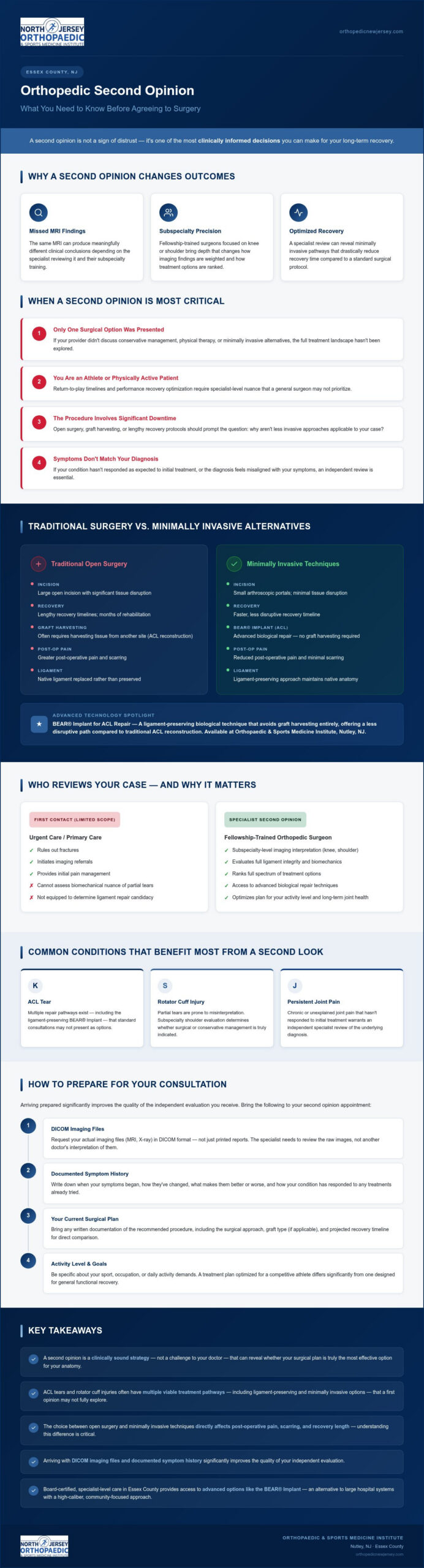
An orthopedic second opinion is an independent clinical evaluation performed by a separate board-certified specialist who reviews your imaging, medical history, and physical examination findings without being influenced by the conclusions of your original provider. It’s not a challenge to your first doctor’s competence. It’s a recognition that orthopedic surgery is a highly specialized field with multiple subspecialties, and that the depth of expertise brought to your case can directly shape your recovery outcome.
For patients navigating joint and tendon injuries, the stakes of that initial diagnosis are high. A missed finding on an MRI, an incomplete assessment of ligament integrity, or unfamiliarity with newer biological repair techniques can steer a treatment plan in a direction that isn’t optimal for your anatomy, activity level, or long-term joint health. Seeking an orthopedic second opinion in Essex County, NJ gives you an independent benchmark against which to evaluate the plan you’ve already been given.
The Difference Between a General Diagnosis and a Surgical Specialist’s View
Urgent care centers and primary care physicians serve a critical function in the early stages of injury management: they rule out fractures, initiate imaging referrals, and provide initial pain management. What they’re not designed to do is interpret the biomechanical nuance of a partial rotator cuff tear or determine whether a specific ACL injury pattern is a candidate for ligament-preserving repair versus traditional reconstruction. A fellowship-trained orthopedic surgeon who focuses specifically on the knee or shoulder brings a level of subspecialty precision that changes how imaging findings are weighted and how treatment options are ranked. The same MRI can produce meaningfully different clinical conclusions depending on who’s reading it and what they’re trained to look for.
When a Second Opinion is Most Critical
Certain clinical situations make an independent review not just reasonable, but essential. Consider seeking a second evaluation if any of the following apply to your case:
- You’ve been presented with only one surgical option without a discussion of conservative or minimally invasive alternatives.
- You’re an athlete or physically active patient who needs clarity on return-to-play timelines and whether your current protocol is optimized for performance recovery.
- The recommended procedure involves significant downtime, graft harvesting, or open surgical access, and you haven’t been told why less invasive approaches aren’t applicable to your case.
- Your symptoms don’t align clearly with the diagnosis you received, or your condition hasn’t responded as expected to initial treatment.
In each of these scenarios, a specialist-level review at a practice like the Orthopaedic & Sports Medicine Institute in Nutley, NJ, can reveal whether advanced options, including minimally invasive techniques or the BEAR® Implant for ACL repair, are viable pathways that weren’t part of your original conversation. That information can be the difference between a prolonged recovery and a genuinely optimized one. Getting an orthopedic second opinion in Essex County, NJ isn’t about starting over; it’s about making sure you’re moving forward on the right path.
Common Conditions Requiring a Second Look in Essex County
Not every orthopedic diagnosis is straightforward, and not every surgical recommendation accounts for the full spectrum of treatment options available today. For patients managing bone and joint conditions across Essex County, the distinction between a competent first opinion and a truly specialized evaluation can determine whether you’re facing a six-month surgical recovery or a significantly shorter, less invasive path. Several specific conditions are particularly prone to being underexplored at the initial consultation level.
These are the diagnoses where an orthopedic second opinion in Essex County, NJ consistently reveals the greatest clinical divergence between what a patient was told and what a subspecialist determines is actually possible.
ACL Injuries and the BEAR® Implant Alternative
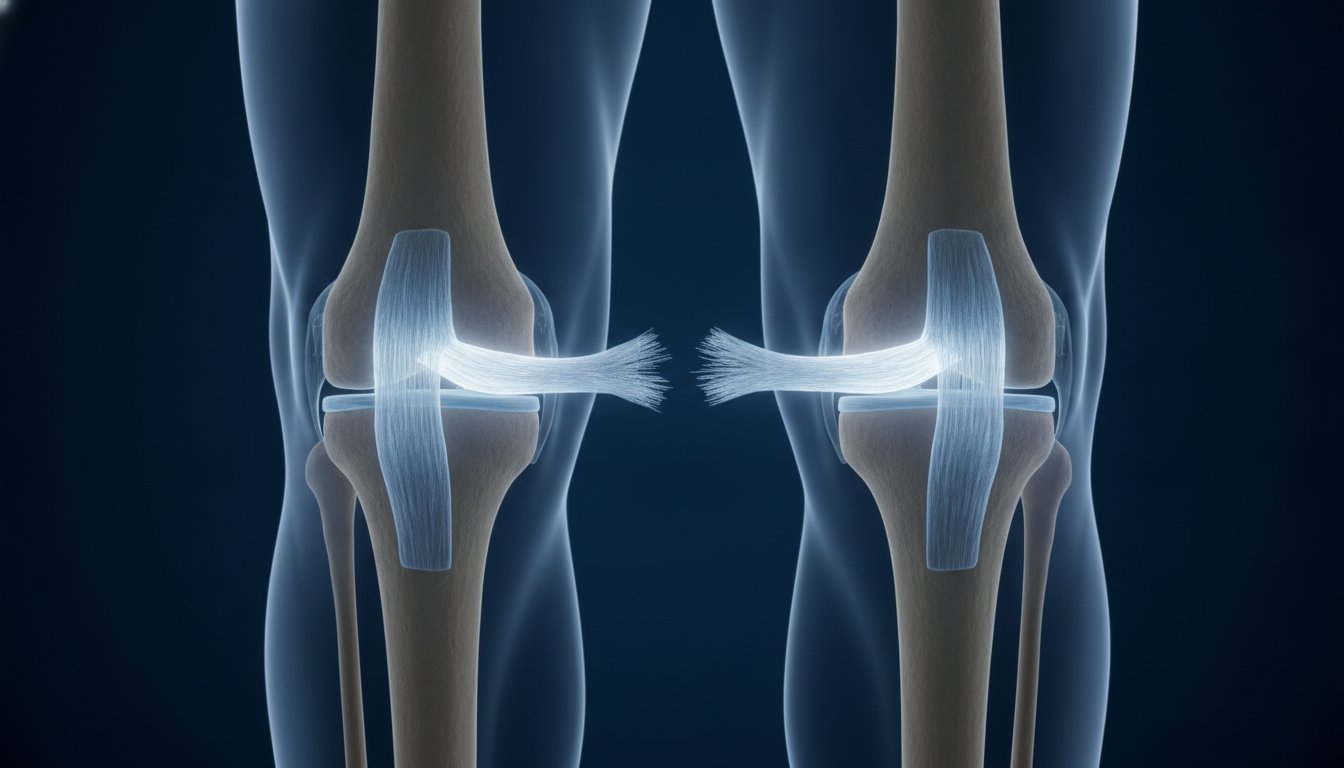
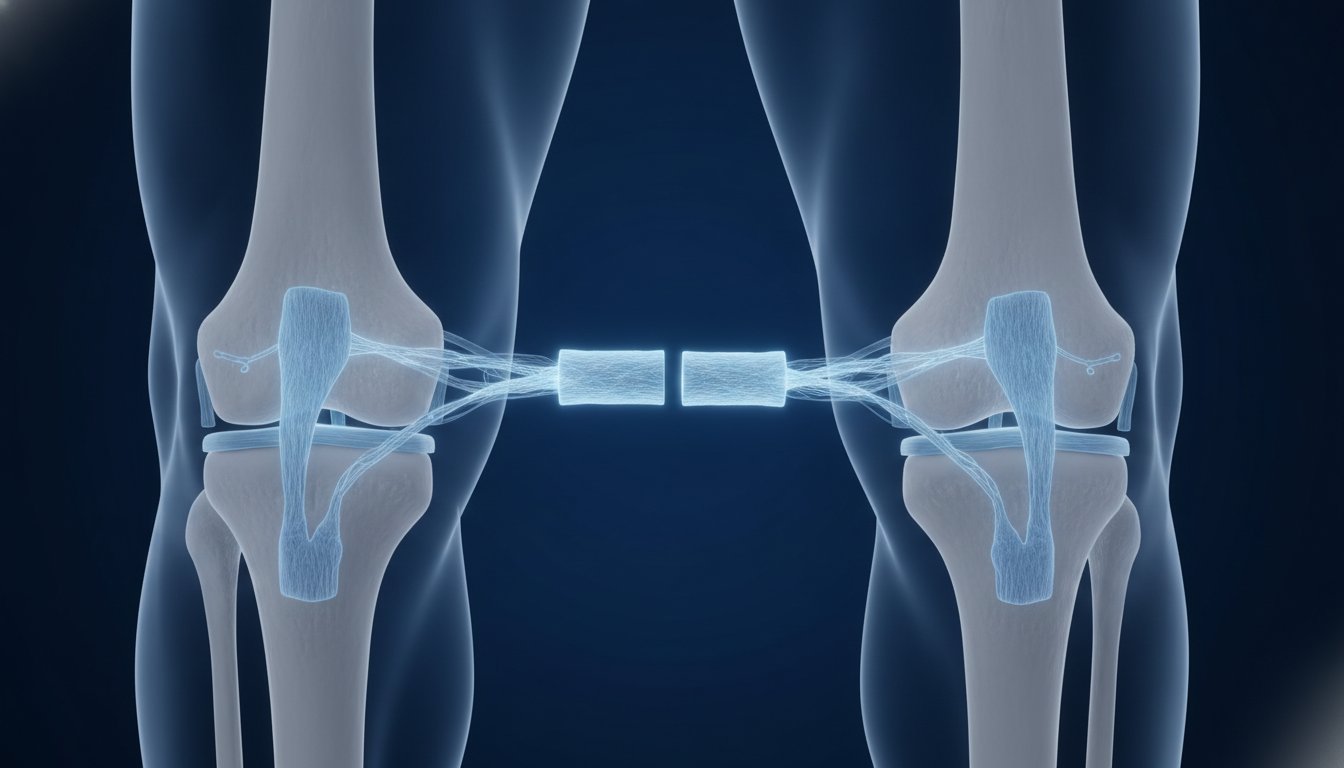
Traditional ACL reconstruction harvests a graft from your own patellar tendon or hamstring, permanently sacrificing healthy tissue to rebuild a torn ligament. For eligible patients, BEAR® implant ACL repair in New Jersey offers a fundamentally different approach: stimulating the native ligament to heal itself using a bioabsorbable scaffold saturated with the patient’s own blood. The result is ligament preservation rather than replacement.
Candidacy for the BEAR® procedure is time-sensitive. The technique is most effective when the torn ligament ends remain in proximity, which means the window for evaluation closes relatively quickly after injury. If your initial consultation didn’t include a discussion of bridge-enhanced repair, seeking a second opinion promptly isn’t optional; it’s urgent.
- Native ligament healing preserves the proprioceptive nerve fibers that graft-based reconstruction cannot replicate.
- Graft harvesting introduces a secondary injury site that can affect long-term donor-site strength and function.
- Timing matters: the earlier a specialist evaluates your MRI for BEAR® candidacy, the more options remain available to you.
Shoulder and Rotator Cuff Complications
Rotator cuff pathology exists on a wide spectrum, from minor partial-thickness tears that respond well to structured rehabilitation, to full-thickness ruptures requiring surgical intervention. The critical question a second opinion answers is which category your injury falls into, and whether arthroscopic rotator cuff repair in NJ represents a less disruptive alternative to the open procedure you may have been quoted.
Chronic shoulder pain that hasn’t resolved after a standard course of physical therapy is another scenario where an independent evaluation adds real clinical value. Persistent symptoms may indicate a labral tear or early glenohumeral arthritis rather than a simple soft-tissue strain, and each of those diagnoses carries a distinct treatment hierarchy. For patients with shoulder arthritis specifically, joint preservation strategies deserve thorough exploration before total shoulder replacement enters the conversation.
Active patients dealing with labral tears face their own set of nuanced decisions. Cartilage repair outcomes are highly dependent on tear pattern, tissue quality, and the surgeon’s arthroscopic experience. A specialist-level review at a practice focused on minimally invasive techniques can clarify whether your anatomy supports a repair that restores full function rather than simply managing symptoms.
If any of these conditions reflect your current situation, a consultation focused specifically on your imaging and functional goals is the logical next step. Explore your minimally invasive treatment options with a board-certified specialist serving the Essex County community.
Traditional Surgery vs. Minimally Invasive Alternatives
The term “surgery” carries significant weight for most patients, and understandably so. What many don’t realize is that “surgery” describes an enormous range of procedural approaches, from large open incisions requiring extended hospital stays to arthroscopic techniques performed through portals smaller than a centimeter. Understanding that distinction is one of the most practical reasons to pursue an orthopedic second opinion in Essex County, NJ before committing to any surgical plan.
Minimally invasive orthopedic surgery in NJ refers to procedures performed through small incisions using specialized instruments and high-definition camera systems, rather than the broad tissue exposure required by traditional open surgery. The clinical advantages are direct and measurable: reduced disruption to surrounding musculature, lower post-operative infection risk, less bleeding, and significantly less post-operative pain. Smaller incisions also mean less scar tissue formation, which matters considerably for joint mobility and long-term function.
Technology is the enabling factor here. Advanced arthroscopic imaging systems, precision instrumentation, and bio-integrative implants allow fellowship-trained surgeons to perform complex tendon and ligament repairs with a level of anatomical accuracy that open surgery simply can’t match in confined joint spaces. The shoulder, knee, and hip are particularly well-suited to arthroscopic approaches because their enclosed architecture benefits from the magnified visualization these systems provide.
Why do some surgeons still default to traditional open methods? The honest answer involves a combination of training exposure, institutional protocols, and equipment access. Surgeons trained predominantly in open techniques are understandably more comfortable with what they know. Adopting minimally invasive protocols requires dedicated fellowship training, significant capital investment in technology, and an ongoing commitment to refining technique. Not every practice makes that investment, which is precisely why the surgeon you consult can determine the options you’re offered.
It’s also worth knowing that patients exploring surgical options have formal rights to independent evaluation. Medicare coverage for second surgical opinions is an established benefit, and many private insurers follow similar guidelines, making an independent review financially accessible for most patients in Essex County.
Recovery Timelines: What a Second Opinion Might Reveal
The gap between open and minimally invasive recovery windows is clinically significant. Traditional open rotator cuff repair, for example, typically involves a longer immobilization period and a more demanding rehabilitation curve than an arthroscopic repair of equivalent tissue damage. Return-to-work timelines for sedentary roles can differ by weeks; for physically demanding occupations or athletic activity, the difference can extend to months. Minimally invasive approaches also tend to reduce dependence on narcotic pain management in the immediate post-operative period, as the trauma to surrounding tissue is substantially lower. Specialized physical therapy, designed around the specific repair technique used, plays an equally important role in compressing that recovery window and restoring functional strength progressively rather than reactively.
Graft Harvesting vs. Synthetic or Bio-Integrative Solutions
Autograft reconstruction, using your own patellar tendon or hamstring tissue, introduces a secondary injury site that carries its own recovery burden. Allograft options eliminate donor-site morbidity but introduce variables related to tissue integration and long-term mechanical performance. Modern bio-integrative solutions occupy a different category entirely: rather than replacing the damaged structure, they create a biological scaffold that supports the body’s own healing response. In 2026, minimally invasive arthroscopy refers to a clinical standard in which high-definition camera-guided instrumentation is used to repair or reconstruct joint structures through small portals, with technique selection increasingly guided by patient-specific anatomy, activity demands, and implant compatibility rather than a one-size-fits-all protocol. For eligible patients, this shift in approach, including options like the BEAR® Implant for ACL injuries, represents a fundamentally different recovery trajectory than what a traditional surgical plan delivers.
How to Prepare for Your Orthopedic Consultation in Nutley, NJ
The quality of an independent evaluation is directly proportional to the quality of information you bring to it. Arriving at your consultation with complete, organized records doesn’t just save time; it allows the reviewing surgeon to make clinically precise judgments rather than working from incomplete data. For anyone pursuing an orthopedic second opinion in Essex County, NJ, preparation is the step that separates a genuinely useful independent review from a surface-level conversation.
Start with your insurance coverage before anything else. Many private insurers explicitly cover specialist second opinions, particularly when surgery has been recommended. Contact your carrier directly to confirm whether the Orthopaedic & Sports Medicine Institute in Nutley is in-network, and ask specifically about out-of-network benefits if applicable. Verify the coverage details yourself rather than assuming the information is accurate based on general policy descriptions.
Document your symptom history in writing before the appointment. Include when the pain began, what activities aggravate or relieve it, how it has changed over time, and every treatment you’ve already tried, including physical therapy, injections, or prior procedures. Surgeons can identify diagnostic patterns more efficiently when this context is presented clearly rather than reconstructed from memory during a brief consultation window.
What to Bring to Your Nutley Office Visit
The single most important item you can bring is the actual DICOM image files from your MRI or CT scan, not just the radiologist’s written report. DICOM files contain the raw imaging data that a fellowship-trained surgeon can scroll through independently, often identifying findings that a general radiology report summarizes or omits. Request these files directly from the imaging center, typically provided on a disc or via a digital download link. Also bring operative reports from any prior surgeries, a current medication list, and any physical therapy discharge summaries. A physical examination at the Nutley office adds clinical information that no remote review can replicate; joint stability testing, range-of-motion assessment, and palpation findings all inform the surgical recommendation in ways that imaging alone cannot capture.
Be specific about your lifestyle goals. Whether you’re aiming to return to competitive tennis, resume hiking the trails at South Mountain Reservation, or simply carry groceries without shoulder pain, that context shapes how a specialist weighs your treatment options.
Questions to Ask During Your Second Opinion
- “Are there minimally invasive alternatives to the surgery I was previously recommended, and do I qualify for them?”
- “What is the clinical success rate of this specific technique for patients in my age group and activity level?”
- “How does your recommended treatment plan differ from what I was told, and what accounts for that difference?”
- “If I’m a candidate for the BEAR® Implant, how much time do I have before that window closes?”
- “What does my realistic return-to-activity timeline look like with each option on the table?”
These questions aren’t confrontational; they’re clinically appropriate. A board-certified specialist will welcome them. Schedule your consultation at the Nutley office and bring these questions with you to get the specific, comparative answers your recovery decision deserves.
Why Choose The Orthopaedic & Sports Medicine Institute for Your Second Look?
There’s a meaningful difference between receiving care from a large hospital system where you’re one of hundreds of cases moving through a department, and consulting with a board-certified specialist whose practice is built around the specific communities of Essex County. The Orthopaedic & Sports Medicine Institute in Nutley, NJ, occupies that second category. It’s a practice where your imaging, your activity goals, and your anatomy are evaluated with the kind of focused attention that generalist settings structurally can’t provide.
Patients seeking an orthopedic second opinion in Essex County, NJ benefit from a practice philosophy centered on transparent communication. Every recommendation comes with a clear explanation of the clinical reasoning behind it. If minimally invasive arthroscopy is the right path, you’ll understand precisely why. If it isn’t, that answer will be equally specific. There’s no proprietary protocol being defended here; the goal is the most effective outcome for your injury and your life.
That commitment extends directly to minimally invasive joint surgery in North Jersey. Rather than defaulting to traditional open procedures, the Institute’s approach prioritizes techniques that reduce tissue disruption, minimize post-operative pain, and compress recovery timelines wherever the clinical evidence supports doing so.
Expertise in Advanced Ligament and Tendon Care
The subspecialty depth here is what separates this practice from a standard orthopedic referral. For patients with shoulder pathology, that means a nuanced approach to shoulder arthritis treatment in NJ that explores joint preservation strategies before replacement enters the conversation. For active residents dealing with instability and pain, labral tear shoulder treatment is approached with the arthroscopic precision that tissue repair outcomes demand. Board-certified status isn’t a background credential; it’s the clinical standard that ensures the surgeon reviewing your case has met rigorous, independently verified benchmarks in surgical training and ongoing competency.
Convenient Access for Essex County Residents
The Nutley office is positioned for straightforward access from Route 21 and the Garden State Parkway, making it a practical choice for patients traveling from Bloomfield, Clifton, Belleville, Kearny, and North Arlington. That geographic convenience matters when you’re managing an active injury and need to attend multiple consultations without adding unnecessary strain to your schedule.
The local athletic community across Nutley and the surrounding towns deserves specialist-level care that understands the demands of returning to competitive sport, not just clinical resolution of symptoms. That’s the standard this practice holds itself to.
Schedule your expert second opinion in Nutley today and get a clear, evidence-based answer about whether your current surgical plan is truly the best option available to you.
Take the Next Step Toward a Recovery Plan That’s Right for You
Your diagnosis doesn’t have to be the final word. This guide has walked through why independent evaluations matter, which conditions benefit most from specialist review, and how minimally invasive techniques can meaningfully change your recovery experience. The throughline is straightforward: the surgeon you consult shapes the options you’re offered, and those options directly affect how fully and how quickly you recover.
An orthopedic second opinion in Essex County, NJ isn’t about doubt. It’s about making sure every viable path, including advanced approaches like the BEAR® Implant and arthroscopic repair, has been genuinely considered for your specific anatomy and goals. That clarity is something you deserve before committing to any surgical plan.
The Orthopaedic & Sports Medicine Institute in Nutley brings board-certified expertise and a focused commitment to minimally invasive care to the communities of Nutley, Bloomfield, and Clifton. Patients here receive a specialist-level evaluation, not a rushed referral.
Book your orthopedic second opinion in Nutley, NJ and get the informed, specific answers your recovery decision requires. The right path forward is closer than you think.
Frequently Asked Questions About Orthopedic Second Opinions in Essex County, NJ
Does insurance typically cover an orthopedic second opinion in NJ?
Most private insurance plans cover specialist second opinions, particularly when surgery has been recommended. Medicare explicitly includes this as a covered benefit. The specific terms vary by carrier and plan tier, so contact your insurer directly before scheduling to confirm whether the Orthopaedic & Sports Medicine Institute in Nutley is in-network and what your cost-sharing responsibility will be. Don’t rely on general policy summaries; ask specifically about second opinion coverage for recommended orthopedic procedures.
Do I need to tell my first doctor that I am seeking a second opinion?
You’re not obligated to inform your original provider, though it’s generally advisable. Most physicians expect patients facing major surgical decisions to seek independent confirmation, and a clinician who discourages that process is worth noting. Practically speaking, your first doctor’s office is often the most efficient source for releasing your imaging files and operative records, which you’ll need for a thorough evaluation. A straightforward records request is all that’s required.
Will I have to repeat my MRI or X-ray for a second opinion?
In most cases, no. A reviewing specialist can work directly from your existing imaging, provided you bring the actual DICOM files rather than just the written radiology report. DICOM files contain the raw image data that a fellowship-trained surgeon can scroll through independently. Request these files from your imaging center before your Nutley consultation. A physical examination will still be performed, since hands-on stability and range-of-motion testing adds clinical information that no imaging study can fully replace.
How long does a second opinion consultation usually take?
A thorough second opinion consultation typically runs between 45 minutes and an hour when you arrive with complete records. That window allows the surgeon to review your imaging, conduct a physical examination, discuss your symptom history and functional goals, and walk through the treatment options that apply to your specific case. Arriving without records or imaging files will reduce the depth of that evaluation considerably, so preparation directly affects the quality of what you leave with.
What if the second opinion contradicts my first diagnosis?
A contradictory second opinion is actually the most valuable outcome you can receive, because it surfaces a genuine clinical decision that deserves your attention. It doesn’t automatically mean the first doctor was wrong; orthopedic subspecialists may weigh the same imaging findings differently based on their training and experience with specific techniques. If the two opinions diverge significantly, a third specialist consultation is a clinically reasonable next step. What matters is that you understand the reasoning behind each recommendation, not just the conclusion.
Can I switch my entire care plan to the second surgeon if I prefer their approach?
Yes, completely. You have the right to transfer your care to any provider you choose, and no referral from your original physician is required to do so. If the Orthopaedic & Sports Medicine Institute’s approach, whether that’s minimally invasive arthroscopy, BEAR® Implant candidacy evaluation, or a different surgical strategy, better aligns with your recovery goals, you can proceed with that practice as your primary treating surgeon. Request a full copy of your medical records from your previous provider to ensure continuity of care.
How soon can I get an appointment for a second opinion in Nutley?
Appointment availability varies, and it’s best to contact the Orthopaedic & Sports Medicine Institute directly to confirm current scheduling timelines. If you’re being evaluated for BEAR® Implant candidacy for an ACL injury, don’t delay that inquiry. The procedure’s eligibility window is time-sensitive, and earlier evaluation preserves more options. When you call to schedule, mention that you’re seeking an orthopedic second opinion in Essex County, NJ following a surgical recommendation, as that context helps the scheduling team allocate appropriate consultation time.
Is a second opinion worth it for a minor injury?
For genuinely minor injuries managed conservatively, a second opinion adds limited value. The calculus changes when surgery is on the table, when symptoms persist despite treatment, or when the diagnosis feels inconsistent with your experience of the injury. A partial rotator cuff tear that “looks minor” on imaging can still carry significant functional implications depending on your activity level and tear pattern. If your recovery isn’t progressing as expected, or if you simply haven’t received a clear explanation of why surgery is necessary, an independent specialist evaluation is worth pursuing.